
Beginner Pickleball Drills to Try
Playing more pickleball will help you improve, but simply playing games is not always the fastest way to develop your skills.
During a game, you may only hit a particular shot a few times. A practice drill allows you to repeat that same movement again and again until it starts to feel more natural.
USA Pickleball similarly recommends focused drilling as a way to develop consistency, touch and confidence instead of relying entirely on match play.
The good news is that beginner pickleball drills do not need to be complicated. You do not need expensive training equipment or hours of practice. A paddle, a few pickleballs and 20 to 30 minutes can be enough for a productive session.
Some of the drills below require a partner and a court, while others can be practiced alone against a wall.
Here are 10 easy pickleball drills for beginners that can help you improve ball control, groundstrokes, serving, returning, dinking, volleys and basic point construction.
What You Need for These Pickleball Drills
You can complete most of these drills with:
- A pickleball paddle
- Several pickleballs
- Access to a pickleball court or suitable practice area
- A partner for some drills
- A wall for solo practice
- Cones, chalk or other markers for optional targets
You do not need to complete all 10 drills every time you practice. Choose three or four skills you want to work on and spend several minutes on each.
Quality repetitions are usually more useful than rushing through a large number of shots.
Before beginning, take a few minutes to move around the court and warm up your shoulders, wrists, hips and legs.
1. Paddle-Up Ball Control Drill
Best for: Paddle control and hand-eye coordination
Players needed: One
Difficulty: Very easy
One of the easiest pickleball drills does not even require a court.
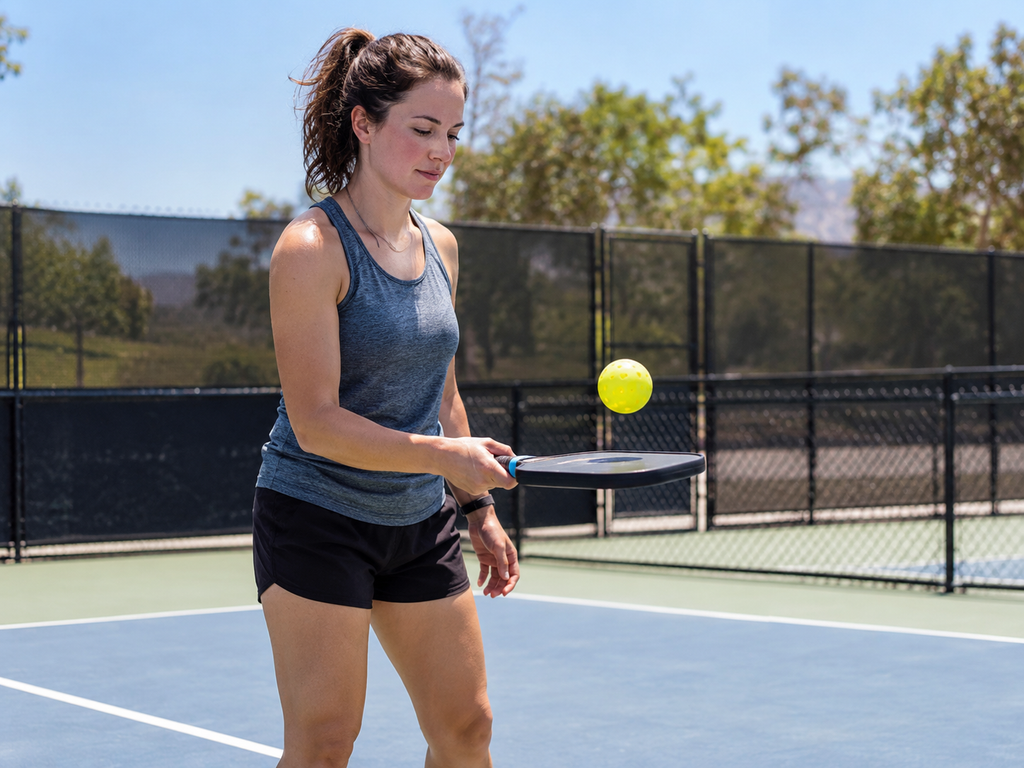
Hold your paddle in front of your body with the face pointing upward. Place a pickleball on the paddle and gently tap it into the air.
Try to keep the ball bouncing vertically rather than allowing it to move several feet away from you.
How to Do It
- Hold the paddle around waist height.
- Tap the ball upward using short movements.
- Keep your eyes on the ball.
- Try to complete 10 consecutive taps.
- Increase the goal to 20, 30 or more as your control improves.
Once this becomes easy, alternate between the two faces of your paddle.
You can also try walking slowly while continuing to bounce the ball.
What This Drill Teaches
This simple exercise helps you become more comfortable controlling the paddle face.
Beginners often move the paddle much more than necessary. Paddle taps encourage smaller, more controlled movements while helping you learn how the angle of the paddle affects the direction of the ball.
Beginner Goal
Start with 10 controlled taps without dropping the ball.
When that becomes comfortable, work toward 30 or more.
2. Solo Wall Rally
Best for: Consistency, paddle control and reaction time
Players needed: One
Difficulty: Easy
A wall can become one of your most useful pickleball practice partners.
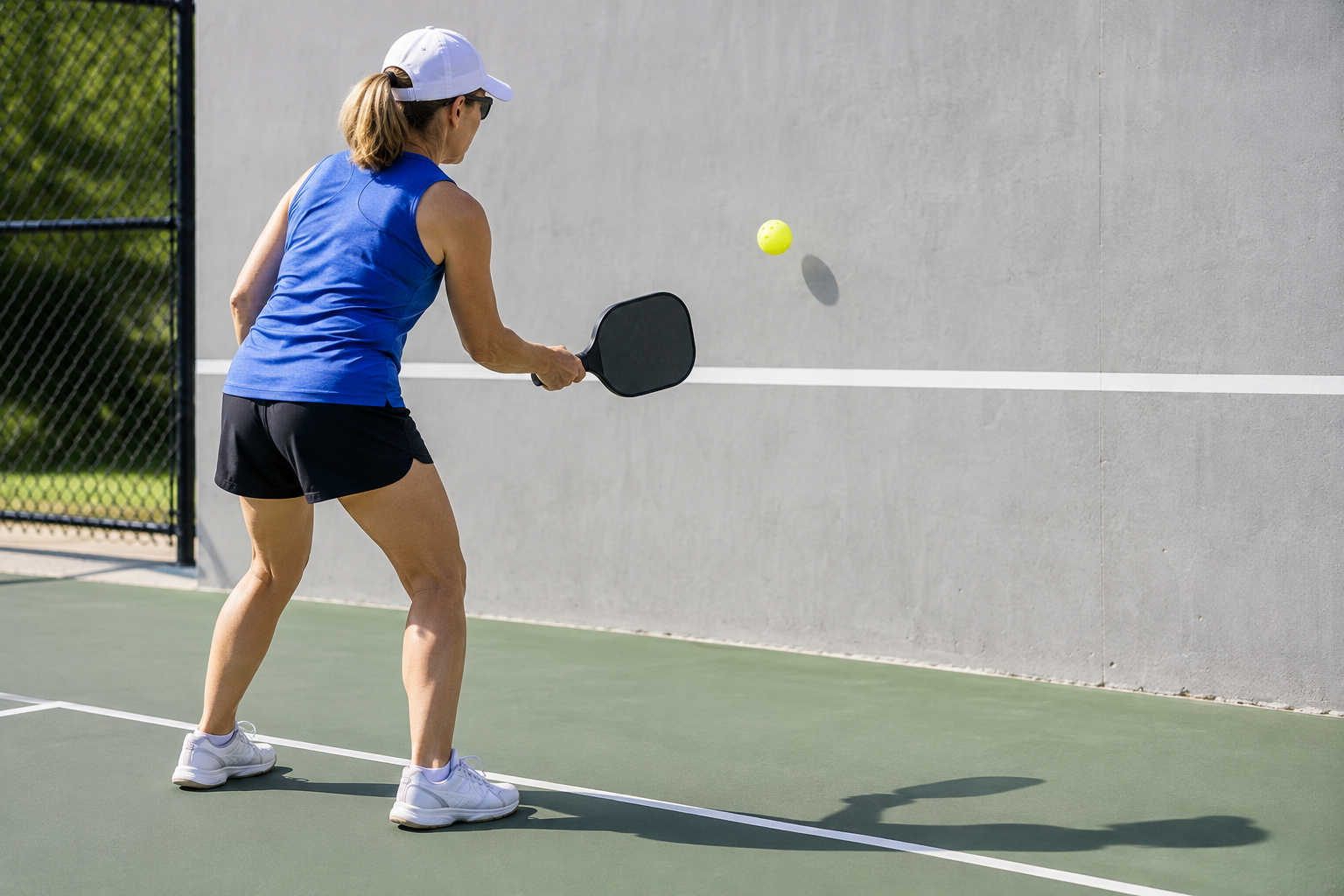
Stand several feet from a solid wall and gently hit the pickleball against it. Allow the ball to bounce before hitting it again.
The goal is not to hit hard. Instead, try to create a predictable rhythm.
How to Do It
- Stand about 6 to 10 feet from the wall.
- Drop the ball and hit a controlled forehand toward the wall.
- Let the returning ball bounce.
- Hit it back again.
- Continue the rally for as long as possible.
Once you can maintain the rally comfortably, alternate between forehands and backhands.
You can also place a piece of tape or chalk mark on the wall and aim toward the target.
What This Drill Teaches
Wall practice gives you far more repetitions in a short amount of time than you normally receive during a game.
It can help you improve:
- Paddle preparation
- Ball tracking
- Contact consistency
- Forehand and backhand control
- Reaction speed
Beginner Goal
Try to complete 20 consecutive controlled shots.
Do not worry about speed. Keeping the rally going is the objective.
3. Forehand and Backhand Groundstroke Drill
Best for: Basic rallying
Players needed: Two
Difficulty: Easy
Groundstrokes are shots that you hit after the ball bounces.
Beginners need to become comfortable hitting from both the forehand and backhand sides because these shots appear throughout almost every pickleball rally.
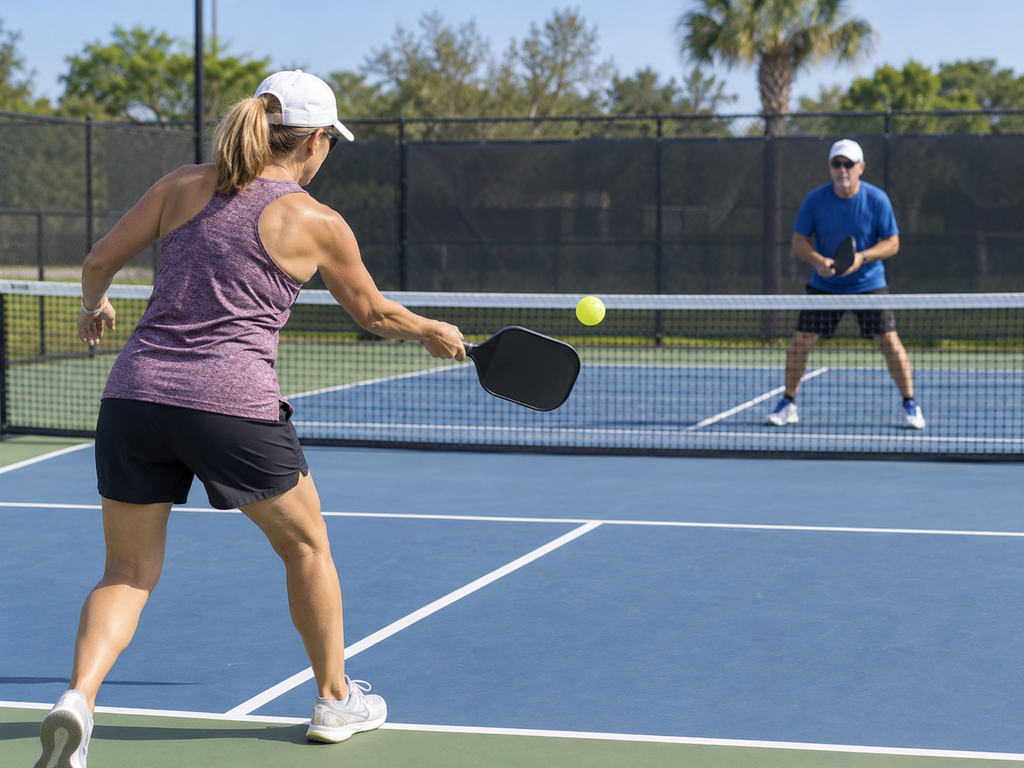
For this drill, you and your partner will simply rally from farther back on the court.
How to Do It
- Position yourselves around the middle or back portion of opposite sides of the court.
- One player gently feeds the ball.
- Allow every ball to bounce before returning it.
- Rally at a comfortable pace.
- Concentrate on keeping the ball in play.
Start by hitting mostly forehands.
After several minutes, intentionally send more balls toward each other’s backhands.
What This Drill Teaches
The goal is to develop repeatable contact rather than power.
Focus on:
- Moving into position before swinging
- Contacting the ball in front of your body
- Using a controlled swing
- Recovering after each shot
- Giving yourself enough margin over the net
Beginners frequently try to hit winners too early. This drill teaches the more important skill of simply returning another playable ball.
Beginner Goal
Work toward a 10-shot cooperative rally.
Once you can regularly reach 10, try for 20.
4. Target Serve Drill
Best for: Serve consistency and placement
Players needed: One
Difficulty: Easy
Your serve starts every rally when your team has the serve, so consistency matters more than trying to hit an extremely fast serve.
Under the current USA Pickleball rules, the serve must travel into the diagonally opposite service court and clear the opponent’s non-volley zone.
This drill helps you practice getting the ball into the correct area repeatedly.
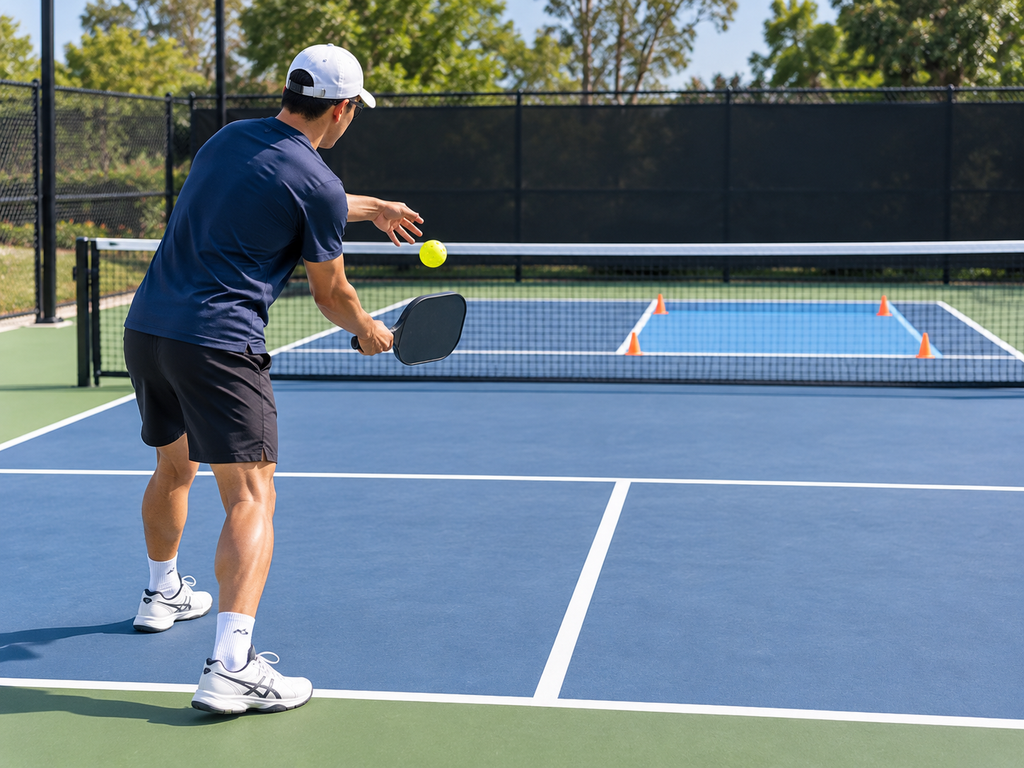
How to Do It
- Stand in your normal serving position.
- Place a target in the opposite service court.
- Serve 10 balls toward the target.
- Record how many land inside the correct service court.
- Move to the other side and repeat.
At first, make your target large.
For example, aim for the deeper half of the service court rather than a tiny spot.
As your accuracy improves, make the target smaller.
What This Drill Teaches
It develops:
- A repeatable serving motion
- Directional control
- Depth
- Confidence under less pressure
Avoid changing your swing dramatically every time you miss.
Instead, make small adjustments to paddle direction, contact and power.
Beginner Goal
Try to put 8 out of 10 serves into the correct service court.
Accuracy comes before speed.
5. Deep Return Drill
Best for: Return of serve
Players needed: Two
Difficulty: Easy
Serving receives plenty of attention from new players, but the return of serve is just as important.
A useful beginner return is usually controlled and deep enough to keep the serving team farther from the net.
USA Pickleball’s beginner skill guidance emphasizes developing reliable serves and returns before expecting precise placement to become automatic.
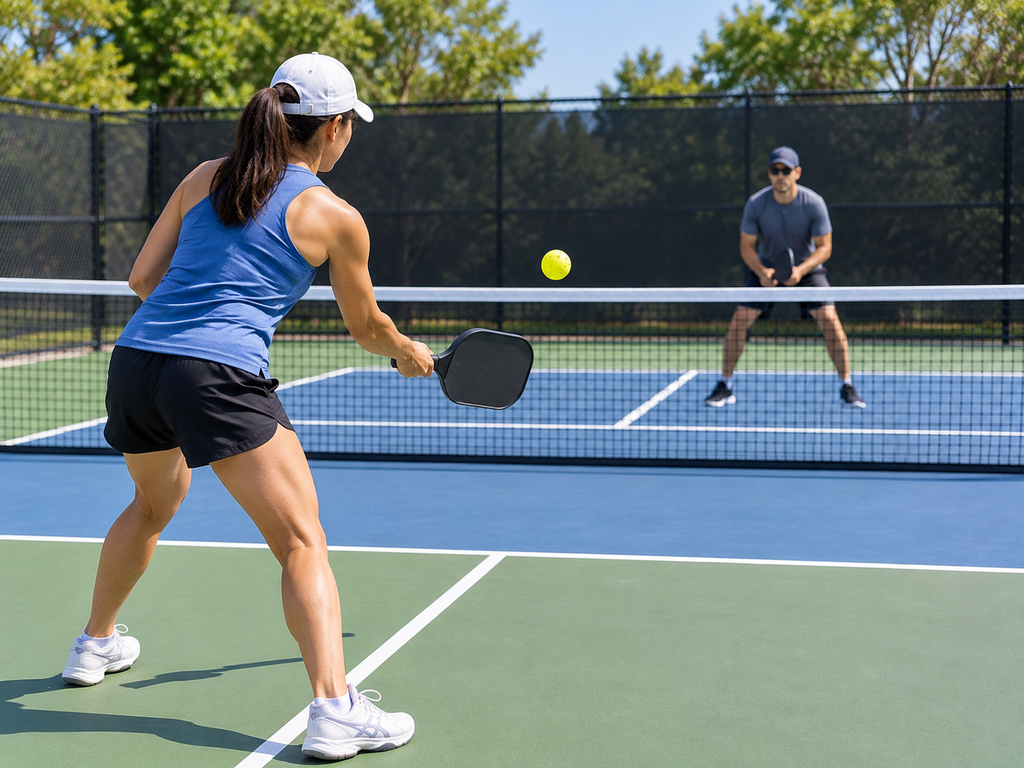
How to Do It
- Have your partner serve normally.
- Allow the serve to bounce.
- Return it toward the back portion of your partner’s court.
- Stop the rally after the return.
- Repeat 10 times and switch roles.
Place cones several feet inside the baseline to create a deep target zone.
Try to land your return between the cones and baseline.
What This Drill Teaches
This drill helps you practice:
- Reading the serve
- Moving behind the ball
- Controlled groundstrokes
- Returning with depth
- Recovering after your shot
After returning, begin practicing the habit of moving toward the non-volley zone rather than standing near the baseline.
Beginner Goal
Aim to land 7 out of 10 returns deep and inside the court.
6. Cooperative Dinking Drill
Best for: Soft touch and control
Players needed: Two
Difficulty: Easy
Dinking is one of pickleball’s signature skills.
A dink is a soft shot played after the bounce that is intended to land in or near the opponent’s non-volley zone.
For this drill, both players stand near their respective non-volley zone lines and cooperatively dink the ball back and forth.
How to Do It
- Stand just behind the non-volley zone line.
- Gently feed the ball to your partner.
- Allow the ball to bounce.
- Hit a soft return over the net.
- Continue the rally using only dinks.
Try to create a smooth arc that carries the ball safely over the net and down into the opponent’s non-volley zone.
What This Drill Teaches
Dink practice develops:
- Soft hands
- Paddle-face control
- Touch
- Patience
- Ball placement
Instead of swinging your entire arm aggressively, use a compact movement and guide the ball.
A relaxed grip can also make it easier to control softer shots.
Beginner Goal
Start with five consecutive dinks.
Then try for 10, 20 and eventually longer rallies.
Do not turn the exercise into a competition too quickly. Cooperative practice allows both players to get more useful repetitions.
7. Crosscourt Dink Drill
Best for: Dink placement and movement
Players needed: Two
Difficulty: Easy to moderate
Once straight-ahead dinking becomes comfortable, try hitting diagonally across the court.
Position yourself at one side of the non-volley zone line while your partner stands diagonally opposite you.
Then dink crosscourt to each other.
How to Do It
- Begin from opposite diagonal positions.
- Feed a soft ball into your partner’s non-volley zone.
- Keep every shot crosscourt.
- Move sideways when necessary instead of reaching excessively.
- Continue for 10 or more shots.
- Switch diagonals and practice the other direction.
What This Drill Teaches
Crosscourt dinking helps develop both placement and movement.
It also requires you to control the direction of the paddle face instead of simply sending every ball straight ahead.
Practicing controlled crosscourt drops and dinks is also part of USA Pickleball’s recommended skill-development work.
Make It Easier
Begin by using only half of the court and work cooperatively.
Make It Harder
After you can sustain the rally, place a small target inside the non-volley zone and try to land your dinks near it.
Beginner Goal
Complete 10 consecutive crosscourt dinks before switching sides.
8. Controlled Volley Drill
Best for: Volleys, reaction time and paddle position
Players needed: Two
Difficulty: Easy to moderate
A volley is a shot hit before the ball bounces.
This drill helps you become comfortable controlling volleys without turning every ball into a hard attack.
Stand near the non-volley zone line with your partner directly opposite you.
Remember that although you may stand close to the line, you cannot legally volley while touching the non-volley zone or its line. Your momentum after the volley also cannot carry you into the zone.
How to Do It
- Both players stand safely behind their non-volley zone lines.
- One player feeds a gentle volley.
- The other blocks the ball back.
- Continue volleying without allowing the ball to bounce.
- Keep the pace slow enough to maintain control.
Try to keep your paddle in front of your body instead of taking large swings.
What This Drill Teaches
This exercise develops:
- Compact paddle movement
- Quick reactions
- Paddle readiness
- Balance
- Volley control
As you improve, gradually increase the pace.
Beginner Goal
Complete 10 controlled volleys in a row.
If the rally regularly breaks down after two or three shots, slow the ball down.
9. Third-Shot Drop Progression
Best for: Soft shots from farther back
Players needed: Two
Difficulty: Moderate
The third-shot drop is one of the more difficult pickleball shots, so beginners should not expect to master it immediately.
But you can begin learning the feel of the shot using a simple progression.
A third-shot drop is a controlled shot designed to land softly in the opponent’s non-volley zone, giving the hitting team an opportunity to move forward. USA Pickleball describes it as an important transition shot between the baseline and the non-volley zone line.
How to Do It
Do not begin at the baseline.
Instead:
- Start a few feet behind the non-volley zone line.
- Have your partner stand across the net.
- Drop the ball in front of yourself.
- Hit a soft shot that lands in your partner’s non-volley zone.
- Complete 10 repetitions.
Once you can consistently control the shot, move one or two steps farther from the net.
Repeat the process until you eventually reach the baseline.
What This Drill Teaches
The progression helps you learn:
- Soft touch
- Arc and trajectory
- Distance control
- Compact swings
- Transition shots
Avoid trying to lift the ball with a huge swing.
USA Pickleball recommends compact preparation and controlled contact for developing reliable third-shot drops.
Beginner Goal
From each distance, try to land 7 out of 10 shots in the non-volley zone before moving farther back.
There is no need to rush toward the baseline.
10. Serve-Return-Third Shot Drill
Best for: Connecting skills into realistic pickleball
Players needed: Two or more
Difficulty: Moderate
Individual drills are valuable, but eventually you need to connect the shots together.
The serve-return-third shot drill recreates the opening sequence of a real pickleball rally.
It also reinforces the sport’s two-bounce rule: the receiving team must allow the serve to bounce before returning it, and the serving team must then allow the return to bounce before playing the next ball.
How to Do It
Player A serves.
Player B returns the serve after the bounce.
Player A allows the return to bounce and then hits the third shot.
Stop the rally at that point and begin again.
After several repetitions, switch roles.
What to Practice
The server should work on:
- Getting the serve in
- Staying ready for the return
- Moving into position for the third shot
- Choosing a controlled third shot
The receiver should work on:
- Letting the serve bounce
- Returning consistently
- Hitting with useful depth
- Moving forward after the return
Once both players become comfortable, continue the rally instead of stopping after the third shot.
Beginner Goal
Complete the serve, return and third shot successfully five times in a row.
This drill is especially useful because it begins to connect isolated skills with the movement and decision-making used in a real game.
How Long Should Beginners Practice Pickleball?
You do not need to practice for several hours to improve.
A focused 20- to 30-minute session can be very productive.
For example:
5 Minutes: Ball Control
Choose:
- Paddle taps
- Wall rallies
5 Minutes: Groundstrokes
Practice:
- Forehands
- Backhands
5 Minutes: Serve and Return
Complete:
- 10 serves from each side
- 10 returns
5 Minutes: Kitchen Skills
Practice:
- Straight dinks
- Crosscourt dinks
5 Minutes: Game-Like Practice
Finish with:
- Serve-return-third shot sequences
You can adjust the session depending on the part of your game that needs the most attention.
How Often Should Beginners Practice?
Consistency matters more than squeezing everything into one long practice session.
For many recreational beginners, practicing two or three times during the week—even for relatively short periods—can make skills feel more familiar.
You can also combine drills with normal games.
For example, spend 15 or 20 minutes practicing before joining recreational play.
The repetitions give you a chance to focus on technique before dealing with scoring, opponents and decision-making.
Common Mistakes When Practicing Pickleball
Drills are helpful only when you practice with a clear purpose.
Watch for these common beginner mistakes.
Hitting Everything Too Hard
Power is not the goal of most beginner drills.
If almost every rally ends after one or two shots, reduce your speed.
Longer controlled rallies give you more repetitions.
Practicing Only Your Forehand
It is tempting to run around the ball and use your stronger side.
But during a real game, you will eventually need your backhand.
Include both sides during practice.
Standing Still After Every Shot
Pickleball requires constant small adjustments.
After hitting, recover into a balanced position and prepare for the next ball.
Reaching Instead of Moving Your Feet
If the ball is several feet away, move toward it instead of stretching your arm as far as possible.
Better positioning usually makes the next shot easier.
Trying Difficult Shots Too Soon
Beginners do not need to practice advanced spin, aggressive speed-ups or highlight-reel shots before they can reliably serve, return and rally.
Build consistency first.
Turning Every Drill Into a Competition
Competitive drills can be useful, but cooperative drills are often better when learning a new skill.
If you and your partner are deliberately giving each other playable balls, you will both receive more repetitions.
How to Know If Your Pickleball Practice Is Working
You do not need advanced statistics.
Track a few simple numbers.
For example:
- How many serves out of 10 land in?
- How many consecutive dinks can you hit?
- How many wall rallies can you complete?
- How many returns land deep?
- How often can you complete the serve-return-third shot sequence?
Record your results once a week.
If you could sustain six dinks when you started and can now regularly reach 20, your control has improved even if you still make mistakes during games.
That kind of progress is easier to see when you measure consistency instead of judging yourself only by wins and losses.
Frequently Asked Questions About Pickleball Drills for Beginners
What is the best pickleball drill for beginners?
There is no single best drill for every beginner, but simple cooperative rallying is one of the most useful places to start.
It develops ball tracking, paddle control, movement and consistency at the same time.
Paddle taps and wall drills are also excellent if you are completely new to using a pickleball paddle.
Can I practice pickleball by myself?
Yes.
Solo pickleball drills can include:
- Paddle taps
- Wall rallies
- Serve practice
- Target practice
- Footwork practice
A wall is especially useful because it allows you to practice hundreds of contacts without needing another player.
Can I practice pickleball without a court?
Yes.
Paddle-control drills require very little space, and many groundstroke or volley exercises can be adapted for a wall.
Serving and full-court movement are easier to practice on an actual pickleball court because the court lines and net provide important visual references.
Should beginners practice dinking?
Yes.
Dinking introduces beginners to soft-ball control and prepares them for play near the non-volley zone.
You do not need advanced dink strategy at first. Concentrate on getting the ball comfortably over the net and keeping it low enough to remain difficult to attack.
Should beginners practice the third-shot drop?
Yes, but keep expectations realistic.
The third-shot drop is more difficult than a basic serve or groundstroke.
Begin close to the non-volley zone and gradually move backward instead of immediately trying to hit perfect drops from the baseline.
Is playing games enough to improve at pickleball?
Games are important because they teach positioning, decisions and point construction, but drills provide concentrated repetitions that games usually cannot.
A good beginner routine includes both.
Practice helps develop the shot. Games teach you when to use it.
Practice Simple Skills Before Complicated Ones
Pickleball becomes much easier when you can reliably perform a few fundamental skills.
You do not need a powerful serve, advanced spin or complicated strategy when you are starting.
Work first on:
- Controlling the paddle
- Getting serves in
- Returning the ball consistently
- Hitting both forehands and backhands
- Maintaining rallies
- Controlling dinks
- Volleying from a balanced position
- Moving into better court positions
Once those skills become more reliable, more advanced shots become much easier to learn.
Start with two or three of these beginner pickleball drills during your next practice session. Keep track of how many successful repetitions you can complete, then try to improve that number the next time you play.
Small improvements in control and consistency add up quickly – and they make actual pickleball games much more enjoyable.