
How Pickleball Scoring Works: A Simple Beginner’s Guide
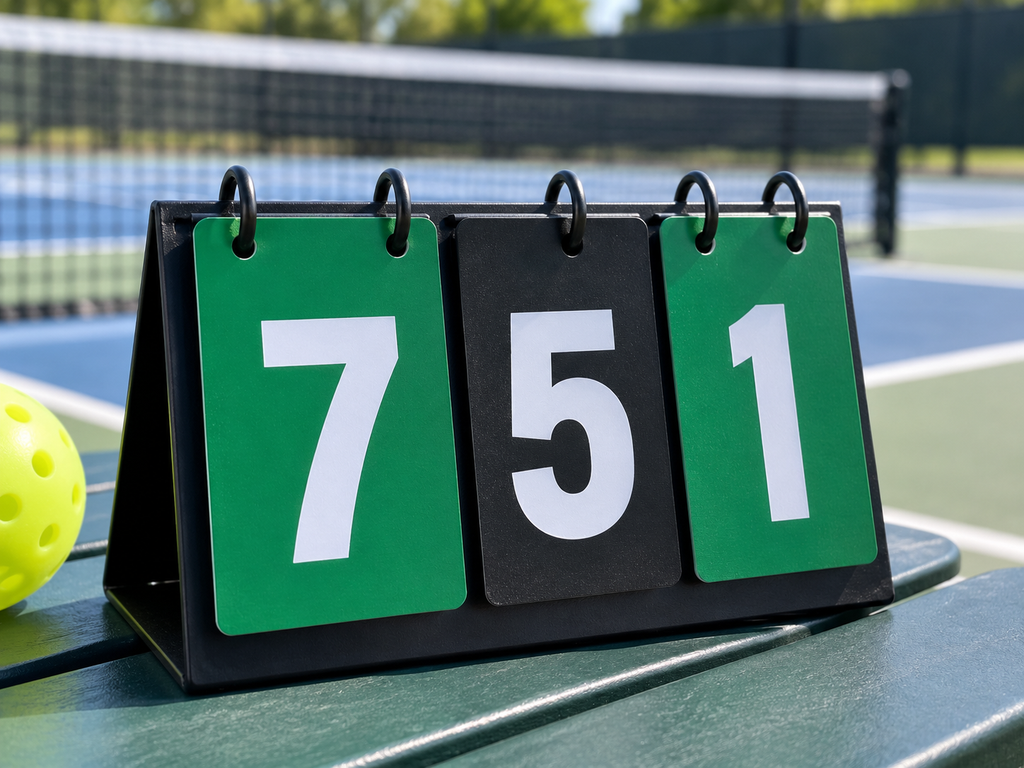
Pickleball scoring can seem confusing when you first step onto the court.
You may hear someone call “4-2-1” or “0-0-2” before serving and wonder why there are three numbers instead of two. You may also notice that a team can win several rallies without its score changing.
There is a simple reason for this: under traditional side-out scoring, which remains the standard scoring system most beginners learn, you can normally score points only while you or your team is serving.
Once you understand that rule and what the three numbers mean in doubles, pickleball scoring becomes much easier to follow.
This guide explains how scoring works in both doubles and singles, why a game starts at 0-0-2, when players change sides and how to know when a game is over.
Pickleball Scoring at a Glance
For traditional pickleball scoring, remember these basic rules:
- Only the serving player or team can normally score a point.
- Most recreational games are played to 11 points.
- You must usually win by at least two points.
- Doubles scores contain three numbers.
- Singles scores contain two numbers.
- In doubles, both partners normally get an opportunity to serve before the serve passes to the other team.
- There is one important exception at the beginning of each game: the team serving first gets only one server before the first side out.
That last rule explains the unusual starting score of 0-0-2.
How Do You Score a Point in Pickleball?
Under traditional side-out scoring, your team earns a point when:
- Your team is serving.
- You win the rally.
If the receiving team wins the rally, it does not receive a point. Instead, the serving team loses that serve.
Depending on the situation, the serve either goes to the serving player’s partner or passes to the opposing team.
Example
Team A is serving with the score:
3-2-1
Team A wins the rally.
The score becomes:
4-2-1
But suppose Team A loses the rally instead.
Team B does not receive a point. The score remains:
3-2
The serving opportunity simply moves to Team A’s second server.
This is one of the biggest differences between traditional pickleball scoring and sports that award a point after every rally.
What Do the Three Numbers Mean in Doubles Pickleball?
Doubles scoring uses three numbers.
For example:
6-4-2
The numbers are always called in this order:
Serving team’s score – Receiving team’s score – Server number
So:
6
The serving team has six points.
4
The receiving team has four points.
2
The person serving is the team’s second server for the current service turn.
USA Pickleball specifies this three-number sequence for doubles side-out scoring.
A simple way to remember it is:
Us – Them – Server
So if your team is serving and leading 8-5 while your first server is serving, you call:
8-5-1
If your partner later becomes the second server without either team’s score changing, the call becomes:
8-5-2
What Do Server 1 and Server 2 Mean?
The third number does not permanently identify one player as Server 1 and the other as Server 2.
Instead, it tells you whether the team is using its first or second serving opportunity during the current service turn.
Suppose you and your partner receive the serve and eventually win the rally, causing a side out.
Your team now gets the serve.
The player who begins that new service turn is Server 1.
If Server 1 eventually loses a rally, the serve passes to the partner, who becomes Server 2.
If Server 2 also loses a rally, the opposing team receives the serve.
Then their first server becomes Server 1 for that service turn.
Think of the third number as:
How many servers has this team used during this turn?
It is not a permanent player number.
Why Does a Pickleball Game Start at 0-0-2?
This is probably the most confusing scoring rule for new players.
A traditional doubles game begins:
0-0-2
Why isn’t it 0-0-1?
Normally, both players on a doubles team get an opportunity to serve before a side out occurs. But the team that serves first at the beginning of the game is given only one serving opportunity.
That starting server is therefore treated as the team’s second server.
If the starting serving team loses the rally, there is an immediate side out and the opposing team gets the serve.
Why does this rule exist?
It helps reduce the advantage of being the team that serves first.
Without the exception, the first team could potentially have two long serving runs before the other team ever touched the ball as the serving team.
So remember:
Only at the start of the game: 0-0-2.
After that first side out, teams normally receive both serving opportunities.
How Serving and Scoring Work in Doubles
Let’s walk through a game from the beginning.
Step 1: The Game Starts at 0-0-2
The first server begins from the right-hand service court.
The score is:
0-0-2
The server serves diagonally into the opponent’s correct service court.
Step 2: The Serving Team Wins the Rally
Because the serving team won the rally, it earns a point.
The score becomes:
1-0-2
The same player continues serving.
However, the server moves to the opposite side of the court before the next serve.
Step 3: The Serving Team Scores Again
The server wins another rally.
The score becomes:
2-0-2
The server switches service courts again.
The same player continues serving until the serving team loses a rally or commits a fault.
Step 4: The Serving Team Loses the Rally
Because this is the opening service turn and the starting server is treated as Server 2, there is now a side out.
No point is awarded to the receiving team.
The score remains:
2-0
The other team now gets the serve.
Step 5: The Other Team Begins Serving
The new serving team begins with its first server.
The score call becomes:
0-2-1
Notice something important: the serving team’s score is always called first.
Even though the scoreboard may have been thought of as Team A 2, Team B 0, the score is now called 0-2-1 because Team B is serving.
What Is a Side Out in Pickleball?
A side out means the right to serve passes from one team to the other.
In standard doubles play, this usually happens after both servers on a team have lost their serving opportunities.
For example:
Team A is serving at:
5-3-1
Server 1 loses the rally.
The score stays 5-3, but Team A’s partner now serves:
5-3-2
Server 2 then loses the rally.
That creates a side out.
Team B now serves.
Because the serving team must announce its score first, the score becomes:
3-5-1
No points were scored during those two lost rallies. Only the serving rights changed.
When Do Players Switch Sides?
Another part of scoring that initially causes confusion is player positioning.
When the serving team scores a point, the two players on that team change their left-right positions.
The server therefore alternates between serving from the right and left service courts as points are scored.
The receiving team does not switch sides simply because the serving team scored.
Example
You begin serving from the right at:
0-0-2
You win the rally.
You and your partner switch sides.
You now serve from the left at:
1-0-2
You win again.
You switch back and serve from the right at:
2-0-2
This alternating pattern can also help players keep track of the score.
The Even-Odd Rule
There is a useful shortcut for remembering your correct position.
For the player who started the game on the right side for a team:
- When that team’s score is even, that player should be on the right.
- When the team’s score is odd, that player should be on the left.
Examples of even scores include:
0, 2, 4, 6, 8 and 10
Examples of odd scores include:
1, 3, 5, 7 and 9
This is useful when players forget who should be standing where.
Instead of guessing, you can use the team’s score to help reconstruct the correct positions.
A Complete Doubles Scoring Example
Suppose Anna and Ben are playing against Chris and Dana.
Anna serves first.
Start
0-0-2
Anna serves.
Anna and Ben win the rally.
Next score
1-0-2
Anna serves again from the opposite side.
Anna and Ben win again.
Next score
2-0-2
Anna serves again.
This time Chris and Dana win the rally.
Because Anna was the starting server of the game and therefore considered Server 2, the serve immediately passes to Chris and Dana.
Side out
Chris and Dana now serve:
0-2-1
Chris is Server 1.
Chris and Dana lose the rally.
No point is awarded to Anna and Ben.
Dana becomes Server 2:
0-2-2
Dana wins the next rally.
Score
1-2-2
Dana switches sides and serves again.
Dana later loses the rally.
Now both servers have completed their turns, so the serve returns to Anna and Ben.
Anna and Ben’s score is still 2, while Chris and Dana have 1.
The new score is:
2-1-1
The pattern continues until one team reaches the winning score with the required margin.
How Many Points Do You Need to Win a Pickleball Game?
Most recreational pickleball games using traditional scoring are played to:
11 points, win by 2.
That means reaching 11 does not automatically end the game.
If the score is:
11-10
the game continues because the leading team is ahead by only one point.
Possible final scores could include:
- 11-7
- 11-4
- 12-10
- 13-11
- 15-13
There is no requirement that every game finish exactly at 11.
Tournament formats can also use games to 15 or 21 points, normally with the same requirement to win by two.
Can a Team Score When It Is Not Serving?
Under traditional side-out scoring, generally no.
Winning a rally while receiving earns your team the opportunity to serve, but it does not normally add a point to your score.
For example:
The score is:
7-6-2
The serving team loses the rally.
The receiving team does not move to seven points.
Instead, a side out occurs.
The new serving team calls:
6-7-1
This idea is the foundation of traditional pickleball scoring:
Serve first. Win the rally. Score the point.
How Does Singles Pickleball Scoring Work?
Singles scoring is simpler because there is only one player on each side.
There is no Server 1 or Server 2.
That means singles scores contain only two numbers:
Server’s score – Receiver’s score
For example:
5-3
means the server has five points and the receiving player has three.
Traditional singles also uses side-out scoring, so only the server scores a point after winning a rally.
If the receiver wins the rally, the receiver gains the serve but does not receive a point.
Where Do You Serve From in Singles?
Your own score determines which side you serve from.
When your score is even, serve from the right side.
When your score is odd, serve from the left side.
So:
| Server’s Score | Serving Side |
|---|---|
| 0 | Right |
| 1 | Left |
| 2 | Right |
| 3 | Left |
| 4 | Right |
| 5 | Left |
An easy memory trick is:
Even = Right
Odd = Left
Doubles vs. Singles Scoring
The basic scoring principle is the same, but doubles adds one extra number.
| Rule | Doubles | Singles |
|---|---|---|
| Traditional points scored only while serving | Yes | Yes |
| Normal recreational game | 11, win by 2 | 11, win by 2 |
| Score numbers called | 3 | 2 |
| Server number used | Yes | No |
| Even score serves from right | Used in positioning | Yes |
| Odd score serves from left | Used in positioning | Yes |
| Two serving opportunities per team | Normally yes | No |
The biggest adjustment for beginners is simply remembering the third number in doubles.
When Should the Score Be Called?
The server should call the score before serving.
Calling the score clearly helps everyone confirm:
- who is serving
- which team is ahead
- which server is serving
- whether everyone is in the correct position
For doubles side-out scoring, remember the order:
Serving score – Receiving score – Server number
For singles:
Serving score – Receiving score
Developing the habit of saying the score clearly before every serve prevents a lot of unnecessary confusion.
Common Pickleball Scoring Mistakes
Mistake 1: Giving a Point to the Receiving Team
This is probably the most common beginner mistake.
Under traditional scoring, winning a rally while receiving does not normally score a point.
It earns the serve.
Mistake 2: Calling the Higher Score First
The leading team’s score is not automatically announced first.
The serving team’s score always comes first.
If your team trails 4-8 but has the serve, you call:
4-8-1
not 8-4-1.
Mistake 3: Thinking Server 1 and Server 2 Are Permanent
They aren’t.
Server 1 and Server 2 refer to the serving order during a particular service turn.
After a side out, the player who begins the team’s new serving turn becomes Server 1.
Mistake 4: Starting the Game at 0-0-1
Traditional doubles begins:
0-0-2
The first serving team gets only one serving opportunity before the first side out.
Mistake 5: Ending the Game at 11-10
A standard game must normally be won by two points.
An 11-10 score therefore does not end the game.
Play continues until someone leads by two.
Mistake 6: Switching Both Teams After Every Point
Only the serving team’s partners switch sides after their team scores under traditional doubles scoring.
The receiving team stays in its positions during that scoring sequence.
What Is Rally Scoring in Pickleball?
You may occasionally play somewhere that uses rally scoring instead of traditional side-out scoring.
Under rally scoring, a point is awarded after a rally regardless of which side served.
This makes it similar to the scoring systems used in several other racket sports.
USA Pickleball has provisionally recognized rally scoring and permits it in certain sanctioned tournament formats. The 2026 rules expanded the available rally-scoring options, although traditional side-out scoring remains an important scoring format and is still used for designated events such as USA Pickleball Golden Ticket tournaments and the National Championships.
For recreational play, always confirm the scoring system before starting.
Someone can simply ask:
“Are we playing side-out scoring or rally scoring?”
For a beginner, learning traditional side-out scoring first is useful because it teaches the three-number doubles score and serving sequence you will commonly encounter on recreational courts.
Traditional Scoring vs. Rally Scoring
The biggest difference is who can earn a point.
Traditional Side-Out Scoring
If the serving team wins the rally:
Point for the serving team.
If the receiving team wins:
No point. The serving opportunity changes.
Rally Scoring
If the serving team wins:
Point for the serving team.
If the receiving team wins:
Point for the receiving team.
So if you’re suddenly playing with people who seem to be awarding points after every rally, don’t assume you misunderstood traditional scoring. They may simply be using a rally-scoring format.
The Easiest Way to Remember Pickleball Scoring
You do not need to memorize every possible situation before playing your first game.
Start with these five rules:
1. Only the serving team scores under traditional scoring.
If you’re receiving and win the rally, you gain the serve rather than a point.
2. Doubles uses three numbers.
Think:
Us – Them – Server
3. Games normally start at 0-0-2.
The opening serving team receives only one serving opportunity.
4. Games are commonly played to 11, win by 2.
Eleven points is not enough if the opponent has ten.
5. In singles, even scores serve right and odd scores serve left.
Remember:
Even = Right. Odd = Left.
Those five ideas will get you through most beginner recreational games.
Pickleball Scoring FAQs
Why are there three numbers in pickleball scoring?
There are three numbers in doubles because players announce the serving team’s score, the receiving team’s score and whether the current server is Server 1 or Server 2.
For example:
7-4-2
means the serving team has seven, the receiving team has four and the team’s second server is serving.
Why does pickleball start at 0-0-2?
The team serving first gets only one serving opportunity at the beginning of a traditional doubles game. The opening server is therefore treated as Server 2.
When that server loses the rally, the serve immediately passes to the opposing team.
Do you have to win pickleball by two points?
Under standard USA Pickleball scoring formats, games are played with a two-point winning margin. A game to 11 therefore continues beyond 11 if necessary.
Can pickleball end 11-10?
Not under the normal win-by-two format.
At 11-10, play continues.
The game could finish 12-10 or continue even longer if the teams keep trading points.
Who serves first after a side out?
In traditional doubles, the new serving team begins its service turn with its first server. Both partners normally have a serving opportunity before another side out occurs.
Does the same player always serve first for a team?
Not necessarily.
Player positions change as points are scored, so who begins a later service turn depends on where the players are correctly positioned when the team receives the serve.
Do both players serve in doubles pickleball?
Normally, yes.
Both partners receive an opportunity to serve during each service turn before a side out.
The exception is the very beginning of the game, when the team serving first receives only one serving opportunity.
Do you switch sides every time you score?
During a traditional doubles service turn, the serving team’s players switch left-right positions each time they score.
The receiving players do not switch just because the serving team scored.
Is singles pickleball scoring easier than doubles?
Usually.
Singles uses only two numbers because there is no Server 1 or Server 2.
The server simply calls the server’s score followed by the receiver’s score.
Final Thoughts
Pickleball scoring looks unusual at first, especially when you hear 0-0-2 for the first time.
But the system becomes much simpler when you break it into a few basic ideas.
Under traditional side-out scoring, you must be serving to normally score a point. Doubles uses three numbers because the score also identifies whether the first or second server is serving. Most recreational games are played to 11 points and must be won by two.
So when you hear:
5-3-1
you can immediately translate it:
The serving team has 5. The receiving team has 3. Server 1 is serving.
Once that starts to feel automatic, following the rest of a pickleball game becomes much easier.
The best way to learn the scoring system is to use it. Call the score before every serve, pay attention to when the serve changes and don’t worry if you have to stop occasionally to work out who should be serving. After a few games, the numbers that once sounded confusing will become a normal part of playing pickleball.