
Pickleball Court Explained: A Beginner’s Guide
Before you start learning how to serve, return or rally, it helps to understand the space where pickleball is played – the pickleball court
A pickleball court may look simple at first. It is a rectangle divided by a net with several painted lines. But each line and section has a specific purpose. Once you know what the different parts of the court are called and where they are located, following instructions and understanding the game becomes much easier.
The good news for beginners is that the court is not complicated. There are only a few main areas to learn: the baselines, sidelines, service courts, centerlines, non-volley zones and net.
This guide walks you through the pickleball court from one end to the other.
How Big Is a Pickleball Court?
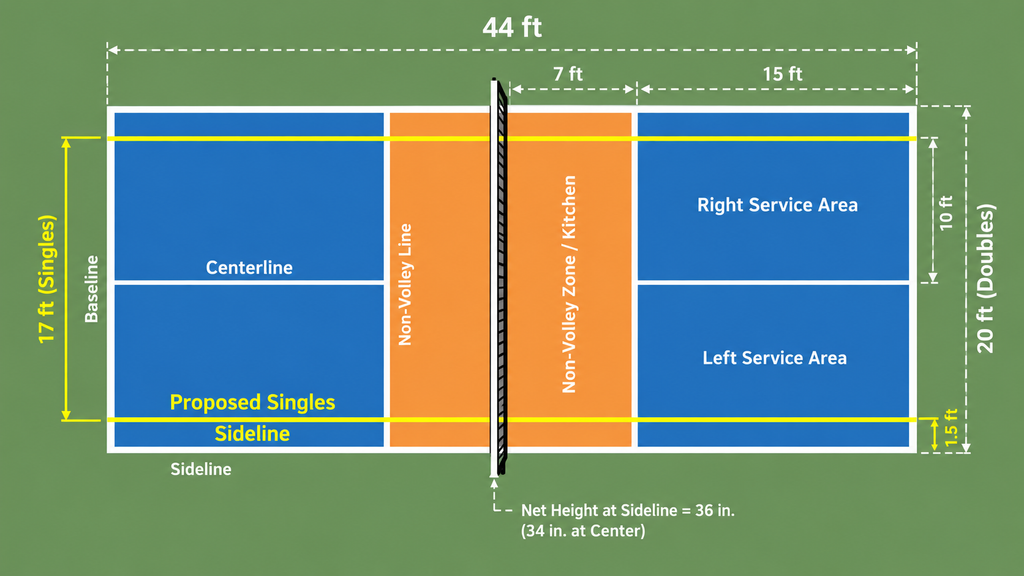
A standard pickleball court measures:
- 20 feet wide
- 44 feet long
Those dimensions are the same for both singles and doubles pickleball. Unlike tennis, where the usable court width changes between singles and doubles, pickleball uses the full 20-foot width for both versions of the game.
The net runs across the center of the court, dividing the 44-foot length into two equal halves.
That means each end of the court extends 22 feet from the net to the baseline.
Although the painted playing area is 20 by 44 feet, an actual pickleball facility needs additional open space around those lines so players have room to move safely beyond the boundaries.
USA Pickleball recommends a minimum total playing surface of approximately 30 feet by 60 feet for a standard court. More surrounding space can make the court safer and more comfortable.
Pickleball Court Dimensions at a Glance
Here are the main measurements beginners should recognize:
- Court width: 20 feet
- Court length: 44 feet
- Distance from net to each baseline: 22 feet
- Non-volley zone depth: 7 feet from the net on each side
- Court line width: approximately 2 inches
- Net height at sidelines: 36 inches
- Net height at center: 34 inches
The dimensions are measured using the outer edges of the appropriate court lines, and official court lines should contrast clearly with the playing surface.
You do not need to memorize every measurement before playing your first game. The most useful numbers to remember initially are 20 feet wide, 44 feet long and 7 feet for each non-volley zone.
The Net
The net divides the pickleball court into two equal ends.
It stretches across the full width of the playing area and slightly beyond the sidelines to the net posts.
A regulation pickleball net is lower in the center than at the sides:
- 36 inches high at the sidelines
- 34 inches high at the center
USA Pickleball specifies that the net should be at least 21 feet 9 inches long, with the posts positioned approximately 22 feet apart.
That two-inch difference between the center and sides gives the net its slight downward curve.
When looking at a court from behind one baseline, the net marks the halfway point. Everything between you and the net is your end of the court, while everything beyond the net is the opposite end.
The Baselines
The baselines are the lines running across the width of the court at each end.
There are two baselines:
- One at one end of the court
- One at the opposite end
Each baseline is parallel to the net and sits 22 feet away from it.
If you stand behind the court and face the net, the baseline is the horizontal boundary immediately in front of you.
The baseline marks the back edge of the official playing area.
The open space behind it is not part of the 20-by-44-foot court itself, but that additional room is still important because players frequently move behind the baseline during play.
The Sidelines
The sidelines are the two long lines running along the sides of the court.
Each sideline extends:
- From one baseline
- Past the net
- To the opposite baseline
The distance between the two sidelines is 20 feet.
Together, the two baselines and two sidelines form the outer rectangular boundary of the pickleball court.
An easy way to remember the difference is:
Baselines are at the back. Sidelines are at the sides.
The Non-Volley Zone
The area immediately next to the net on both sides is called the non-volley zone, commonly known as the kitchen.
Each non-volley zone extends:
- The full 20-foot width of the court
- 7 feet back from the net
Because there is one on each side of the net, the two non-volley zones together cover a 14-foot-long section through the center of the court.
The non-volley zone is one of the most recognizable features that makes a pickleball court different from many other racket-sport courts.
The Non-Volley Zone Line
The painted line running parallel to the net and seven feet away from it is called the non-volley zone line.
You will also commonly hear players call it the:
- Kitchen line
- NVZ line
The line runs from one sideline to the other.
An important detail when learning the layout is that the non-volley zone line itself is considered part of the non-volley zone.
Visually, this means the kitchen begins at the net and extends all the way through the painted non-volley zone line.
The non-volley zone line also creates a clear dividing point between the front portion of each side of the court and the deeper service-court area behind it.
The Centerline
Behind the non-volley zone on each end of the court, you will see a line running down the middle.
This is the centerline.
The centerline begins at the non-volley zone line and continues toward the baseline.
It divides that portion of the court into two equal service courts.
When you stand behind a baseline and look toward the net, the centerline separates:
- The right service court
- The left service court
The centerline does not continue through the non-volley zone to the net.
This is an easy detail to overlook when first studying a court diagram.
The kitchen remains one continuous rectangular area across the full width of each side.
The Right Service Court
The section behind the non-volley zone and to the right of the centerline is called the right service court when you are facing the net from that end of the court.
It is bounded by:
- The baseline
- One sideline
- The centerline
- The non-volley zone area at the front
The right service court occupies one half of the deeper portion of that end of the court.
You may also hear it referred to as the even court in discussions about positioning and scoring, although understanding those terms is part of learning how the game operates rather than understanding the physical court itself.
For now, simply recognize it as the service area on the right side when facing the net.
The Left Service Court
On the other side of the centerline is the left service court.
Like the right service court, it extends from the baseline toward the non-volley zone.
Together, the left and right service courts fill the area between the baseline and the non-volley zone.
From behind the baseline, the court therefore has a simple structure:
Left service court | Centerline | Right service court
The same arrangement appears on the opposite end of the net.
How Large Is Each Service Court?
Each complete end of the pickleball court is 20 feet wide.
Because the centerline divides the area evenly, each service court is approximately 10 feet wide.
From the baseline to the non-volley zone line is 15 feet.
You can calculate this from the overall court dimensions:
- Net to baseline: 22 feet
- Non-volley zone: 7 feet
- Remaining distance: 15 feet
So the main rectangular area associated with each service court is approximately:
10 feet wide by 15 feet deep
This helps show how compact a pickleball court really is.
Understanding the Court From Baseline to Net
One of the easiest ways to learn the court is to mentally walk from the back toward the center.
Starting behind one end of the court, you encounter:
Baseline → Service-Court Area → Non-Volley Zone Line → Non-Volley Zone → Net
After crossing the net, the same layout appears in reverse:
Net → Non-Volley Zone → Non-Volley Zone Line → Service-Court Area → Baseline
The court is essentially symmetrical.
If you understand one half, you understand the other.
The Area Between the Baseline and Kitchen
The official court does not have a special painted zone between the baseline and non-volley zone line beyond its division into the right and left service courts.
However, players and coaches often informally refer to portions of this space using terms such as the transition area or transition zone.
These terms describe areas of the existing court rather than additional official court markings.
You will not normally find a line painted across a regulation court labeled “transition zone.”
That distinction is useful for beginners because instructional diagrams may sometimes show extra shaded areas that do not actually appear on the physical court.
Which Court Lines Are Actually Painted?
A standard pickleball court contains a relatively small number of official lines.
These include:
- Two baselines
- Two sidelines
- Two non-volley zone lines
- Two centerlines
The net runs across the middle but is obviously not a painted line.
There is no additional painted line separating a “transition zone,” no separate singles sideline and no separate doubles sideline.
That simplicity is one reason the court becomes easy to recognize after only a few games.
Pickleball Court Lines Are Part of the Court
Court lines are not merely visual markers floating outside the playing area.
They form part of the areas they define.
For example, the outer boundary lines are part of the court, while the non-volley zone line belongs to the non-volley zone.
USA Pickleball specifies court lines at approximately 2 inches wide and recommends that they be a consistent color that contrasts clearly with the playing surface.
For a beginner, this is mainly important because you should think of the lines as having actual width rather than imagining them as infinitely thin boundaries.
Is the Pickleball Court Different for Singles and Doubles?
No.
A standard picleball court remains 20 feet wide by 44 feet long whether two people or four people are playing.
The sidelines do not move.
The baselines do not move.
The non-volley zones do not change.
The net remains in the same position.
The centerlines remain the same.
This differs from a tennis court, which has additional doubles alleys that change the usable width depending on the format being played.
On a pickleball court, the same permanent markings work for both standard singles and doubles.
Why a Pickleball Court Can Look Smaller Than Expected
Beginners coming from tennis often notice how compact a pickleball court feels.
A pickleball court measures 20 by 44 feet, which places players much closer to the net and to one another than they would be across a full tennis court.
The seven-foot non-volley zones also occupy a significant portion of the court near the net.
From one baseline to its non-volley zone line is only 15 feet.
Understanding these distances helps explain why the different areas of the court are visually easy to identify once you are standing on one.
The Playing Surface Around the Court
The painted rectangle is only part of a complete pickleball playing space.
Players need room outside the court boundaries to move comfortably.
USA Pickleball identifies approximately 30 by 60 feet as a minimum recommended overall playing surface for a court, with additional surrounding space desirable when available.
This means the open area around the baselines and sidelines matters even though it is not part of the 20-by-44-foot marked court.
A court squeezed tightly between walls, fences or other obstacles may technically have the correct painted dimensions while still providing an uncomfortable playing environment.
Pickleball Court Surfaces
Pickleball is generally played on a firm, smooth surface that allows the ball to bounce predictably.
Permanent outdoor courts commonly use surfaces built over:
- Asphalt
- Concrete
Specialized sport coatings may then be applied to provide appropriate texture, traction and visibility.
USA Pickleball notes that hard surfaces such as concrete or asphalt can be suitable for outdoor play when they are properly prepared and free of debris.
Indoor facilities may use dedicated sport surfaces or other hard flooring suitable for pickleball.
Whatever the material, a useful court surface should be reasonably consistent, clean and free from dangerous cracks, loose objects or other hazards.
Why Pickleball Courts Often Use Different Colors
Many dedicated courts use contrasting colors to make different areas easy to recognize.
For example, a facility might use one color for the main playing area and another for the non-volley zones.
The exact color combination is not what defines the court.
What matters most is that the boundary markings remain clearly visible against the playing surface.
This visual contrast allows players to identify baselines, sidelines, centerlines and non-volley zone lines quickly.
Indoor and Outdoor Court Layouts
The official dimensions of the pickleball court do not change simply because the game moves indoors or outdoors.
A standard court remains:
20 feet wide by 44 feet long
The non-volley zones remain seven feet deep.
The net remains in the center.
The same basic lines and court sections remain in place.
What can change is the surrounding environment.
Outdoor courts may have fences, wind screens, lighting and drainage systems, while indoor courts may be surrounded by walls, curtains or neighboring courts.
But the fundamental court layout remains recognizable.
Outdoor Court Orientation
For permanent outdoor courts, direction can matter because of sunlight.
USA Pickleball recommends a north-south orientation when possible. This reduces the likelihood of players looking directly into a low morning or evening sun while facing the opposite side of the court.
Court orientation does not change the court’s dimensions or markings, but it can affect visibility and comfort.
This is mainly a consideration for people designing or constructing courts rather than something a beginner needs to worry about when arriving at an existing facility.
Dedicated Pickleball Courts
A dedicated pickleball court is built and marked specifically for pickleball.
These are usually the easiest courts for beginners to understand because the surface contains only the lines needed for the sport.
On a dedicated court, you can usually identify the complete layout immediately:
- Baselines
- Sidelines
- Centerlines
- Non-volley zone lines
- Net
There are no unrelated tennis, basketball or badminton markings competing for attention.
Temporary Pickleball Courts
Pickleball can also be played on temporary courts.
Tape, temporary court markers or removable lines can be used to create the correct dimensions on a suitable hard surface.
A portable pickleball net can then be positioned across the center.
Even though the setup is temporary, the basic layout should still reproduce the same regulation court:
20 feet wide by 44 feet long with seven-foot non-volley zones on each side of the net.
USA Pickleball notes that temporary lines can be created using materials such as tape or chalk, provided the layout is visible and usable.
Pickleball Lines on a Tennis Court
You may encounter pickleball courts created inside or alongside existing tennis courts.
Because the two sports use different court dimensions, additional pickleball lines are often painted or temporarily marked over the tennis surface.
This can make the court look confusing at first because several colors of lines may cross one another.
When playing on a shared surface, focus only on the lines designated for pickleball.
Look for the rectangle measuring 20 by 44 feet and identify its:
- Baselines
- Sidelines
- Non-volley zone lines
- Centerlines
Once you recognize those features, it becomes much easier to ignore the unrelated markings.
Understanding a Court With Multiple Pickleball Line Colors
Some recreation centers use gym floors or multi-use outdoor surfaces containing markings for several sports.
Instead of trying to follow every line, start with the pickleball net.
From there:
- Find the non-volley zone lines approximately seven feet from each side of the net.
- Follow the pickleball sidelines toward the ends of the court.
- Locate the baselines.
- Find the centerlines running between the baselines and non-volley zone lines.
This gives you the complete pickleball court regardless of what other markings appear on the surface.
Court Space Beyond the Lines
Beginners sometimes assume they should remain completely inside the painted rectangle.
The court lines define the official playing area, but the surrounding surface is still part of the physical space used by players.
That is why dedicated facilities provide extra room around the court.
Behind each baseline, players need space before reaching a fence, wall or neighboring court.
Space beside the sidelines is also helpful for movement and for retrieving balls.
When looking at a court for the first time, do not judge its usable size only by the painted rectangle. The surrounding clearance is an important part of a properly designed playing environment.
The Pickleball Court Is Symmetrical
One of the easiest features to remember is that the standard court is symmetrical.
Each end contains:
- One baseline
- Two sideline sections
- One centerline
- Two service courts
- One seven-foot non-volley zone
The net sits exactly between the two ends.
If you were to rotate the court 180 degrees, the layout would look essentially the same.
This symmetry makes court orientation much easier for beginners.
A Simple Way to Read the Court
When you first arrive at a pickleball court, identify four things in this order:
1. Find the Net
The net divides the court into two equal halves.
2. Find the Kitchen
Look immediately beside the net for the seven-foot non-volley zone on each side.
3. Find the Baselines
These are the back boundaries at opposite ends of the court.
4. Find the Centerlines
These divide the deeper portion of each end into right and left service courts.
Once you can identify those four features, almost every other part of the court becomes obvious.
Common Pickleball Court Terms Beginners Should Know
Here is a quick reference to the main court terminology.
Baseline: The boundary line across the back of each end of the court.
Sideline: One of the two long outer boundaries running along the sides.
Net: The barrier dividing the court into two equal ends.
Non-Volley Zone: The seven-foot-deep area immediately beside the net on each side.
Kitchen: The common name for the non-volley zone.
Non-Volley Zone Line: The line seven feet from the net that marks the back edge of the non-volley zone.
Kitchen Line: Another common name for the non-volley zone line.
Centerline: The line dividing the deeper area behind the non-volley zone into left and right service courts.
Right Service Court: The service area on the right when facing the net.
Left Service Court: The corresponding service area on the left.
Transition Area: An informal term commonly used for part of the space between the baseline and non-volley zone. It is not a separately marked official section of the court.
Common Beginner Misunderstandings About the Court
The Kitchen Is Not Just the Kitchen Line
The kitchen is the entire seven-foot-deep non-volley zone between the net and its boundary line.
The painted line is simply its back boundary and is itself part of the non-volley zone.
Singles Does Not Use a Narrower Court
The standard 20-foot width remains in use for both singles and doubles.
There are no pickleball singles sidelines inside the regular sidelines.
The Centerline Does Not Reach the Net
The centerline stops at the non-volley zone line.
It does not divide the kitchen into two official halves.
The Transition Zone Is Not an Additional Painted Zone
You may hear coaches refer to a transition zone, but you should not expect to find special transition-zone lines painted on a regulation court.
The Painted Court Is Smaller Than the Full Playing Surface
The official lines occupy a 20-by-44-foot rectangle, but additional clear space around those lines is needed for a practical playing area.
Checking a Court Before Playing
Even when a court has the correct layout, it is worth taking a quick look at the physical condition of the surface.
Check for:
- Standing water
- Loose gravel
- Leaves
- Sand
- Cracks
- Uneven surfaces
- Loose tape on temporary lines
- Objects close to the sidelines or baselines
- Problems with the net
Outdoor courts can collect debris between uses, while temporary indoor courts may have tape or portable net components that have shifted.
Recognizing the proper court layout also makes it easier to notice when something appears out of position.
The Pickleball Court Is Easier to Learn Than It Looks
At first, terms such as baseline, centerline, service court and non-volley zone can make a pickleball court sound more complicated than it really is.
In practice, the layout is very simple.
Remember the basic structure:
The court is 20 feet wide and 44 feet long.
The net divides it in half.
A seven-foot non-volley zone sits on each side of the net.
Behind each non-volley zone are two service courts divided by a centerline.
The sidelines and baselines form the outer boundaries.
That is the basic geography of the pickleball court.
Once you can walk onto a court and immediately identify those areas, you have the foundation you need to understand where everything happens during a pickleball game.