
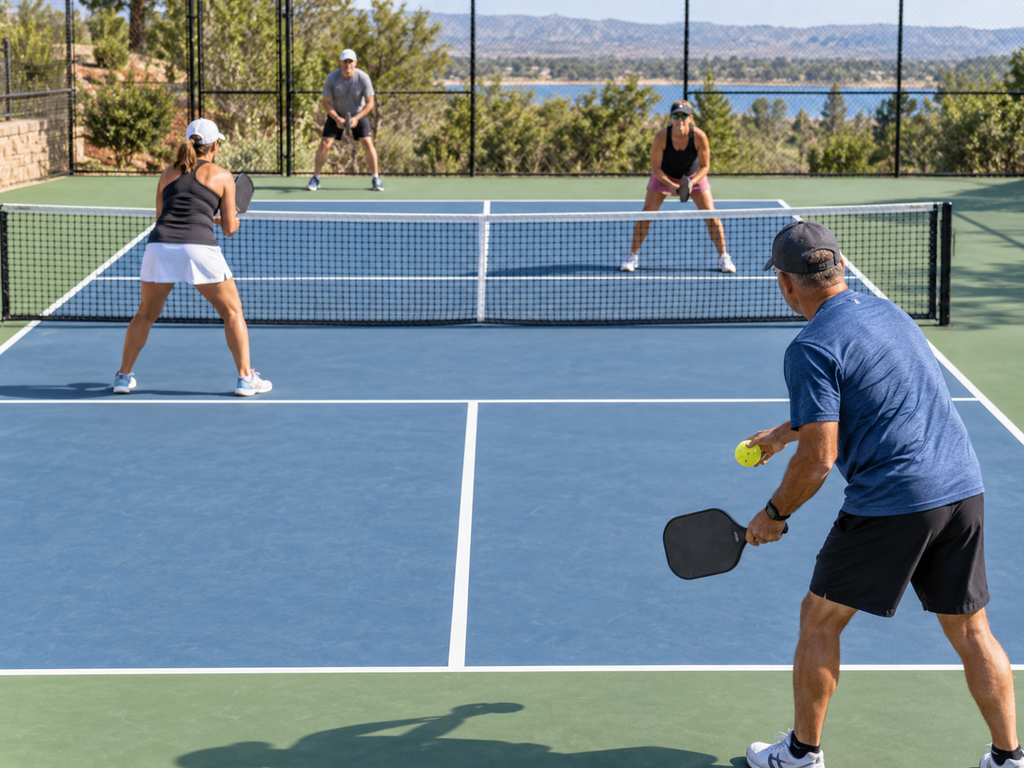
Pickleball doubles positioning is about knowing where you and your partner should stand during different stages of a point.
For beginners, positioning can feel confusing because both players are constantly adjusting based on who is serving, who is returning and where the ball is being played. The good news is that recreational doubles follows a few simple positioning patterns that quickly become familiar once you understand them.
This guide explains the basic court positions used when serving, returning and playing rallies so you can move with your partner and avoid leaving unnecessary gaps.
Why Positioning Matters in Doubles
In doubles pickleball, you are responsible for only half the court—but that does not mean you should simply stand in your half and stay there.
Good positioning helps you:
- Cover open space
- Support your partner
- Reduce easy angles for opponents
- Avoid leaving large gaps between teammates
- Reach more balls comfortably
- Move toward stronger attacking positions together
The key idea is simple:
You and your partner should usually move as a team.
When one player moves forward, sideways or backward, the other player should usually adjust as well.
Basic Starting Position When Serving
When your team is serving, the server must stand behind the baseline in the correct service area.
The server’s partner usually stands behind or near the baseline as well.
This is important because the serving team must allow the return of serve to bounce before hitting the next shot.
Standing too far forward can make it difficult to handle a deep return.
A common beginner setup is:
- Server behind the baseline
- Server’s partner behind or close to the baseline
- Both players prepared to hit the third shot after the return
Once the return bounces and your team plays the next ball, both players can begin working forward when the situation allows.
Where the Server Should Stand
The server must serve from behind the baseline and between the sideline and centerline.
Many recreational players stand a little closer to the center of their service box rather than directly beside the sideline.
This can make it easier to recover toward the middle of the court after serving.
After the serve, the server should remain behind the baseline long enough to prepare for the return.
Do not rush toward the kitchen immediately after serving.
Because the return must bounce before the serving team can hit it, moving too far forward may leave you trying to play the ball at your feet or while moving backward.
Where the Server’s Partner Should Stand
The server’s partner is not required to stand behind the baseline, but recreational players will usually benefit from starting there.
Standing near the baseline keeps both teammates in a similar position and allows them to react to the return together.
If the partner begins too far forward, a deep return can create an awkward situation where one player is near the kitchen while the other remains deep in the court.
For beginners, it is generally easier to start together and move forward together.
Basic Starting Position When Returning Serve
The receiving team usually starts differently.
The returner stands behind the baseline and prepares to receive the serve.
The returner’s partner can usually stand near the non-volley zone line, often called the kitchen line.
This creates an important positional advantage.
Because the serve must bounce before the return is hit, the receiving team knows exactly who must wait for the bounce: the returner.
The returner’s partner does not need to stay back.
A common receiving formation is therefore:
- Returner behind the baseline
- Returner’s partner near the kitchen line
After returning the serve, the returner should usually begin moving forward toward the kitchen.
The goal is for both receiving players to eventually establish themselves near the non-volley zone line.
Where the Returner Should Stand
The returner should usually begin behind the baseline with enough space to handle a deep serve.
Standing directly on the baseline can make deep serves difficult to play comfortably.
A small amount of space behind the line gives you room to step forward into shorter serves while still allowing you to handle balls that land deep.
After hitting the return, begin moving toward the kitchen line.
A deeper return often gives you more time to move forward because your opponents must wait for the ball to travel farther before playing their next shot.
Where the Returner’s Partner Should Stand
The returner’s partner will usually begin near the kitchen line.
From this position, the partner is already prepared for the next phase of the point.
The partner should stay alert and avoid drifting backward unnecessarily.
Once the returner moves forward, the two teammates can establish a strong side-by-side position near the kitchen.
Moving From the Baseline Toward the Kitchen
Many doubles points begin with players at different depths of the court.
Eventually, both teams will often try to establish positions near the kitchen line.
When moving forward, avoid thinking that you must reach the kitchen in one sprint.
Instead, move forward when the ball gives you time.
You may need to:
- Hit a shot.
- Move several steps forward.
- Stop and prepare.
- Hit another shot.
- Continue moving forward.
This controlled progression helps you avoid being caught while running when your opponent hits the ball.
If you are still moving when the opponent makes contact, it becomes harder to change direction and react.
Side-by-Side Positioning During Rallies
Once both partners reach the kitchen line, they will usually play side by side.
This is the basic doubles rally position.
Each player roughly protects half of the court, but the two players should remain connected rather than treating the court as two completely separate areas.
Avoid standing too far apart.
A large gap between partners can become an easy target for opponents.
At the same time, do not stand so close together that both players cover the same space.
A practical goal is to maintain enough distance to cover your side while still protecting the middle.
Protecting the Middle
The middle of the court is one of the most common areas where doubles teams experience confusion.
Both players may assume the other person will take the shot.
The result is often a ball passing directly between them.
Good positioning reduces this problem.
When you and your partner remain reasonably close together, the center becomes easier to cover.
Communication also helps.
Simple calls such as:
- “Mine”
- “Yours”
- “Out”
can reduce hesitation.
The important thing is not to stand so far apart that the middle becomes a large open lane.
Moving Side to Side Together
When the ball moves toward one sideline, both teammates should usually shift in that direction.
Imagine your partnership connected by an invisible rope.
If your partner moves several feet toward the sideline, you should usually shift in the same direction.
This helps protect the strongest angles available to your opponents.
For example, if the ball is played toward your partner’s right side, your partner may move toward the sideline to cover the ball.
You should also shift slightly right.
If you remain completely still, a large gap may appear between you and your partner.
This coordinated movement is sometimes called shading.
You are adjusting your position based on where the ball is located.
Positioning When the Ball Is in Front of Your Partner
If your partner is hitting the ball, your job is not to stand motionless and watch.
You should adjust your position so you are ready for the opponent’s next shot.
If your partner moves toward the sideline, move slightly toward your partner.
If your partner moves forward, stay connected.
If your partner is forced backward, you may need to adjust backward as well.
The goal is to maintain a balanced formation rather than allowing the team to become stretched across the court.
Avoid the Staggered Formation
One common beginner mistake is having one player near the kitchen while the other player remains near the baseline.
This creates a staggered formation.
Sometimes this happens temporarily during a point, but remaining in this position for too long can create problems.
Opponents can hit balls:
- Into the large gap between players
- At the deeper player’s feet
- Behind the forward player
- Through open angles created by the uneven formation
Whenever possible, teammates should work toward being at similar depths on the court.
Think side by side rather than one in front of the other.
What to Do When Your Partner Gets Pulled Wide
Sometimes your partner must move outside or close to the sideline to reach a ball.
When this happens, you should usually move toward the middle.
Your job is to cover some of the space your partner temporarily left open.
Do not remain frozen on your original half of the court.
Once your partner recovers toward their normal position, you can also shift back.
This constant adjustment helps the team maintain balanced court coverage.
What to Do When You Are Pulled Wide
If you are pulled toward the sideline, focus first on reaching the ball and making a controlled shot.
Your partner should shift toward the middle to help cover the open space.
After hitting, recover toward your normal position as soon as the rally allows.
You do not necessarily need to return to an exact spot.
Instead, restore a balanced relationship with your partner.
Positioning When One Player Is Forced Back
Sometimes a lob, deep shot or defensive exchange forces one player away from the kitchen line.
If your partner retreats several steps, staying directly at the kitchen line may create a large gap between you.
Depending on the situation, you may need to move backward slightly to maintain a more connected formation.
The goal is not always to stand in exactly the same horizontal line.
The goal is to avoid becoming so separated that opponents can easily attack the space between you.
Once your team regains control, both players can work forward again.
Keep Your Position Based on the Ball
Your positioning should constantly respond to where the ball is located.
If the ball moves left, your team generally shifts left.
If the ball moves right, your team generally shifts right.
If your team is pushed backward, both players may need to adjust backward.
If your team gains time to move forward, both players should look for opportunities to advance.
Instead of memorizing exact spots on the court, think about maintaining a strong relationship between:
- You
- Your partner
- The ball
That relationship determines where you should stand.
Common Doubles Positioning Mistakes
Standing Too Close to the Baseline After Returning
After returning serve, beginners sometimes remain at the baseline.
This gives the serving team more open court to work with.
When possible, begin moving forward after your return.
Rushing Forward After Serving
The serving team must allow the return to bounce.
Running forward immediately after serving can leave you badly positioned for a deep return.
Stay back until you are prepared to play the third shot.
Leaving a Large Gap Between Partners
Standing too far apart makes the middle easier to attack.
Stay reasonably connected with your partner.
Not Moving When Your Partner Moves
If your partner shifts toward the sideline and you stay still, the court can open up between you.
Move laterally together.
Standing One Up and One Back
A long-lasting staggered formation makes it harder to defend the court as a team.
Try to move toward similar court depth whenever possible.
Running Through the Opponent’s Contact
Moving while your opponent hits the ball makes reaction more difficult.
Whenever possible, stop and establish your balance before the opponent strikes.
A Simple Positioning Pattern to Remember
For recreational doubles, you can simplify positioning into three basic stages.
When Serving
Both players usually begin near or behind the baseline.
Stay back for the return and then work forward when your shots allow.
When Returning
The returner begins behind the baseline.
The returner’s partner begins near the kitchen line.
After returning, the returner moves forward to join the partner.
During Established Rallies
Both players usually try to position themselves side by side near the kitchen line.
From there, move left, right, forward or backward together based on the ball.
Positioning Is About Partnership
Doubles positioning is less about standing on one exact spot and more about maintaining good spacing with your partner.
Your positions will change throughout every rally.
The most important habits are:
- Start in the correct general areas when serving and returning
- Move forward when the situation allows
- Try to establish side-by-side positions
- Shift left and right together
- Protect the middle
- Avoid large gaps between partners
- Adjust when your teammate is pulled out of position
With practice, these movements become automatic.
Instead of constantly thinking about where you should stand, you will begin recognizing how the position of the ball and your partner naturally determines where you need to be.