
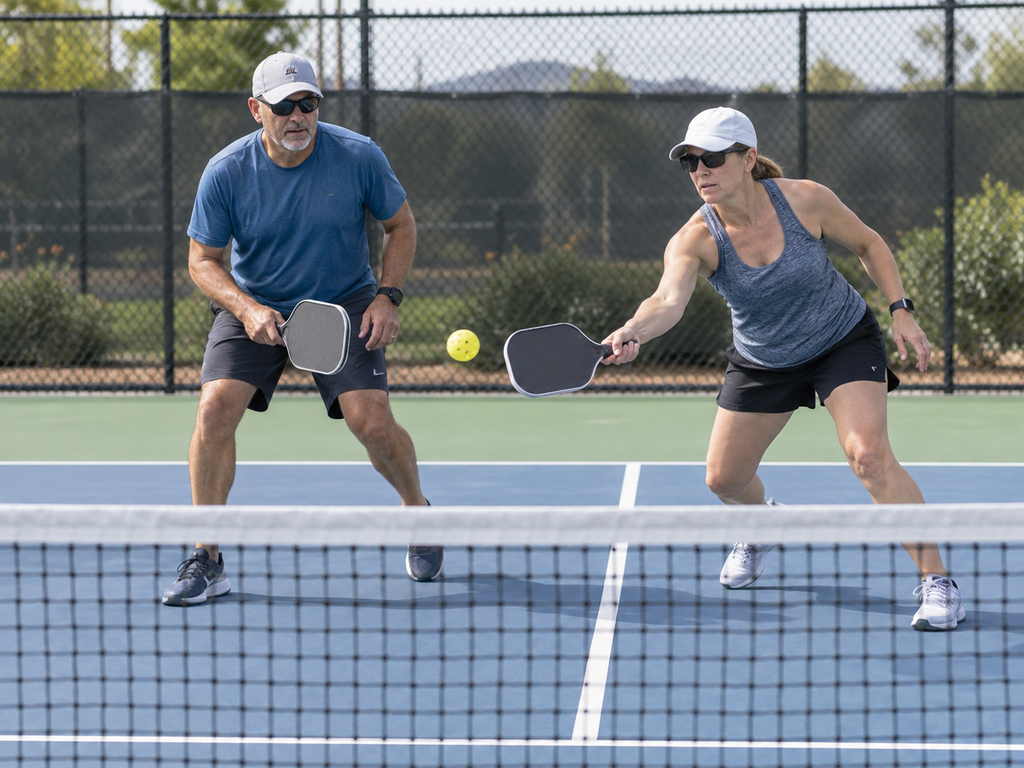
Playing doubles pickleball is not just about where you stand. It is also about how you move in relation to your partner.
Beginners often focus so much on following the ball that they forget about the space between themselves and their teammate. One player moves forward while the other stays back. One chases a wide ball while the other remains in the middle. Before long, a large gap appears and the opposing team has an easy target.
Good doubles teams usually move more like a connected unit.
That does not mean both players must stand in exactly the same position or copy every step. It means they adjust together so that the court stays reasonably covered and neither player becomes isolated.
This article focuses specifically on that idea: moving forward, backward and sideways with your pickleball partner.
Why Partners Should Move Together
A pickleball court is small, but two players still have a lot of space to defend.
When partners become separated, the open areas between them can become easy targets. Opponents may hit through the middle, into an uncovered sideline or into space created when one player moves without the other adjusting.
Moving together helps reduce those openings.
Think of you and your partner as being connected by an invisible rope. If one player moves several feet to the left, the other player normally shifts left as well. If one moves toward the kitchen, the other should usually look for an opportunity to move forward too.
The goal is not perfect symmetry.
The goal is to keep the team connected.
Avoid Becoming Two Separate Players
One of the most common beginner patterns in doubles is for each player to act independently.
The ball goes toward one side of the court, so that player runs after it. The other player stays exactly where they were.
Now the team may be stretched across the court.
Another common situation happens when one player reaches the kitchen while the partner remains near the baseline. The opponents can then hit toward the deeper player or place the ball into the large space between the two teammates.
A stronger approach is to constantly ask:
Where is my partner moving, and how should I adjust with them?
That simple awareness can dramatically improve court coverage.
Moving Sideways Together
Sideways movement happens constantly during rallies.
Imagine both players are near the kitchen line and the ball is hit toward your partner on the left side of the court.
Your partner may need to move farther left to reach the ball.
Instead of remaining completely still, you should usually shift slightly left as well.
Why?
Because your partner’s movement creates additional space toward the middle of the court. By moving with them, you help close that space.
The same principle works in the opposite direction.
If your partner moves right, you usually move right.
This is sometimes described as shifting together or sliding together.
The players remain separate enough to cover their sides of the court, but they move in the same general direction.
Think of Your Team as a Wall
A useful way to visualize doubles positioning is to imagine that you and your partner form a defensive wall.
When the ball moves toward one side of the court, the wall shifts toward that side.
Suppose the ball is near the opponent’s right sideline.
Both you and your partner may shift slightly in that direction because that is where the next shot is most likely to come from.
The player closest to the ball may move more.
The partner moves less.
But both players adjust.
This keeps the space between them manageable instead of creating a large hole in the middle.
How Much Space Should Be Between Partners?
There is no single perfect distance because positioning changes throughout every rally.
However, partners generally want to avoid standing extremely far apart.
If the gap becomes too large, opponents can hit through the middle.
If players stand too close together, they may leave the sidelines exposed or interfere with each other’s shots.
A practical beginner goal is simply to maintain a comfortable, connected distance where both players can still protect their side while helping cover the middle.
Watch your partner using your peripheral vision.
You should usually have a sense of where they are without needing to turn your head and look directly at them.
Moving Forward Together
Forward movement is especially important in doubles pickleball.
Teams usually want to work toward stronger court positions together rather than leaving one player far behind.
For example, after returning serve, the returning player often begins moving forward.
Their partner may already be positioned closer to the kitchen.
The goal is for the returning player to join their partner when it is safe to do so.
Once both players are near the kitchen line, they can defend and attack from a more connected position.
Problems occur when one player moves forward too aggressively while their partner remains far back.
That creates a split formation.
One player is near the kitchen.
The other is near the baseline.
The large gap between them gives opponents several options.
They can hit toward the deeper player, attack the feet of the forward player or place the ball into the open space between them.
Do Not Rush Forward Just to Stay Together
Moving together does not mean blindly following your partner.
Sometimes one player must stay back because they are under pressure.
For example, your partner might receive a deep shot while you have already moved forward.
If they are struggling to control the ball, continuing to stand aggressively at the kitchen may leave your team badly separated.
You may need to recognize the situation and adjust.
Good partner movement is based on what is happening in the rally, not on a rigid rule.
The important idea is that both players should continually work toward becoming connected again.
Moving Backward Together
Beginners sometimes assume that once they reach the kitchen, they should never move backward.
Usually you do want to protect your position near the kitchen line.
But certain situations may force both players to retreat.
A high defensive lob is an obvious example.
If the ball goes over your heads, one or both players may need to move backward.
Another example occurs when the opponents attack aggressively and you need additional time to defend.
If your partner is forced several steps backward, remaining far ahead of them can create a large gap.
You may also need to give some ground so the team stays connected.
The goal is not to retreat unnecessarily.
It is to avoid leaving one player isolated.
Watch Your Partner, Not Just the Ball
Most beginners watch the ball almost exclusively.
That is understandable. You need to know where the ball is.
But doubles positioning requires awareness of three things at the same time:
- the ball
- the opponents
- your partner
You do not need to stare at your partner.
Instead, develop awareness through peripheral vision.
Notice when they move wide.
Notice when they move forward.
Notice when they are forced backward.
Then make a small adjustment yourself.
These small movements often matter more than dramatic sprints across the court.
What Happens When Your Partner Moves Wide?
Sometimes your partner must move far toward the sideline to reach a shot.
When that happens, the middle of the court may become exposed.
Your job is usually to shift slightly toward your partner’s side.
You are not taking over their entire half of the court.
You are simply helping cover the space they had to leave.
After the shot, your partner should try to recover toward a more normal position.
You should also recover with them.
The entire team shifts out and then shifts back.
Recover After Every Shot
Moving with your partner is not only about reacting to the ball.
It is also about recovering after the ball leaves your side.
Suppose your partner moves several feet toward the sideline to hit a wide ball.
After making the shot, they should begin moving back toward their normal position.
You should also adjust.
Do not remain permanently shifted to one side after the reason for moving there has disappeared.
Good doubles movement has a rhythm:
Move. Hit. Recover. Reset.
That cycle happens repeatedly during rallies.
Do Not Chase Your Partner
There is a difference between moving together and following your partner too closely.
If your partner moves left, you do not need to run directly beside them.
That would create a new problem by leaving another part of the court open.
Instead, think of your movement as a smaller version of theirs.
If your partner moves several feet toward the sideline, you may only need to move one or two steps.
You are adjusting the team’s shape, not copying every movement.
Communicate When Necessary
Partner movement becomes easier when teammates communicate.
Simple calls can prevent confusion.
For example:
“Mine.”
“Yours.”
“Switch.”
“Back.”
“Move up.”
Communication is especially useful when unusual situations force players out of their normal positions.
However, strong teams eventually develop movement patterns that require very little talking.
Both players learn to recognize when they should shift.
What If Both Players Go for the Same Ball?
Balls hit through the middle can create confusion.
Both players may move toward the ball at the same time.
That is normal occasionally.
The important part is what happens afterward.
Once one player takes the shot, both players should quickly recover into useful positions.
Do not remain crowded together in the middle.
Similarly, do not overreact by immediately sprinting to opposite sidelines.
Reset your spacing and prepare for the next ball.
Common Beginner Mistake: One Player Chases Everything
Some players naturally try to cover too much court.
They chase balls far onto their partner’s side and continue moving even when their teammate is already in position.
This can make teamwork difficult.
If your partner frequently crosses into your side, communicate clearly about who should cover which areas.
Moving together does not mean one player should control the entire court.
Each player still has responsibilities.
The goal is coordinated coverage.
Common Beginner Mistake: Staying Frozen
The opposite problem is also common.
One player hits the ball while the partner stands completely still.
Then the ball moves to the opposite side and the same thing happens again.
This produces large gaps because the team never adjusts to the location of the rally.
Even small movements can solve this.
A single step sideways may improve your position.
A step forward may help close the distance between you and your partner.
A small retreat may prevent your teammate from becoming isolated.
You do not need to constantly run.
You simply need to keep adjusting.
Common Beginner Mistake: One Up and One Back
One of the clearest signs that partners are not moving together is when one player stays near the kitchen while the other remains deep near the baseline for an extended period.
Sometimes this formation is unavoidable for a few shots.
But the team should normally try to reconnect.
The deeper player may look for an opportunity to move forward.
The forward player may need to become slightly more conservative until the partner catches up.
The goal is eventually to establish a more balanced team position.
Use Small Adjustment Steps
Partner movement should usually be controlled.
Large running steps can make it difficult to stop and react.
Instead, use short adjustment steps whenever possible.
Shuffle sideways.
Move forward in controlled steps.
Recover your balance after moving.
These movements help you stay ready while also keeping proper spacing with your partner.
Practice Moving Without Even Hitting the Ball
You can practice partner movement without playing a full game.
Stand on the same side of the net with your partner.
Imagine the ball moving from left to right.
Shift together.
Move left.
Return toward the middle.
Move right.
Recover again.
Then practice moving forward together and retreating together.
This simple exercise helps both players understand the idea of maintaining connection.
A Simple Rule for Recreational Doubles
When you are unsure what to do, use this basic guideline:
If your partner moves several steps in one direction, consider whether you should move slightly in the same direction.
Do not automatically copy them.
Look at the ball and the available court space.
But avoid standing still while your partner moves far away from you.
Stay Connected, Not Perfectly Aligned
Good doubles partners do not move like robots.
One player may be slightly ahead.
One may be slightly wider.
The exact positions constantly change.
What matters is that the team remains reasonably connected.
When one player moves, the other reacts.
When one player is pulled wide, the other helps cover the middle.
When one moves forward, the other looks for an opportunity to join them.
When one is forced backward, the other recognizes the developing gap.
That awareness makes the court feel much smaller and easier to defend.
Final Takeaway
Moving with your pickleball partner is about maintaining useful spacing throughout a doubles rally.
Instead of treating the court as two completely separate halves, think of you and your partner as one defensive unit.
Move sideways together when the ball shifts across the court. Work forward together when the opportunity allows. Adjust backward when necessary and avoid leaving large spaces between you.
You do not need perfect synchronization.
You simply need to keep noticing where your partner is and make small adjustments that keep the two of you connected.
Once that habit develops, doubles movement becomes more natural and your team becomes much harder to pull apart.