
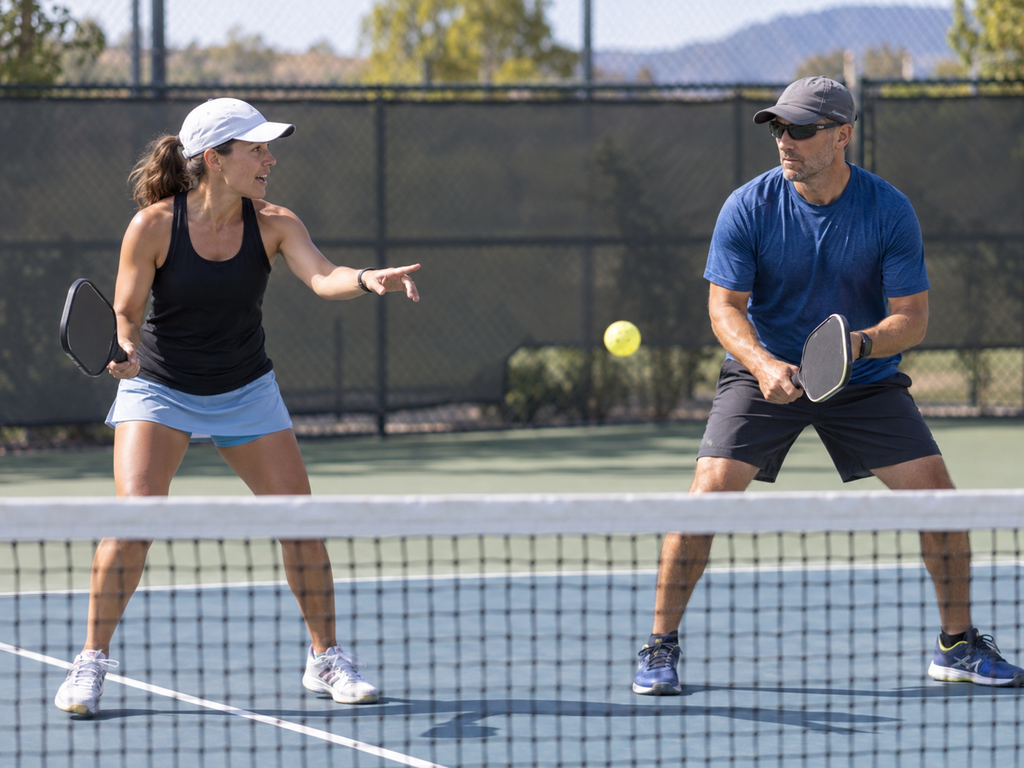
Playing doubles means sharing the court with a partner, and good communication can make that partnership feel much easier. You do not need complicated signals or constant conversation. A few clear words, used at the right time, can prevent hesitation, reduce collisions and help both players make better decisions.
For beginners especially, communication is less about advanced strategy and more about making sure both partners understand who is taking the ball and what is happening during the rally.
Why Communication Matters in Doubles
In doubles, there are many situations where either player could potentially reach the ball. A shot may travel between you and your partner, land near the middle of the court or force both of you to move toward the same area.
Without communication, both players may go for the ball at the same time. In other situations, each player may assume the other person will take it, allowing the ball to pass untouched.
Clear communication helps answer one important question quickly:
Who is playing the ball?
When that answer is clear, both players can move and react with more confidence.
Good communication can help you:
- Avoid running into your partner.
- Prevent both players from swinging at the same ball.
- Reduce hesitation on shots near the middle.
- Help your partner understand when you are taking responsibility.
- Make decisions faster during rallies.
- Recover more smoothly after each shot.
You do not need to talk constantly. The goal is to communicate when uncertainty could affect the point.
Use Short, Clear Calls
During a rally, there is very little time for long instructions. Communication should be simple enough to understand immediately.
Two of the most useful calls are:
“Mine!”
This tells your partner that you intend to play the ball.
“Yours!”
This tells your partner that you believe they should take the ball.
These calls work because they are short, familiar and easy to hear.
The earlier you make the call, the more useful it becomes. Calling “mine” after both players have already started swinging does not solve much. Try to make the decision as soon as you recognize where the ball is going.
Call “Mine” When You Are Taking the Ball
If you clearly intend to play a ball that your partner might also reach, saying “mine” removes uncertainty.
This is especially helpful on balls traveling through the middle of the court.
Imagine a shot coming between two players. Both might initially believe they can reach it. If one player makes an early, confident call of “mine,” the other player can move out of the way and prepare for the next shot.
The call should match your action. If you say “mine,” commit to playing the ball whenever possible.
Repeatedly calling “mine” and then backing away can make communication less trustworthy.
Call “Yours” When Your Partner Is in the Better Position
Sometimes you recognize that your partner has the easier or more natural play on the ball. A quick “yours” can help confirm that decision.
However, be careful about using “yours” too late.
If the ball is already close and your partner has not prepared to hit it, suddenly calling “yours” may create more confusion instead of less.
Whenever possible, the player who intends to take the ball should make the stronger call.
In many beginner situations, “mine” is more reliable than waiting for someone else to say “yours.”
Communicate on Balls Down the Middle
Shots toward the middle are one of the most common causes of confusion in doubles.
A ball traveling directly toward one player is usually easy to identify. A ball traveling between two partners is different because both players may believe it belongs to them.
Middle balls are where simple communication becomes especially valuable.
As soon as one player recognizes that they have the better play, they can call:
“Mine!”
The other player can then avoid reaching into the same space.
Over time, regular partners often develop a better sense of which player normally handles certain middle balls. Even then, communication is still useful when the situation is unclear.
Do Not Fight Over Every Ball
Good doubles communication also means recognizing when your partner is already committed to the shot.
If your partner is clearly moving into position and preparing to swing, you usually do not need to reach across and try to take the ball too.
Two players competing for the same shot can lead to:
- Paddle collisions.
- Players running into each other.
- Poor contact.
- Late swings.
- Open areas of the court after the shot.
Once your partner has clearly committed, allow them space to complete the play unless communication tells you otherwise.
Speak Loud Enough to Be Heard
A communication call only works if your partner can hear it.
You do not need to shout aggressively, but your voice should be clear enough to cut through normal court noise.
Outdoor courts may have wind, traffic, other players or nearby conversations. Indoor courts may have echoes and multiple games happening at once.
Use a firm, simple voice.
“Mine!”
is much easier to understand than a quiet or uncertain:
“I think I have it.”
Confidence in the call helps your partner react quickly.
Make Calls Early
Timing matters almost as much as the words you use.
An early call gives your partner time to react.
A late call may force both players to change direction suddenly.
For example, if a ball is floating toward the center of the court and you know you are going to take it, call “mine” while the ball is still approaching rather than waiting until it reaches your paddle.
Early communication helps both players stay balanced and organized.
Avoid Changing Your Call at the Last Second
One of the most confusing situations occurs when a player calls for a ball and then suddenly gives it up.
For example:
“Mine!”
followed immediately by:
“Yours!”
This can leave both players unsure about what to do.
Sometimes a ball changes direction or a player realizes they cannot reach it, so changing the decision may be unavoidable. But whenever possible, make a clear decision and commit to it.
Consistent calls help build trust between partners.
Communicate Before the Point When Helpful
Not all doubles communication happens during the rally.
A quick conversation before the serve can help both players understand what to expect.
For example, partners may briefly clarify who will handle a ball that comes directly through the middle or who normally takes certain shots.
The discussion does not need to be complicated.
A simple comment such as:
“You take the middle if it comes to your forehand.”
can remove uncertainty before the point begins.
This becomes especially useful when playing with a new partner.
Talk Between Points
Between points is also a good time to clear up confusion.
If both players repeatedly go for the same ball, address it calmly.
You might say:
“I’ll call mine earlier on those middle balls.”
or:
“If you have the better angle, go ahead and take it.”
Small adjustments can prevent the same misunderstanding from happening again.
The goal is not to blame your partner. The goal is to make the next point easier.
Keep Communication Constructive
Doubles communication should help your partner, not add pressure.
Avoid reacting to mistakes with criticism, sarcasm or frustration.
Comments such as:
“You should have taken that.”
or:
“Why didn’t you call it?”
usually do not improve the next point.
Instead, keep communication focused on what both players can do next.
For example:
“Let’s call the middle balls earlier.”
That keeps the conversation useful and team-focused.
Encourage Your Partner
Communication is not only about deciding who hits the ball.
Simple encouragement can also help partners stay relaxed and confident.
Short comments such as:
- “Nice shot.”
- “Good try.”
- “We’re good.”
- “Next one.”
- “Good idea.”
can help maintain a positive atmosphere during the game.
This is especially useful after an error.
Everyone misses shots. A partner who feels supported is more likely to stay focused on the next rally instead of worrying about the previous mistake.
Do Not Overcommunicate During the Rally
Communication is helpful, but too much talking can become distracting.
You do not need to describe every shot or give constant instructions while your partner is preparing to hit.
During active play, keep communication short and necessary.
Calls such as:
“Mine.”
“Yours.”
or another simple agreed-upon word are usually enough.
Save longer conversations for between points.
Be Careful With Unclear Words
Some words can sound similar during fast play, especially on noisy courts.
If you and your partner find that certain calls are confusing, simplify them.
The best communication system is the one both players immediately understand.
For most recreational players, short calls such as “mine” and “yours” work because they are easy to recognize.
Whatever words you use, try to use them consistently.
Communicating With a New Partner
You may not always play with the same person.
When playing with someone new, do not assume they use the same habits or expectations as your usual partner.
Before the game begins, a short conversation can help.
You might simply say:
“Let’s call the middle balls so we don’t both go for them.”
That establishes a basic communication system immediately.
As the game continues, you will usually become more comfortable recognizing which balls each player prefers to take.
Trust Your Partner’s Call
Communication works best when both players respect each other’s decisions.
If your partner clearly calls “mine,” avoid continuing to swing for the same ball unless there is an obvious reason to intervene.
Trust allows each player to act without hesitation.
If both partners ignore each other’s calls, communication quickly becomes meaningless.
The more consistently you respond to your partner’s calls, the easier doubles movement becomes.
Learn From Confusing Points
Miscommunication will still happen.
Two players may both swing.
Both may leave the ball.
Someone may make a late call.
Instead of becoming frustrated, use the situation as information.
Ask yourself:
- Was the call too late?
- Was the call too quiet?
- Did neither player communicate?
- Did both players hesitate?
- Did one player ignore the other person’s call?
Often, the solution is very simple: make the next call earlier and clearer.
Keep the System Simple
Beginners sometimes assume good doubles teams use complicated communication systems. In recreational play, that usually is not necessary.
Start with the basics:
Call “mine” when you are clearly taking the ball.
Use “yours” when it helps your partner recognize that they have the better play.
Speak early enough to give your partner time to react.
Respect your partner’s call.
Discuss repeated confusion between points.
That simple system can prevent many of the most common communication problems in doubles.
Communication in Doubles
Good doubles communication does not require constant talking. It requires clear decisions at the moments when both players might otherwise hesitate.
A simple “mine” or “yours” can prevent two players from chasing the same ball or watching a playable shot pass between them. Early calls, consistent language and respectful communication also make it easier for partners to trust each other and stay focused on the next shot.
Keep the calls short, make them early and use them consistently. As you and your partner become more comfortable playing together, many decisions will begin to feel more natural, but clear communication will still remain one of the simplest ways to keep both players working together on the court.