
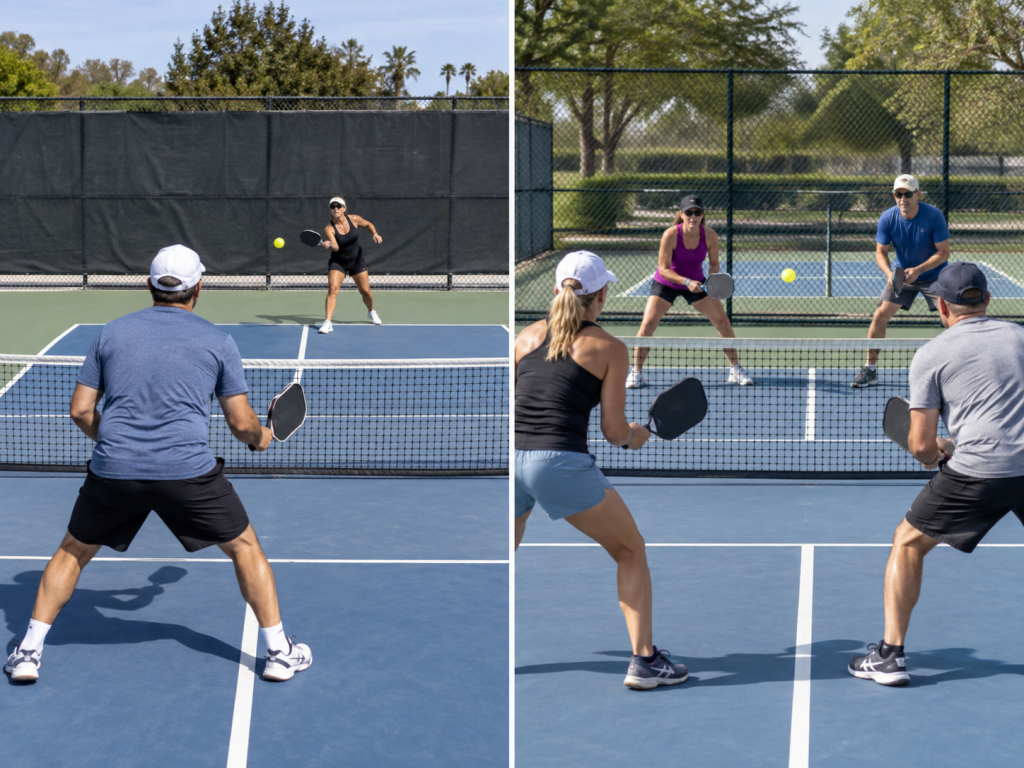
Pickleball can be played as singles, with one player on each side of the court, or doubles, with two players on each side. The court dimensions stay the same, but the way you cover the court, serve and position yourself changes significantly.
For beginners, this difference can make singles and doubles feel like two versions of the same sport. The basic rules and equipment remain familiar, but your responsibilities on the court are different.
In doubles, you share the court with a partner. In singles, every ball on your side is your responsibility. That simple difference affects where you stand, how much you move and what kinds of shots you are likely to play.
Understanding these changes helps you adjust more quickly when switching between singles and doubles.
The Biggest Difference: How Much Court You Must Cover
The most obvious difference between singles and doubles is court coverage.
In doubles, two players divide responsibility for the court. Each player generally protects a portion of the available space while also moving with their partner as the rally develops.
In singles, one player must cover the entire court.
That means singles usually requires more running, more recovery movement and greater awareness of open space.
A ball that would normally be your partner’s responsibility in doubles is now yours.
You may need to move:
- From sideline to sideline
- From the baseline toward the kitchen
- Backward to defend a deep shot
- Forward again after hitting from the backcourt
Because there is more open space in singles, placement becomes especially important. A shot does not always need to be extremely powerful to be effective. Simply directing the ball away from your opponent can force them to cover a large distance.
Court Coverage in Doubles
In doubles, court coverage is shared.
Instead of one player trying to protect the entire width of the court, partners usually work together to reduce the amount of open space available to their opponents.
When both players are positioned well, the court can feel much smaller.
For example, once both partners reach the kitchen line, they may each be responsible for roughly one side of the court while still helping protect the middle.
The exact responsibility depends on where the ball is coming from, but both players normally adjust together rather than standing completely independently.
This shared coverage means doubles players often make shorter movements than singles players.
However, positioning becomes more dependent on teamwork.
If one player moves and the other does not adjust, a large gap may appear.
Court Coverage in Singles
Singles requires a different mindset.
Because there is no partner protecting the other half of the court, you must constantly think about where your opponent can send the next ball.
You usually want to recover toward a position that gives you the best chance of reaching shots on either side.
That does not always mean standing exactly in the middle of the court.
Your recovery position often depends on:
- Where you hit your previous shot
- Where your opponent is positioned
- Whether you are near the baseline or kitchen
- The angle your opponent has available
For example, if you hit the ball deep into your opponent’s right corner, you may shift slightly toward that side because your opponent’s possible angles are different from those available from the middle of the court.
The goal is to avoid leaving large areas completely unprotected.
Serving in Singles
Singles serving follows the same basic diagonal service pattern used in doubles, but there is only one server on each side.
You serve from the right service court when your score is even and from the left service court when your score is odd.
This makes your score directly connected to your serving position.
For example:
- A score of 0 means you serve from the right.
- A score of 1 means you serve from the left.
- A score of 2 means you serve from the right again.
Because there is only one player per side, there is no need to keep track of a first server and second server.
That makes the serving sequence simpler in singles.
However, where you serve can have a bigger impact because your opponent must cover the entire court after returning.
Serving in Doubles
Doubles serving requires additional awareness because both partners may have an opportunity to serve before the opposing team gains possession of the serve.
Players must also maintain the correct serving positions based on the team’s score and the rotation that has occurred during the game.
The server still serves diagonally into the opposite service court, but the presence of four players makes positioning more important.
The serving team usually begins with both players farther back because the serve must bounce before it can be returned and the return must also bounce before the serving team can play it.
After those required bounces, the players begin working toward stronger court positions.
Positioning After the Serve in Singles
Singles positioning after the serve often involves balancing aggression with court coverage.
After serving, you must be prepared for the return while also protecting the entire width of your side.
Because the return must bounce before you hit it, you normally remain behind or near the baseline until the return lands.
After playing your next shot, you may begin moving forward if the situation allows.
The challenge is that moving forward can leave space behind you while staying back can allow your opponent to control more of the court.
Your positioning therefore depends heavily on the quality of your shot.
A deep shot may give you time to move forward.
A weak or short shot may force you to stay defensive.
Positioning After the Serve in Doubles
In doubles, the serving team’s positioning is affected by the two-bounce rule in much the same way, but the responsibilities are shared.
The server and their partner usually stay back initially because the return must bounce before the serving team can hit it.
After that bounce, both players may begin moving toward the kitchen line when appropriate.
The important difference is that partners usually try to advance together.
If one player reaches the kitchen while the other stays near the baseline, the team can become stretched apart.
That creates open spaces opponents can attack.
Positioning When Returning Serve in Singles
The returner in singles generally wants to give themselves enough room to handle a deep serve.
Starting too close to the baseline can make it difficult to respond comfortably if the serve lands near the back of the service court.
After returning, the returner can often begin moving forward because the serving player must allow the return to bounce.
A deep return can make this easier by keeping the server farther away from the kitchen.
However, because singles involves more open space, the returner must remain aware of passing shots to either side.
Moving forward aggressively without being properly balanced can leave large areas exposed.
Positioning When Returning Serve in Doubles
In doubles, the returner’s partner usually begins near the kitchen line while the returner waits deeper for the serve.
After hitting the return, the returner often moves forward to join their partner.
This creates one of the common positional patterns in doubles: the returning team may reach the kitchen before the serving team.
Once both returning players are established near the kitchen line, they can cover the front of the court together.
The returning player’s main positioning goal is therefore not only to hit the return but also to transition forward into a coordinated position with their partner.
The Kitchen Line in Singles
The kitchen line remains important in singles, but positioning there feels different because one player must protect the full court.
Standing near the kitchen can allow you to:
- Take time away from your opponent
- Reach shorter shots more easily
- Apply pressure with volleys
- Control more of the front court
However, the sidelines are farther away when you are alone.
A well-placed passing shot can force you to move quickly from one side to the other.
Because of this, singles players often need to think carefully about their balance and recovery after every shot.
The Kitchen Line in Doubles
In doubles, the kitchen line is often one of the strongest positions because two players can cover most of the front court together.
When both partners are positioned near the kitchen, each player has less space to protect than a singles player would.
The middle of the court is shared, while each player also protects their outside sideline.
Small movements can help the team respond to changing ball angles.
Because the court is covered by two people, opponents have fewer obvious open spaces.
This is why coordinated positioning is especially important in doubles.
The Middle of the Court Changes Meaning
The middle of the court has different importance in singles and doubles.
In singles, the middle is often valuable as a recovery area because it can help you reach balls hit toward either sideline.
However, you may not always recover to the exact center. Your best position depends on where the ball and your opponent are located.
In doubles, the middle is shared between two players.
This creates a different challenge.
Instead of asking, “Can I reach the middle?” players often need to know, “Who is responsible for this ball?”
Without clear positioning and awareness, both partners may move toward the same ball or both may expect the other person to take it.
Sidelines Are More Important in Singles
Singles creates more opportunities to use the sidelines because there is only one defender.
If your opponent is positioned toward one side, the opposite side may be open.
Wide serves and angled shots can pull the opponent away from the center and create additional space.
This does not mean every shot should be aimed aggressively toward the sidelines.
Trying to hit extremely precise lines can also cause unnecessary errors.
The important difference is that open court appears more often in singles.
Sidelines Are More Protected in Doubles
In doubles, each sideline is normally protected by one player.
That makes extreme angles and passing shots more difficult because there are two defenders covering the court.
A shot that would easily pass a singles opponent may go directly toward the second player in doubles.
As a result, doubles players often focus more on maintaining strong positions and creating smaller openings rather than simply hitting into a large empty area.
Singles Requires More Recovery Movement
After almost every shot in singles, you should think about where you need to move next.
Hitting the ball is only part of the point.
If you hit a strong shot but remain far away from a useful recovery position, your opponent may simply place the next ball into the open court.
Good singles movement often follows a simple pattern:
Hit the ball, recover and prepare again.
This cycle continues throughout the rally.
Doubles Requires More Coordinated Movement
In doubles, recovery is still important, but it involves your partner.
Both players should pay attention to how the team’s overall court coverage changes.
If your partner moves toward the sideline to play a ball, you may need to shift slightly toward the middle.
If your partner moves forward, you may eventually need to move forward as well.
The goal is to avoid creating unnecessary gaps between teammates.
Singles Often Has More Open Space
With only two players on the court, singles naturally contains more unprotected space.
This can create longer running patterns and more opportunities to move an opponent around.
You may see more shots directed:
- Deep into corners
- Toward open sidelines
- Behind a player who has moved forward
- Away from the opponent’s current position
Court awareness becomes extremely important because every movement can create a new opening.
Doubles Has Less Open Space
With four players on the same court, there are fewer large areas available.
Opponents may be able to cover shots that would be clear winners in singles.
This is especially true when both players are positioned well near the kitchen line.
Because there is less empty court, small positional mistakes become important.
A narrow gap between partners or a player standing slightly too far from the sideline can become the available target.
Switching From Doubles to Singles
Players who mainly play doubles often notice immediately how demanding singles court coverage feels.
You may instinctively expect someone else to cover certain balls.
There is no partner to do that.
You also need to recover more aggressively after each shot because leaving one side of the court open can be costly.
Another adjustment involves shot selection.
A ball hit safely toward the middle in doubles may not create much pressure.
In singles, moving the opponent toward one side and then using the open court can be more effective.
Switching From Singles to Doubles
Players moving from singles to doubles often need to adjust in the opposite direction.
You no longer need to chase every ball.
Trying to cover your partner’s entire side can actually hurt your team’s positioning because it may leave your own area open.
You also need to become more aware of where your partner is standing.
Instead of positioning yourself only in relation to the ball and opponent, you are also positioning yourself relative to your teammate.
That is one of the biggest mental adjustments between the two formats.
Singles and Doubles Use the Same Court Differently
The physical court does not change between singles and doubles.
The baseline, sidelines, kitchen and service courts remain in the same places.
What changes is how much of that space each player must protect.
In singles, one player covers an entire side.
In doubles, two players divide and share that responsibility.
This affects almost every positional decision during a point.
A Simple Way to Remember the Difference
Think of singles as individual court coverage and doubles as shared court coverage.
In singles, ask yourself:
“Where is the open space, and how do I recover so I can protect as much of the court as possible?”
In doubles, ask:
“Where is my partner, and are we covering the court together?”
Those two questions capture much of the positional difference between the formats.
Final Thoughts
Singles and doubles pickleball use the same basic court and many of the same rules, but they require different approaches to court coverage, serving and positioning.
Singles places the entire side of the court under one player’s responsibility. You must move farther, recover after each shot and constantly protect open space.
Doubles divides that responsibility between two teammates. Movement becomes more coordinated, court coverage becomes tighter and positioning depends on where your partner is standing as well as where the ball is going.
Learning these differences makes it easier to switch between formats without treating singles as simply doubles without a partner—or doubles as singles with someone standing beside you.