
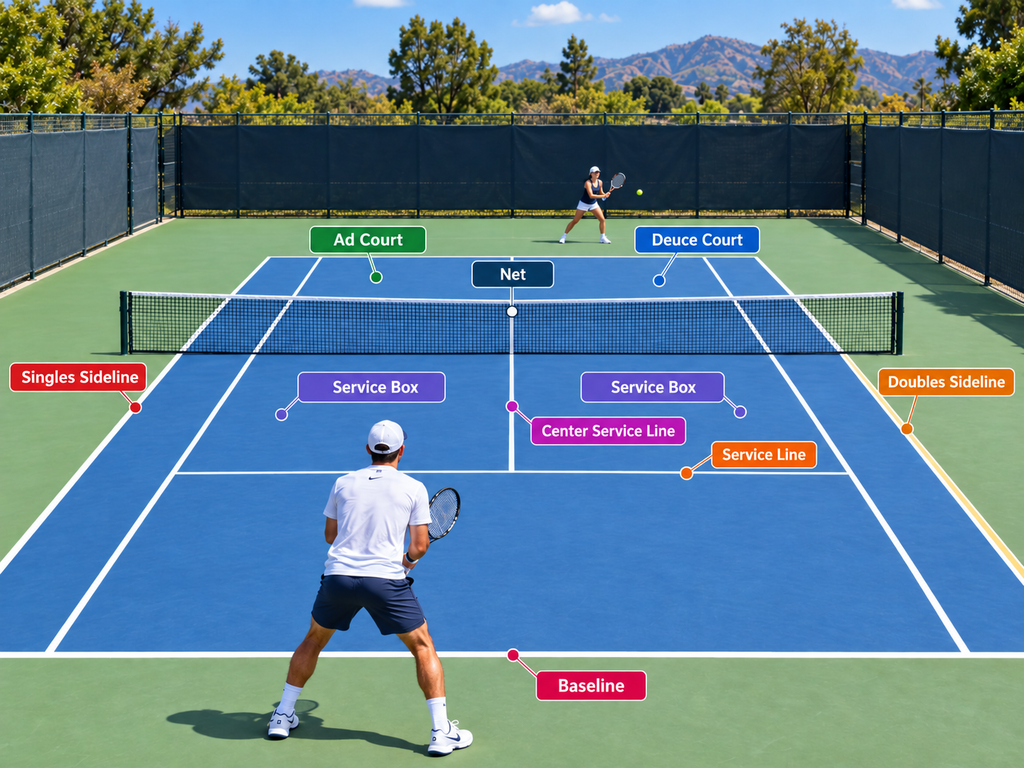
Before you begin learning serves, groundstrokes, volleys, or match play, it helps to understand the parts of a tennis court – the space you are playing on. A tennis court contains several lines and areas, and each one has a specific purpose.
At first, all those markings can look complicated. Fortunately, the basic layout is easy to understand once you know what each line represents.
In this guide, you will learn the baselines, singles and doubles sidelines, service lines, service boxes, center markings, net, doubles alleys, and other court areas you will use throughout your beginner tennis journey.
The Basic Layout of a Tennis Court
A full-size tennis court is a rectangle divided into two equal halves by a net.
The standard court is:
- 78 feet (23.77 m) long
- 27 feet (8.23 m) wide for singles
- 36 feet (10.97 m) wide for doubles
The extra width used for doubles comes from the two narrow strips running along the sides of the singles court.
The dimensions are standardized under the official Rules of Tennis.
Although tennis courts can have different surfaces, such as hard court, clay, or grass, the main markings and dimensions of a standard full-size court remain the same.
Now let’s look at each part individually.
The Baseline
The baseline is the line running across the back of each end of the tennis court.
There is one baseline on each side of the net.
Because the court is 78 feet long, each baseline is 39 feet from the center of the net.
The baseline forms the back boundary of the court. Many tennis rallies are played from around this area, which is why beginners will hear the word “baseline” frequently during lessons and matches.
The baseline is also important when serving because the server begins from behind it.
For now, the easiest way to remember it is:
The baseline is the back line of the tennis court.
When you are standing at one end of the court and facing the net, the baseline is the horizontal line immediately in front of or beneath you near the back of the playing area.
The Center Mark
Look at the middle of each baseline and you will see a short line extending slightly into the court.
This is the center mark.
The center mark divides the baseline into a left half and a right half.
Under the official court specifications, the center mark is 4 inches (10 cm) long.
Although it is one of the smallest markings on the court, it is an important reference point. Players use it to identify the two sides of the baseline and to orient themselves correctly on the court.
A useful beginner distinction is that the center mark is located on the baseline, while the longer center service line is located farther forward between the two service boxes. They are not the same line.
The Sidelines
The long lines running from one end of the court to the other are called the sidelines.
Tennis courts actually have two different sets of sidelines:
Singles sidelines and doubles sidelines.
Which boundary applies depends on whether you are playing singles or doubles.
Singles Sidelines
The singles sidelines are the inner pair of long lines.
They form the left and right boundaries of the court during singles play.
The distance from one singles sideline to the other is 27 feet (8.23 m).
When you look at a full tennis court, do not automatically assume the outermost lines are always the playing boundaries. In a singles match, the narrower inside sidelines define the usable width of the court.
That is one of the most important court markings for a new player to recognize.
Doubles Sidelines
The doubles sidelines are the outermost long lines on each side of the court.
When doubles is played, these outer lines become the side boundaries, increasing the court width from 27 feet to 36 feet (10.97 m).
The court itself does not physically change between singles and doubles. Instead, players use different sideline markings.
Think of it this way:
Singles uses the inner sidelines. Doubles uses the outer sidelines.
Once you remember that distinction, the collection of lines along the sides of the court becomes much easier to understand.
The Doubles Alleys
The narrow strip between each singles sideline and doubles sideline is commonly called the doubles alley or tramline.
Each alley is 4 feet 6 inches (1.37 m) wide.
There is one doubles alley on the left side of the court and another on the right.
These areas account for the additional width of a doubles court.
During singles, the doubles alleys are outside the singles playing boundary. During doubles, they become part of the court.
This is why learning the difference between the singles and doubles sidelines is so important. The same physical court can have a different usable width depending on the format being played.
The Net
The net stretches across the entire middle of the court and separates the two sides.
It divides the 78-foot court into two equal 39-foot halves.
The net is supported by posts and is slightly lower in the center than at the sides. The official height is 3 feet (0.914 m) at the center and 3 feet 6 inches (1.07 m) at the posts.
You may notice a strap running over the middle of the net. This helps hold the center of the net at the correct height.
The net is more than simply a divider. It is the central reference point for several other court markings. For example, the service lines are measured from the net, and the service boxes sit directly alongside it.
When identifying areas of the court, it is often easiest to begin with the net and work outward.
The Service Lines
On each side of the net is another line running parallel to the net.
This is the service line.
Each service line is positioned 21 feet (6.40 m) from the net.
Do not confuse the service line with the baseline.
The baseline is at the very back of the court. The service line is much closer to the net.
The service line forms the back edge of the service boxes.
Because there is one service line on each half of the court, the markings appear symmetrically on both sides of the net.
The Center Service Line
Running from the middle of the service line toward the net is the center service line.
It divides the service area into two equal sections.
There is a center service line on both sides of the net.
Together with the service line, singles sidelines, and net, the center service line creates the rectangular areas known as the service boxes.
Beginners sometimes confuse the center service line with the center mark on the baseline.
Remember:
Center mark: small marking on the baseline.
Center service line: longer line dividing the service boxes.
Knowing the difference will make court diagrams and tennis instructions much easier to follow.
The Service Boxes
There are four service boxes on a tennis court—two on each side of the net.
Each half of the court contains a left service box and a right service box.
A service box is bordered by:
- the net
- the service line
- the center service line
- the singles sideline
One important detail is that the service boxes use the singles sidelines even during doubles play. The doubles alleys do not become part of the service boxes.
This means the service area remains the same width whether you are playing singles or doubles.
The service boxes are among the most visually distinctive areas of a tennis court because the service line and center service line divide the front portion of each side into two clear rectangles.
The Deuce Court and Ad Court
You may also hear players and coaches refer to the deuce court and ad court.
These terms describe the two sides of each player’s half of the court.
From a player’s perspective while facing the net:
- the deuce court is the right side
- the ad court is the left side
The center mark and center service line provide useful visual references separating these two sides. The terms are especially common when describing locations on the court.
For a beginner learning court anatomy, the main thing to remember is simply that “deuce side” means the right side and “ad side” means the left side from the perspective of the player facing the net.
The Area Between the Baseline and Service Line
The large section between the baseline and the service line does not have additional official boundary markings inside it.
This is the deeper part of each side of the court.
You may hear this general area described as the backcourt, particularly when discussing where a player is positioned. USTA terminology describes the backcourt as the area around the baseline.
Visually, it is easy to recognize because it is the large open rectangle behind the service boxes.
For beginners, understanding this area helps make phrases such as “move toward the baseline” or “stay deeper in the court” easier to visualize.
The Area Near the Net
The portion of the court between the service line and net is the front area of the court.
Unlike the baseline, service line, or sidelines, terms such as “net area” describe a general location rather than a separate official boundary.
The two service boxes occupy most of this space.
As you progress through beginner tennis lessons, you will frequently hear court positions described relative to the net, service line, and baseline. Knowing these three landmarks gives you an easy mental map of how far forward or backward you are standing.
Understanding the Court Lines
Tennis lines are not merely visual guides. They define the boundaries of different areas of the court.
A useful principle for beginners is that the lines themselves are part of the area they define. A ball touching the applicable boundary line is considered to have landed on that boundary rather than beyond it. The ITF describes balls landing on or inside the relevant court lines as in.
The official specifications also require court measurements to be taken to the outside edge of the lines.
You do not need to memorize line widths and construction measurements to begin playing. What matters most is being able to identify which line is which.
How the Main Court Parts Fit Together
When looking at the entire court, start with the largest landmarks.
The net divides the court into two halves.
At the far end of each half is the baseline.
Running lengthwise along the court are the singles sidelines, with the doubles sidelines farther outside them.
The spaces between those two sets of sidelines are the doubles alleys.
Moving inward from the baseline toward the net, you reach the service line.
Between the service line and net, the center service line divides the area into two service boxes.
Finally, the small center mark divides each baseline into left and right sides.
Once you understand that structure, the court stops looking like a collection of unrelated lines and starts looking like a simple set of connected areas.
Tennis Court Dimensions at a Glance
For a standard full-size tennis court:
Court length: 78 feet (23.77 m)
Singles width: 27 feet (8.23 m)
Doubles width: 36 feet (10.97 m)
Width of each doubles alley: 4 feet 6 inches (1.37 m)
Distance from net to service line: 21 feet (6.40 m)
Net height at center: 3 feet (0.914 m)
Net height at posts: 3 feet 6 inches (1.07 m)
These dimensions follow the official full-size court specifications.
You do not need to memorize every measurement before playing. For most beginners, recognizing the names and locations of the markings is far more useful.
A Simple Way to Remember the Court
If you are standing behind one baseline and looking toward the opposite end, visualize the court in layers.
You begin at the baseline.
Move forward through the large back portion of the court until you reach the service line.
Beyond that are the two service boxes, divided by the center service line.
Continue forward and you reach the net.
The same layout is mirrored on the opponent’s side.
Along the entire length of the court, the singles sidelines form the narrower boundary. Outside them sit the doubles alleys, followed by the outer doubles sidelines.
That simple mental picture is enough to orient yourself almost anywhere on a tennis court.
Final Thoughts
Learning the parts of a tennis court is one of the first steps toward becoming comfortable on it.
You do not need to memorize every measurement immediately. Start by being able to identify the baseline, center mark, singles sidelines, doubles sidelines, doubles alleys, service lines, center service line, service boxes, and net.
Once those landmarks become familiar, instructions involving court position become much easier to understand.
Soon, instead of seeing a rectangle covered with unfamiliar lines, you will see a clear map of the court—and know exactly where each part is and what it represents.