
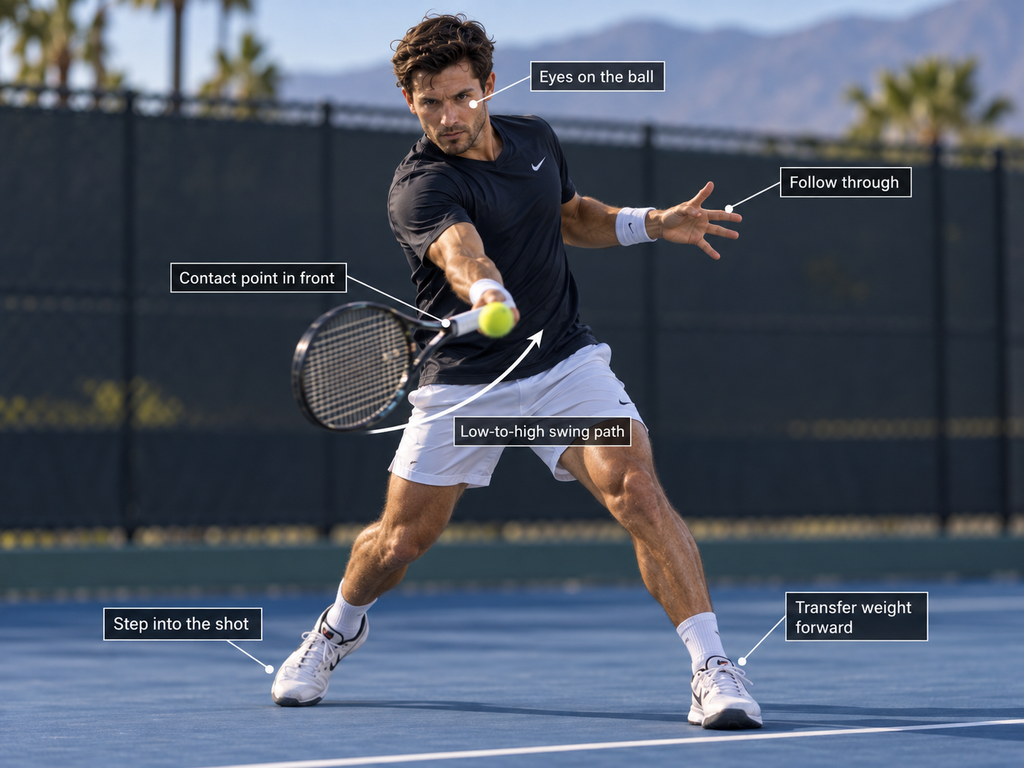
A reliable forehand is one of the most useful shots a beginner can develop in tennis. It is commonly used when the ball comes to the dominant side of your body and gives you a practical way to return shots, extend rallies and direct the ball back across the net with control.
For beginners, the goal is not to hit the forehand as hard as possible. The goal is to build a simple, repeatable motion that helps you prepare early, meet the ball in a comfortable position and finish the swing without losing balance.
A controlled forehand can be broken into three main parts: preparation, contact and finish. Learning how these parts connect gives you a dependable starting point for rallying.
What Is a Tennis Forehand?
A forehand is a groundstroke normally played on the same side of the body as the hand holding the racket.
For a right-handed player, most forehands are played on the right side. For a left-handed player, they are usually played on the left.
The ball generally bounces before you hit a forehand groundstroke. You prepare as the ball approaches, swing forward to make contact and continue the racket through a natural follow-through.
The entire movement should feel connected rather than like three separate actions.
Start From a Ready Position
A good forehand begins before you swing.
Between shots, face generally toward the opponent with your knees slightly bent and your weight balanced over the balls of your feet. Hold the racket comfortably in front of your body so you can react in either direction.
Avoid standing completely upright or allowing the racket to hang loosely by your side.
The ready position should make it easy to recognize where the incoming ball is going and begin preparing immediately.
Recognize the Forehand Early
As soon as you see that the ball is coming toward your forehand side, begin preparing.
One of the most common beginner problems is waiting until the ball is already close before moving the racket. Late preparation often forces you to rush the swing or make contact too close to your body.
Instead, start turning as soon as you recognize the direction of the ball.
Early preparation gives you more time to move into position and makes the actual swing much simpler.
Turn Your Shoulders
Begin the forehand by turning your upper body toward the side where you will hit the ball.
For a right-handed player, this normally means turning the shoulders toward the right. A left-handed player turns toward the left.
This shoulder turn brings the racket back naturally.
You do not need an exaggerated backswing. Beginners usually benefit from keeping the preparation compact and controlled.
Think of turning your body rather than pulling the racket far behind you with your arm.
Keep the Racket Preparation Simple
As you turn, allow the racket to move back with you.
The racket should be prepared early enough that you are not still taking it backward when the ball reaches you.
Avoid making a large loop simply because you have seen advanced players use one. Professional forehands can involve more complicated racket paths because those players have exceptional timing and experience.
A beginner needs a motion that can be repeated consistently.
A compact preparation makes it easier to time the incoming ball.
Move Into Position
Preparing the racket correctly will not help much if you are too far away from the ball.
Use your feet to create enough space between your body and the incoming ball.
You want to reach the ball comfortably without stretching excessively and without having the ball crowd your body.
Small adjustment steps can be especially helpful as the ball gets closer.
Instead of planting your feet too early, continue making small positioning adjustments until you are ready to swing.
Create Comfortable Spacing
Spacing is one of the most important parts of a controlled forehand.
If you are too close to the ball, your arm may become cramped and the racket may have difficulty moving freely.
If you are too far away, you may have to reach for the ball and lose control.
Try to position yourself so your hitting arm has room to move naturally through the shot.
The exact distance varies between players, but the feeling should be comfortable rather than stretched or crowded.
Let the Ball Come Into Your Hitting Zone
You do not need to attack every ball immediately after the bounce.
For a basic beginner forehand, allow the ball to rise into a comfortable hitting area whenever possible.
A ball that is approximately between knee and waist height is often easier for a beginner to control than one that is extremely low or high.
Watch the ball after it bounces and judge where it will enter your comfortable contact zone.
Good forehand timing comes partly from learning where you prefer to meet the ball.
Begin the Forward Swing
Once you are prepared and properly positioned, start moving the racket forward toward the ball.
The swing should be smooth rather than sudden.
Your body can begin rotating back toward the net as the racket moves forward.
Do not think of the forehand as an arm-only movement. Your shoulders and torso help support the swing while your arm guides the racket toward the ball.
For a beginner, smooth acceleration is more useful than trying to generate maximum racket speed.
Make Contact in Front of Your Body
A basic forehand is normally easier to control when contact occurs slightly in front of your body rather than beside or behind you.
For a right-handed player, this means meeting the ball in front of the right side of the body. The same principle applies on the left side for a left-handed player.
Contacting the ball too late can make the racket feel trapped behind you.
Contacting too far in front can cause you to reach and lose stability.
Your goal is to find a comfortable contact point where your arm can extend naturally while you remain balanced.
Watch the Ball Into Contact
Keep your attention on the ball as it approaches your racket.
Beginners often look toward their intended target before they have actually struck the ball. This can cause the head and upper body to move too early and make clean contact more difficult.
Try to keep your eyes focused around the contact area as the racket meets the ball.
You will not literally see every detail of the impact, but maintaining visual attention on the ball can help improve timing and consistency.
Keep the Racket Face Controlled
The angle of the racket face at contact has a major effect on where the ball travels.
If the racket face is opened too far upward, the ball may float or travel long.
If it is closed excessively downward, the ball may go into the net.
For a basic controlled forehand, aim for a stable racket face around contact rather than intentionally changing the angle at the last second.
Avoid flicking or twisting the wrist in an attempt to steer the ball.
A consistent racket face combined with a smooth swing gives you a better chance of producing a predictable shot.
Swing Through the Ball
Do not stop the racket immediately when it touches the ball.
Continue swinging forward through the contact area.
The racket should move along its natural path after impact instead of abruptly slowing down.
Thinking about swinging through the ball can help prevent hesitant contact.
You still do not need to swing hard. A smooth continuation of the racket is enough.
Guide the Forehand Forward and Upward
A beginner forehand usually benefits from a swing that travels forward while also rising naturally.
The forward movement helps send the ball across the court while the upward component helps provide net clearance and supports a controlled trajectory.
Avoid trying to lift the ball by suddenly scooping underneath it.
The upward motion should be part of the overall swing.
Imagine the racket continuing forward and gradually rising as you complete the shot.
Finish the Swing Naturally
After contact, allow the racket to continue across and upward rather than forcing it to stop.
For many beginner forehands, the racket finishes somewhere around shoulder level or across the upper part of the body.
The exact finishing position can vary depending on the height of the ball, the direction of the shot and the individual player.
What matters most is that the finish happens naturally because the racket continued through the ball.
A comfortable follow-through is usually a sign that you did not interrupt the swing at contact.
Stay Balanced Through the Finish
A controlled forehand should not leave you falling sideways or stumbling forward.
As you finish, try to remain balanced enough that you could prepare for another shot.
You may naturally transfer some weight as you swing, but control is more important than forcing a dramatic weight shift.
If you repeatedly lose balance after hitting, you may be swinging too aggressively or contacting the ball from a poor position.
A useful beginner test is simple: after your follow-through, can you comfortably recover for the next ball?
If you can, your movement is probably under reasonable control.
Do Not Force the Follow-Through
The follow-through is the result of a good swing rather than something you need to manufacture.
Trying to force the racket into a particular finishing pose can make the motion stiff.
Instead, concentrate on preparation, spacing, contact and swinging through the ball.
If those parts are working correctly, the racket should naturally continue into a balanced finish.
Use a Comfortable Swing Speed
Beginners often assume that improving a forehand means swinging faster.
That usually makes learning more difficult.
Start with a speed that allows you to control the racket throughout the entire motion.
You should feel that you can repeat approximately the same swing several times without losing your balance or timing.
Once the movement becomes more dependable, racket speed can gradually increase.
Consistency should come before power.
Aim for Comfortable Net Clearance
When learning to rally, you do not need to hit close to the top of the net.
Giving the ball some comfortable clearance reduces the margin for error.
The objective is to send a controlled ball over the net and into the court rather than trying to produce an aggressive winner.
A slightly higher, controlled shot often gives beginners more time to recover and prepare for the next forehand.
This makes it easier to develop longer rallies.
Keep Your First Forehand Target Simple
Instead of aiming for small areas near the lines, give yourself a large target.
The middle portion of the court is an excellent place to begin.
Aiming toward a larger area lets you concentrate on the quality of your movement instead of worrying about precise placement.
Your first goal should be producing repeatable contact and keeping the ball in play.
Precision can develop later as the forehand becomes more dependable.
Common Preparation Mistakes
Several forehand problems begin before the forward swing even starts.
Preparing late is one of the most common. When you wait too long to turn, everything else must happen quickly.
Another mistake is taking the racket too far back. A very large backswing gives beginners more movement to coordinate and can make timing harder.
Some players also stop moving their feet once they recognize a forehand. They prepare the racket correctly but fail to create enough space around the ball.
A simple preparation should involve three things happening early: recognize the forehand, turn your body and move into position.
Common Contact Mistakes
Poor contact often comes from spacing or timing problems.
Contacting the ball too close to the body can make the swing cramped.
Allowing the ball to travel too far behind you can make it difficult to direct the shot forward.
Reaching excessively for the ball can also reduce control.
Another common mistake is trying to change the racket face at the final moment.
Instead of manipulating the racket during contact, focus on arriving in position early and bringing a stable racket through the ball.
Better positioning usually produces better contact.
Common Finishing Mistakes
Some beginners stop their swing as soon as the racket touches the ball.
This creates a short, hesitant motion and can make it difficult to control depth.
Others swing so aggressively that they finish completely off balance.
The ideal beginner finish falls between those extremes.
Allow the racket to continue naturally while staying balanced and ready to recover.
You should feel that the swing has been completed rather than interrupted or forced.
Practice the Forehand Without a Ball
You can rehearse the forehand movement before adding the challenge of an incoming ball.
Start in your ready position.
Turn your shoulders and prepare the racket.
Imagine the ball approaching your forehand side.
Move the racket forward toward an imaginary contact point slightly in front of your body.
Continue the swing forward and upward into a comfortable finish.
Then return to your ready position.
Repeating this slowly can help you understand the sequence of the movement.
The goal is not to swing quickly. It is to make the motion feel connected.
Practice With Easy Feeds
Once the basic movement feels comfortable, practice with slowly fed balls.
Have a partner gently send balls toward your forehand side or use another controlled feeding method available to you.
Try to receive similar balls repeatedly so you can concentrate on your technique.
Focus on preparing early, adjusting your feet, meeting the ball in front and finishing smoothly.
Do not worry about hitting hard.
Consistent feeds make it easier to recognize what good contact feels like.
Progress Into Short Rallies
After you can control individual forehands, begin using them in simple rallies.
Keep the rally cooperative rather than competitive.
Both players should try to send manageable balls back to each other.
Your objective is to keep the ball moving rather than win the point.
This teaches you to prepare for a forehand when you do not know exactly where or when the next ball will arrive.
Start with a few controlled exchanges and gradually try to keep the rally going longer.
Use a Simple Forehand Checklist
When learning the forehand, you do not need to think about dozens of technical details.
Use a short sequence:
Prepare early.
Create space with your feet.
Meet the ball slightly in front.
Keep the racket controlled through contact.
Swing forward and upward.
Finish balanced.
If something goes wrong, identify which part of that sequence broke down instead of immediately changing your entire swing.
Build a Forehand You Can Repeat
A beginner forehand does not need to look powerful or complicated.
It needs to give you a dependable way to return the ball and continue a rally.
Prepare as soon as you recognize the forehand. Move your feet until you have comfortable space. Meet the ball slightly in front of your body with a stable racket. Continue the swing forward and upward and allow the racket to finish naturally while you remain balanced.
Practice those fundamentals at a manageable speed.
When you can repeat the same controlled forehand again and again, you have the foundation you need to start building more consistent rallies.