
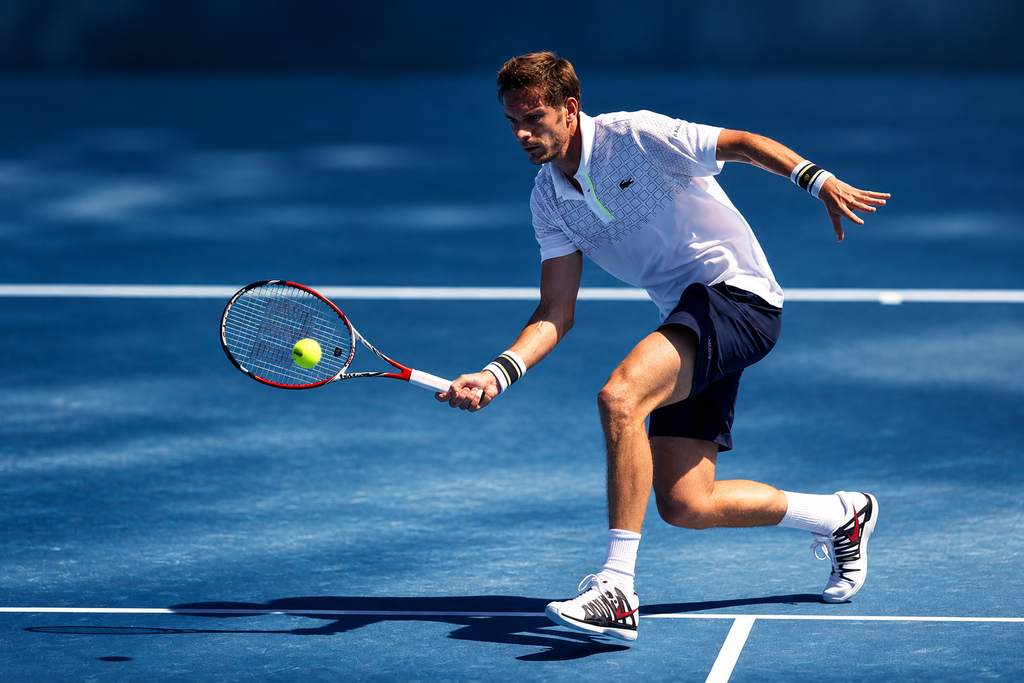
A tennis volley is a shot you hit before the ball bounces. Volleys are most commonly played when you are closer to the net, where there is less time to react and less space for a large swing.
For beginners, the goal is not to hit spectacular winning volleys. The goal is to learn a simple, compact motion that lets you control the racket, meet the ball cleanly and become comfortable handling shots from a shorter distance.
Unlike a groundstroke, where you usually have time to prepare for a larger swing after the ball bounces, a volley relies on quick preparation and a short movement of the racket.
What Is a Volley?
A volley occurs when you strike the ball while it is still in the air.
If the ball bounces before you hit it, the shot is no longer a volley.
You will usually hit volleys somewhere between the service line and the net. The closer you are to the net, the less time you have to react, which is why the volley technique needs to remain simple.
The basic sequence is:
- Get into a ready position.
- Recognize whether the ball is coming to your forehand or backhand side.
- Turn the racket toward the incoming ball.
- Meet the ball in front of your body.
- Keep the racket movement compact.
- Recover to your ready position.
The important idea is that you are meeting the ball, not taking a full swing at it.
The Beginner Volley Mindset
Beginners often assume they need to generate a lot of power on volleys.
Usually, they do not.
When you are near the net, the incoming ball already carries speed. Your racket mainly needs to provide a stable surface that redirects that speed.
Think of the volley as a controlled block or short punch rather than a groundstroke.
A useful beginner thought is:
Prepare early, meet the ball and keep the racket steady.
Trying to swing harder usually makes the shot more difficult to control.
Start With a Balanced Ready Position
Before the opponent strikes the ball, stand in a position that allows you to react in either direction.
Keep your:
- feet slightly wider than shoulder-width apart
- knees comfortably bent
- weight toward the balls of your feet
- upper body relaxed
- racket in front of your body
- racket head above your hands
Use both hands to support the racket while waiting for the ball.
Keeping the racket in front reduces the distance it has to travel when you need to volley.
If the racket is hanging beside or behind your body, you may not have enough time to prepare.
Use a Continental Grip
The continental grip is commonly used for both forehand and backhand volleys because it allows you to handle balls on either side without making a major grip change.
A simple way to find it is to hold the racket somewhat like you would hold a hammer.
The grip may feel unfamiliar if you normally use a different grip for your forehand groundstroke. Give yourself time to get comfortable with it.
One major advantage of the continental grip is efficiency. When the ball is coming quickly at the net, you do not want to spend valuable time making large grip changes.
Keep the Racket in Front
One of the most important habits in beginner volleying is keeping the racket in front of your body.
You generally do not need to take the racket far behind you.
Instead, turn slightly toward the incoming ball while keeping the racket relatively close to your body.
The preparation should feel compact.
A large backswing creates several problems:
- it takes longer
- it makes timing harder
- it can cause you to contact the ball late
- it makes controlling the racket face more difficult
The shorter the reaction time, the more valuable a compact motion becomes.
The Forehand Volley
For a forehand volley, the ball arrives on the same side as your racket hand.
From your ready position, turn slightly toward the ball and bring the racket into position.
Avoid pulling the racket far behind your body.
Keep the racket head up and try to meet the ball slightly in front of you.
As the ball arrives, make a short forward movement through the contact point.
The motion should be much smaller than a regular forehand groundstroke.
Your goal is to provide a firm, controlled racket face and redirect the ball.
After contact, the racket may continue forward slightly, but you do not need a long follow-through.
Then return the racket to the ready position.
The Backhand Volley
For a backhand volley, the ball arrives on the opposite side of your racket hand.
Keep your non-racket hand on the racket during your initial preparation. This helps you turn the racket into position without making an unnecessarily large movement.
As you prepare, turn your shoulders slightly and position the racket in front of your body.
Release the supporting hand as necessary and meet the ball slightly in front.
Again, the racket movement should remain compact.
You are not trying to perform a full backhand swing.
Think about presenting the racket face to the ball and guiding the ball toward your target.
After contact, recover the racket to the middle so you are ready for the next shot.
Contact the Ball in Front
Good volley contact normally happens in front of your body rather than beside or behind you.
Contacting the ball in front gives you better control of the racket face and makes it easier to direct the shot.
If you wait until the ball reaches your body, you may feel crowded and rushed.
To improve your contact point, prepare as soon as you recognize where the ball is going.
Do not wait until the ball is almost beside you before moving the racket.
Early preparation makes a compact volley much easier.
Keep the Racket Face Stable
The angle of the racket face has a major influence on where the volley goes.
If the racket face opens too much, the ball may float high or travel long.
If the racket face closes too much, the ball may go into the net.
Beginners often change the racket-face angle because they swing with the wrist.
Try to keep your wrist reasonably stable through contact.
You do not need to squeeze the racket as tightly as possible, but you do want enough stability that the racket does not wobble when the ball arrives.
Think of your hand, wrist and racket working together as a controlled unit through the contact area.
Do Not Swing Like a Groundstroke
One of the biggest differences between a volley and a groundstroke is the size of the swing.
Groundstrokes often involve:
- a larger backswing
- more body rotation
- more racket acceleration
- a longer follow-through
A beginner volley usually requires much less.
Your racket is already close to the ball because you are closer to the net.
Use the incoming ball’s speed instead of trying to create all the speed yourself.
A simple cue is:
Short preparation, short contact motion, quick recovery.
Use Your Feet to Help the Volley
Volleying is not only about what your arms and racket are doing.
Your feet help you stay balanced and reach the correct contact point.
When possible, move toward the ball rather than stretching your arm while your feet remain planted.
For a comfortable forehand volley, you may naturally step with the opposite foot as you move through the shot.
For a backhand volley, you may naturally step with the foot on the opposite side of your racket hand.
Do not become overly concerned about forcing a specific step every time. Tennis happens quickly and you will not always have time for perfect footwork.
The beginner priority is maintaining balance while moving toward the ball.
Stay Athletic Near the Net
Standing upright makes it harder to react quickly.
Keep your knees slightly bent and stay light on your feet.
As your opponent is about to hit, use a small split step: a light hop that lands with your feet apart and your body balanced.
The purpose is not to jump high.
The purpose is to put your body in a responsive position so you can move toward either side.
After each volley, try to regain that balanced position rather than standing and watching your shot.
Do Not Stand Too Close to the Net
Beginners sometimes move extremely close to the net because it seems like that should make volleying easier.
It can actually create problems.
If you stand too close:
- fast shots become difficult to react to
- balls hit toward your body become uncomfortable
- you may struggle with balls that travel above or behind you
Give yourself enough space to see the ball and react.
As you become more comfortable, you will begin to recognize when moving closer gives you an advantage and when you need more room.
For now, focus on finding a position where you can stay balanced and react comfortably.
Aim for Control Before Power
Your first volleys do not need to be winners.
Try to send the ball safely into the court.
A controlled volley that lands comfortably inside the court is far more useful for learning than a hard volley that you cannot repeat.
Good beginner targets include larger areas of the court rather than the sidelines.
Once you can consistently make clean contact, you can gradually work on placing the ball more precisely.
Control comes first.
Forehand and Backhand Volleys Should Feel Similar
Your forehand and backhand volleys use different sides of the racket, but the fundamental idea remains the same:
- prepare early
- keep the movement short
- meet the ball in front
- maintain a stable racket face
- stay balanced
- recover quickly
Avoid treating the backhand volley as an entirely different type of shot.
Learning one simple volleying structure for both sides makes reacting at the net easier.
Common Beginner Volley Mistakes
Taking a Large Backswing
A big backswing takes too much time and often creates inconsistent contact.
Better approach: Keep the racket in front and use a compact movement.
Swinging Too Hard
Trying to generate excessive power can make the racket face unstable.
Better approach: Let the incoming ball provide much of the pace and concentrate on clean contact.
Letting the Racket Drop
If the racket starts too low, you may be late getting it into position.
Better approach: Keep the racket head comfortably up in your ready position.
Using Too Much Wrist
A loose or flipping wrist can change the racket-face angle during contact.
Better approach: Keep the wrist stable and guide the racket through the ball.
Contacting the Ball Too Late
Allowing the ball to reach the side of your body makes the volley more difficult.
Better approach: Prepare earlier and try to meet the ball in front.
Standing Flat-Footed
If your weight is settled on your heels, reacting becomes slower.
Better approach: Stay athletic with your knees slightly bent and your weight ready to move.
Watching the Result Too Soon
Looking toward your target before contact can interfere with clean ball tracking.
Better approach: Keep your attention on the ball through the contact area.
A Simple Beginner Volley Practice
Start close enough to your practice partner that they can gently feed balls to you without forcing you to react to high speed.
Begin with forehand volleys.
Keep your racket in front and try to return each feed with a short controlled motion.
Do not worry about hitting hard.
After several successful contacts, repeat the exercise on the backhand side.
Then have your partner alternate between forehand and backhand feeds.
Your goal is to return to your ready position between every shot.
As your control improves, your partner can gradually increase the pace or vary the direction.
The progression should be:
clean contact → consistent control → quicker reactions
Not:
maximum speed immediately.
Practice Catching the Ball With the Racket
Another useful way to understand the volley is to imagine that the strings are briefly “catching” the incoming ball.
You are not literally holding the ball on the racket, but the image encourages a softer, more controlled movement.
Instead of attacking every ball with a large swing, try to feel the ball make contact with the center of the strings before you redirect it.
This can help beginners develop better touch and awareness of the racket face.
Build Confidence Closer to the Net Gradually
Being near the net can feel uncomfortable at first because the ball reaches you much faster than it does from the baseline.
That reaction is normal for new players.
You do not need to begin with fast feeds.
Start slowly enough that you can recognize whether the ball is going to your forehand or backhand side and prepare correctly.
As the movements become more familiar, gradually increase the speed.
The objective is to develop calm reactions instead of panicked swings.
A Simple Volley Checklist
When practicing your volleys, check these fundamentals:
- Racket starts in front.
- Racket head stays up.
- Preparation remains compact.
- Contact happens before the bounce.
- Contact is slightly in front of the body.
- Wrist remains stable.
- Swing stays short.
- Feet stay active.
- You recover to the ready position after the shot.
You do not need to execute every volley perfectly.
Use the checklist to identify one or two habits to improve at a time.
Final Thoughts
The tennis volley becomes much easier when you stop treating it like a smaller version of a groundstroke.
You do not need a large backswing or a powerful swing.
Start with the racket in front, prepare early, meet the ball before it bounces and use a compact movement with a stable racket face.
At first, simply becoming comfortable reacting to the ball near the net is meaningful progress.
With repetition, the shorter reaction time begins to feel more manageable and the volley becomes a controlled, reliable shot rather than something you rush to survive.