
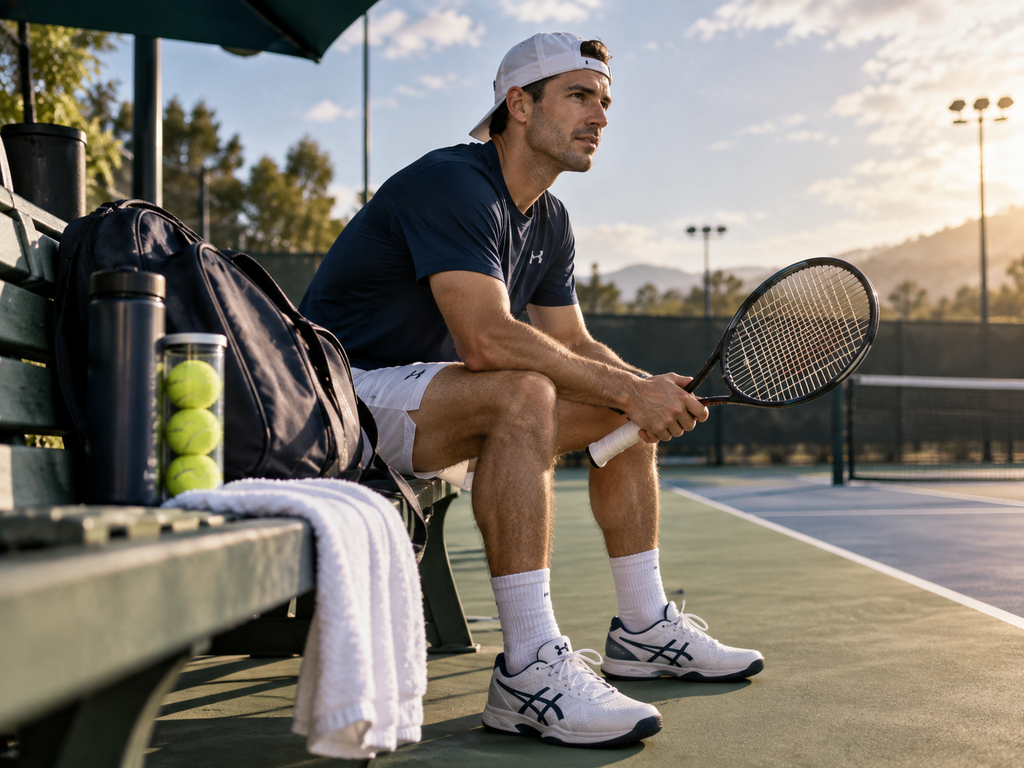
Starting tennis does not require a large collection of specialized equipment.
For a beginner, the goal is much simpler: have a suitable racket, comfortable court shoes, a few tennis balls and clothing that allows you to move freely. Everything else can be added later as you learn what you actually need.
Buying too much equipment before you have played regularly can make tennis seem more complicated and expensive than it needs to be. A basic setup is enough to begin practicing, taking lessons and playing recreational matches confidently.
What You Actually Need to Start Playing Tennis
A beginner can start with four basic things:
- A tennis racket
- Tennis balls
- Appropriate athletic shoes
- Comfortable athletic clothing
You may also want a water bottle and a small bag, but neither needs to be specialized tennis equipment.
The important thing is choosing equipment that makes learning comfortable rather than buying advanced products designed for experienced players.
Choosing Your First Tennis Racket
Your racket is the most important piece of tennis equipment you will buy.
Beginner rackets are generally designed to make it easier to contact the ball and generate useful power without requiring perfect technique.
Instead of choosing a racket because a professional player uses it, look for something comfortable and forgiving.
Racket Head Size
The racket head is the area containing the strings.
A larger head gives you a larger hitting area and usually a larger sweet spot. The sweet spot is the part of the string bed where contact feels most solid and comfortable.
Beginners often benefit from a racket with a moderately large head because slightly off-center shots are more forgiving.
A head size somewhere around 100 to 110 square inches is a practical starting range for many adult beginners.
Extremely small racket heads generally demand more precise contact and are usually less beginner-friendly.
Racket Weight
Rackets vary considerably in weight.
A lighter or moderately weighted racket is usually easier for a beginner to maneuver while learning the forehand, backhand, serve and volley.
However, extremely light rackets are not automatically better.
A racket should feel light enough that you can swing comfortably without struggling to control it, but substantial enough that it does not feel unstable when contacting the ball.
For many adult beginners, a racket roughly within the 260 to 300 gram unstrung range can provide a reasonable starting point.
The exact number matters less than how comfortable the racket feels in your hand.
Grip Size
The grip is the handle of the racket.
Tennis rackets are available in different grip sizes because players have different hand sizes.
A grip that is much too large can make the racket difficult to maneuver. A grip that is too small may encourage you to squeeze the handle excessively to keep the racket stable.
If you are choosing between two sizes and are unsure, the smaller size is often easier to adjust because an overgrip can be added later to slightly increase the handle thickness.
If possible, hold several rackets before buying one.
The racket should feel secure without requiring you to grip it tightly.
Do Beginners Need an Expensive Racket?
No.
A beginner does not need a professional-level racket to learn tennis effectively.
More expensive rackets may use higher-grade materials or provide specific combinations of control, stability, power and feel. Those differences can become more meaningful once your technique and preferences develop.
At the beginning, you probably do not yet know whether you prefer:
- More power
- More control
- A heavier racket
- A lighter racket
- A different balance
- A particular string setup
That knowledge comes from playing.
A comfortable entry-level or intermediate racket from a reputable manufacturer is usually enough to begin.
Should You Buy a Pre-Strung Racket?
For a first racket, a pre-strung model is perfectly reasonable.
Pre-strung rackets arrive ready to play and eliminate the need to choose strings and tension before you understand how either affects the racket.
Eventually, you may want to experiment with different string types and tensions.
For now, the factory strings are usually sufficient.
Tennis Balls
You obviously need tennis balls, but beginners do not need large quantities.
A few balls are enough for casual hitting.
If you are practicing serves or drills by yourself, having several additional balls means you spend less time collecting them between repetitions.
Regular Tennis Balls
Standard tennis balls are appropriate for most adult beginners.
They are the familiar yellow balls used for normal recreational and competitive tennis.
They move faster and bounce more than beginner training balls, so they can initially feel difficult to control.
That is normal.
As your timing improves, regular balls become much easier to manage.
Beginner Training Balls
Some beginners may find slower training balls helpful.
These balls are designed to move more slowly or bounce differently than standard tennis balls, giving beginners additional time to prepare and make contact.
Depending on the type, you may see balls identified by colors such as red, orange or green.
They are commonly used in progressive tennis programs, particularly for children, but some adult beginners also find slower balls useful when learning basic rallies.
You do not need them in order to learn tennis, but they can make early practice easier.
Tennis Shoes Matter More Than Many Beginners Expect
Your shoes are one of the most important equipment decisions you will make.
Running shoes and tennis shoes are designed for different types of movement.
Running primarily involves forward movement.
Tennis requires repeated:
- Side-to-side movement
- Short sprints
- Sudden stops
- Direction changes
- Split steps
- Recovery movements
Tennis shoes are designed to provide greater lateral support and court stability during these movements.
If you plan to play regularly, proper tennis shoes are a worthwhile purchase.
Can You Start With Regular Athletic Shoes?
For your first casual session, a comfortable pair of supportive athletic shoes may be enough.
But if you intend to continue playing, tennis-specific shoes are preferable.
Avoid shoes with poor lateral stability or extremely soft, elevated soles that may feel unstable when changing direction.
Your footwear should fit securely while allowing your toes enough room to remain comfortable during stops and directional changes.
Court Surface and Shoes
Different tennis courts can place different demands on footwear.
You may eventually encounter shoes designed specifically for:
- Hard courts
- Clay courts
- Grass courts
Beginners usually do not need multiple pairs.
A good general-purpose tennis shoe is enough unless you consistently play on a surface that requires something more specialized.
What Clothing Should You Wear?
You do not need traditional tennis clothing to start playing.
Wear lightweight athletic clothes that allow unrestricted movement.
Your clothing should make it easy to:
- Rotate your upper body
- Reach overhead
- Bend your knees
- Move laterally
- Run forward and backward
Shorts, athletic pants, skirts, dresses, T-shirts and performance tops can all work.
The exact style matters much less than comfort and movement.
If you play outdoors, breathable clothing can make longer sessions more comfortable in warm conditions.
Do You Need Tennis Pockets?
Not necessarily.
During match play, players often keep an extra tennis ball in a pocket so they have another ball available for the next serve.
Shorts, skirts or other tennis clothing with suitable pockets can therefore be convenient.
But this is not an essential purchase when you first begin.
A Water Bottle
Tennis involves repeated movement and can become physically demanding quickly.
Bring water whenever you practice or play.
A specialized sports bottle is unnecessary. Any convenient reusable bottle is fine.
For longer sessions, especially in hot conditions, make sure you have enough fluid available for the entire session.
Do You Need a Tennis Bag?
Not immediately.
If you own one racket, a few balls and a water bottle, an ordinary backpack or athletic bag can easily carry everything you need.
Tennis bags become more useful when you start carrying:
- Multiple rackets
- Extra clothing
- Shoes
- Towels
- Larger quantities of balls
- Accessories
Until then, use whatever bag you already have.
Accessories You Can Wait to Buy
Tennis stores contain many accessories that can make playing more convenient, but very few are essential for a new player.
You can comfortably begin without most of them.
Overgrips
An overgrip is a thin layer wrapped around the existing racket grip.
It can improve comfort, absorb sweat or slightly change the thickness and feel of the handle.
You may eventually replace overgrips regularly because they become worn or slippery.
But if your racket’s original grip feels comfortable, there is no need to immediately replace or cover it.
Vibration Dampeners
A vibration dampener is a small accessory placed between the strings near the bottom of the racket head.
Some players like the change in sound or feel that it creates.
Others prefer playing without one.
A dampener is optional and will not turn poor technique into good technique.
Try one later if you are curious.
Wristbands and Headbands
Wristbands and headbands can help manage sweat during hot or intense sessions.
They are useful accessories for some players but completely optional.
A towel can perform much of the same function between points or practice drills.
Hats and Visors
A hat or visor can be useful when playing outdoors, particularly when sunlight makes it difficult to see the ball.
Again, this is a convenience rather than essential tennis equipment.
Use one if it makes outdoor play more comfortable.
Sunglasses
Sports sunglasses can help in bright conditions.
If you choose to wear them, they should fit securely enough that they do not move excessively while you run or swing.
You do not need specialized tennis sunglasses when starting.
Extra Rackets
One racket is enough for a beginner.
Competitive players often carry several rackets because strings can break during matches or because they want backup equipment with identical specifications.
A beginner rarely needs that immediately.
Consider purchasing a second racket when you begin playing frequently enough that a broken string could interrupt an important practice session or match.
Tennis Strings
Strings deserve attention eventually, but beginners often worry about them earlier than necessary.
Strings differ in:
- Material
- Thickness
- Durability
- Comfort
- Power
- Spin potential
- Feel
String tension also changes how the racket behaves.
Those differences become more relevant once your strokes become repeatable enough that you can actually notice them.
For a beginner, comfortable general-purpose strings installed within the racket manufacturer’s recommended tension range are usually sufficient.
You do not need an advanced string setup simply because experienced players discuss one.
Ball Machines
A ball machine automatically feeds tennis balls toward you so you can practice strokes repeatedly.
It can be useful for focused practice, but it is absolutely not beginner equipment.
Ball machines can also be expensive.
Beginners can develop the same foundational movements through lessons, partner practice, wall practice and simple feeding drills.
If you later become a regular player who wants independent practice sessions, a ball machine may become more useful.
Training Aids
You may encounter equipment designed to improve specific parts of your technique, including:
- Swing trainers
- Target systems
- Resistance devices
- Specialized rebound equipment
- Footwork markers
Some training aids can be useful in the right situation.
None are necessary for learning the fundamentals.
A racket, balls, court and structured practice will teach you far more at the beginning.
What About a Tennis Ball Hopper?
A ball hopper or basket makes it easier to carry and collect a large number of tennis balls.
It is convenient if you practice serves or drills using dozens of balls.
It is unnecessary for normal recreational play.
If you eventually begin doing regular independent practice sessions, a basket may save considerable time.
Until then, it can wait.
Should Beginners Buy Used Tennis Equipment?
Used equipment can be a practical way to reduce the cost of starting tennis.
Rackets in good structural condition can remain perfectly playable for years.
If considering a used racket, inspect it for:
- Serious cracks
- Significant frame damage
- Loose or broken parts
- A badly deteriorated grip
- Heavily damaged strings
Grips and strings can usually be replaced.
Structural damage to the racket frame is a more serious concern.
Shoes are different.
Because footwear changes shape through use and the sole gradually loses support and traction, buying properly fitting new tennis shoes is generally preferable when possible.
Renting or Borrowing Equipment
If you are not yet sure whether you will continue playing tennis, borrowing or renting a racket can make sense.
Some tennis clubs, coaches and recreational facilities provide beginner rackets.
Using borrowed equipment for your first few sessions allows you to experience different racket sizes and weights before purchasing your own.
Once you know you want to continue, owning your own racket gives you a consistent piece of equipment for learning.
A Simple Beginner Tennis Setup
Your first tennis setup does not need to be complicated.
A practical beginner kit can consist of:
One comfortable beginner-friendly racket
Choose something manageable, forgiving and appropriate for your hand size.
A few tennis balls
Standard balls are fine, although slower training balls can help during early practice.
Supportive tennis shoes
Prioritize stability, fit and comfort.
Comfortable athletic clothing
Wear something that allows unrestricted movement.
Water
Bring enough to remain comfortable throughout your session.
That is enough to start playing tennis.
What You Can Add Later
As you begin playing regularly, you may gradually add:
- A tennis bag
- Extra balls
- Overgrips
- A second racket
- Preferred strings
- A hat or visor
- Wristbands
- A towel
- A ball basket
- Specialized training equipment
The important word is gradually.
Allow your playing habits to determine what you buy.
Someone who plays casually once a month has very different equipment needs from someone practicing several times every week.
Avoid Buying Equipment to Solve Technique Problems
One of the easiest traps for beginners is assuming that equipment will solve problems that are actually caused by technique.
A new racket will not automatically fix:
- Late preparation
- Poor footwork
- Inconsistent contact
- Incorrect grip
- Lack of balance
- Poor recovery
Equipment can make tennis more comfortable and suitable for your abilities, but learning the fundamentals remains more important.
Before replacing your racket because a particular shot feels difficult, give yourself time to develop the movement.
Beginners naturally make inconsistent contact while learning.
That does not mean the equipment is wrong.
Start Simple and Learn What You Prefer
Your first tennis equipment does not have to be your permanent equipment.
As you play more, you will begin discovering preferences that you cannot realistically know before you start.
You may discover that you prefer a slightly heavier racket. You may want a smaller head for greater control. You may find one type of string more comfortable than another or decide that certain shoes feel better on the courts where you usually play.
Those decisions are easier to make after you have developed some experience.
For now, keep your setup simple.
Choose a comfortable racket, bring a few tennis balls, wear supportive shoes and clothing that allows you to move freely.
That gives you everything you actually need to step onto the court and start learning with confidence.