
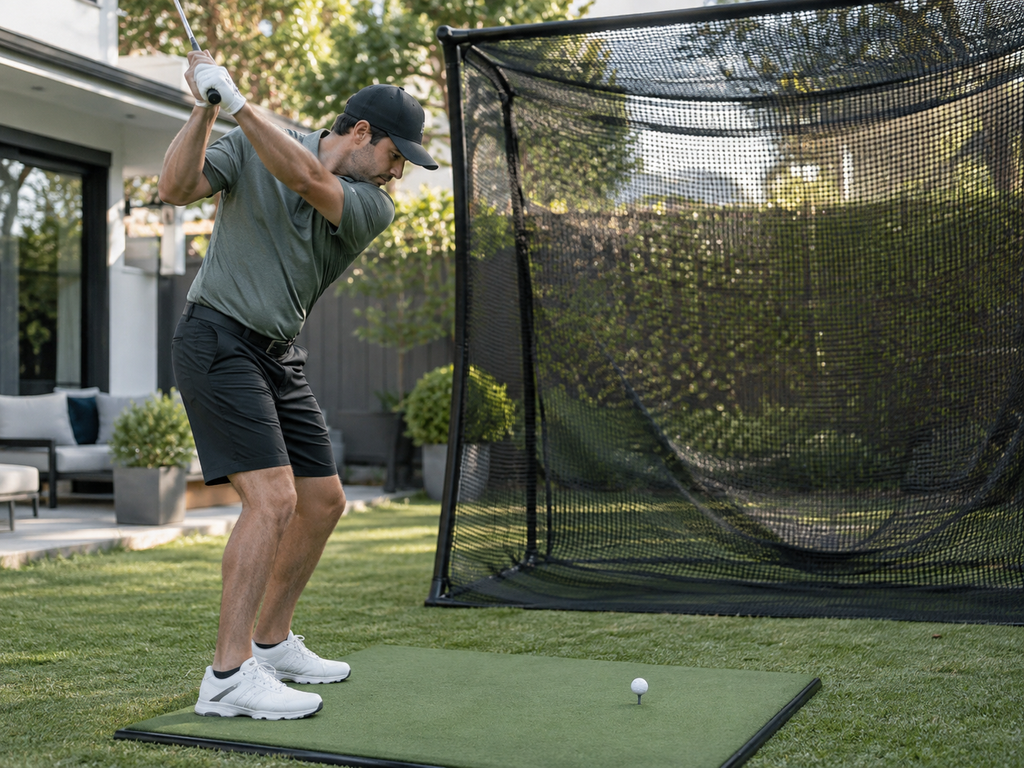
Practicing golf at home can make it much easier to work on your swing regularly. You do not need a full driving range or a large backyard to get useful repetitions. With a properly positioned practice net and a suitable hitting mat, you can create a dedicated practice area that allows you to hit real golf shots while helping protect your lawn, walls, windows and surrounding property.
The goal of a home hitting setup is not to recreate an entire golf course. It is to give you a convenient and reasonably safe place where you can make swings, strike golf balls and develop a more consistent practice routine.
A simple setup can include only a golf mat, practice net, golf balls and enough open space to swing comfortably. More elaborate setups may include targets, impact screens or launch monitors, but the net and mat remain the foundation.
Why Practice at Home?
One of the biggest challenges for beginner golfers is getting enough repetitions.
Going to a driving range requires travel, time and usually a bucket of balls. Home practice removes many of those obstacles.
A net and hitting mat can allow you to practice for 10 or 15 minutes whenever you have time instead of waiting until you can schedule a full range session.
Shorter but more frequent sessions can also make practice easier to incorporate into your week.
You might hit 20 balls before work, practice for a few minutes in the evening or work on your swing during a weekend without leaving home.
The convenience can encourage consistency.
What a Practice Net Does
A golf practice net is designed to catch golf balls after impact.
Instead of watching the ball travel 100 or 200 yards, you hit the ball into a net positioned only a short distance in front of you.
The net absorbs the ball’s energy and prevents it from continuing toward nearby objects.
This makes it possible to hit golf balls in spaces where normal full-flight shots would obviously be impossible.
Practice nets can be used in locations such as:
- Backyards
- Garages
- Covered patios
- Large indoor rooms
- Basements with sufficient ceiling height
- Dedicated golf practice areas
The important requirement is having enough room to swing safely.
What a Hitting Mat Does
A hitting mat creates a stable surface from which you can strike golf balls.
Repeatedly hitting golf shots from natural grass can quickly damage a lawn because the club may remove pieces of turf with each swing.
A mat helps protect the ground while providing a consistent hitting surface.
Most golf mats use synthetic turf designed to imitate the feel of grass.
Some mats are small and designed primarily for the ball and club to contact. Others are large enough for you to stand on while hitting.
For a permanent home practice area, a larger mat is often more comfortable because your feet and the golf ball remain on the same level.
Choosing a Practice Net
Golf nets come in many different sizes and designs.
For home practice, size is one of the most important considerations.
A larger net provides a bigger margin for error. This can be particularly helpful for beginners whose shots may occasionally leave the clubface at unexpected angles.
Look for a net that provides enough coverage both vertically and horizontally.
A net should also be deep enough to absorb the energy of a golf ball without allowing the ball to rebound aggressively toward you.
Some nets include side barriers or optional side panels. These can provide additional protection if shots occasionally travel to the left or right.
Durability is another important consideration.
Golf balls can place significant stress on netting when they repeatedly strike the same area. Materials designed specifically for golf practice are generally preferable to lightweight recreational netting.
Choosing a Hitting Mat
The hitting mat receives repeated contact from both the golf ball and the club.
For that reason, durability and cushioning matter.
Very thin mats may be inexpensive, but they can provide limited protection when the club strikes the surface.
A thicker mat with some cushioning underneath can reduce the harsh impact that may occur when the club contacts the mat before or after the golf ball.
The mat should also remain stable during the swing.
If the mat slides, bunches or moves under your feet, it can interfere with your setup and create unnecessary distractions.
Look for a mat with enough weight or traction to stay securely in position.
Full-Size Mats vs Small Hitting Strips
Home golf mats generally fall into two basic categories.
A full-size mat allows you to stand and hit from the same surface.
This provides a more natural setup because your feet and the golf ball remain level.
A smaller hitting strip may only provide enough space for the golf ball and club impact area.
These strips are easier to store and usually require less space, but you may need to stand on another surface of similar height.
If your feet are significantly higher or lower than the ball, your setup can feel different from normal golf conditions.
For that reason, keeping the hitting surface and stance area approximately level is preferable.
Finding Enough Space to Swing
Before purchasing equipment, determine whether your chosen area provides enough room for a complete golf swing.
Stand where you expect to hit and make several slow practice swings without a ball.
Check the space around you carefully.
Make sure the club cannot reach:
- Walls
- Furniture
- Ceiling fans
- Light fixtures
- Garage doors
- Posts
- Shelves
- Trees
- Vehicles
- Other objects
Remember that a driver is considerably longer than a wedge or short iron.
An area that feels comfortable with a short club may not provide enough clearance for a driver.
Also consider your height and swing shape.
Two golfers using the same club may require different amounts of space.
Positioning the Net
The practice net should be positioned directly in front of the hitting area.
Follow the manufacturer’s recommended hitting distance whenever one is provided.
You want enough distance to swing comfortably without standing so close that your club could contact the net.
At the same time, moving too far away increases the possibility that a poorly struck shot could miss the net.
For many home setups, keeping the golfer relatively close to a large net provides a useful balance between swing clearance and ball containment.
The net should also be centered on your expected target line.
Think Beyond the Center of the Net
It is easy to assume every golf shot will travel directly into the middle of the net.
That should never be your safety plan.
Golf shots can occasionally come off the clubface at severe angles.
A ball may be struck from the heel, toe, top or other part of the clubface and travel somewhere completely unexpected.
For that reason, consider the entire area surrounding the practice net.
Ask yourself what would happen if the ball missed the net.
If the answer involves a window, vehicle, person or neighboring property, the setup needs additional protection.
Side netting or additional barriers may be appropriate.
Protecting the Area Behind the Net
A practice net should be able to stop the golf ball without allowing it to reach whatever is behind it.
Avoid positioning a net directly against fragile surfaces unless the net system is specifically designed for that configuration.
Ideally, there should be additional safe space behind the net.
If the ball somehow passes through damaged netting, that additional space provides another layer of protection.
Regularly inspect what is behind your practice area as well.
A location that was safe yesterday may not be safe today if someone parks a vehicle or places equipment behind the net.
Check the Net Before Every Session
Practice nets gradually wear over time.
Repeated shots may strike the same area hundreds or thousands of times.
Before hitting balls, quickly inspect the net for:
- Holes
- Torn stitching
- Loose connections
- Damaged support poles
- Worn impact areas
- Sagging sections
- Detached side panels
Small holes can become larger surprisingly quickly.
Never assume that a net is safe simply because it successfully stopped golf balls during your previous session.
Securing the Net
Outdoor practice nets may move in wind or shift after repeated impacts.
Make sure the net is properly assembled and secured according to its instructions.
Some systems use stakes, weights or supporting frames to remain stable.
A collapsing or moving net can create both a safety problem and an inconvenience.
If strong winds are present, it may be better to postpone the session rather than rely on an unstable setup.
Using Real Golf Balls
Many golf practice nets are designed to handle normal golf balls.
Using real balls provides realistic clubface contact and impact feel.
However, real golf balls can travel at very high speeds.
That makes proper net setup especially important.
If you are uncertain about the safety of the surrounding area, reduced-flight or foam practice balls can provide another option.
They will not provide exactly the same impact sensation as real golf balls, but they may be useful in smaller or more restricted spaces.
Creating a Clear Target
One limitation of net practice is that you cannot watch the full flight of the golf ball.
Because the ball travels only a short distance before reaching the net, you receive less information about where the shot would eventually finish.
Adding a target to the net can make your practice more purposeful.
Many nets include a central target.
You can also use a safe target attachment designed for the net.
The target gives you a visual reference for alignment and starting direction.
Instead of simply hitting balls into a large surface, you now have a specific area to aim toward.
Align the Mat With the Target
Once your net is positioned, make sure the hitting mat is aligned properly.
The edge of the mat can sometimes provide a useful visual reference.
You may also position an alignment stick or club on the ground beside the hitting area.
Your goal is to understand where the target actually is rather than gradually aiming farther left or right without noticing.
Because you cannot see the complete ball flight, consistent alignment becomes especially important during net practice.
Keep the Hitting Area Clean
Small pieces of dirt, stones or debris can collect on hitting mats, especially when they are used outdoors or inside garages.
Keep the mat relatively clean before practicing.
Debris can interfere with the hitting surface and may be struck by the golf club.
It is also a good idea to keep loose objects away from the surrounding practice area.
The area around your feet should remain clear so you can swing without worrying about stepping on equipment or losing your balance.
Rotate the Hitting Area
Repeatedly striking balls from exactly the same position can wear down one section of a mat faster than the rest.
If your mat allows it, periodically move the ball position slightly or rotate the mat.
This helps distribute wear across a larger area.
Pay particular attention to the section immediately in front of the ball because the club may repeatedly strike that area.
If the turf begins separating, tearing or becoming excessively thin, the mat may need repair or replacement.
Create a Simple Practice Station
A useful home golf practice area does not need to contain many accessories.
A simple station might include:
- Practice net
- Hitting mat
- Small container of golf balls
- Alignment stick
- Target on the net
- Clubs you want to practice
Keeping the area organized makes practice easier.
If you have to spend ten minutes setting everything up every time you want to hit a few balls, you may practice less frequently.
A convenient setup removes that friction.
Practice With a Purpose
Having unlimited access to a home hitting area can create another problem: mindless repetition.
It is easy to hit ball after ball without paying attention to what you are doing.
Instead, give each session a simple objective.
For example, you might hit 20 controlled shots while focusing on balance.
During another session, you might work on making consistent contact.
You can also change clubs after a small number of shots rather than hitting dozens of balls continuously with the same club.
The net provides repetition, but the value of those repetitions depends on how deliberately you practice.
Start With Slower Swings
When using a new practice area for the first time, begin with short and controlled swings.
This allows you to confirm that you have enough space and that the net is positioned correctly.
Gradually increase the length and speed of your swings only after you are comfortable with the setup.
This approach can also help you discover potential clearance problems before making a full-speed swing.
Be Careful With Drivers
Drivers create some of the highest ball speeds in golf.
They also require more swing space because of their longer shafts.
Before hitting driver into a home practice net, confirm that both the net and your practice environment can safely handle it.
Check ceiling clearance, side clearance and the distance between your hitting position and the net.
If your setup comfortably accommodates irons but feels questionable with a driver, use the space for the clubs that can be practiced safely.
Indoor Practice Considerations
Indoor practice can be extremely convenient, particularly when weather prevents outdoor sessions.
However, indoor environments require additional attention to clearance.
Ceiling height is one of the biggest concerns.
A golf club can travel much higher during the backswing and follow-through than beginners sometimes expect.
Also consider nearby windows, doors, electronics and household items.
A garage may provide more usable space than a normal room because it usually contains fewer fragile surfaces.
Regardless of location, never assume a space is large enough until you have tested your complete swing carefully.
Outdoor Practice Considerations
Backyards often provide more swinging room, but they create different challenges.
Wind can affect the stability of the net.
Rain and sunlight can gradually degrade materials.
Uneven ground can also make it difficult to position the mat securely.
Choose a relatively level area whenever possible.
If the mat rocks or shifts, add a stable base underneath rather than practicing from an unstable surface.
Store portable nets and mats according to their manufacturer’s recommendations when they are not being used.
Practice Net Limitations
A practice net is useful, but it cannot provide all the information available from hitting balls on a driving range.
When a ball enters the net after only a few yards, you cannot directly observe:
- Full trajectory
- Curve
- Carry distance
- Total distance
- Landing angle
- Final target position
A shot may feel solid but still produce an undesirable ball flight.
For that reason, home net practice is particularly useful for repetition, contact, setup and movement work.
It should complement opportunities to observe full ball flight whenever those opportunities are available.
Mats Can Hide Certain Contact Problems
Hitting mats are convenient, but they behave differently from natural turf.
On grass, hitting the ground significantly behind the golf ball usually produces an obvious poor result because the club enters the turf before reaching the ball.
Some mats allow the club to slide across the surface and still make reasonably solid contact.
This can make certain heavy strikes feel better than they would on grass.
Pay attention to where the club contacts the mat.
Some golfers place a small towel, tape line or other safe reference behind the ball to help identify whether the club is contacting the ground too early.
The goal is to use the mat as a practice surface without assuming every shot that feels acceptable would produce the same result from natural turf.
Build a Setup You Will Actually Use
The best home practice area is not necessarily the largest or most expensive one.
It is the setup that is safe, convenient and easy enough to use regularly.
A large permanent practice station may be ideal if you have the space.
Someone with limited room may be better served by a portable net and mat that can be assembled quickly and stored afterward.
Convenience matters because frequent short sessions can add up to a significant amount of practice.
Make Safety the Priority
Golf balls and golf clubs can both cause serious damage when used in confined spaces.
Always make sure people and pets are completely outside the hitting area before swinging.
Do not allow anyone to stand beside or behind the net.
Stop immediately if someone enters the practice zone.
Inspect your equipment regularly and replace worn components before they fail.
A home practice setup should make golf practice easier, not create unnecessary risks.
Final Thoughts
A practice net and hitting mat can turn a garage, backyard or other suitable space into a useful golf practice area.
The net allows you to hit golf balls without requiring hundreds of yards of open space, while the mat provides a durable surface that protects the ground and gives you a consistent place to hit from.
Start by choosing an area with enough room for your complete swing. Position a properly sized net in front of the hitting area, make sure the surrounding environment is protected and use a stable mat that keeps your stance and ball position comfortable.
Once the setup is safe and convenient, home practice becomes much easier to fit into your routine.
You do not need to hit hundreds of balls every day. Even short sessions can give you additional opportunities to make swings, work on consistent contact and reinforce the movements you are trying to develop.