
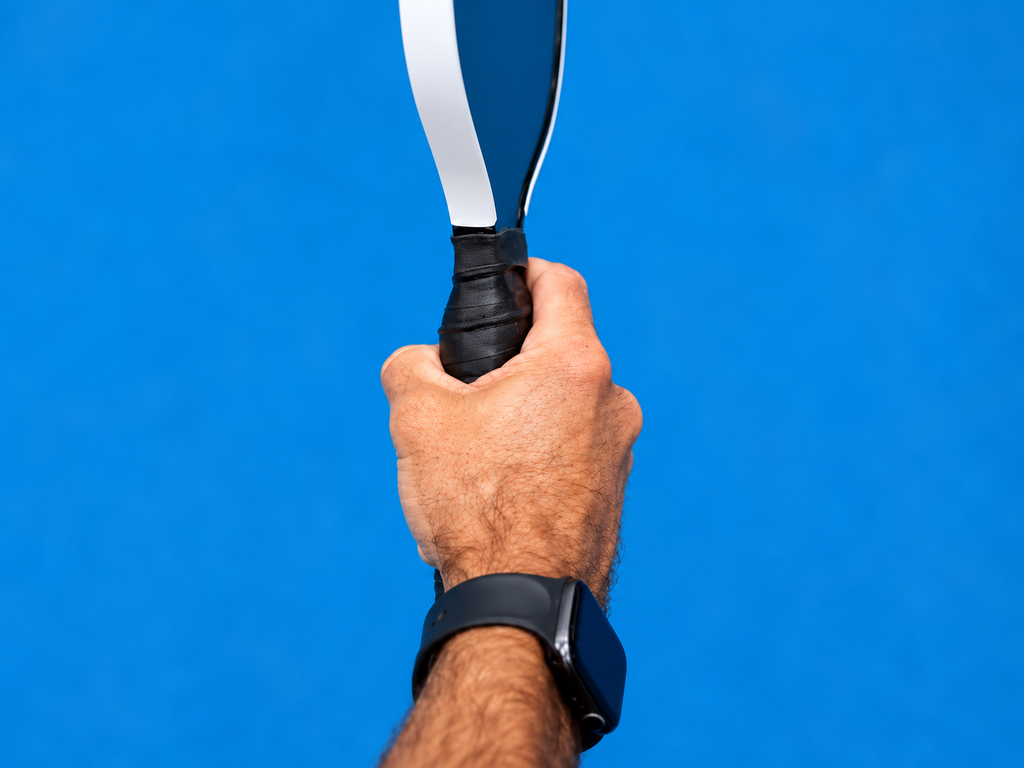
Learning to Hold a Pickleball Paddle with a Comfortable Grip gives you a reliable starting point for controlling the paddle. As a beginner, you do not need to memorize a collection of grip styles or make complicated hand changes. You need a simple pickleball paddle grip that feels comfortable, keeps the paddle secure and can be repeated consistently.
A useful beginner grip should allow you to hold and move the paddle without squeezing it as tightly as possible. Your hand should remain secure around the handle, but your wrist and forearm should feel reasonably relaxed. The goal is control rather than force.
USA Pickleball currently recommends the continental grip as a versatile starting grip for beginners. It describes a natural hand position similar to holding the paddle in a neutral orientation. For this lesson, however, the important point is the function of the grip rather than memorizing its name.
How to Hold a Pickleball Paddle with a Comfortable Grip
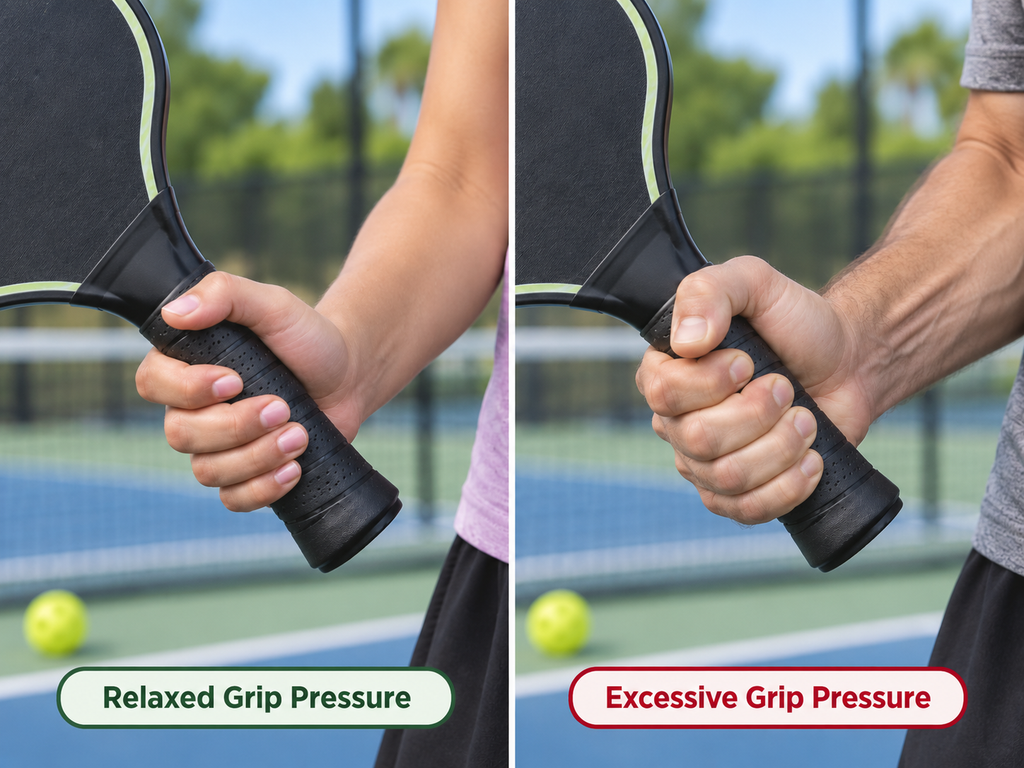
Start by identifying the paddle handle. This is the part designed to be held in your hand. Place your dominant hand naturally around the handle rather than gripping the paddle face or moving your hand unnecessarily high toward the hitting surface.
Wrap your fingers securely around the handle. Let the thumb support the hold without pressing or squeezing harder than necessary. Your palm and fingers should work together so the paddle feels stable.
Next, check your grip pressure. The paddle should not feel as if it could easily slide, rotate or fall out of your hand. At the same time, you should not need maximum hand strength to keep it under control.
Hold the paddle in front of your body and make a few small movements. If the paddle remains secure while your hand, wrist and forearm stay reasonably relaxed, you have a useful starting grip.
The final goal is repeatability. Release the handle briefly, pick the paddle up again and see whether you can naturally return to approximately the same comfortable hand position.
Place Your Hand on the Paddle Handle
A pickleball paddle has a hitting surface and a handle. For ordinary play, the handle is the primary gripping area. The basic hand position should give you enough contact with the handle to control the paddle without forcing your hand into an awkward position. The approved curriculum specifically identifies secure, natural hand placement on the handle as the foundation of this lesson.
Place your palm against the handle and allow your fingers to wrap naturally around it. You should be able to close your hand comfortably rather than stretching your fingers or forcing them into an unusual shape.
⚠ AVOID:
Avoid moving the hand so high that you are gripping near the paddle face. A high hand position can reduce the amount of handle available for a normal, secure hold.
At the other extreme, avoid allowing so much of your hand to hang beyond the bottom of the handle that the paddle becomes difficult to stabilize. A small amount of variation is normal because hands and paddle handles differ. What matters is whether the paddle feels secure and controllable.
A simple beginner pickleball grip is sometimes compared with naturally shaking hands with the paddle or holding a hammer. These comparisons are intended only to help you find a neutral starting position. You do not need to force your hand to match a precise picture if that position feels uncomfortable.
Grip discomfort should not be ignored simply because you are trying to imitate a particular hand position. Adjust the placement slightly until you can maintain a secure hold without obvious strain.
Use Comfortable Grip Pressure
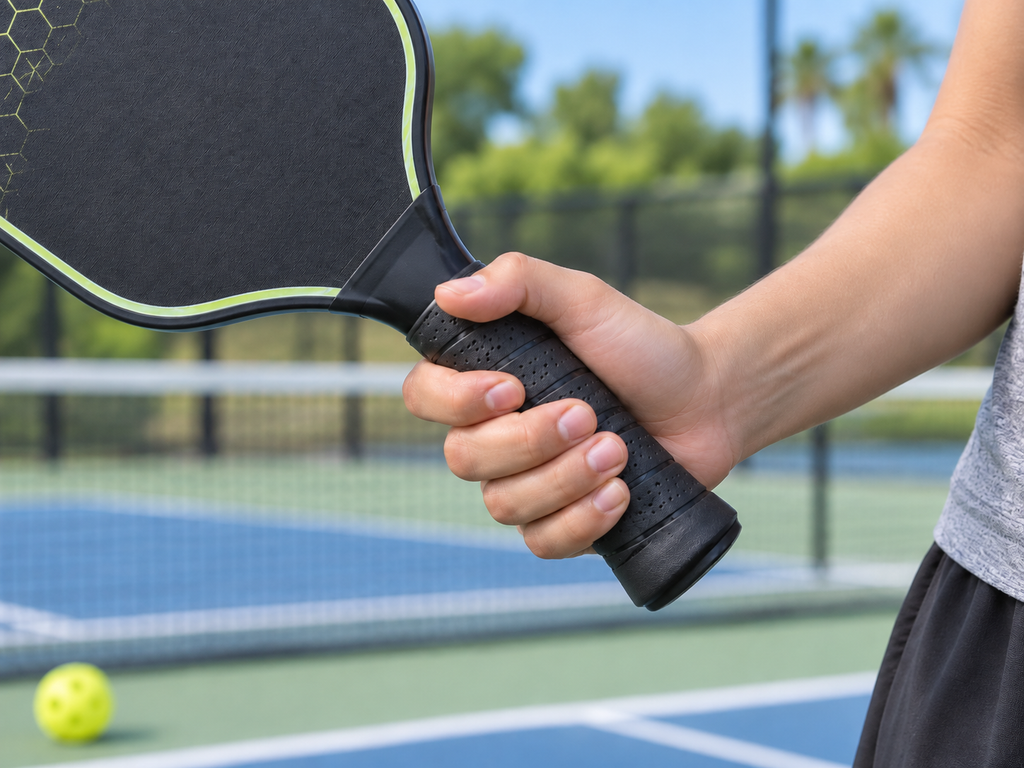
One of the most common beginner misunderstandings is assuming that holding the paddle securely means squeezing as hard as possible.
It does not.
Your grip needs enough pressure to keep the paddle in your hand during normal movement. Beyond that point, additional squeezing may simply create unnecessary tension in the fingers, hand and forearm.
USA Pickleball instructional material also uses relaxed grip pressure when teaching touch and control, illustrating the broader coaching principle that maximum squeezing is unnecessary for paddle control.
To check your own pickleball grip pressure, hold the paddle normally and notice what happens in your forearm. If the muscles feel constantly rigid before you have even moved the paddle, deliberately reduce the pressure slightly.
Now make several small paddle movements.
If the paddle still feels secure, the extra tension was unnecessary.
Continue reducing excessive pressure until you find a comfortable middle ground: secure enough that the paddle will not slip, but relaxed enough that you can move it freely.
Do not become overly concerned with assigning your grip an exact numerical pressure. Grip-pressure numbers sometimes appear in coaching advice, but a true beginner is better served by a simple functional test: secure without excessive squeezing.
Pressure may naturally change somewhat during play. Your immediate objective is simply to avoid making maximum tension your permanent default.
Keep the Paddle Stable in Your Hand
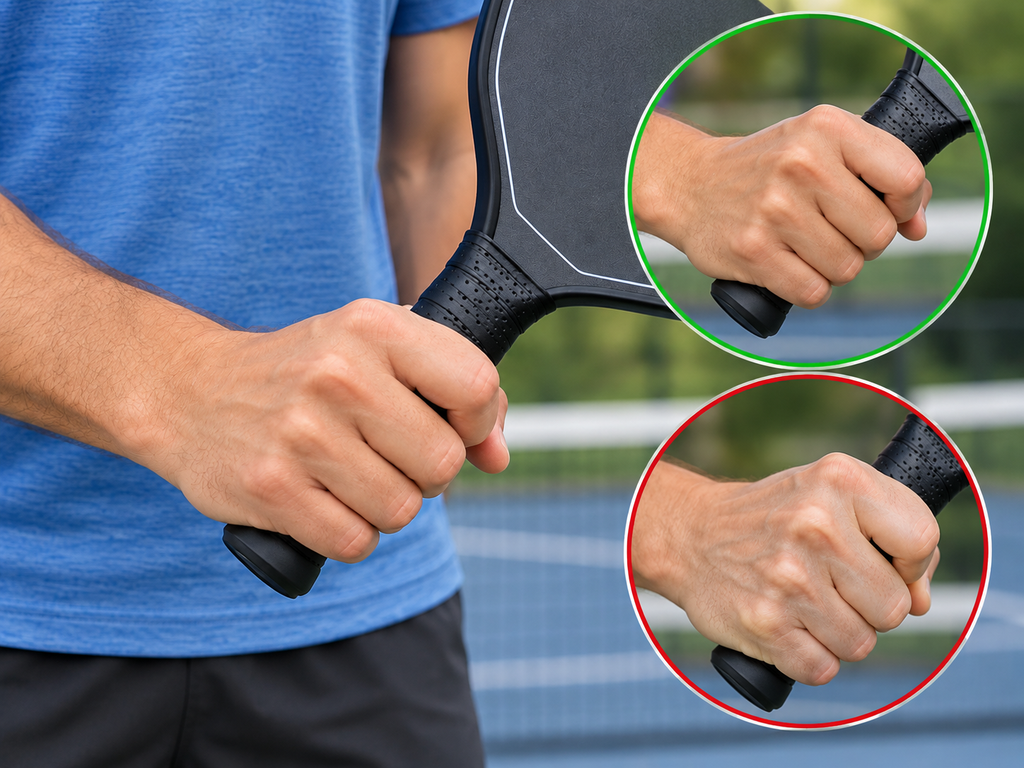
Relaxed does not mean loose enough for the paddle to move unpredictably.
When you gently move the paddle forward, backward or from side to side, the handle should remain reasonably stable in your hand. If the paddle repeatedly rotates without you intending it to, slips downward or feels as though it could leave your hand, increase your grip pressure slightly or improve the way your fingers are wrapped around the handle.
Stability becomes especially easy to notice when you slowly change the paddle’s orientation. Hold it in front of you and gently turn the paddle one direction and then the other. Your hand should remain connected to the handle without needing to clamp down with maximum force.
This exercise is not intended to teach paddle-face control or stroke mechanics. It simply allows you to test whether your beginner pickleball grip keeps the paddle under control during basic movement.
Your grip has reached a useful starting point when the paddle follows your intended movement rather than shifting independently inside your hand.
Security also matters for safety. The paddle should always be held well enough that normal practice movement will not cause it to slip or leave your hand. Maintain adequate space from other people whenever you are experimenting with paddle movement, and avoid exaggerated swings during grip practice.
Reset to the Same Grip
A functional grip becomes more useful when you can find it again without a long adjustment process.
Hold the paddle in your normal beginner grip and briefly notice three things: where your fingers sit, where your thumb rests and how much pressure you are using.
Then place the paddle safely in your other hand or release your gripping hand briefly.
Re-grip the handle.
Check the position again.
The goal is not to reproduce the placement with microscopic precision. You are developing a recognizable default grip that feels familiar whenever you pick up the paddle.
Repeat the process several times. If each attempt produces a completely different position, slow down and use the same simple reference points: hand on the handle, fingers wrapped securely, thumb supporting the hold and pressure comfortable rather than excessive.
Eventually, you should be able to pick up the paddle and find your basic grip with very little thought.
This repeatability is more useful at this stage than learning numerous specialized grip changes. The approved beginner progression specifically emphasizes returning to the same basic grip rather than introducing advanced variations for different strokes.
Recognize an Inefficient Grip
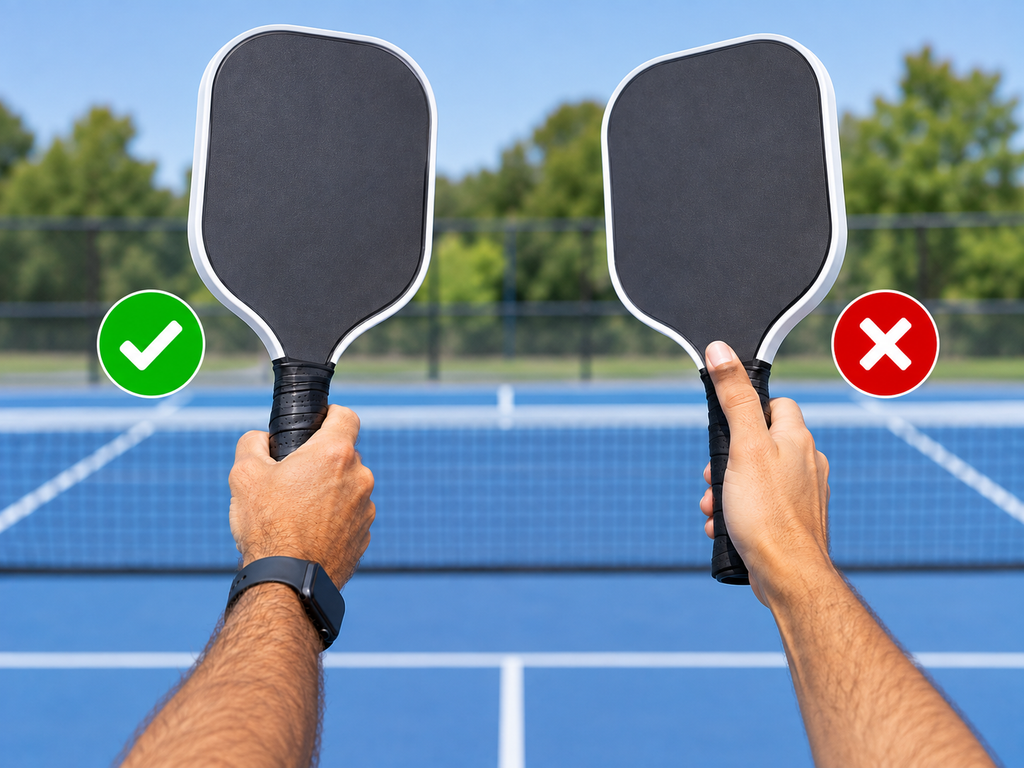
A beginner grip does not have to look identical from one player to another. However, several signs can tell you that your current hold is making paddle control unnecessarily difficult.
Excessive squeezing is easy to recognize. Your fingers, hand and forearm remain strongly tense even during gentle practice. The correction is to reduce pressure gradually while making sure the paddle remains secure.
Awkward hand placement may make the handle feel difficult to control or uncomfortable. Instead of forcing the position, move your hand slightly until your fingers can wrap naturally around the handle.
Repeated paddle rotation means the grip is probably too loose or poorly supported. Wrap the fingers more securely or add a small amount of pressure.
Unnecessary wrist and forearm tension often accompanies a grip that is tighter than necessary. Reduce the pressure and make smaller, slower paddle movements until you can maintain control without stiffness.
Difficulty finding the same grip again usually means you have not yet developed a simple default position. Repeated grip resets are more useful than experimenting with additional grip styles.
The important question is not, “Does my hand look exactly like another player’s?” It is, “Can I hold the paddle comfortably, securely and repeatedly?”
Common Beginner Grip Mistakes
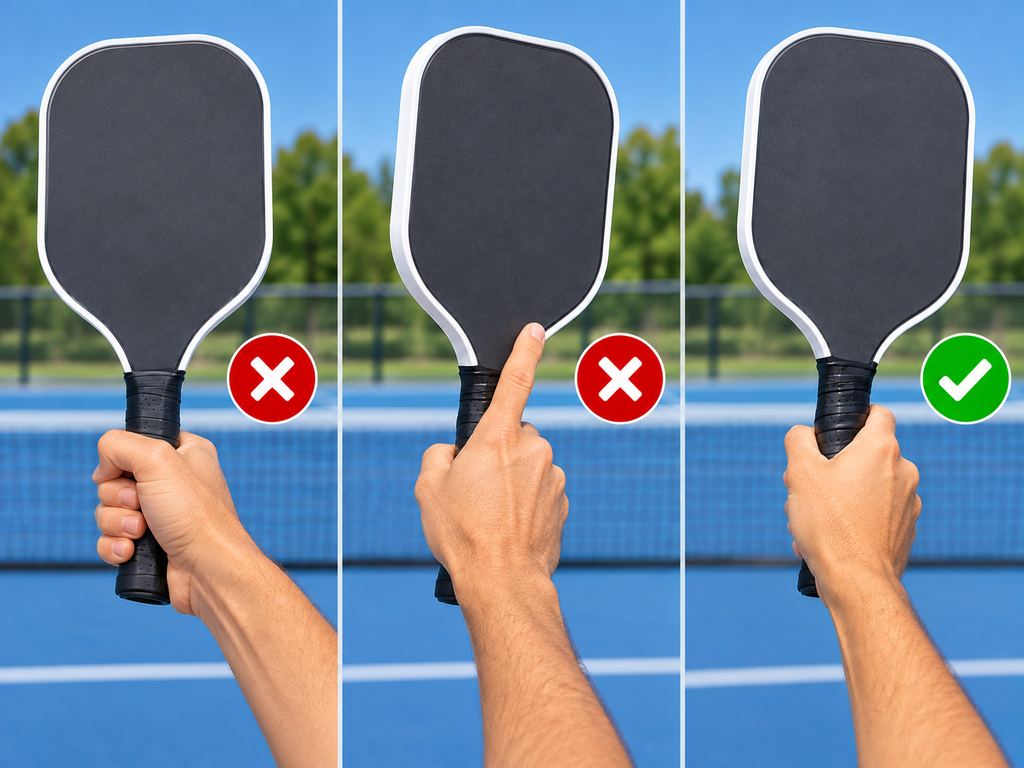
One frequent mistake is gripping as tightly as possible. Beginners sometimes believe a stronger hold automatically produces better control. Instead, start with enough pressure to prevent slipping and avoid maintaining unnecessary maximum tension.
Another mistake is holding too high on the paddle. Keep the hand primarily on the handle so the fingers can wrap around the gripping surface securely.
A third mistake is holding the paddle so loosely that it twists unexpectedly. Relaxation is useful only while the paddle remains under control. Add enough pressure to stabilize it.
Some beginners also change their hand placement after almost every movement. Constant changes make it harder to establish a repeatable starting position. For now, return to the same comfortable basic hold unless there is a clear reason to adjust it.
Another common problem is trying several advanced grip styles immediately. Grip terminology can become detailed, but learning several variations does not automatically improve beginner control. USA Pickleball’s current beginner instruction presents the continental grip as a versatile starting option, which supports keeping the initial approach simple rather than constantly changing grips.
Finally, avoid treating the name of the grip as more important than its function. Knowing a label does not help if the paddle is slipping, your forearm is rigid or you cannot reproduce the position. At this stage, comfort, security and repeatability matter more.
Practice: Grip Reset and Gentle Paddle Control
This activity develops the exact skill this lesson is designed to teach: establishing a secure, comfortable paddle grip repeatedly and maintaining it during gentle movement. The curriculum’s success standard is being able to recreate the grip without excessive squeezing and keep control of the paddle during low-force movement.
Use one paddle and stand in a clear area with adequate space around you. Full swings are not required.
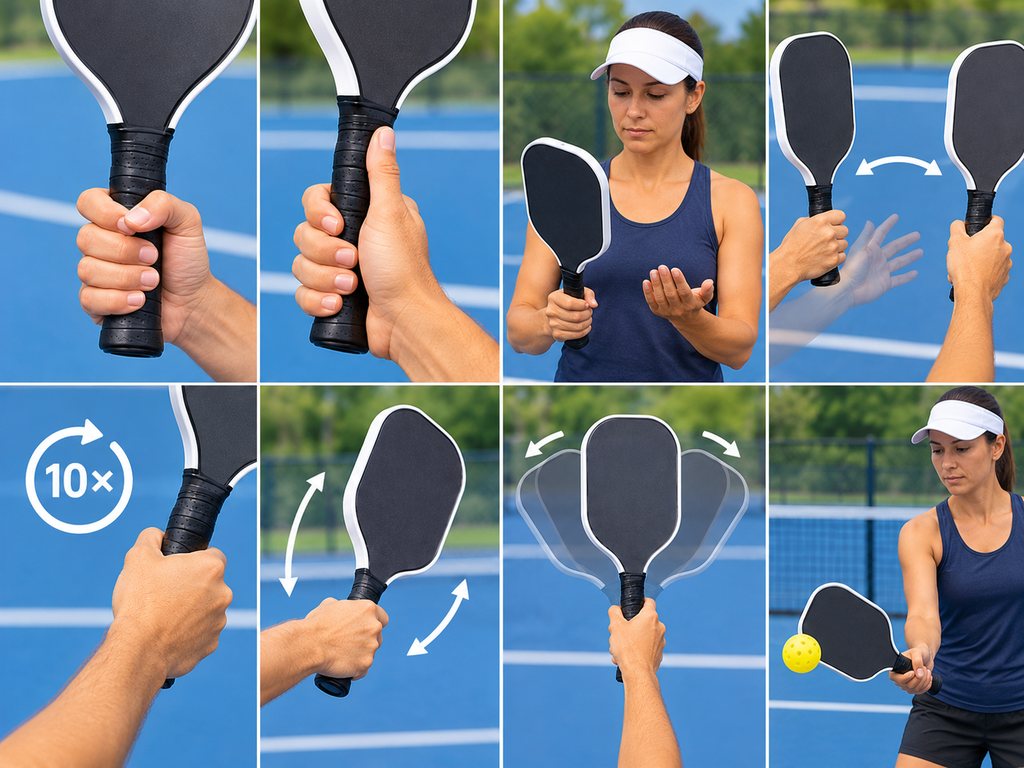
Hold the paddle by the handle and establish your comfortable grip. Check that your fingers are wrapped securely and that the thumb supports the hold. Notice whether your hand and forearm contain unnecessary tension. Hold the paddle in front of your body for a moment. Release your gripping hand briefly, then re-establish the same grip. Repeat this grip-reset process 10 times. After each reset, check both hand placement and pressure rather than trying to complete the repetitions quickly. Next, make small, gentle forward-and-back paddle movements while keeping the handle secure. Slowly change the paddle orientation a little in each direction and check whether it remains stable rather than rotating unexpectedly. If you have adequate space and can do so safely, finish with a few gentle, stationary, low-force ball contacts. Do not use full swings. Concentrate on maintaining the same secure grip throughout the activity. Stop and reset whenever the grip becomes excessively tight or the paddle begins slipping.
Success does not mean completing the activity quickly. You have met the objective when you can establish approximately the same comfortable pickleball paddle hand position repeatedly and maintain control of the paddle during gentle movement.
If the grip feels uncomfortable, change it rather than forcing the position. If the paddle feels unstable, improve finger contact or add a small amount of pressure. If your hand and forearm become unnecessarily tense, reduce the pressure and repeat the movement more gently.
Build Control Before Adding Complexity
A beginner does not need a collection of specialized grips before learning to control the paddle.
Different grip styles and grip changes can be useful in more developed play, but they add complexity that is not necessary for this first paddle-control skill. The approved lesson scope specifically excludes specialized grip changes, advanced spin grips, serve grips and detailed grip terminology.
For now, keep your attention on four simple questions.
Is your hand on the handle?
Does the position feel comfortable?
Is the paddle secure without excessive squeezing?
Can you find the same grip again?
If the answer to all four is yes, you have a functional beginner grip.
This is also coaching guidance rather than a requirement that every pickleball player use one exact hand position. The current USA Pickleball rulebook governs how the game is played and separately addresses equipment requirements; beginner grip technique is taught through instructional guidance rather than as a prescribed playing position.
Summary
To Hold a Pickleball Paddle with a Comfortable Grip, place your hand securely around the paddle handle and allow your fingers to wrap naturally around it. Use enough grip pressure to prevent the paddle from slipping or rotating unexpectedly, but avoid continuously squeezing with maximum force.
Keep the hand, wrist and forearm reasonably relaxed during gentle movement. If the paddle feels unstable, improve the finger position or add a small amount of pressure. If your hand becomes unnecessarily tense, reduce the pressure while maintaining control.
Practice releasing and re-gripping the paddle until you can return naturally to the same functional beginner grip. Prioritize comfort, security, control and repeatability rather than complicated grip terminology or advanced variations.
Previous: Move Safely Around the Pickleball Court
Next: Use a Balanced Pickleball Ready Position