
Learning to Control the Pickleball Paddle Face is one of the first steps toward making predictable contact with a pickleball. The paddle face is the broad hitting surface that meets the ball. Small changes in the direction that surface points can noticeably change where the ball goes and how high it travels.
At this stage, you do not need a complete forehand, backhand, volley or serve. The goal is simpler: learn what the paddle face is doing at contact, make gentle contact near the usable center of the paddle and begin connecting a particular paddle angle with the resulting ball flight.
This is a control skill, not a power skill. Short movements and slow, predictable practice make it easier to see cause and effect. When the ball goes higher, lower or in an unexpected direction, you can observe the result and make a small correction rather than immediately swinging harder.
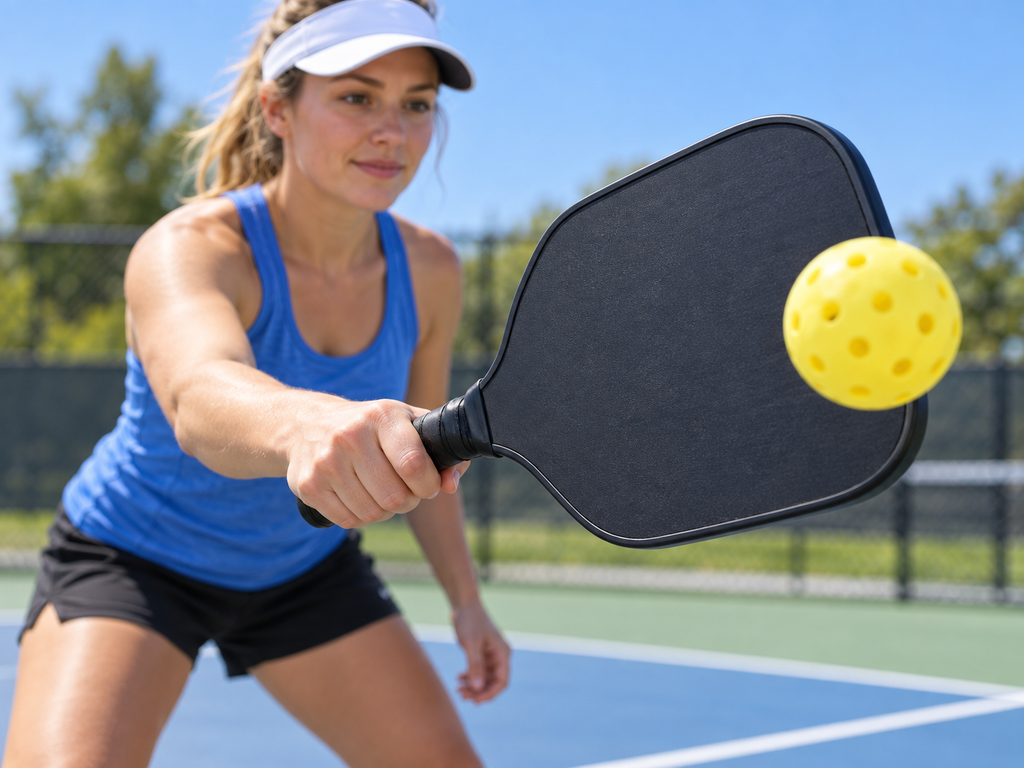
How to Control the Pickleball Paddle Face
To Control the Pickleball Paddle Face, begin in a balanced position with your normal comfortable grip and the paddle held in front of your body.
Use a simple sequence:
- Identify the hitting face of the paddle.
- Hold the paddle steadily in front of you.
- Make gentle contact with the ball.
- Watch the height and direction of the ball.
- Adjust the paddle face slightly if necessary.
- Repeat the contact and compare the result.
Keep each adjustment small. A major change in paddle angle can produce a major change in ball flight, making it difficult to understand which correction actually helped.
Your grip should remain secure but comfortable. There is no need to squeeze harder simply because you are concentrating on the paddle face. Excessive tension can make a simple movement feel stiff and difficult to repeat.
The terms open, neutral or square, and closed describe useful basic paddle-face orientations. A square face is approximately vertical, an open face points more upward, and a closed face points more downward. These are instructional descriptions rather than fixed positions that must be held at every moment of play.
Recognize an Open Paddle Face
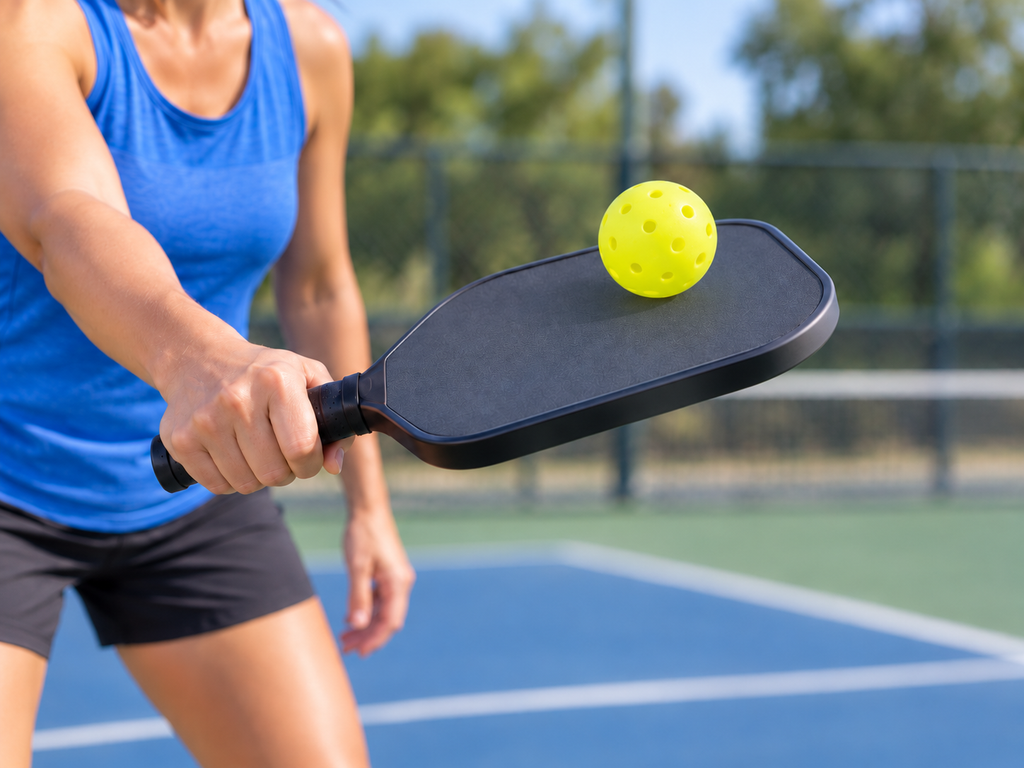
An open paddle face means the hitting surface is tilted upward rather than remaining approximately vertical.
Hold the paddle in front of you and imagine the hitting face looking partly toward the sky. The greater the upward tilt, the more open the paddle face has become.
With gentle contact, a more open face generally encourages the ball to leave the paddle on a higher path. A small amount of opening can therefore provide useful lift. Too much opening, however, may send the ball much higher than intended.
A beginner often opens the paddle excessively when trying to help the ball into the air. The resulting contact may send the ball upward rather than forward with control.
If your gentle contacts repeatedly rise much higher than you intended, do not make a dramatic correction. Turn the face slightly toward a more neutral position and try again.
Compare several repetitions. Your objective is to recognize the relationship between what the paddle face was doing and what happened to the ball.
Recognize a Closed Paddle Face
A closed paddle face is tilted in the opposite direction. The hitting surface points somewhat downward.
Starting from a roughly vertical paddle, gently rotate the hitting face toward the court. That is a closed tendency.
A more closed paddle face tends to send the ball on a lower path. If the face is excessively closed during simple beginner contact, the ball may travel downward too quickly or fail to gain enough height.
Beginners sometimes close the paddle unexpectedly while trying to control the ball with the hand or wrist. The paddle appears reasonably positioned before contact but changes angle as the ball arrives.
If your ball repeatedly travels much lower than expected, first check the paddle face. Return it slightly toward neutral rather than immediately adding a harder swing.
Again, use small changes. You are developing awareness of the face, not trying to discover one exact angle that works for every possible ball.
Find a More Neutral Paddle Face
Between strongly open and strongly closed positions is a more neutral paddle face. You may also hear a near-vertical orientation described as square.
For this lesson, think of neutral as a useful middle starting point rather than a perfectly measured angle.
Hold the paddle in front of your body and position the hitting surface approximately upright. Make a short, gentle contact and observe the ball.
A stable, reasonably neutral face can help produce a more controlled forward path when combined with suitable contact and paddle movement. The exact result still depends on several things, including where the ball meets the paddle and how the paddle is moving.
The important beginner skill is not memorizing a precise paddle angle. It is learning to recognize extremes.
If the face is dramatically open, notice it.
If the face is dramatically closed, notice it.
If the ball consistently follows an unintended path, compare the paddle angle at contact with the previous attempt and make a small adjustment.
With repetition, you should begin to associate a stable middle orientation with more predictable contact.
Contact the Ball Near the Center of the Paddle
Paddle-face control also depends on where the ball contacts the paddle.
Look at the broad hitting surface and identify its central usable area. During beginner practice, aim to meet the ball somewhere near this area rather than close to the top, bottom or side edges whenever practical.
You do not need perfect precision. A pickleball is moving, and real contact will naturally vary.
The goal is simply to make centered contact more often.
Off-center contact can produce a less predictable result. The paddle may feel different in your hand, the ball may leave at an unexpected angle or the contact may feel less stable than a more centered hit.
When this happens, avoid reacting by swinging harder on the next attempt.
Instead:
- • return the paddle to a comfortable position;
- • use the same short movement;
- • watch the next ball carefully;
- • concentrate on allowing the ball to meet the broad central portion of the paddle.
Think of centered contact as a target area rather than a tiny exact point.
This keeps the exercise practical and prevents you from becoming so concerned with perfect contact that your movement becomes tense.
Use a Short Controlled Paddle Movement
Large swings make paddle-face awareness more difficult.
When the paddle travels through a long backswing and a fast forward swing, several things can change before contact. The paddle face may rotate, the timing becomes more difficult and the extra speed can hide whether your main problem was angle, contact location or force.
Use a short controlled paddle movement instead.
Start with the paddle in front of your body. Move it gently toward the ball with a simple forward action. A slight upward component may be useful when the ball needs some lift, but the movement should remain compact.
You are not practicing a complete stroke.
Avoid winding the paddle far behind your body. Avoid trying to generate maximum speed. Avoid using a large follow-through merely because it feels more like a full shot.
For now, a successful contact is one you can observe and repeat.
After each contact, return the paddle in front of your body. Re-establish your balance and comfortable grip before the next repetition.
This makes each attempt easier to compare with the one before it.
Adjust One Thing at a Time
Beginners often make several corrections at once after a missed contact.
A ball goes too high, so the player closes the paddle face sharply, swings faster, changes the grip and moves the contact point all on the next attempt. If the following ball improves, there is no clear way to know why. If it becomes worse, there are too many possible causes.
Use a simpler method.
If the ball repeatedly travels too high:
Check whether the paddle face is excessively open. Move it slightly toward neutral and repeat the same gentle contact.
If the ball repeatedly travels too low:
Check whether the paddle face is excessively closed. Open it slightly and try again.
If the ball repeatedly travels in an unexpected direction:
Notice whether the paddle face remains stable during contact. Also check whether you are contacting the ball far from the central area of the paddle.
Then repeat.
Do not expect every ball to produce exactly the same result. Instead, look for an overall improvement in repeatability.
The useful sequence is:
contact → observe → make one small adjustment → repeat
This teaches you to use the ball’s flight as feedback.
Common Beginner Paddle-Face Mistakes
Opening the Paddle Too Much
The paddle is tilted strongly upward and gentle contacts rise much higher than intended.
Correction: Move the face only slightly toward a more neutral position. Keep the next movement just as gentle so you can compare the result.
Closing the Paddle Too Much
The hitting face points too far downward and the ball travels lower than expected.
Correction: Open the face by a small amount. Avoid solving the problem simply by swinging harder.
Changing the Face During Contact
The paddle begins in one position but rotates noticeably as the ball arrives.
Correction: Use a shorter movement and keep the hand comfortably stable. Focus on maintaining the chosen paddle-face orientation through the brief contact area.
Swinging Too Hard
The player tries to create control by increasing speed.
Correction: Reduce the movement. Use gentle contact so the relationship between paddle angle and ball flight is easier to observe.
Contacting Far from the Center
The ball repeatedly meets the edge or another outer portion of the paddle.
Correction: Slow the exercise down, use predictable feeds and concentrate on allowing the ball to reach the broad central hitting area.
Making a Large Correction After One Error
One high ball produces an extreme closed face on the next attempt, followed by another extreme correction.
Correction: Judge patterns rather than reacting dramatically to one contact. Make small adjustments and give yourself several repetitions to evaluate them.
Practice: Paddle-Face Control
Use a clear practice area with enough space between participants. Keep all activities low force, avoid hard swings and make sure unused balls remain outside normal movement areas.
Stage 1: Stationary Self-Taps
Begin with simple self-taps.
Hold the paddle in front of your body with a comfortable grip. Gently tap the ball upward from the paddle face.
Do not try to create a high bounce. Use enough force only to lift the ball a manageable distance.
As you tap:
- Watch the ball meet the paddle.
- Notice the angle of the paddle face.
- Observe where the ball travels.
- Try to keep the face stable.
- Repeat several times.
Start with individual taps if continuous tapping is difficult. Tap once, catch the ball and reset.
As control improves, try two or three gentle taps before catching it.
Your objective is not to set a juggling record. The exercise is successful when you can observe the relationship between face angle and ball direction.
Stage 2: Gentle Predictable Feeds
A partner can now provide slow, predictable feeds. If working alone, use another simple method that allows the ball to arrive gently without requiring fast movement.
Begin in a balanced ready position with the paddle in front.
The feeder sends the ball at an easy pace toward a comfortable contact area.
For each repetition:
- Watch the ball approach.
- Keep your grip comfortable.
- Use a short paddle movement.
- Contact the ball gently.
- Aim for the broad central part of the paddle face.
- Observe the resulting height and direction.
- Reset before the next feed.
Do not try to turn this into a rally. One controlled contact followed by a reset provides clearer feedback.
Complete several repetitions while keeping the face approximately neutral. Look for increasingly similar ball flights rather than maximum distance.
Stage 3: Small Adjustment Challenge
Once gentle contacts are reasonably repeatable, deliberately explore small paddle-face changes.
Start from your controlled position.
For several contacts, open the paddle face slightly. Observe whether the ball tends to leave on a higher path.
Then return toward neutral and compare the result.
Next, close the face slightly. Observe the lower tendency.
Return to the more controlled middle orientation.
The differences should be modest. Extreme paddle angles are unnecessary.
Finish by attempting several gentle contacts in which your goal is simply to produce similar ball height and direction repeatedly.
Progression
As your control improves, alternate between three tasks:
- • produce a slightly higher gentle contact;
- • return to a more neutral controlled contact;
- • produce a slightly lower gentle contact.
Use paddle-face adjustment rather than increased force as your main experiment.
Then return to your normal controlled contact and try to produce several similar results in succession.
If the exercise starts becoming fast or forceful, reduce the pace.
Looking for Sports Advice & Ideas?
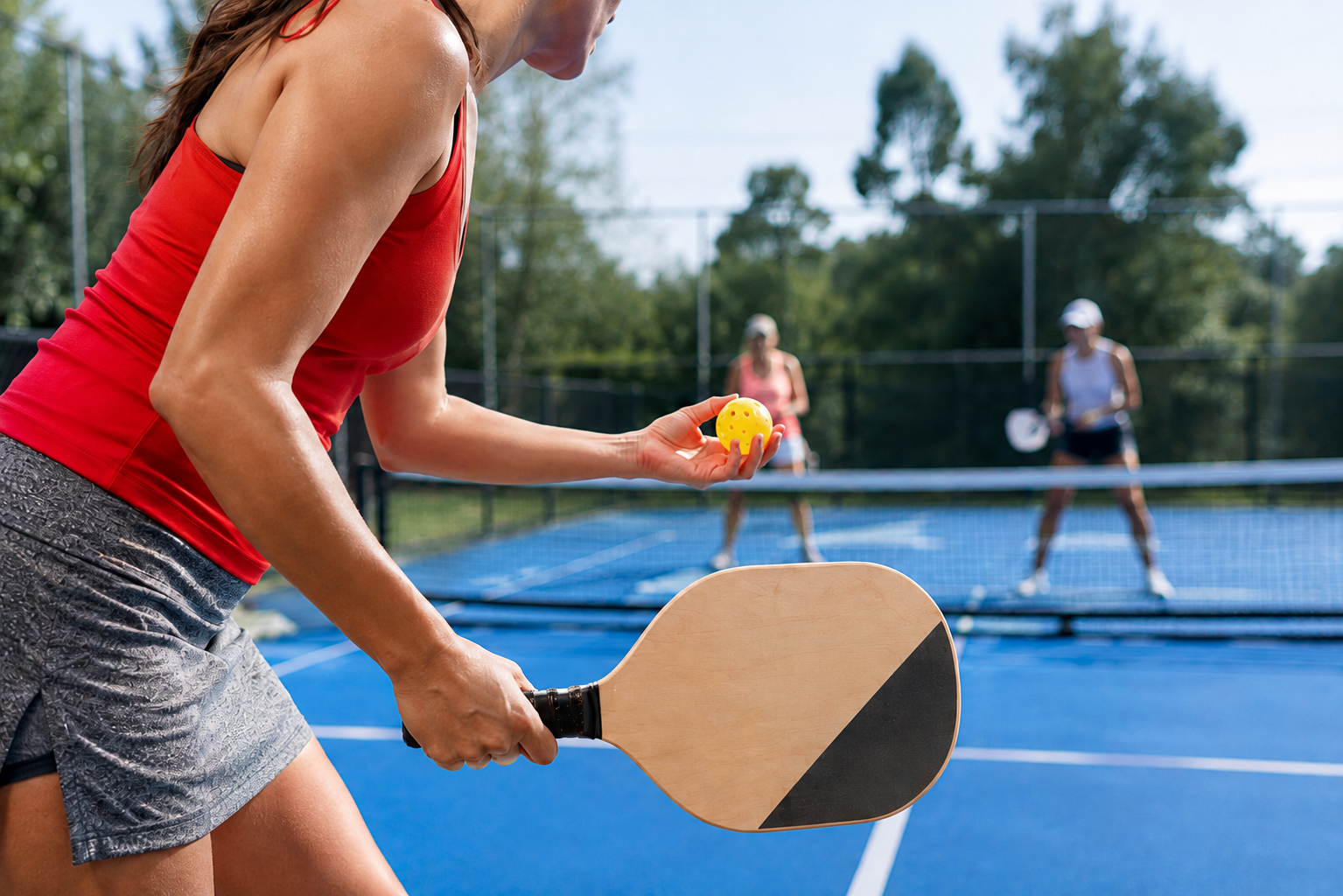
Pickleball Sports Articles
Pickleball Articles and Guides Discover practical pickleball tips, techniques, and strategies to help you improve your skills and enjoy every game. From learning the fundamentals and developing consistent shots to mastering…
Success Standard
You have completed the activity successfully when you can intentionally make small paddle-face adjustments, recognize how those adjustments affect the ball and produce several gentle, repeatable contacts without using a large swing.
Perfect contact is not required.
The important result is that you can observe what happened, identify a likely paddle-face correction and make the next adjustment in a controlled way.
Summary
The paddle face is the broad surface that contacts the pickleball, and its angle has a strong influence on basic ball height and direction.
An open paddle face is tilted upward and tends to produce a higher ball path. A closed face is tilted downward and tends to produce a lower path. A more neutral or square orientation provides a useful middle starting point for controlled beginner contact.
Aim to contact the ball near the broad central area of the paddle when practical. Keep paddle movements short, grip pressure comfortable and practice speed manageable.
When a contact does not produce the result you expected, observe the ball and adjust only a small amount. Avoid extreme paddle angles, oversized swings and large corrections after a single mistake.
Control develops through repeated gentle contact: observe the result, make one small adjustment and repeat.
Previous: Use a Balanced Pickleball Ready Position
Next: Track the Pickleball Through Flight and Bounce