
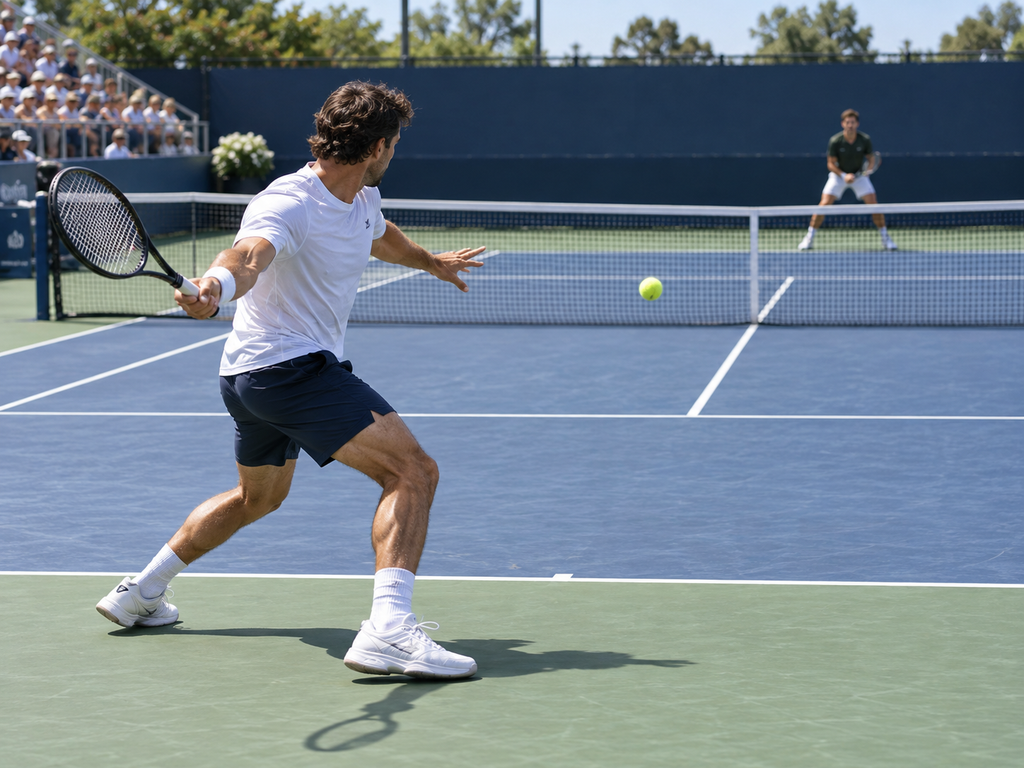
Making the right shot decision can be just as important as executing the shot itself. During competitive matches, advanced tennis players must constantly evaluate ball speed, spin, court position, opponent movement, and the available targets. A technically excellent groundstroke can still be the wrong choice if it introduces unnecessary risk or gives the opponent an advantage.
Effective tennis shot selection involves recognizing what the incoming ball allows you to do and choosing a response that fits the situation. Under pressure, this becomes particularly important. Players who understand when to attack, defend, redirect, or maintain a rally can make better use of their skills without depending on difficult winners or impulsive decisions.
Why Shot Selection Matters in Competitive Tennis
Shot selection is the process of choosing which shot to play based on the conditions of the rally.
It includes decisions about direction, depth, pace, spin, and whether to remain near the baseline or move forward.
At advanced levels, players often possess several technically reliable options. The challenge is determining which option provides the greatest practical advantage.
For example, a player may be capable of hitting a powerful down-the-line forehand. However, attempting that shot while stretched wide and contacting the ball late may be less effective than returning a controlled crosscourt ball.
Good shot selection helps players:
- Reduce unnecessary errors during difficult rallies.
- Recognize realistic attacking opportunities.
- Maintain pressure without overhitting.
- Adapt to an opponent’s court position.
- Preserve useful court coverage after each shot.
- Make reliable decisions during important points.
The objective is not always to choose the safest possible shot. It is to select an appropriate level of risk for the opportunity available.
Assess the Incoming Ball Before Choosing Your Shot
The incoming ball determines which shots are realistic.
Advanced players benefit from evaluating several characteristics before committing to a response.
Ball Depth
A deep ball that pushes you behind the baseline generally reduces your attacking options.
You may need to prioritize controlled contact and recovery.
A shorter ball can provide an opportunity to move forward and select a more aggressive target.
However, not every short ball is easy. A low, heavily spinning ball may still require a conservative response.
Ball Height
Contact height influences the available trajectories.
A high ball may allow a more aggressive shot if you can position yourself comfortably. A ball below net height usually requires an upward component to clear the net, making a powerful, downward-directed winner unrealistic from many positions.
Consider whether the ball’s height supports your intended target.
Ball Speed and Spin
Fast incoming shots reduce preparation time.
Heavy topspin can change bounce height, while slice may produce a lower or skidding bounce.
These characteristics affect your spacing, timing, and ability to redirect the ball.
A shot that is manageable against a slow feed may become unnecessarily risky against a fast, heavily spinning ball.
Your Balance and Contact Position
Even a favorable incoming ball may not create a genuine attacking opportunity if you arrive late or make contact while off balance.
Before attempting a demanding shot, assess whether you have enough time and space to execute it reliably.
Your physical position is part of the decision, not merely a technical detail.
Understand Your Shot Options Under Pressure
Advanced tennis requires recognizing the difference between maintaining a rally, applying pressure, and escaping a difficult situation.
Neutral Shots
A neutral shot helps maintain a competitive rally without introducing excessive risk.
It typically uses manageable pace, useful depth, and an appropriate target.
Neutral shots are especially valuable when neither player has a clear advantage.
They allow you to remain involved in the point while waiting for a better opportunity.
Attacking Shots
An attacking shot is intended to create or increase pressure.
It may involve greater pace, a more demanding angle, an earlier contact point, or movement toward the net.
The purpose is not necessarily to end the point immediately.
An effective attacking shot may force a weaker reply that creates a more favorable next opportunity.
Defensive Shots
A defensive shot is played when your court position or the incoming ball limits your options.
The objective is to return the ball in a way that gives you a chance to recover.
Depending on the situation, a deeper, higher shot or a controlled slice may provide additional time.
Attempting an aggressive winner while stretched wide or moving backward often creates unnecessary risk.
Finishing Shots
A finishing shot is selected when the opponent’s position and the available ball create a realistic opportunity to end the point.
Examples include a manageable short ball with open court available or a high volley near the net.
The important distinction is that finishing opportunities should be recognized rather than forced.
How to Choose Between Crosscourt and Down-the-Line Shots
Directional decisions are among the most common challenges in competitive tennis.
When Crosscourt Is the Better Option
A crosscourt groundstroke often provides useful margin because of the diagonal court distance and lower net height toward the center.
It may be the better choice when:
- You are in a neutral baseline rally.
- The incoming ball is difficult or deep.
- You are moving toward a sideline.
- You need a reliable target while recovering.
- A directional change would require an awkward contact.
However, crosscourt is not automatically safe. A short crosscourt ball can create an attacking opportunity for the opponent.
When Down the Line Makes Sense
A down-the-line shot may be appropriate when you are balanced, have time to prepare, and recognize a useful opening.
It can redirect a rally and force the opponent to change direction.
The decision should account for the higher net near the sideline, the shorter available court distance, and your recovery position afterward.
Avoid attempting this direction simply because the opposite court appears open.
The incoming ball must support a controlled redirection.
Use the Opponent’s Position to Guide Your Decision
Shot selection depends on more than your own contact position.
The opponent’s location and movement affect whether a target is useful.
Against an Opponent Positioned Behind the Baseline
A player standing deep may have more time to handle powerful groundstrokes but may need to cover additional distance to reach shorter balls.
A controlled shorter angle may be effective when you can execute it from a suitable position.
However, a weak short ball may allow the opponent to move forward and attack.
Against an Opponent Recovering From a Wide Position
An opponent moving toward the center may leave space behind their movement or toward the opposite court.
Choose a target that creates difficulty without requiring unnecessary precision.
Remember that the opponent’s recovery speed affects whether the opening is realistically available.
Against an Opponent at the Net
When facing a net player, your choices may include a passing shot, lob, or controlled ball directed toward their feet.
The appropriate response depends on the net player’s position and your ability to make contact.
A low ball struck from a defensive position may not provide a realistic passing-shot winner.
In that case, a controlled dipping return or lob may offer a better chance of extending the point.
Make Better Decisions When You Have Little Time
Not every rally allows extended analysis.
Against fast, aggressive opponents, decisions must often be made quickly.
The solution is to develop reliable decision rules through practice.
Use Simple Priorities
When pressured, concentrate on three questions:
- Can I make balanced contact?
- Is there a realistic attacking opportunity?
- Which target gives me the best chance of producing a useful next situation?
These questions do not need to become a deliberate checklist during every shot.
With practice, they can develop into automatic recognition habits.
Reduce Unnecessary Complexity
Trying to choose between too many options during a fast rally can delay preparation.
Develop a small number of dependable responses for common situations.
For example, you may use a controlled deep crosscourt ball as your usual response when stretched wide.
You can still select another shot when conditions justify it.
Prepare for More Than One Possibility
Avoid deciding on an attacking direction before recognizing the incoming ball.
Anticipation is useful, but premature commitment can create errors when the opponent changes placement.
Read the ball first, then finalize the shot decision as early as the available information permits.
How Match Score Influences Shot Selection
Pressure can change how players perceive risk.
A shot that feels comfortable at 40–0 may suddenly become difficult at break point.
Advanced players should recognize this psychological effect without allowing the scoreboard to dictate every technical decision.
On Break Points
A break point is important, but it does not automatically require a conservative or aggressive shot.
Choose an approach that reflects your strengths, the opponent’s tendencies, and the actual ball.
A well-established pattern may be more reliable than an unfamiliar attacking attempt.
During Tiebreaks
Tiebreak points can create pressure because each point contributes directly to a short scoring sequence.
Maintain your normal preparation routine and avoid making abrupt tactical changes solely because the score is close.
Use proven shot patterns while remaining responsive to opportunities.
After Losing Several Points
Players sometimes attempt difficult winners to reverse momentum immediately.
This can increase errors and reinforce the problem.
Instead, identify whether the previous points were lost through poor decisions, execution mistakes, or strong opponent play.
Adjust only what the evidence supports.
When Protecting a Lead
Playing excessively cautiously can allow an opponent to control rallies.
Continue using purposeful depth and placement rather than simply guiding balls into the court.
Appropriate risk remains necessary even when you are ahead.
Five Advanced Tennis Shot Selection Drills
These drills help players connect recognition, tactical decisions, and shot execution under realistic conditions.
Drill 1: Attack, Neutral, or Defend
Objective: Recognize the correct tactical response to different incoming balls.
Setup: A partner feeds balls with varied speed, depth, and placement.
Instructions:
- Begin in a balanced baseline position.
- Observe the incoming ball.
- Identify whether the situation favors attacking, neutral play, or defense.
- Execute a shot appropriate to that situation.
- Recover and prepare for the next feed.
- Repeat for three sets of eight balls.
Practice focus: Evaluate the decision separately from the shot result.
A technically missed ball does not necessarily mean the tactical choice was incorrect.
Drill 2: Directional Decision Challenge
Objective: Improve crosscourt and down-the-line choices.
Setup: Play controlled baseline rallies with a partner who varies ball placement.
Instructions:
- Begin a neutral rally.
- Maintain crosscourt exchanges when appropriate.
- Redirect down the line only when the incoming ball offers a realistic opportunity.
- Continue the point competitively.
- Review each attempted change of direction.
- Repeat for ten to fifteen points.
Practice focus: Recognize when a directional change is justified.
Drill 3: Pressure Feed Response
Objective: Develop reliable decisions when preparation time is limited.
Setup: Have a partner provide moderately fast, varied feeds.
Instructions:
- Begin near your normal rally position.
- React to the incoming shot without knowing its direction in advance.
- Choose a practical target based on your balance and available time.
- Avoid forcing winners from difficult positions.
- Recover and prepare for the next ball.
- Complete sets of six to ten feeds.
Practice focus: Simplify decisions under time pressure while maintaining purposeful placement.
Drill 4: Scoreboard Pressure Points
Objective: Maintain sound shot selection during important points.
Setup: Play practice games beginning at 30–30 or deuce.
Instructions:
- Begin each game at the selected score.
- Use normal serving and scoring rules.
- Play each point competitively.
- After the game, identify one important shot decision.
- Evaluate whether the choice matched the situation.
- Alternate servers and repeat.
Practice focus: Maintain tactical discipline rather than becoming excessively cautious or aggressive.
Drill 5: Decision Review Practice Set
Objective: Improve awareness of recurring shot-selection errors.
Setup: Play a short set against a regular practice opponent.
Instructions:
- Play using normal match rules.
- Record the session if practical.
- Review selected points afterward.
- Identify the incoming ball, your position, and the chosen shot.
- Consider whether another option offered a better risk-reward balance.
- Select one recurring decision-making issue for the next practice session.
Practice focus: Identify patterns across multiple points instead of criticizing isolated mistakes.
Common Tennis Shot Selection Mistakes
Attacking From Poor Balance
A player may recognize open court but lack the position required to reach it reliably.
Correction: Evaluate your contact and balance before selecting an aggressive target.
Choosing Targets That Are Too Demanding
A narrow sideline target may offer little advantage over a larger available area.
Correction: Use the amount of precision required to create pressure without taking unnecessary risk.
Playing Too Defensively Under Pressure
Fear of making an error can cause players to hit short, passive balls.
Correction: Maintain purposeful depth and suitable pace, even when prioritizing reliability.
Forcing Direction Changes
Changing direction from an awkward position can reduce control.
Correction: Redirect when the incoming ball and your preparation support the shot.
Ignoring the Opponent’s Recovery
An apparently open target may disappear before your ball reaches it.
Correction: Consider the opponent’s movement and available recovery time.
Judging Decisions Only by Results
A risky shot may occasionally win a point, while an appropriate shot may still miss.
Correction: Separate decision quality from execution quality when reviewing performance.
How to Measure Shot Selection Improvement
Improved tennis shot selection should produce more effective decisions across repeated match situations.
Track Decision Errors
Identify points where the selected shot was unnecessarily risky or poorly suited to the incoming ball.
Distinguish these from normal technical errors.
Measure Attacking Opportunity Conversion
Record how often you recognize manageable attacking balls and create pressure without immediately making an error.
You do not need to win every attacking point to demonstrate progress.
Monitor Errors Under Pressure
Compare unforced errors during neutral points with those occurring at deuce, break point, or late in a tiebreak.
Look for recurring changes in shot choice rather than assuming every pressure-point error has the same cause.
Evaluate Defensive Decisions
Observe whether your defensive returns give you a chance to recover and continue the rally.
A successful defensive decision may involve extending the point rather than immediately changing momentum.
Review Tactical Consistency
After several matches, identify whether you continue selecting appropriate shots when tired, frustrated, or facing unfamiliar opponents.
Progress involves maintaining reliable decision-making across different conditions.
Develop Better Shot Decisions Through Practice
Effective tennis shot selection requires recognizing the incoming ball, evaluating your position, and choosing a response that matches the opportunity.
Advanced players should learn to distinguish between situations that favor neutral play, controlled aggression, and defense. They should also recognize how the opponent’s position, available targets, and match score influence the risk associated with each choice.
Start by reviewing recurring decision-making mistakes during practice matches. Use structured drills to improve recognition, then test those decisions against unpredictable opponents and competitive scoring.
The goal is not to eliminate risk or make every shot perfect. It is to choose shots that make the best use of your abilities and give you a stronger chance of controlling the point over time.