
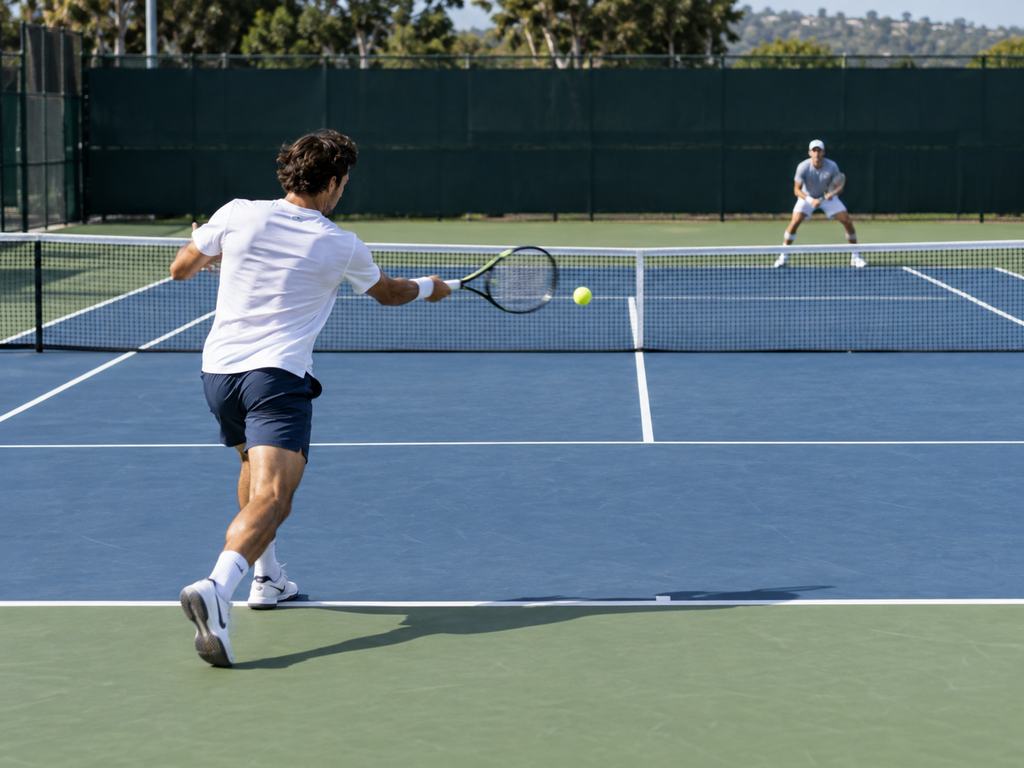
A strong serve can create an advantage, but what happens immediately afterward often determines whether that advantage continues. Advanced players understand that an effective service game involves more than delivering a fast or accurate first shot. It also requires anticipating the return, recovering into position, and selecting a first groundstroke that supports a deliberate tactical plan.
Developing a serve plus one tennis strategy helps players connect serve placement with the next shot instead of treating them as separate actions. By recognizing the returns that different serves are likely to produce, you can prepare earlier, apply pressure more consistently, and build points around your strongest groundstrokes.
What Is Serve Plus One in Tennis?
Serve plus one refers to the server’s first shot after the serve is returned. In most baseline situations, this is a forehand or backhand groundstroke, although it can also be a volley when the server moves forward.
The concept is straightforward: the serve and the next shot should work together tactically.
Rather than serving toward a target and reacting without a plan, the server considers where the return may travel and how to respond.
For example, a wide serve may pull the receiver toward the sideline. If the return comes back toward the middle, the server may have an opportunity to direct the next ball into open space.
However, the expected return is never guaranteed. An effective serve-plus-one pattern must remain flexible enough to handle different responses.
Why Serve Plus One Matters
Advanced serve-plus-one play can help players:
- Prepare for the receiver’s likely reply.
- Maintain an advantage created by serve placement.
- Reduce hesitation after the serving motion.
- Use a preferred groundstroke more frequently.
- Recognize when to attack or remain neutral.
- Create repeatable patterns during service games.
The primary objective is not necessarily to hit a winner with the first groundstroke.
A successful serve-plus-one shot may simply maintain pressure, force a defensive response, or establish control of the rally.
How Serve Placement Influences the First Groundstroke
The direction of the serve affects the receiver’s starting position, movement, and available return angles.
Understanding these relationships is the foundation of a purposeful serve-plus-one plan.
Wide Serve Plus One
A wide serve directs the receiver toward the outer portion of the service box.
When effective, it can force lateral movement and create space elsewhere in the court.
For example, a right-handed server delivering a wide slice serve from the deuce court may pull the receiver toward the receiver’s forehand side if the receiver is also right-handed.
Depending on the quality and direction of the return, the server may have an opportunity to attack the opposite side.
However, a wide serve can also create a sharp return angle.
If the receiver reaches the ball comfortably, they may direct the return away from the server.
Tactical principle: Use wide placement to create movement, but recover according to the actual return rather than assuming the court will remain open.
Body Serve Plus One
A body serve is directed toward the receiver’s position, making it more difficult to establish comfortable spacing.
A successful body serve may produce a shorter or less controlled return.
This can create an opportunity for the server to step forward and play a purposeful first groundstroke.
However, the receiver may still produce a strong reply, particularly if they anticipate the serve.
Tactical principle: Use body placement to disrupt return preparation and look for a manageable follow-up ball.
T Serve Plus One
A T serve travels toward the center service line.
This placement can reduce some of the wide return angles available to the receiver.
A strong T serve may also force a rushed response when the receiver is positioned toward the outside of the court.
If the return comes back through the middle, the server may have an opportunity to use a preferred groundstroke to begin applying pressure.
Tactical principle: Use central placement to influence return direction and prepare for a controlled attacking opportunity.
How Serve Spin Affects the Next Shot
Serve variation adds another dimension to point construction.
Different spins can alter the receiver’s contact position, timing, and likely return.
Flat Serve Plus One
A fast flat serve can reduce the receiver’s reaction time.
When effective, it may produce a blocked or abbreviated return.
The server should be prepared for the possibility of a shorter ball, but must not assume that every fast serve produces a weak reply.
After serving, recover promptly and evaluate the return’s depth.
If the ball is manageable, a controlled attacking groundstroke may be appropriate.
If the return is deep or powerful, prioritize a reliable response.
Slice Serve Plus One
A slice serve introduces lateral movement through its flight and bounce.
Wide slice serves can move the receiver away from the central court, potentially creating space for the next shot.
However, the sideways movement can also allow the receiver to produce a sharp angled return.
The server should adjust recovery according to the returner’s actual contact position.
Kick Serve Plus One
A kick serve can produce a high bounce that challenges the receiver’s preferred contact height.
An uncomfortable return may provide the server with a favorable first groundstroke.
For example, a kick serve toward an opponent’s backhand may produce a shorter reply if the receiver struggles with high contact.
However, advanced opponents may take kick serves early or return them aggressively.
Use the serve’s actual effect to guide the next shot.
How to Anticipate the Return Without Guessing
Anticipation is useful, but premature commitment can leave the server vulnerable.
A reliable serve-plus-one strategy combines knowledge of likely returns with continuous observation.
Watch the Receiver’s Starting Position
Before serving, notice whether the receiver stands close to the baseline, farther back, or toward one side.
This can influence both your serve selection and the likely return.
For example, a receiver standing far behind the baseline may have more time to react to a fast serve but may be vulnerable to certain wide angles.
Observe the Receiver’s Movement
After serving, identify how the receiver moves toward the ball.
A receiver who is stretched wide may have fewer comfortable directional options than one who reaches the ball in balance.
However, even defensive receivers can produce unexpected returns.
Use the movement as information rather than a guarantee.
Recover Before Committing
After completing the serve, establish balance and prepare for the next shot.
Avoid moving aggressively toward a predicted return before recognizing its actual direction.
A well-timed split step around the receiver’s contact can help you react to the outgoing ball.
Plan a Preferred Response and an Alternative
An effective pattern includes a preferred attacking option and a safe response if the return is better than expected.
For example:
Preferred response: Attack a manageable return with your forehand toward an available area.
Alternative response: Play a controlled deep groundstroke if the return arrives quickly or pushes you backward.
This flexibility prevents the tactical plan from becoming a liability.
Use Your Strongest Groundstroke After the Serve
Advanced players often attempt to create opportunities for their most effective groundstroke.
For a player with a powerful, reliable forehand, this may involve preparing to use the forehand on the first ball after serving.
Recognize the Forehand Opportunity
A return directed toward the middle may allow the server to move around the backhand and strike a forehand.
This is sometimes called a run-around forehand or inside-out forehand opportunity, depending on the target and resulting direction.
However, moving around the backhand requires enough time and court space.
Trying to force a forehand against a fast, deep return may leave the server out of position.
Prepare for the Backhand When Necessary
A strong serve-plus-one game should not depend entirely on one stroke.
If the return travels toward the backhand side and provides insufficient time to move around it, execute a controlled backhand instead.
Maintaining a favorable rally position is more important than forcing a preferred stroke on every point.
Match the Next Shot to the Return
A short, slower return may allow you to step forward and apply pressure.
A deep return may require a neutral groundstroke.
A wide return may force a defensive response.
The serve creates the tactical opportunity, but the return determines which follow-up is realistic.
Four Serve Plus One Patterns for Advanced Players
These patterns provide starting points for competitive practice. They should be adapted to the receiver’s positioning, strengths, and actual responses.
Pattern 1: Wide Serve, Attack Open Court
Sequence:
- Deliver a well-placed wide serve.
- Recover and observe the receiver’s movement.
- Identify whether the return provides a manageable attacking ball.
- Direct the first groundstroke toward an available area.
- Continue the point if the opponent reaches the shot.
Purpose: Use lateral displacement to create an attacking opportunity.
Common risk: Assuming the opponent cannot produce an angled return.
Pattern 2: Body Serve, Attack the Short Return
Sequence:
- Deliver a body serve that limits comfortable return preparation.
- Recover into a balanced position.
- Recognize whether the return lands short.
- Move forward on a manageable ball.
- Direct a controlled attacking groundstroke toward an appropriate target.
Purpose: Use uncomfortable return contact to create a shorter reply.
Common risk: Advancing before confirming that the return is attackable.
Pattern 3: T Serve, First Groundstroke to a Deep Target
Sequence:
- Serve toward the T with appropriate pace or spin.
- Recover and prepare for the return.
- Recognize the incoming ball’s direction and depth.
- Direct the first groundstroke toward a deep target that maintains pressure.
- Continue constructing the point.
Purpose: Use central serve placement to establish a controlled attacking sequence.
Common risk: Attempting a narrow target when the return does not provide sufficient time.
Pattern 4: Kick Serve to Backhand, Forehand Follow-Up
Sequence:
- Deliver a kick serve toward the receiver’s backhand side.
- Observe whether the high bounce creates an uncomfortable return.
- Prepare for a possible shorter or central reply.
- Use a forehand when the return and your position allow.
- Continue with a controlled attacking pattern.
Purpose: Create an opportunity for a preferred groundstroke through serve spin and placement.
Common risk: Moving around the backhand before knowing where the return will land.
Five Serve Plus One Tennis Drills
These exercises develop the connection between serving, recovery, return recognition, and the first groundstroke.
Drill 1: Serve and Recovery Timing
Objective: Improve readiness immediately after serving.
Setup: One player serves while a partner returns cooperatively.
Instructions:
- Deliver a serve toward a broad target.
- Complete the serving motion naturally.
- Recover toward an appropriate position.
- Use a split step as the receiver makes contact.
- Play a controlled first groundstroke.
- Repeat for ten serves from each side.
Practice focus: Establish balance before responding to the return.
Drill 2: Wide Serve and Open-Court Follow-Up
Objective: Connect wide serve placement with a suitable attacking response.
Setup: The server targets the wide section of the service box while the receiver returns normally.
Instructions:
- Serve toward the wide target.
- Observe the receiver’s position.
- Recognize the actual return direction.
- Attack an available area if the ball permits.
- Use a neutral response if the return is difficult.
- Continue the point.
Complete ten to fifteen repetitions.
Practice focus: Use the serve-created opportunity without forcing a predetermined winner.
Drill 3: Body Serve and Short-Ball Attack
Objective: Recognize attacking opportunities following body serves.
Setup: Serve toward a broad body target against a practice partner.
Instructions:
- Deliver the body serve.
- Recover promptly.
- Evaluate the return’s depth.
- Move forward when the ball is manageable.
- Execute a controlled first groundstroke.
- Continue until the point ends.
Practice focus: Distinguish between genuinely weak returns and those requiring a neutral response.
Drill 4: Preferred Groundstroke Challenge
Objective: Create appropriate opportunities for your strongest groundstroke.
Setup: Play service points with a partner who varies return direction.
Instructions:
- Choose a serve target.
- Prepare for the likely return without committing early.
- Use your preferred groundstroke when positioning permits.
- Select the other groundstroke when necessary.
- Continue the rally competitively.
- Review whether forcing your preferred shot helped or harmed the point.
Practice focus: Balance tactical preferences with sound court coverage.
Drill 5: Serve Plus One Practice Games
Objective: Apply serve-plus-one patterns under realistic scoring pressure.
Setup: Play standard service games against a regular practice opponent.
Instructions:
- Select a serve-plus-one objective before each point.
- Deliver the serve using your normal routine.
- Respond to the actual return.
- Continue the point using regular scoring.
- Record whether the intended pattern developed.
- Compare outcomes after several games.
Practice focus: Evaluate the quality of the serve and first-groundstroke combination, not simply whether the point was won.
Common Serve Plus One Mistakes
Admiring the Serve Instead of Recovering
A player may deliver an effective serve but remain unprepared for the return.
Correction: Treat recovery as part of the serving sequence.
Predicting the Return Too Early
Assuming the return will travel toward one target can leave the opposite side open.
Correction: Prepare for likely responses while maintaining the ability to react.
Forcing a Forehand on Every Return
Moving around the backhand can create an attacking opportunity, but it may also expose the court.
Correction: Use the preferred groundstroke only when time and positioning allow.
Attacking Every First Groundstroke
Not every serve produces an advantage.
Correction: Evaluate the return before increasing aggression.
Using Predictable Serve Patterns
Repeatedly choosing the same placement may allow the receiver to anticipate the return situation.
Correction: Maintain effective patterns while introducing purposeful variation.
Ignoring the Quality of the Serve
A serve that lands short or in a comfortable returning area may not create the expected opportunity.
Correction: Assess the actual serve and receiver response instead of relying on the planned sequence.
How to Measure Serve Plus One Performance
Serve-plus-one improvement should be evaluated through both tactical execution and competitive outcomes.
First Groundstroke Success
Track how often your first shot after the serve lands in the intended target area.
Compare results across similar serve placements and return conditions.
Serve-Created Attacking Opportunities
Record how frequently your serve produces a manageable attacking ball.
This helps determine whether your selected serve patterns are achieving their tactical purpose.
Errors on the First Groundstroke
Monitor unforced errors on the shot immediately following the serve.
Frequent errors may indicate poor recovery, overly aggressive choices, or an unrealistic tactical pattern.
Serve Plus One Points Won
Track points won when you successfully execute the intended serve and first-groundstroke sequence.
However, do not rely on this statistic alone.
The quality of the opponent’s return and subsequent rally can influence the result.
Pattern Reliability Under Pressure
Compare your performance during cooperative practice with results during service games and tiebreaks.
An effective pattern should remain usable when the receiver changes direction or the score creates additional pressure.
Build a Service Game Around the First Two Shots
A reliable serve plus one tennis strategy connects serve placement, return recognition, recovery, and purposeful first-groundstroke selection.
Begin by identifying which serve targets most often produce manageable returns. Develop a preferred follow-up shot while maintaining a practical alternative for stronger replies.
Practice these combinations against live receivers instead of relying only on predictable feeds. As your execution improves, introduce different serve types, return positions, and match-scoring situations.
The goal is not to win every point immediately after serving. It is to use the serve and first groundstroke together to establish a favorable rally position, maintain pressure, and create better opportunities as the point develops.