
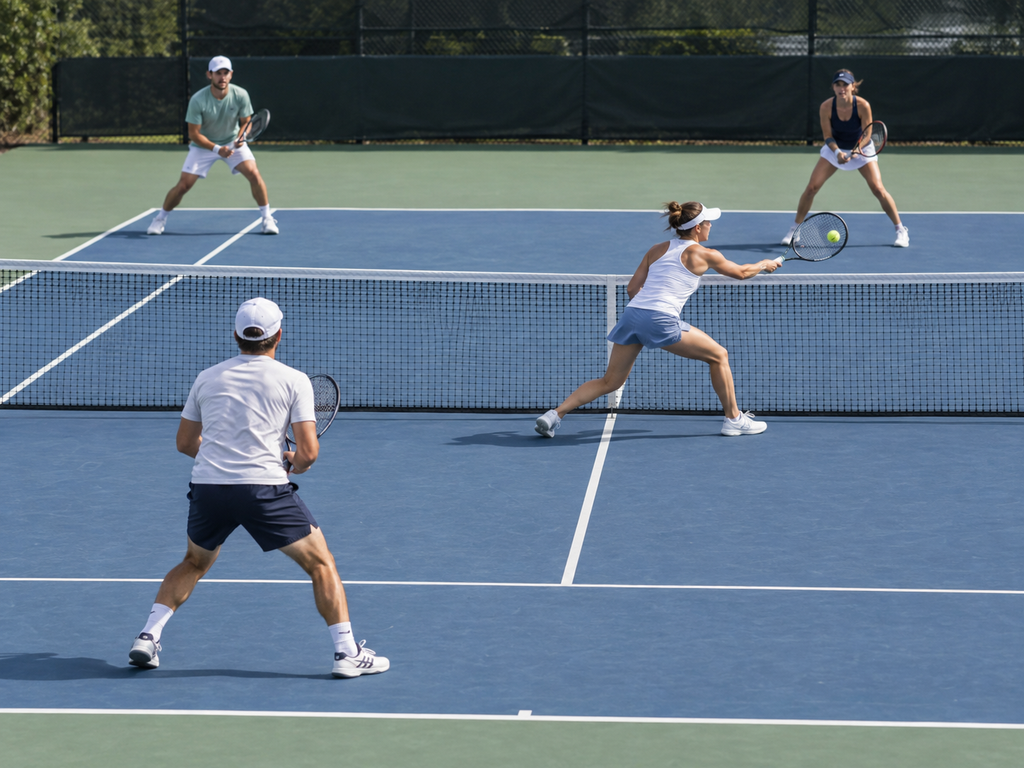
Competitive doubles tennis demands more than dependable serves, returns, and volleys. At advanced levels, players must coordinate their movements, influence the opponent’s return choices, and create pressure through positioning before the ball even crosses the net. Teams that consistently control the middle of the court and anticipate each other’s movements can make it difficult for opponents to establish comfortable rallies.
Developing advanced tennis doubles tactics involves using deliberate poaching movements, specialized serving formations, coordinated net coverage, and tactical communication. These techniques help experienced teams move beyond reacting to the ball and begin shaping how points develop. Their effectiveness depends on timing, reliable execution, and a shared understanding of each partner’s responsibilities.
What Makes Advanced Doubles Different?
Intermediate doubles strategy usually emphasizes fundamental court positioning, serving and returning responsibilities, and clear communication.
Advanced doubles adds coordinated tactical patterns intended to influence the opponent’s shot selection.
Rather than simply waiting for a volley opportunity, the net player may move deliberately to intercept a return. The serving team may use an unusual formation to change the receiver’s available targets, while the returning team may adjust its position to counter those movements.
Advanced doubles requires players to consider several factors simultaneously:
- Serve direction and the return angles it creates.
- The net player’s interception opportunities.
- Partner coverage when one player changes position.
- The opposing team’s preferred return patterns.
- Whether a formation creates pressure or exposes unnecessary space.
- How to disguise intended movements without compromising readiness.
The objective is not to use complicated formations on every point. It is to develop reliable options that make your team less predictable and more effective.
How Poaching Works in Doubles Tennis
Poaching occurs when the net player moves across the court to intercept a ball that would otherwise travel toward their partner.
It is one of the most recognizable attacking tactics in competitive doubles.
A successful poach can reduce the returner’s available time and turn a routine return into an attacking volley.
However, poaching also creates a temporary change in court coverage.
The timing and coordination of that movement are essential.
Recognize a Good Poaching Opportunity
Poaching is often more effective when the returner is under pressure or likely to hit toward a predictable area.
Potential opportunities include:
- A serve that forces the receiver into an uncomfortable contact position.
- A returner who repeatedly directs balls crosscourt.
- A second shot that is likely to float near the middle.
- A receiver who prepares late or struggles to change direction.
- A planned serve placement that supports the net player’s movement.
An effective poach should be based on more than simply seeing a ball near the center.
The net player must be able to reach and control the volley.
Time the Movement Carefully
Moving too early may allow the returner to recognize the opening and hit behind the poaching player.
Moving too late may prevent the net player from reaching the ball.
In a planned poach, the net player commonly begins moving around the returner’s hitting action, using the serve’s direction and the receiver’s preparation as cues.
The precise timing depends on serve speed, distance from the net, and the returner’s tendencies.
Choose the Volley Target
After intercepting the ball, the poaching player should select a target that reduces the opponents’ ability to respond.
Depending on the available court, useful options may include:
- A firm volley toward open space.
- A controlled volley between the opposing players.
- A low volley directed toward an opponent’s feet.
- A short angled volley when contact height permits.
Attempting maximum power is not always necessary.
A well-placed interception may be more effective than a harder volley directed toward an opponent who is already prepared.
Planned Poaching vs. Reactive Poaching
Advanced doubles teams benefit from understanding the difference between prearranged and opportunistic movement.
Planned Poaching
In a planned poach, the server and net player agree before the point that the net player will attempt to cross.
The server is responsible for adjusting court coverage if the movement occurs.
This approach can create pressure because the net player commits to an interception opportunity.
However, it also creates risk if the returner directs the ball behind the poaching player.
Clear communication is essential.
Reactive Poaching
Reactive poaching occurs when the net player recognizes an opportunity during the rally.
The movement is based on the opponent’s contact and the ball’s likely path rather than a predetermined plan.
This may be appropriate when a return floats slowly toward the center or the opponent makes contact while off balance.
The partner must recognize the movement and adjust accordingly.
When Not to Poach
Avoid forcing a poach when:
- The returner has comfortable contact and clear down-the-line options.
- The server cannot cover the space left behind.
- The net player is too far from the intended interception.
- The incoming ball is likely to be too low or fast for a controlled volley.
- Communication between partners is unclear.
An unsuccessful poach can leave the court exposed.
The objective is to create an advantage, not simply move aggressively.
Understanding the I-Formation in Doubles
The I-formation is a specialized serving arrangement in which the server’s partner begins near the center service line, usually in a low crouched position.
Viewed from behind the server, the two teammates appear approximately aligned along the center of the court.
The formation is intended to make the net player’s post-serve movement less predictable.
How the I-Formation Works
Before serving, the partners agree on the net player’s movement.
The net player may move toward either side after the serve.
The server adjusts to cover the appropriate part of the court.
The receiving team must respond without knowing exactly which direction the net player will take.
Why Teams Use the I-Formation
The I-formation can help:
- Disrupt predictable crosscourt returns.
- Create uncertainty about the net player’s movement.
- Encourage the receiver to change their preferred return target.
- Set up planned interceptions.
- Change the rhythm of a return game.
However, its effectiveness depends on execution.
A receiving team that recognizes the pattern early may target the area the serving team leaves exposed.
Communicating the Movement
Teams often use agreed hand signals or verbal instructions before the serve.
For example, the net player may indicate whether they intend to move left or right.
Both partners must understand who will cover each area after the movement.
Do not introduce the formation during an important match without first practicing its responsibilities.
Understanding the Australian Formation
The Australian formation places the server and net player on the same general side of the center line before the serve.
This differs from a conventional serving formation, where the net player usually starts on the opposite half from the server.
The Australian formation can change the return angles and encourage the receiver to select a less familiar target.
How the Formation Creates Pressure
By occupying the same side, the serving team presents an unusual court arrangement.
The receiver may need to return down the line or toward another area that differs from their preferred crosscourt target.
The server usually moves to cover the opposite side after serving, according to the team’s plan.
When to Use the Australian Formation
This formation may be useful when:
- The receiver consistently produces strong crosscourt returns.
- The serving team wants to influence return direction.
- The net player is effective at controlling the middle.
- The partners have practiced the required coverage movement.
It is less useful when the receiver can consistently exploit the available opening or when the server struggles to recover into position.
I-Formation vs. Australian Formation
| Feature | I-Formation | Australian Formation |
|---|---|---|
| Starting net-player position | Near the center service line | Same general side as the server |
| Main tactical purpose | Disguise the net player’s direction | Change conventional return geometry |
| Movement requirement | Coordinated movement to either side | Server and partner cover designated areas |
| Common risk | Leaving space if movements are mistimed | Exposing the opposite side |
| Communication | Planned signals and coverage | Planned signals and coverage |
Neither formation is automatically superior.
Choose the arrangement that supports your team’s strengths and challenges the receiver’s preferred patterns.
How to Control the Net as a Doubles Team
Net control involves more than standing close to the net.
It requires coordinating positions so that the team can intercept appropriate shots without exposing excessive space.
Control the Middle
The middle of the doubles court is a valuable attacking area because balls directed there may create uncertainty between opponents.
A net player who can intercept central balls places pressure on the opposing team.
However, moving too aggressively toward the middle can leave the alley exposed.
The correct position depends on the ball’s location and the opponent’s available shot angles.
Move Together
When both partners are near the net, they should respond to the ball’s location as a coordinated unit.
If one player moves toward the sideline, the other may need to adjust toward the center to reduce the resulting gap.
Avoid maintaining fixed positions while the rally moves across the court.
Recognize Low and High Volley Opportunities
A higher volley may provide an opportunity to finish the point with controlled placement.
A low volley often requires a more conservative response because the ball must travel upward to clear the net.
Advanced net players should recognize the difference and avoid attempting difficult winners from unsuitable contact heights.
Anticipate the Lob
Teams that move aggressively forward must remain aware of lob opportunities.
A player positioned very close to the net may struggle to recover against a well-placed lob.
Coordinate which partner will retreat when a lob travels over the team.
The correct response depends on ball direction, height, and each player’s position.
Build Serve-and-Net Patterns
The serving team’s first two movements can strongly influence a doubles point.
A planned combination of serve placement and net-player action may create an attacking opportunity before the rally develops.
Wide Serve With Net Pressure
A wide serve forces the receiver to move laterally.
The net player may use the receiver’s movement to anticipate a return through a reachable area.
However, a comfortable receiver may also produce a sharp angle or return behind an aggressive poach.
Use the pattern only when the serve creates a realistic interception opportunity.
Body Serve With Central Coverage
A body serve may restrict the receiver’s preparation and produce a more central reply.
The net player can prepare to intercept a ball traveling through the middle.
The server must remain ready for a return that bypasses the net player.
T Serve With Planned Movement
A serve toward the T may encourage particular return directions depending on the receiver’s position.
The net player can use an agreed movement to challenge the likely response.
This pattern is especially useful when the serving team has already observed a repeatable return tendency.
The key is to coordinate the serve, net movement, and server recovery rather than treating them as separate actions.
How to Counter Aggressive Doubles Formations
Advanced doubles also requires knowing how to respond when opponents use poaching and unconventional formations.
Against Frequent Poaching
An opponent who crosses aggressively may leave space behind their movement.
A controlled down-the-line return can discourage predictable poaching when the target is available.
Another option is to return with enough control to prevent an easy interception.
Avoid forcing a difficult down-the-line winner simply because the net player moves.
Against the I-Formation
Observe whether the net player consistently moves toward one side.
If the movement becomes predictable, select a return target that exploits the resulting opening.
Maintain awareness of the server’s recovery position.
Against the Australian Formation
Recognize which side of the court the serving team initially leaves less protected.
Choose a return target that you can execute reliably while considering where the server is likely to move.
A formation may appear to create a large opening, but a coordinated serving team can recover quickly.
Target the actual available space rather than relying only on the starting positions.
Five Advanced Doubles Tactical Drills
Drill 1: Planned Poaching Practice
Objective: Coordinate net-player movement with serve placement.
Setup: Four players take normal doubles serving and receiving positions.
Instructions:
- The serving team agrees on a poaching direction.
- The server delivers a controlled serve.
- The net player moves according to the plan.
- The server adjusts court coverage.
- The returner plays a realistic return.
- Continue the point competitively.
Complete ten repetitions before changing roles.
Practice focus: Timing, communication, and court coverage after the attempted interception.
Drill 2: I-Formation Movement Drill
Objective: Develop reliable movement responsibilities from the I-formation.
Setup: The server’s partner begins near the center service line in an appropriate low position.
Instructions:
- Agree on the net player’s movement direction.
- Use a clear signal before serving.
- Deliver a controlled serve.
- Move into the planned coverage positions.
- Play out the return.
- Repeat using the opposite movement direction.
Practice focus: Coordinated positioning rather than attempting an immediate winner.
Drill 3: Australian Formation Coverage
Objective: Improve movement and recovery from the Australian formation.
Setup: Both serving partners begin on the same general side of the center line.
Instructions:
- Identify each partner’s post-serve responsibility.
- Deliver the serve.
- Move into the planned coverage positions.
- Have the receiver vary return placement.
- Continue the point.
- Review any uncovered areas.
Practice focus: Recover efficiently without leaving unnecessary space.
Drill 4: Two-Up Net Control
Objective: Improve coordinated net coverage.
Setup: Two players begin near the net while opponents feed controlled shots from the baseline.
Instructions:
- Maintain useful spacing between partners.
- Adjust laterally according to ball direction.
- Intercept appropriate shots.
- Communicate on central balls.
- Respond to occasional lobs.
- Repeat in sets of eight to ten feeds.
Practice focus: Maintain coordinated movement and choose realistic volley targets.
Drill 5: Formation Selection Practice Set
Objective: Apply different serving formations against a live receiving team.
Setup: Play a short doubles set.
Instructions:
- Use conventional positioning for several service points.
- Introduce the I-formation during selected points.
- Use the Australian formation when appropriate.
- Record return quality and court-coverage problems.
- Review which formation creates the most useful pressure.
- Adjust the tactical plan as the set develops.
Practice focus: Select formations based on their effectiveness rather than using variation simply for novelty.
Common Advanced Doubles Mistakes
Poaching Too Early
Moving before the receiver commits can reveal the intended interception.
Correction: Practice timing the movement around the receiver’s contact while maintaining balanced preparation.
Poaching Without Partner Coverage
An aggressive net movement may leave an opening if the server does not adjust.
Correction: Agree on coverage responsibilities before using planned poaches.
Using Complicated Formations Without Practice
The I-formation and Australian formation can create confusion when partners do not understand their roles.
Correction: Rehearse positioning and movement before applying them in competition.
Standing Too Close to the Net
Excessive forward positioning may increase vulnerability to lobs.
Correction: Choose a position that balances volley opportunities with the ability to respond to higher balls.
Becoming Predictable
Repeatedly using the same poach direction can allow opponents to anticipate the movement.
Correction: Maintain effective patterns while introducing deliberate alternatives.
Ignoring the Receiver’s Strengths
A formation that works against one returner may be ineffective against another.
Correction: Evaluate return tendencies and adapt the team’s tactical plan.
How to Measure Advanced Doubles Performance
Advanced doubles tactics should be evaluated through both their immediate results and their influence on the opponent’s decisions.
Poaching Success
Track planned poach attempts, successful interceptions, and points won.
Separate a well-timed poach that produces an error from a poor attempt that happens to win the point.
Formation Effectiveness
Compare return quality and point outcomes when using conventional, I-formation, and Australian positioning.
A formation should create a practical advantage rather than simply appear unusual.
Net Interception Rate
Observe how often the net player reaches appropriate central balls and directs volleys toward useful targets.
Coverage Errors
Record points lost because partners moved into the same area or left an avoidable opening.
Repeated coverage errors often indicate communication problems.
Return Pressure
Evaluate whether your formations and net movements cause opponents to choose less comfortable return targets.
A successful tactic may create pressure even when the net player does not touch the ball.
Build a More Coordinated Doubles Attack
Effective advanced tennis doubles tactics depend on purposeful movement, reliable communication, and coordinated court coverage.
Poaching allows the net player to challenge expected returns, while the I-formation and Australian formation create different tactical possibilities during service points. Strong net control helps teams maintain pressure without leaving unnecessary openings.
Begin by developing one dependable planned poach and practicing the required partner coverage. Then introduce specialized formations and evaluate how opponents respond.
As your coordination improves, select tactics according to the receiving team’s tendencies and your own strengths. The goal is not to use the most complicated formation, but to make your doubles team more effective, adaptable, and difficult to predict.