
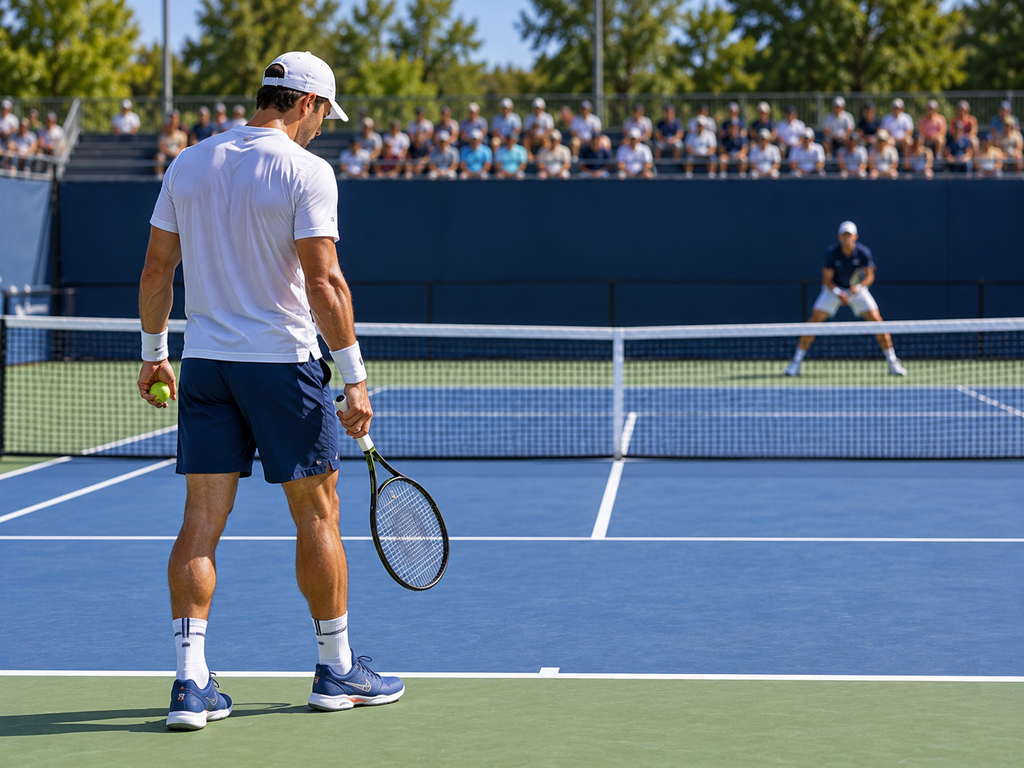
Competitive tennis challenges more than a player’s physical skills. Even experienced players can struggle to perform consistently when facing break points, losing several games in succession, or trying to close out a match. A technically reliable serve may become less dependable under pressure, while frustration after a missed shot can affect decisions during the following point.
Developing tennis mental toughness helps players respond more effectively to these situations. It involves maintaining attention, managing emotions, and continuing to make purposeful decisions regardless of the score. Mental toughness does not mean ignoring frustration or remaining completely calm throughout a match. It means recognizing difficult reactions and using practical routines to return attention to what can be controlled.
What Is Mental Toughness in Tennis?
Mental toughness refers to the psychological skills that help players perform effectively when facing challenges, uncertainty, and competitive pressure.
In tennis, these skills include concentration, emotional regulation, confidence, resilience, and the ability to make appropriate decisions after setbacks.
A mentally tough player is not necessarily someone who never feels nervous.
Even experienced competitors may experience tension before an important serve or frustration after a missed opportunity.
The difference lies in how they respond.
Useful mental skills include:
- Maintaining attention on the current point.
- Recovering after mistakes without prolonged distraction.
- Using consistent preparation routines.
- Making tactical decisions without becoming overly cautious or reckless.
- Responding constructively to changes in momentum.
- Accepting uncertainty without abandoning a match plan.
- Evaluating performance without allowing individual mistakes to define the entire match.
These abilities can be developed through structured practice.
Like stroke technique or court movement, mental skills generally become more reliable when practiced repeatedly under realistic conditions.
Understand How Pressure Affects Tennis Performance
Pressure develops when a player considers an outcome especially important.
A break point, tiebreak, match point, or decisive service game may increase the perceived consequences of an error.
This can affect attention, movement, and decision-making.
Physical Responses to Pressure
Competitive pressure may produce increased heart rate, muscle tension, faster breathing, or a feeling of nervous energy.
These responses are not automatically harmful.
A moderate level of activation can support alertness and readiness.
However, excessive tension may interfere with fluid movement and coordinated stroke execution.
A player who becomes unusually tight may shorten the serving motion, rush a groundstroke, or lose confidence in a normally dependable technique.
Attention Changes Under Pressure
Some players become distracted by the score, previous mistakes, or the possibility of losing.
Others begin consciously controlling technical movements that normally occur automatically.
For example, thinking about several separate parts of the serving motion immediately before contact may disrupt an established rhythm.
During competition, simple performance cues are often more practical than detailed technical analysis.
Decision-Making Under Pressure
Pressure can encourage opposite reactions.
Some players become excessively conservative and avoid reasonable attacking opportunities.
Others attempt difficult winners to end points quickly and escape uncomfortable rallies.
Neither approach is automatically appropriate.
The objective is to select shots according to the actual rally situation rather than allowing anxiety or frustration to determine the decision.
Develop a Consistent Between-Point Routine
One of the most practical ways to strengthen tennis mental toughness is to establish a repeatable routine between points.
A useful routine creates a transition from the previous result to preparation for the next exchange.
It should be simple enough to use throughout an entire match.
Step 1: Acknowledge the Previous Point
Briefly recognize what happened without turning it into a prolonged emotional reaction.
If you missed a routine backhand, identify the problem only if the reason is reasonably clear.
Avoid repeatedly replaying the mistake.
A short observation such as “I rushed the contact” is more useful than labeling your entire performance negatively.
Step 2: Release Unnecessary Tension
Allow your shoulders, hands, and breathing to return toward a comfortable state.
You might take one controlled breath while walking toward your next position.
The objective is not to eliminate every sign of nervousness.
It is to avoid carrying unnecessary physical tension into the next shot.
Step 3: Choose a Simple Tactical Intention
Select one practical objective for the upcoming point.
Examples include:
- Serve toward a reliable target.
- Maintain useful depth during neutral rallies.
- Prepare early for the return.
- Use a familiar attacking pattern when the opportunity develops.
Avoid creating a complicated sequence that depends on the opponent producing one exact response.
Step 4: Commit to the Next Point
Once you have selected a practical intention, direct attention toward the next serve or return.
Use your normal ready position and preparation routine.
Follow the applicable time-between-points rules rather than extending the routine unnecessarily.
The purpose is to create dependable preparation, not additional delay.
How to Manage Pressure During Important Points
Important points often increase the temptation to change playing habits.
However, a point’s importance does not automatically change which tactical choice is most effective.
Break Points
When facing break point, concentrate on selecting a serve or return you can execute reliably.
Avoid introducing unfamiliar techniques simply because the point feels decisive.
If your normal serving pattern has been effective, consider continuing to use it.
If the opponent has consistently attacked a particular serve, make a purposeful adjustment.
The decision should reflect match evidence rather than fear.
Tiebreaks
Tiebreaks create frequent score changes and can make individual errors feel particularly significant.
Focus on the same preparation process used during ordinary games.
You may choose different tactics based on court position, opponent tendencies, or serve quality, but avoid treating every point as an emergency.
Serving for the Match
Players sometimes become unusually cautious when serving for a set or match.
They may reduce racket acceleration, guide second serves, or avoid attacking manageable balls.
Others become impatient and try to finish points immediately.
A better approach is to maintain your established serving rhythm and select shots based on their usual tactical value.
The goal remains to play an effective point, not to force the match to end.
Recover Mentally After Mistakes
Mistakes are unavoidable in competitive tennis.
A player can make a reasonable tactical decision and still miss the shot.
Mental recovery begins with distinguishing the decision from the execution.
Separate Good Decisions From Poor Execution
Imagine receiving a manageable short ball while your opponent is well outside the court.
You choose an appropriate target but miss the shot.
The result is disappointing, but the attacking decision may still have been correct.
Treating every error as evidence of a poor decision can discourage appropriate aggression.
Instead, evaluate whether the shot was suitable and whether the execution needs improvement.
Avoid Emotional Carryover
Frustration becomes especially harmful when it influences several points after the original mistake.
A missed volley may be followed by a rushed serve, an overly aggressive return, or a loss of concentration.
Use your between-point routine to interrupt that sequence.
Recognize the emotion without allowing it to determine the next tactical choice.
Replace Unhelpful Self-Talk
Self-talk can influence attention and confidence.
Statements such as “I always miss this shot” or “I’m going to lose this match” direct attention toward negative predictions.
Replace them with short, actionable cues.
Examples include:
- “Prepare early.”
- “Commit to the target.”
- “Play the next ball.”
- “Use my normal routine.”
The goal is not to make unrealistic positive declarations.
It is to focus attention on an action you can perform.
Understand Match Momentum Without Overreacting
Momentum is commonly used to describe periods when one player appears to gain confidence, control more rallies, or win several points in succession.
However, a sequence of won or lost points does not necessarily prove that an underlying psychological force has changed the match.
Tennis outcomes are influenced by serving order, shot execution, tactics, and normal variation.
Advanced players should examine what is actually changing.
When Your Opponent Wins Several Points
Avoid assuming that the opponent has become unbeatable simply because they have won several consecutive rallies.
Ask whether there is an identifiable pattern.
Are your returns landing short? Has the opponent improved first-serve placement? Are you making more errors when changing direction?
If you identify a repeated tactical problem, make an appropriate adjustment.
If no clear pattern exists, continue using reliable decisions rather than making unnecessary changes.
When You Win Several Games
Success can create its own problems.
A player who gains a lead may become impatient, attempt riskier winners, or lose concentration.
Continue evaluating the incoming ball and selecting appropriate targets.
Do not abandon a successful strategy simply because the score is favorable.
When the Match Changes Direction
An opponent may begin returning serve from a different position, changing spin, or attacking earlier.
These adjustments can produce a genuine tactical shift.
Recognize what has changed and consider a response.
The most useful question is not “Who has the momentum?” but “What is producing the current results?”
Build Confidence Through Preparation
Confidence is often treated as a feeling that players must create before competing.
In practice, dependable confidence can also develop from preparation and evidence.
Practice Important Situations
Repeatedly practicing serves at deuce, returns on break point, and tiebreak situations can make those conditions more familiar.
Simulation does not eliminate competitive pressure, but it provides opportunities to practice routines and decisions before an actual match.
Use Evidence From Training
Review previous practice results.
If you have repeatedly executed a particular serve or rally pattern successfully, that experience provides a reason to trust it during competition.
Avoid evaluating your entire ability based on a few unsuccessful points.
Set Process-Based Objectives
Outcome goals such as winning a tournament can provide motivation, but they are not fully controllable.
Process goals focus on actions within your influence.
Examples include:
- Completing your normal serving routine.
- Selecting appropriate return targets.
- Recovering promptly after difficult points.
- Maintaining purposeful depth during neutral rallies.
These objectives remain useful regardless of the final score.
Five Tennis Mental Toughness Drills
Mental skills become more dependable when practiced during tennis rather than discussed only after matches.
Drill 1: Between-Point Routine Practice
Objective: Develop a repeatable preparation process.
Setup: Play a series of normal practice points.
Instructions:
- Complete the point.
- Briefly acknowledge the result.
- Release unnecessary tension with a comfortable breath.
- Select one tactical intention.
- Prepare for the next point using your normal routine.
- Repeat for fifteen to twenty points.
Practice focus: Use the same process after both successful and unsuccessful points.
Drill 2: Break-Point Simulation
Objective: Practice reliable decisions during important scoring situations.
Setup: Play service games beginning at 30–40.
Instructions:
- Begin each game with the server facing break point.
- Follow normal scoring rules.
- Use established serving and return routines.
- Play the point without introducing unfamiliar techniques.
- Continue until the game finishes.
- Alternate serving roles and repeat.
Practice focus: Maintain normal preparation and appropriate tactical choices despite the score.
Drill 3: Error Recovery Challenge
Objective: Reduce the influence of mistakes on subsequent points.
Setup: Play competitive practice points with a partner.
Instructions:
- Complete each point normally.
- After an unforced error, use your established reset routine.
- Identify one practical cue for the next point.
- Avoid making major technical adjustments during the match.
- Continue the next point.
- Review whether the previous mistake affected your decision-making.
Practice focus: Recover attention without demanding immediate perfection.
Drill 4: Tiebreak Concentration Drill
Objective: Maintain focus during repeated scoring pressure.
Setup: Play several standard seven-point tiebreaks using normal service rotation and scoring.
Instructions:
- Begin each tiebreak at 0–0.
- Use a consistent routine between points.
- Select practical tactical objectives.
- Record moments when the score influenced your choices.
- Complete the tiebreak.
- Review one decision-making issue before the next round.
Practice focus: Maintain a dependable process regardless of score changes.
Drill 5: Momentum Response Practice
Objective: Develop appropriate responses to winning and losing streaks.
Setup: Play a short practice set.
Instructions:
- Play several games without interruption.
- After a run of three or more consecutive lost points, briefly review whether there is a recurring tactical cause.
- Make one adjustment only when the evidence supports it.
- Apply the same evaluation after a winning streak.
- Continue the match.
- Review whether the adjustments improved your decisions.
Practice focus: Respond to observable patterns rather than the emotional significance of a streak.
Common Mental Toughness Mistakes
Trying to Eliminate Nervousness
Nervousness is a normal response to competition.
Correction: Focus on manageable preparation and performance cues rather than demanding complete calm.
Changing Technique During Important Points
Consciously controlling too many mechanical details can interfere with established skills.
Correction: Use simple cues and rely on technique developed during practice.
Dwelling on Previous Errors
Repeatedly reviewing mistakes during the match can interfere with preparation.
Correction: Make a brief observation, reset, and return attention to the next point.
Confusing Aggression With Confidence
Attempting difficult winners is not necessarily evidence of mental strength.
Correction: Choose shots according to the situation, including when controlled play is the better option.
Becoming Passive When Ahead
Protecting a lead by avoiding every reasonable risk can allow the opponent to dictate rallies.
Correction: Continue playing purposeful tennis with appropriate shot margins.
Assuming Momentum Cannot Change
A losing streak does not determine the remaining result.
Correction: Evaluate current tactical conditions and make practical adjustments.
How to Measure Mental Toughness Improvement
Mental skills are difficult to summarize with one statistic, but several indicators can help you evaluate progress.
Routine Consistency
Track how often you complete your between-point routine during practice matches.
The goal is to maintain the process after both wins and losses.
Recovery After Errors
Observe whether mistakes continue affecting subsequent points.
You might record instances when frustration leads to rushed decisions or unnecessary aggression.
Look for improvement across several matches.
Shot Decisions Under Pressure
Compare tactical choices during ordinary points with those made at break point or during tiebreaks.
The objective is not identical shot selection but consistently appropriate decisions.
Attention and Distraction
After practice, note situations when your attention shifted toward previous mistakes, future outcomes, or unrelated concerns.
Identify which preparation cues helped you return to the point.
Performance Review
Use brief post-match notes rather than attempting to analyze every emotional response.
Consider three questions:
- Which situations challenged my concentration?
- How did I respond to setbacks?
- What one mental routine should I practice next?
This provides a practical way to monitor progress without turning mental performance into another source of pressure.
Develop Mental Toughness Through Consistent Practice
Tennis mental toughness is not the absence of nerves, frustration, or disappointment. It is the ability to respond to those experiences while continuing to prepare, compete, and make purposeful decisions.
Begin with a simple between-point routine. Practice using it during competitive drills, simulated pressure situations, and real matches.
Learn to separate shot selection from execution, evaluate momentum through observable patterns, and use brief performance cues when concentration becomes difficult.
Over time, these habits can support more reliable decision-making and help you handle the demands of competitive tennis without allowing individual points or temporary setbacks to control the rest of your match.