
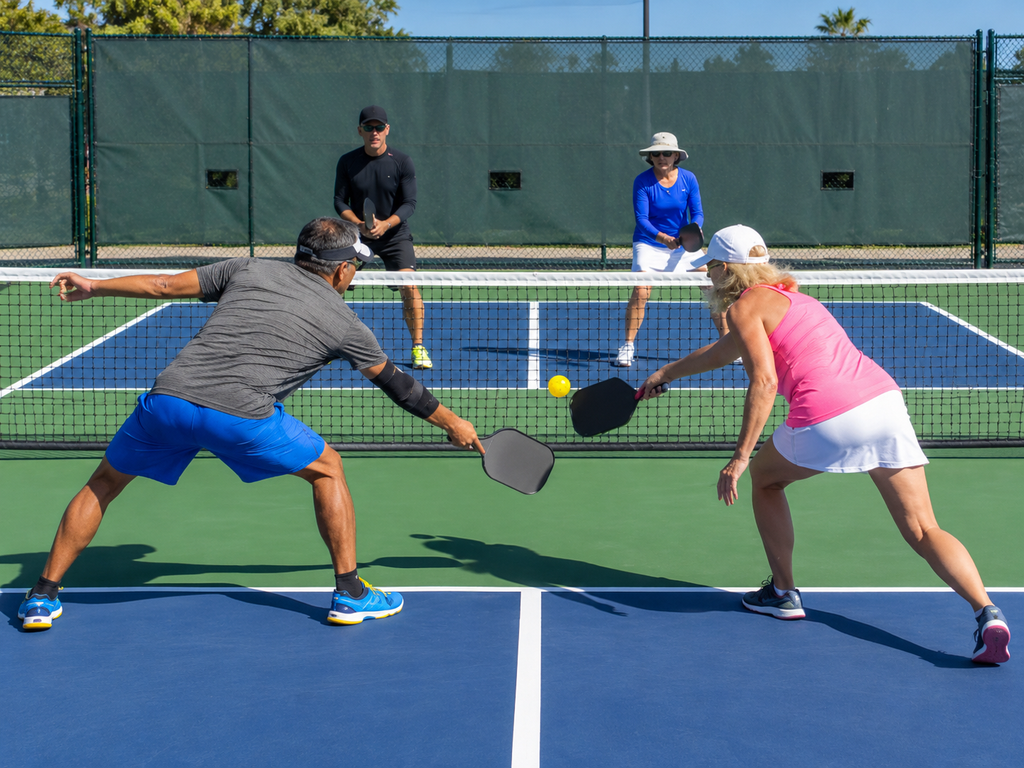
Strong doubles pickleball requires more than two players who can execute accurate shots. At competitive levels, partners must understand how their positions influence each other, how court coverage changes during a rally, and when to adjust their movement to maintain control.
Effective advanced pickleball doubles positioning involves coordinated movement, tactical spacing, anticipation, and communication. Small positional adjustments can determine whether a team intercepts an attack comfortably or leaves an opening for opponents.
Unlike beginner doubles positioning, which focuses on understanding starting locations and basic partner movement, advanced positioning requires players to adapt continuously as the ball changes direction.
The objective is not simply to stand in the correct place. It is to maintain useful court coverage while creating opportunities to control the rally.
Understand Court Coverage as a Team Responsibility
In doubles pickleball, each player covers part of the court, but those responsibilities are not fixed throughout the rally.
Both partners must adjust according to the ball’s location, the opponents’ positions, and the available return angles.
Effective court coverage depends on understanding which areas are most vulnerable at a particular moment.
Why Positioning Changes During Every Rally
When a ball travels toward one sideline, the available attacking angles change.
The player nearest that side may need to move toward the ball, while the partner adjusts to protect the middle.
If the ball moves toward the opposite side, both players may need to shift again.
These adjustments help maintain balanced coverage and reduce unnecessary gaps.
Think of Doubles Positioning as a Connected System
Instead of treating each player’s location independently, consider the relationship between both partners.
A movement by one player often requires an adjustment by the other.
For example, if your partner moves wide to retrieve a dink, remaining in your original position may leave the middle exposed.
A controlled shift toward the center can help protect that opening.
However, moving too far may leave your own sideline vulnerable.
The correct adjustment depends on the ball’s location and the opponent’s available shots.
Maintain Effective Spacing Between Partners
Proper spacing is essential for coordinated doubles play.
Partners who stand too far apart may leave openings through the middle. Players who stand too close together may expose the sidelines and interfere with each other’s shots.
There is no single distance that works for every rally.
Spacing must adjust dynamically.
Avoid Large Middle Gaps
When both partners move toward their respective sidelines without accounting for each other’s positions, an opening may develop between them.
Opponents can exploit that space with drives, volleys, or carefully placed dinks.
Maintain awareness of the middle while responding to wide shots.
Avoid Crowding Your Partner
Excessive movement toward a partner can create confusion.
Two players reaching for the same ball may collide or interfere with each other’s paddle movements.
Communicate responsibilities and allow enough space for comfortable shot execution.
Adjust According to Shot Direction
A ball sent toward an opponent’s outside position may require both players to shift toward that side.
A ball directed through the middle may require a more balanced central position.
The key is maintaining complementary coverage rather than following a rigid spacing rule.
Use Ball-Side Positioning to Improve Coverage
Ball-side positioning is an important concept in advanced doubles strategy.
When the ball moves toward one side of the court, the team adjusts to cover the angles most likely to be available to the opponent.
Shift Toward the Ball
Imagine your team is positioned at the kitchen line.
You send a crosscourt dink toward the opponent on your right.
Because the opponent now contacts the ball from that side, certain return angles become more likely.
Your team may benefit from shifting slightly toward the ball’s location.
The player closest to the sideline protects the outside angle, while the partner adjusts toward the middle.
Avoid Overcommitting
Shifting toward the ball does not mean abandoning the opposite side entirely.
An opponent may still be capable of redirecting the ball sharply across the court.
The amount of movement should reflect the opponent’s contact position, balance, and available shot options.
A player contacting the ball low and while reaching generally has fewer aggressive options than someone striking comfortably above net height.
Recover as the Rally Changes Direction
When the ball moves to another part of the court, both partners should reassess their positions.
Advanced positioning is a continuous process.
Players must adjust without becoming so focused on movement that they lose readiness for the next shot.
Control the Middle of the Court
The middle is one of the most frequently contested areas in competitive doubles pickleball.
Opponents may target it to create uncertainty about which player should respond.
At higher levels, simply calling every middle ball is not enough.
Partners need an understanding of coverage responsibility.
Establish Middle-Ball Responsibilities
Several factors influence who should take a ball traveling between partners:
- Which player has the more comfortable contact point.
- Whether one player is already moving toward the ball.
- Which player is better positioned for the next exchange.
- Whether the incoming shot favors a forehand or backhand response.
- Whether one partner has called for the ball.
A common preference is allowing the player with a favorable forehand to take certain middle balls.
However, forehand priority should not override better positioning or create unnecessary reaching.
Communicate Early
Short calls such as “mine” or “yours” can reduce hesitation.
Communication should happen early enough to influence the decision.
Calling for a ball after both partners have committed may not prevent confusion.
Recognize When to Yield
Sometimes your partner has a better opportunity to execute the shot.
Avoid reaching across their natural hitting space simply because the ball appears near the middle.
Effective teamwork includes recognizing when not to take a shot.
Coordinate Movement at the Kitchen Line
The non-volley zone line is an important position in competitive doubles because it allows players to intercept shots and control many exchanges.
However, reaching the kitchen is only part of successful positioning.
Partners must maintain appropriate coverage while responding to dinks, speed-ups, and defensive returns.
Move Together During Dink Exchanges
When the ball moves laterally, both players should make controlled adjustments.
The player nearest the ball may shift toward the target, while the other protects the middle and remains ready for a directional change.
Avoid remaining completely stationary while your partner is pulled wide.
Protect Against Speed-Ups
During fast exchanges, maintain an athletic stance and keep the paddle in a ready position.
Excessive leaning toward one anticipated target can leave you vulnerable to a sudden attack in another direction.
Your position should allow a compact response to balls directed toward the body, middle, or open court.
Recognize When One Partner Is Pulled Forward
A short dink may require one player to step into the non-volley zone to play the ball after it bounces or to volley legally without contacting the zone.
The other partner should remain aware of potential openings.
After contact, the player who stepped forward should recover as the rally allows.
The objective is to maintain useful team coverage throughout the movement.
Understand Offensive and Defensive Positioning
Advanced doubles positioning changes depending on whether your team is attacking, defending, or engaged in a neutral rally.
Offensive Positioning
When your team has an attacking advantage, positioning should support the likely responses.
For example, a controlled attack that forces an opponent into a low defensive contact may create an opportunity to maintain pressure.
Both partners should remain ready for weak returns without crowding each other or assuming the point is finished.
Defensive Positioning
When opponents gain the advantage, court coverage becomes more important than aggressive movement.
A player forced backward or wide may need additional space to return the ball.
The partner should adjust to protect vulnerable areas while remaining prepared for another attack.
Defensive positioning may require temporary separation from an ideal kitchen-line formation.
Neutral Positioning
During a balanced dink exchange, neither team may have a clear attacking advantage.
Maintain a ready stance, appropriate partner spacing, and awareness of potential changes in direction.
Neutral rallies provide opportunities to build pressure without taking unnecessary positional risks.
Manage Uneven Court Positioning
One challenging doubles situation occurs when one partner is at the kitchen while the other remains farther back.
This commonly happens during the transition from the baseline.
Recognize the Vulnerability
A team with uneven forward positioning may expose gaps or provide opponents with opportunities to target the deeper player.
The advanced player at the kitchen must consider the partner’s position rather than assuming normal coverage responsibilities.
Avoid Automatic Retreat
The forward player should not always retreat simply because a partner remains behind.
Retreating may surrender a valuable position without improving coverage.
Instead, evaluate the opponents’ attacking options and the deeper partner’s ability to defend.
Support the Transition
When possible, the forward player can help protect reachable middle balls while the deeper partner attempts controlled resets.
However, avoid reaching across large distances or interfering with the partner’s shots.
Both players should look for opportunities to reestablish coordinated kitchen-line positioning.
Use Switching and Defensive Rotations
Advanced doubles teams occasionally need to exchange court responsibilities during a rally.
This may occur after a wide retrieval, a lob, or an unusual defensive movement.
Recognize When Switching Is Necessary
Imagine one player is forced far outside their normal side of the court.
Their partner may move toward the exposed center or opposite area to maintain coverage.
If the rally continues, returning immediately to the original sides may be impractical.
A temporary switch can help the team remain organized.
Communicate the Change
Clear communication becomes important during unexpected movement.
Short calls can indicate whether partners should switch, stay, or cover a particular area.
Avoid complicated discussions during active points.
Teams can establish preferred responses during practice.
Recover Without Creating New Gaps
Returning to preferred sides should occur when the rally allows.
Forcing a switch during a fast exchange can create confusion or leave open court space.
Maintain effective coverage first. Restore preferred positions when there is a suitable opportunity.
Position Against Common Attacking Patterns
Advanced opponents often use predictable pressure patterns to exploit weak coverage.
Recognizing these patterns improves positioning decisions.
Against Middle Drives
Keep the paddle ready and establish responsibility for shots between partners.
Avoid both players moving toward the ball without communication.
Against Wide Dinks
Shift according to the ball’s location while maintaining awareness of the middle.
The partner away from the ball should be prepared to cover an opening created by the wide movement.
Against Sharp Crosscourt Angles
Consider the opponent’s contact position and ability to produce an angled shot.
Do not move so far toward the middle that the sideline becomes unprotected.
Against Lobs
Identify which player is best positioned to retrieve the lob.
If one partner moves backward, the other should adjust to maintain coverage and avoid collisions.
A controlled defensive return is usually more useful than attempting a difficult overhead from a compromised position.
Against Repeated Speed-Ups
Maintain compact paddle preparation and avoid unnecessary movement immediately before contact.
Partners should recognize which zones they can defend effectively without crowding each other’s hitting space.
Read Your Opponents to Anticipate Court Coverage Needs
A major component of advanced pickleball doubles positioning is anticipating how an opponent is likely to play the next ball.
Good anticipation comes from observing patterns rather than guessing.
Watch Contact Height
An opponent contacting the ball below net height generally has fewer strong downward attacking options.
A higher contact point may create more aggressive possibilities.
Positioning should reflect the likely range of responses.
Observe Paddle Preparation
Paddle orientation and swing preparation can provide clues about the intended shot.
However, skilled opponents may disguise their intentions.
Avoid committing so early that a directional change leaves you unable to recover.
Identify Preferred Targets
Some opponents repeatedly direct speed-ups toward the middle.
Others favor crosscourt angles or target a particular player’s backhand.
Recognizing repeated patterns can improve preparation.
Continue evaluating each shot rather than assuming the opponent will always use the same target.
Common Advanced Doubles Positioning Mistakes
Several positioning errors can limit even technically strong doubles teams.
Moving Independently
When partners react without considering each other’s positions, unnecessary gaps can appear.
Maintain awareness of both players throughout the rally.
Overprotecting the Middle
Although the middle is important, shifting too far inward may leave the sidelines vulnerable.
Adjust according to the opponent’s available angles.
Standing Too Close Together
Crowding reduces comfortable paddle space and can create confusion over shot responsibility.
Maintain enough separation for both players to react naturally.
Failing to Recover After Wide Shots
A player who remains outside their coverage area after hitting a wide ball may expose the next target.
Recover as soon as the rally allows.
Assuming Every Ball Is Yours
Reaching into your partner’s hitting space can cause missed shots and collisions.
Use communication and recognize when your partner has a stronger position.
Remaining Static at the Kitchen
Kitchen-line positioning requires continuous small adjustments.
Standing still regardless of ball location can make defensive coverage less effective.
Advanced Pickleball Doubles Positioning Drills
Structured partner drills can improve coordinated movement and reduce hesitation during competitive rallies.
Drill 1: Coordinated Lateral Shifting
Setup: Two partners position themselves at the kitchen line while two opponents feed controlled dinks to different areas.
Execution:
- The feeding team directs balls alternately toward the left and right sides.
- The defending pair shifts according to the ball’s location.
- The player nearest the target moves to receive the ball.
- The partner adjusts to maintain middle coverage.
- Continue the rally while evaluating spacing.
Goal: Develop coordinated lateral movement without excessive crowding or separation.
Drill 2: Middle-Ball Responsibility
Setup: Two partners stand in a normal doubles formation while an opponent feeds balls toward the middle.
Execution:
- Deliver controlled balls to several middle locations.
- The receiving players communicate responsibility before contact.
- Each player attempts a controlled return when taking the ball.
- Adjust the feeding direction and speed gradually.
- Switch partners or roles as needed.
Goal: Improve communication and reduce hesitation on middle balls.
Drill 3: Wide Ball and Recovery
Setup: Four players begin a cooperative doubles dink rally.
Execution:
- One team directs a dink toward an outside target.
- The receiving player moves to contact the ball.
- Their partner adjusts toward the middle.
- After the return, both players recover according to the rally.
- Continue with additional wide placements.
Goal: Improve team coverage when one player is pulled away from their usual position.
Drill 4: Defensive Rotation Scenarios
Setup: Four players begin a doubles rally with one team assigned a defensive scenario.
Execution:
- The feeding team sends a controlled lob or wide shot.
- The defending team retrieves the ball while adjusting court responsibilities.
- Partners communicate whether they will switch or recover to their previous positions.
- Continue the point under normal rules.
- Review how effectively the team maintained coverage.
Goal: Improve decision-making during unusual movements and defensive exchanges.
Drill 5: Competitive Coverage Challenge
Setup: Play standard doubles points with a specific positioning objective.
Examples include protecting the middle, maintaining appropriate spacing, or recovering after wide dinks.
After each rally, assess:
- Did both partners adjust to the ball’s location?
- Were middle-ball responsibilities clear?
- Did either player leave an unnecessary opening?
- Were recovery movements appropriate?
- Did the team maintain balance during attacks and defensive exchanges?
Goal: Apply coordinated positioning principles under realistic match conditions.
Develop a Reliable Doubles Positioning System
Advanced teams benefit from establishing a shared understanding of court coverage.
This does not require complicated formations for every situation.
Instead, partners should agree on basic principles that can adapt to different rallies.
A practical system includes:
- Follow the ball’s location: Adjust positioning according to available return angles.
- Protect the middle: Recognize gaps without abandoning the sidelines unnecessarily.
- Communicate responsibilities: Use short calls to reduce confusion.
- Support the deeper player: Adjust coverage when one partner remains in transition.
- Recover after movement: Reestablish balanced spacing when the rally allows.
- Adapt to opponents: Change positioning when repeated attacking patterns become clear.
These principles provide a foundation for effective teamwork while allowing flexibility.
Final Thoughts
Strong advanced pickleball doubles positioning is built on coordination, awareness, and continuous adjustment.
The best teams do not rely on fixed court locations throughout every rally. They recognize how the ball’s position changes the available angles, move together to protect vulnerable areas, and communicate when responsibilities become uncertain.
Effective court coverage also requires discipline. Overcommitting to one target, crowding a partner, or moving without regard for the next shot can quickly surrender an advantage.
By practicing coordinated shifting, middle coverage, defensive rotations, and recovery movement, advanced players can develop stronger partnerships and more reliable competitive performance.
The objective is to make two players function as one organized team while remaining flexible enough to respond to the changing demands of each point.