
The tennis serve can feel like one of the hardest shots to learn. You need to control the ball toss, coordinate your body and send the ball into a relatively small target across the net.
You do not need a fast or advanced serve when you are starting. Your first goal is to build a simple motion that helps you place the ball inside the correct service box consistently.
This guide breaks the serve into manageable steps so you can develop control before adding more speed or spin.
Quick Answer
To serve in tennis, stand behind the baseline and turn slightly sideways. Hold the racket with a continental grip, toss the ball above and slightly in front of your hitting shoulder then swing upward and contact it at your highest comfortable reach.
The ball must cross the net and land in the service box diagonally opposite you.
Focus on a repeatable toss, relaxed swing and large target area. Power can come later.
Suggested Video: A short demonstration of the complete beginner serve from the front and side views.
In This Guide
Table of Contents
- Quick Answer
- In This Guide
- Basic Tennis Serving Rules
- What You Need
- How to Serve in Tennis Step by Step
- Beginner Serving Drills
- Common Serving Mistakes
- Should Beginners Focus on Accuracy or Power?
- A Simple Serving Routine
- Frequently Asked Questions
- Build Consistency Before Adding Speed
- Recommended Beginner Tennis Gear
- Continue Learning
Basic Tennis Serving Rules
Every point in tennis begins with a serve.
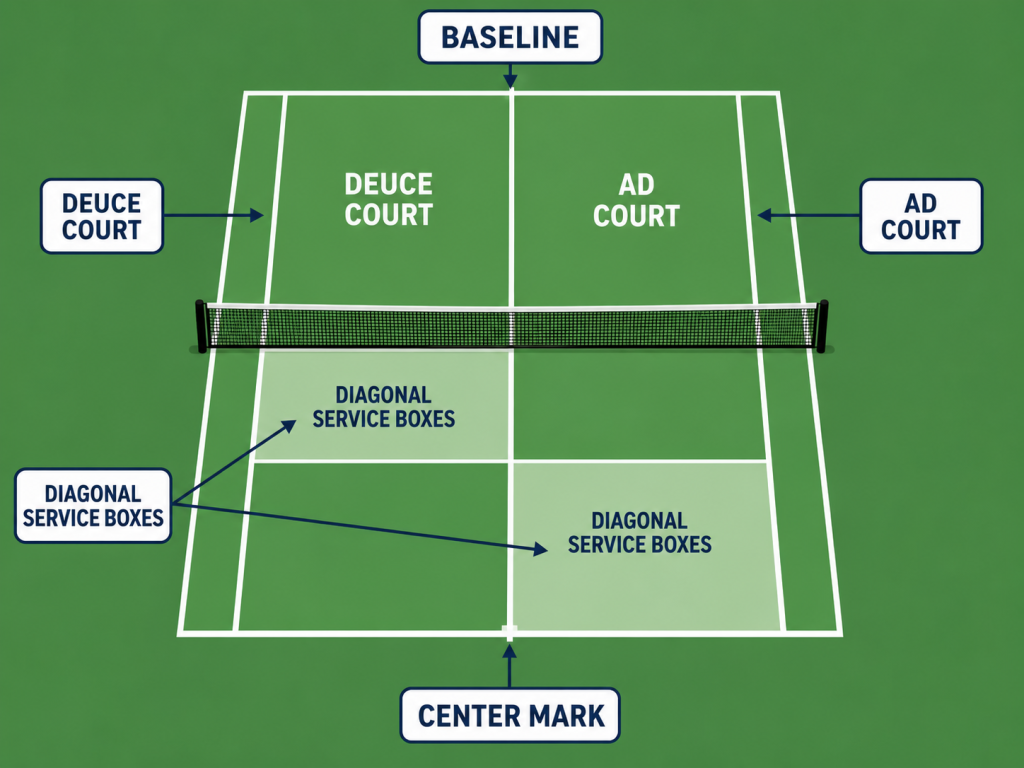
The server starts each game from the right side of the center mark, known as the deuce court. After each point, the server alternates between the right and left sides.
The ball must travel over the net and land inside the service box diagonally opposite the server.
You normally receive two attempts:
- If the first serve misses, you receive a second serve.
- If both serves miss, you lose the point.
- If the serve touches the net and lands in the correct service box, it is a let and the serve is replayed.
You must remain behind the baseline until you strike the ball. Touching or crossing the baseline too early is a foot fault.
If you make a poor toss, you do not have to hit it. You may catch the ball or allow it to fall before starting again.
These requirements are covered in the official World Tennis Rules of Tennis.
Suggested Visual: A labeled court diagram showing the baseline, center mark, deuce court, ad court and diagonal service boxes.
What You Need
You do not need expensive equipment to practice your serve.
Start with:
- A comfortable tennis racket
- Several tennis balls
- Supportive tennis shoes
- An open court or safe practice area
- Two cones or markers for target practice
Having several balls allows you to repeat the motion without stopping after every serve.
How to Serve in Tennis Step by Step
Step 1: Use the Continental Grip
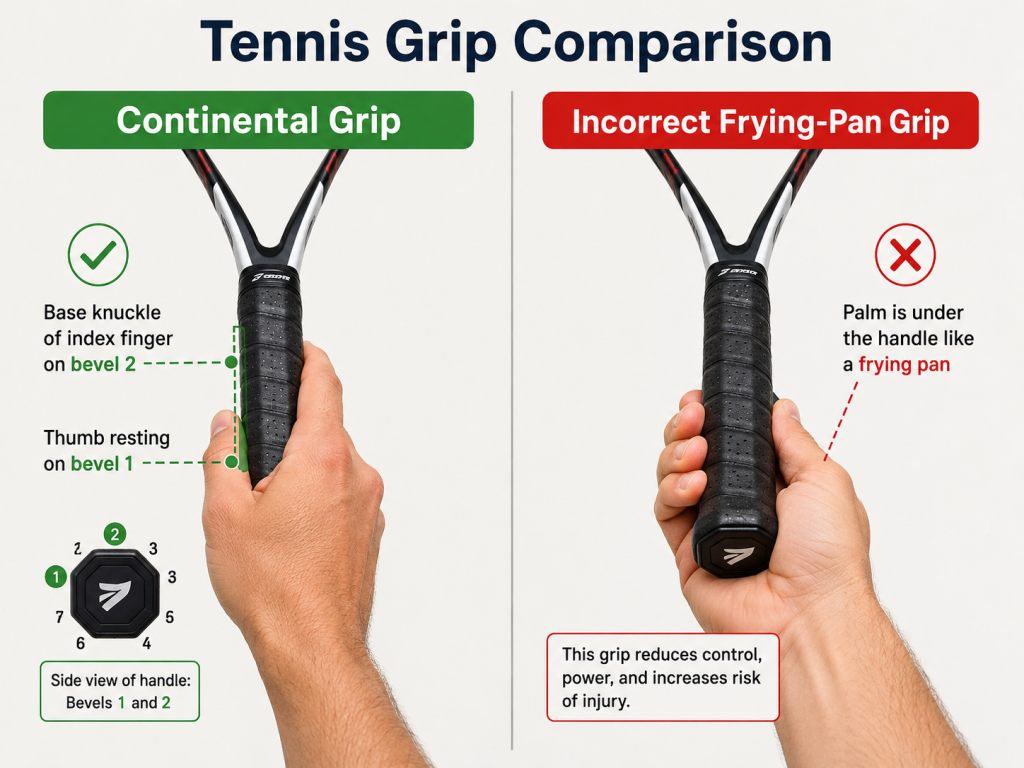
The continental grip is the standard starting grip for an overhand serve. It supports a natural serving motion and allows you to develop different types of serves later.
To find it:
- Hold the racket in front of you with the frame turned sideways.
- Imagine shaking hands with the racket handle.
- Hold it like a hammer rather than a frying pan.
- Keep your hand and wrist relaxed.
Many beginners initially use a forehand grip because it feels easier. It may help you make contact, but it can restrict the swing and make proper serving technique harder to develop.
The USTA continental grip guide recommends looking at the thin edge of the racket instead of directly at the strings when learning the grip.
Suggested Visual: Close-up comparison of the continental grip and an incorrect frying-pan grip.
Step 2: Set Your Stance
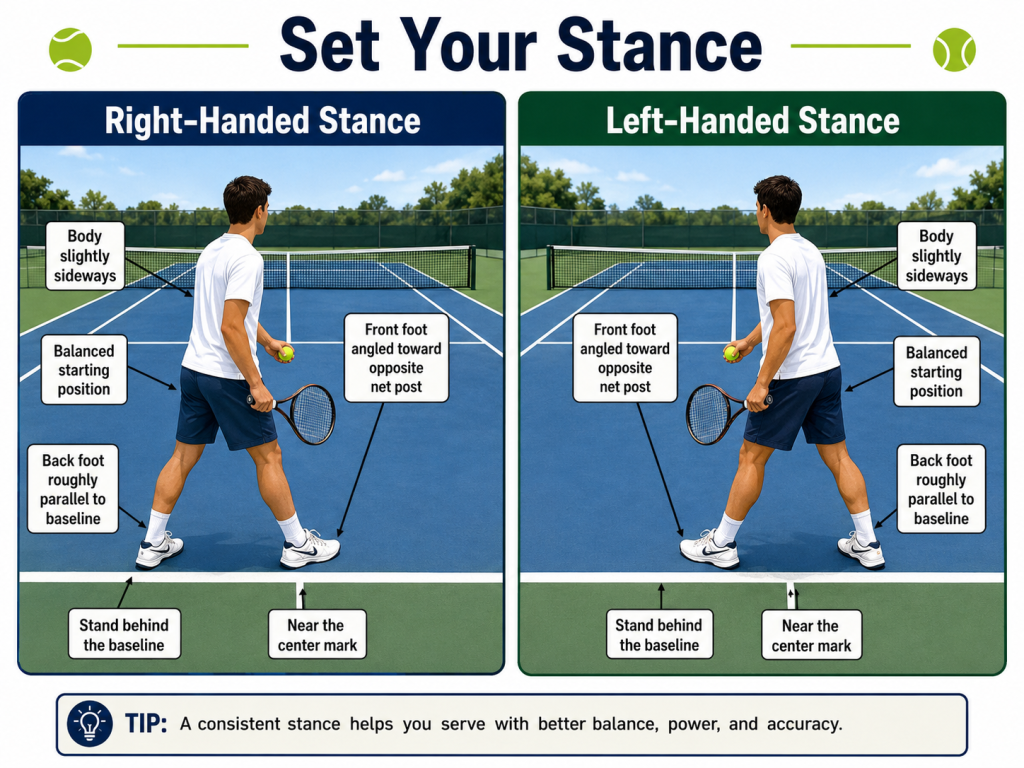
Stand behind the baseline near the center mark.
If you are right-handed:
Place your left foot in front.
Angle it toward the opposite net post.
Position your right foot behind and roughly parallel to the baseline.
Left-handed players can reverse this position.
Turn your body slightly sideways instead of facing the net directly. Keep your feet about shoulder-width apart and your knees relaxed.
Your starting position should feel balanced. Avoid leaning forward or backward before beginning the motion.
Suggested Visual: Right-handed and left-handed serving stances shown side by side.
Step 3: Make a Consistent Ball Toss
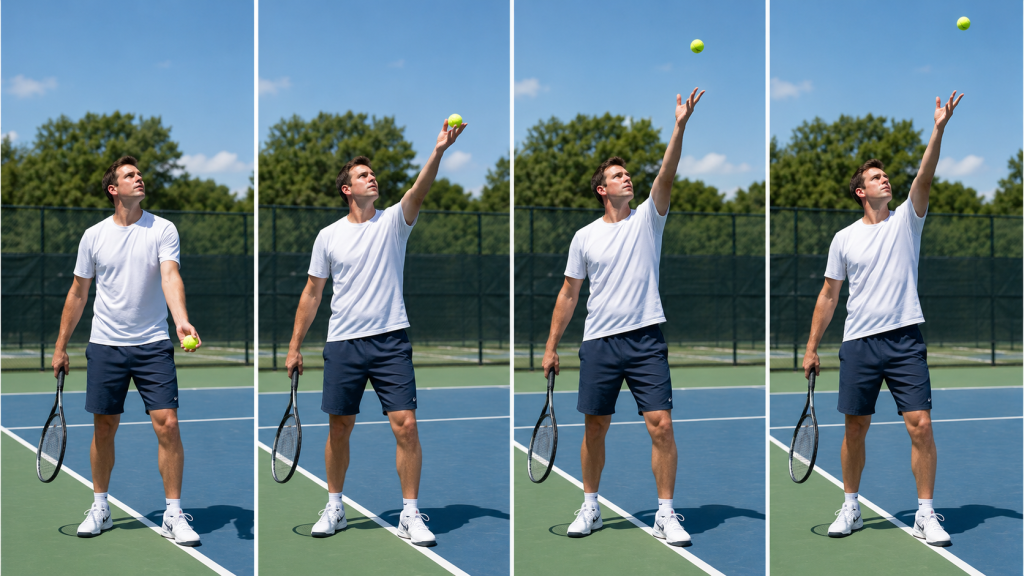
Your serve will only be as consistent as your toss.
Hold the ball lightly in your fingertips instead of squeezing it in your palm. Raise your tossing arm smoothly and release the ball above and slightly in front of your hitting shoulder.
The toss should be high enough for you to reach upward without rushing. It should not force you to lean backward, forward or sideways.
If the toss moves too far away from your ideal contact point, catch it and start again.
Step 4: Reach the Trophy Position
As your tossing arm rises, bend your hitting arm and allow the racket to move upward behind you.
At this point:
- Your tossing arm should extend upward.
- Your hitting elbow should be bent.
- Your shoulders should remain turned.
- Your knees may bend slightly.
- Your body should remain balanced.
This is called the trophy position because it resembles the figure on top of a sports trophy.
Do not force yourself into an exaggerated pose. It should be a natural part of one continuous motion.
Step 5: Swing Up Toward the Ball
The tennis serve is primarily an upward movement.
From the trophy position, extend your body and hitting arm toward the ball. Allow the racket to accelerate naturally as it moves upward.
Avoid hitting forward at the ball as if you were playing a groundstroke. Swinging upward helps the ball clear the net while still allowing it to travel down into the service box.
Keep your grip relaxed. Squeezing the racket too tightly creates tension in your hand, arm and shoulder.
Step 6: Contact the Ball at Full Reach
Try to contact the ball at your highest comfortable reach and slightly in front of your body.
At contact:
- Extend your hitting arm.
- Keep your head up.
- Continue watching the ball.
- Allow your shoulders to rotate naturally.
- Maintain a relaxed arm and grip.
Do not force a sharp wrist snap. The racket should move through the ball as part of one continuous swing.
Suggested Visual: Side view showing the ideal contact point and full arm extension.
Step 7: Follow Through and Recover
After contact, allow the racket to continue across your body.
A right-handed player will usually finish with the racket moving toward the left side. A left-handed player will generally finish toward the right.
Your body may move slightly into the court after you hit the ball. Regain your balance and prepare for the return.
The serve begins the point. Do not remain frozen after your follow-through.
Beginner Serving Drills
Toss-and-Catch Drill
Practice the ball toss without using your racket.
- Set up in your serving stance.
- Raise your tossing arm smoothly.
- Release the ball above and slightly in front of you.
- Allow it to fall near your front foot.
- Repeat until the toss regularly reaches the same area.
Complete three sets of ten tosses.
Serve From the Service Line
Move closer to the net and serve from near the service line.
Use a shorter and slower motion. Focus on clearing the net and landing the ball inside the correct box.
As your control improves, gradually move backward until you can serve from the baseline.
Large Target Drill
Place two cones inside the middle of the service box. Aim between them instead of trying to hit close to the lines.
Count how many serves land inside the target area out of ten attempts.
Begin by aiming for six successful serves. Once you can do that consistently, work toward eight.
Suggested Video: A short demonstration of all three beginner drills.
Common Serving Mistakes
| Problem | Likely cause | What to try |
|---|
| Serve keeps hitting the net | Low toss or low contact point | Toss higher and swing upward |
| Ball goes long | Toss is too far behind or racket face is too open | Move the toss slightly forward |
| Serve goes in different directions | Inconsistent toss | Practice the toss separately |
| Little control | Swinging too hard | Reduce speed and aim for the center |
| Uncomfortable motion | Tight grip or incorrect grip | Relax your hand and check the continental grip |
| Foot fault | Starting too close to the baseline | Begin several inches behind the line |
IMPORTANT: Do not try to fix every problem during one practice session. Choose one issue and work on it for several repetitions before changing something else.
Should Beginners Focus on Accuracy or Power?
Accuracy should come first.
A fast serve that repeatedly misses does not help you begin the point. A controlled serve that lands inside the service box gives you an opportunity to play.
Focus on:
- A consistent toss
- Clean contact
- Comfortable rhythm
- A large target
- A balanced finish
Once you can place six to eight serves out of ten into the correct box, gradually experiment with more speed.
A Simple Serving Routine
Using the same routine before every serve can improve your timing and confidence.
Try this sequence:
- Stand behind the baseline.
- Choose a large target.
- Check your grip.
- Take one slow breath.
- Bounce the ball two or three times.
- Set your feet.
- Toss and swing with a relaxed motion.
- Recover for the next shot.
The exact number of ball bounces does not matter. What matters is creating a routine you can repeat.
Frequently Asked Questions
What grip should a beginner use for a tennis serve?
Use the continental grip. It supports a natural serving motion and gives you room to develop flat, slice and spin serves later.
Where should I aim?
Aim toward the middle of the correct service box. This gives you a larger margin for error than aiming close to the lines.
Where should the ball toss go?
The toss should rise above and slightly in front of your hitting shoulder. You should be able to contact it at full reach without leaning or chasing the ball.
Can I catch a bad toss?
Yes. If you decide not to swing, you may catch the ball or allow it to fall before restarting your service motion.
Do I need to jump when serving?
No. Beginners should focus on balance, rhythm and clean contact first. More leg drive can be added as the motion becomes coordinated.
How often should I practice?
Two or three short sessions each week can be more useful than one exhausting session. Stop when fatigue causes your toss or technique to become unreliable.
Build Consistency Before Adding Speed
Your first tennis serve does not need to look like a professional serve.
Start with a comfortable stance, continental grip and repeatable toss. Swing upward, contact the ball at full reach and aim through the center of the service box.
One controlled serve you can repeat is more valuable than ten powerful serves you cannot place.
Recommended Beginner Tennis Gear
You do not need an advanced racket to start practicing your serve. Look for a comfortable beginner racket with a forgiving head size and a manageable weight.
A few tennis balls, supportive court shoes and simple target markers are enough for your first practice sessions.
Continue Learning
Improve the rest of your game with practical beginner tennis lessons and drills.