
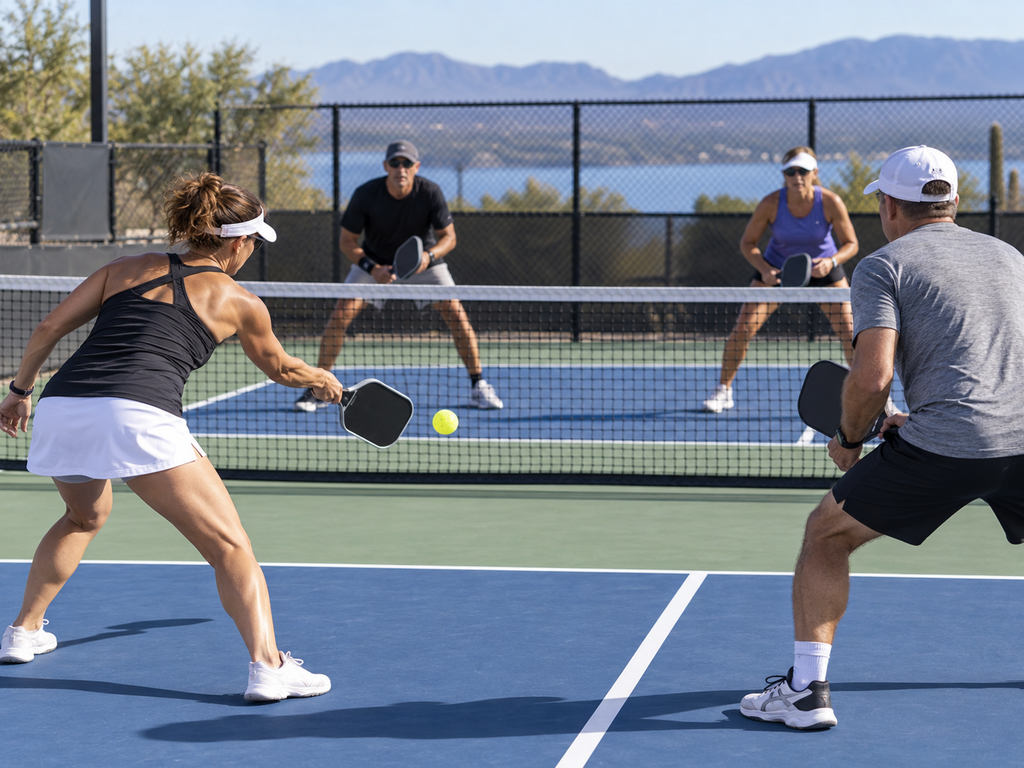
Winning competitive pickleball points requires more than accurate shots, quick reactions, and powerful attacks. Experienced players understand how to influence an opponent’s position, limit their available responses, and create opportunities before attempting a winning shot.
Effective advanced pickleball strategy involves constructing rallies with a clear purpose. Instead of reacting to every ball independently, players use positioning, placement, timing, and controlled pressure to shape how a point develops.
The goal is not to attack at every opportunity. It is to recognize which shots improve your position, which shots increase pressure, and when the conditions favor an aggressive finish.
Understand How Point Control Works
Controlling a pickleball point does not necessarily mean hitting harder or keeping your opponents on defense throughout the rally.
Control means influencing the decisions your opponents must make.
A player who repeatedly sends accurate shots to difficult locations can force opponents to move, change their contact points, or return balls from uncomfortable positions. Over several exchanges, these adjustments may produce a weaker response.
Three elements determine how effectively a player controls a rally:
- Court position: Occupying positions that provide strong coverage and useful attacking angles.
- Shot placement: Directing the ball toward locations that restrict an opponent’s options.
- Shot selection: Choosing an appropriate response based on ball height, opponent positioning, and the current state of the rally.
These elements work together. An accurate shot becomes more valuable when it improves your position or makes your opponent’s next shot more difficult.
For example, a controlled dink directed toward an opponent’s outside foot may force an awkward reach. If the resulting return sits higher than intended, you may gain an opportunity to attack.
The opening was created by the preceding shot rather than by an immediate attempt to win the point.
Build Points Instead of Forcing Winners
One of the clearest differences between intermediate and advanced play is how players approach point construction.
Intermediate players often recognize an attacking opportunity only after receiving an obviously weak ball. Advanced players attempt to create that opportunity through a planned sequence.
Use a three-stage approach
A practical point-construction sequence involves three stages.
1. Establish a neutral position
Begin by choosing shots that allow you to maintain or recover a balanced court position.
When opponents apply pressure, a controlled defensive response may be more productive than attempting a difficult counterattack.
2. Create a positional advantage
Once the rally stabilizes, use placement or variation to move an opponent away from a comfortable position.
This might involve directing a dink wider, targeting the middle between doubles partners, or changing the depth of a shot.
3. Attack the resulting opening
When an opponent returns a ball above a comfortable attacking height, loses balance, or leaves a vulnerable court area, consider a controlled offensive shot.
Do not assume every elevated ball is attackable. Your balance, contact point, opponents’ readiness, and available angles should determine whether an attack is appropriate.
This approach encourages patience without making your play passive.
Use Placement to Manipulate Opponent Positioning
Advanced pickleball strategy relies heavily on directing the ball where it creates the greatest tactical advantage.
A shot does not need to land near a sideline to be effective. Often, a reliable target slightly away from an opponent’s preferred contact position produces more consistent pressure.
Move opponents before attacking open space
Consider a doubles rally in which both opponents are positioned near the non-volley zone line.
A controlled dink toward one opponent’s outside foot may force that player to move laterally and contact the ball below net height.
If the opponent stretches wide and their partner does not adjust, space may develop near the middle.
Your next shot can exploit that opening if the incoming ball allows it.
However, opponents may recover quickly or shift together. Always reassess the court before directing the next shot.
Target uncomfortable contact points
Useful placement targets include:
- The feet of an opponent moving forward.
- The outside foot of a player defending a wide ball.
- The space between doubles partners when communication is uncertain.
- The backhand side of an opponent who consistently struggles with that contact.
- A short angle that requires an opponent to move away from a balanced position.
These are tactical options rather than universal weaknesses.
An opponent with a strong backhand, for example, may welcome balls directed to that side. Successful placement depends on observation and adaptation.
Change Pace to Disrupt Rally Rhythm
Competitive players often become comfortable when opponents repeatedly deliver the same ball speed, height, and direction.
Changing pace can disrupt that rhythm.
A slower, carefully placed shot may force an opponent to generate their own pace. A faster shot delivered at the right moment may catch them transitioning between defensive and offensive positions.
The important consideration is timing.
Recognize when a pace change is useful
A pace change may be effective when:
- Your opponents are anticipating another soft exchange.
- A ball arrives high enough for a controlled attack.
- An opponent is moving and has not established a balanced stance.
- A previous shot has created space or forced an awkward response.
Avoid increasing pace simply because a rally has lasted several exchanges.
Attacking a low ball from an unstable position often gives opponents an easy opportunity to counter.
The strongest pace changes are supported by favorable positioning and a suitable contact point.
Control the Middle in Doubles Play
The middle of the court is an important tactical area in competitive doubles.
Shots through the middle can reduce available angles and create uncertainty about which partner should respond.
However, directing every shot through the middle becomes predictable.
Use middle pressure deliberately
A middle target can be useful when both opponents are positioned wide or when their preferred shot responsibilities overlap.
During a fast exchange, a well-placed ball between players may cause hesitation.
At other times, an opponent positioned centrally may have an easy opportunity to attack the same ball.
Observe which player takes middle shots, whether partners communicate clearly, and how they recover after contact.
Your own team should establish clear responsibilities while remaining flexible. Forehand preference can help determine coverage, but positioning, reach, and the incoming ball’s direction may be more important during a particular rally.
Recognize the Difference Between Neutral and Attackable Balls
Good shot selection depends on understanding the advantage offered by an incoming ball.
Not every ball should receive the same response.
| Ball situation | Strategic response |
|---|---|
| Low ball below net height | Use control to maintain or restore a neutral rally |
| High, attackable ball | Consider a controlled offensive shot |
| Fast ball directed toward your body | Block or counter according to your readiness |
| Wide ball pulling you off court | Prioritize balance and a safe recovery |
| Weak return leaving an opening | Direct the next shot toward a favorable target |
These decisions are influenced by more than ball height alone.
An elevated ball may still be difficult to attack if you are reaching backward or moving rapidly. A lower ball may offer an offensive opportunity for a skilled player who has excellent balance and a favorable angle.
Evaluate the complete situation before committing.
Create Pressure Without Losing Court Position
Aggressive intentions become counterproductive when players sacrifice their own coverage.
For example, attempting an extreme crosscourt angle may pull you well outside the sideline. Even if the shot lands successfully, your opponent may redirect the return into the space you have abandoned.
Advanced players consider the consequences of their shots before choosing a target.
Apply controlled pressure
To keep offensive pressure sustainable:
- Prefer targets that challenge opponents without requiring unnecessary risk.
- Recover toward the most likely return, rather than automatically moving to the same spot.
- Maintain a balanced paddle-ready position after contact.
- Coordinate lateral movement with your doubles partner.
- Avoid committing too early to an anticipated shot.
Court control involves protecting against your opponent’s next response while creating your own attacking opportunities.
A shot that produces pressure but leaves you badly exposed may not provide a genuine tactical advantage.
Adapt Your Strategy to Different Opponents
A successful advanced pickleball strategy should change according to the opponents you face.
A tactic that works against a player with slow lateral movement may be ineffective against someone who covers wide angles comfortably.
Use the opening rallies to identify tendencies.
Observe movement and recovery
Watch whether opponents recover efficiently after wide shots, remain balanced while moving forward, and coordinate court coverage.
A team that consistently leaves the middle exposed after defending wide dinks may be vulnerable to controlled changes of direction.
Evaluate shot preferences
Some opponents prefer fast exchanges, while others are more comfortable with soft, patient rallies.
You may gain an advantage by forcing opponents into situations that do not suit their strengths.
For example, against a player who attacks almost every elevated ball, prioritize keeping your defensive shots low and preparing for counters.
Identify decision-making patterns
Pay attention to what opponents do under pressure.
Do they repeatedly speed up crosscourt? Do they favor a defensive lob when pulled wide? Does one partner take most middle balls?
Recognizing these patterns improves anticipation.
However, avoid assuming that an opponent will always repeat the same response. Strong players adapt when they recognize that their habits are being targeted.
Make Better Decisions During Important Points
Pressure can cause players to abandon effective patterns, rush attacks, or choose unusually risky shots.
Advanced competitors benefit from maintaining a consistent decision-making process.
Before serving or receiving, identify a simple tactical intention.
This may involve targeting return depth, maintaining a strong court position, or directing early shots away from an opponent’s preferred attacking zone.
During the rally, focus on the incoming ball and the available tactical options rather than the score.
When a point becomes uncomfortable, prioritize a shot that restores balance or reduces immediate danger.
There is no requirement to attempt a winner simply because the point is important.
A high-percentage decision can be more valuable than an impressive but unreliable shot.
Practice Advanced Point Construction
Improving tactical awareness requires practice situations that encourage deliberate decisions.
These drills can help connect shot selection with court positioning and point control.
Drill 1: Create the opening
Setup: Four players begin a cooperative doubles rally at the non-volley zone line.
Execution:
- Begin with controlled dinks.
- Attempt to move an opponent away from a balanced position.
- Look for a return that creates a clear attacking opportunity.
- Attack only when the ball and your position support the decision.
Goal: Develop patience and recognize when a neutral exchange becomes favorable.
Drill 2: Change pace with purpose
Setup: Two players exchange controlled shots, beginning with a soft rally.
Execution:
- Maintain a consistent rally rhythm.
- Introduce a faster shot only when receiving a suitable ball.
- Have the receiving player attempt a controlled defense or counter.
- Reset and repeat, changing the timing of the attack.
Goal: Improve the ability to change pace without sacrificing accuracy or balance.
Drill 3: Target and recover
Setup: Two players rally crosscourt or in a designated half of the court.
Execution:
- Direct the ball toward a target that requires movement.
- Recover into a balanced position immediately after contact.
- Observe how the opponent responds.
- Select the next shot according to the space available.
Goal: Connect tactical placement with effective recovery.
Drill 4: Tactical doubles points
Setup: Play regular doubles points with one specific strategic objective.
Choose an objective such as creating middle pressure, maintaining coordinated court coverage, or avoiding attacks from poor contact positions.
After each point, briefly evaluate whether your decisions supported the objective.
Goal: Apply tactical discipline under realistic match conditions.
Common Advanced Strategy Mistakes
Even experienced players make tactical errors when they become impatient or rely too heavily on familiar patterns.
Common problems include:
- Attacking too early: Attempting offensive shots before gaining a suitable contact point.
- Overusing power: Increasing ball speed when placement or patience would create greater pressure.
- Predictable targeting: Repeatedly sending shots toward the same location without evaluating the opponent’s response.
- Poor recovery: Focusing on shot execution without preparing for the return.
- Ignoring partner positioning: Creating gaps through uncoordinated movement.
- Failing to adapt: Continuing an unsuccessful pattern despite clear evidence that opponents are comfortable defending it.
The solution is not to avoid aggressive play. It is to become more selective about when and how aggression is used.
Develop a Consistent Tactical Approach
Strong competitive pickleball combines anticipation, controlled execution, and the ability to adjust as rallies develop.
Before each shot, consider three questions:
- What is my current position? Are you balanced, recovering, defending, or ready to attack?
- What options does my opponent have? Which returns are most likely from their current position?
- What does my next shot accomplish? Will it improve court coverage, create pressure, or exploit an existing opening?
These questions help prevent reactive shot selection and encourage purposeful play.
With repeated practice, the process becomes more intuitive. Instead of thinking through every possibility, players begin recognizing familiar patterns and responding efficiently.
Effective advanced pickleball strategy is built on controlling situations rather than forcing spectacular shots.
Experienced players create opportunities through accurate placement, disciplined positioning, intelligent variation, and an understanding of opponent tendencies.
The most valuable improvement is learning to recognize when a point is neutral, when pressure is developing, and when a genuine attacking opportunity appears.
By constructing points deliberately and selecting shots that support your court position, you can become a more consistent and adaptable competitive player.