
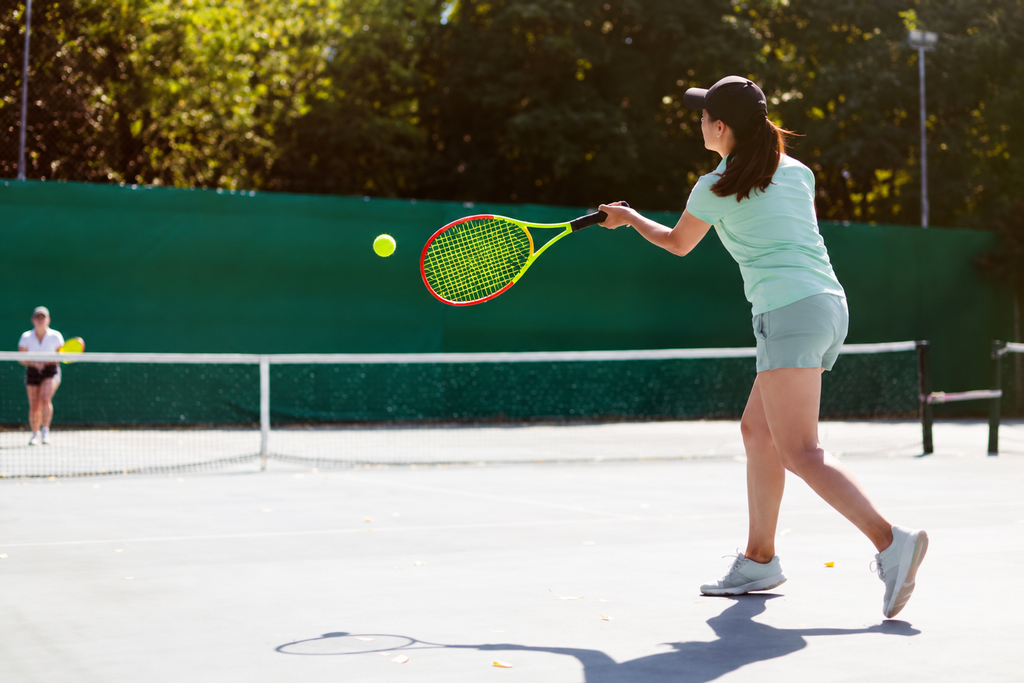
Knowing how to approach the net in tennis can help intermediate players turn favorable baseline situations into attacking opportunities. Instead of remaining behind the baseline throughout every rally, moving forward at the right moment allows you to intercept the opponent’s next shot earlier and potentially finish the point with a controlled volley or overhead.
However, approaching the net is not simply a matter of running forward after hitting a strong groundstroke. Effective net approaches require recognizing the right opportunity, selecting a suitable approach shot, moving into a useful volleying position, and preparing for the opponent’s response. By developing these skills together, you can become more comfortable transitioning from baseline rallies to attacking play.
What Is a Net Approach in Tennis?
A net approach occurs when a player moves forward from a deeper court position with the intention of taking control of the point near the net.
The approach usually begins with a groundstroke, although players may also move forward after a serve or another shot that creates an attacking opportunity.
The shot played while advancing is called an approach shot.
Its purpose is to make the opponent’s next reply difficult while giving you time to establish a useful position for a volley or overhead.
A successful approach does not necessarily produce an immediate winner.
It may instead force the opponent into a defensive return that you can intercept on the following shot.
Why Approaching the Net Can Be Effective
Moving forward offers several potential advantages:
- You can intercept suitable balls before they travel deeper into the court.
- You reduce the time available for the opponent to react after your volley.
- You create opportunities to direct balls into open areas.
- You can pressure opponents who struggle with passing shots or lobs.
- You add variety to a baseline-oriented playing style.
These advantages depend on timing and shot quality.
A poorly chosen approach can leave you exposed to passing shots, lobs, or balls directed toward your feet.
The objective is to approach when the situation gives you a reasonable opportunity to apply pressure.
When Should You Approach the Net?
Recognizing the appropriate moment to move forward is one of the most important aspects of net play.
Not every short ball or powerful groundstroke creates a good attacking opportunity.
When Your Opponent Hits a Manageable Short Ball
A shorter ball may allow you to step inside the baseline and contact it from a more attacking position.
However, consider the ball’s height, pace, spin, and your ability to reach it comfortably.
A slow ball that bounces at a useful height often provides a better opportunity than a low, heavily spinning ball that forces you to stretch.
Before committing to the net, determine whether you can hit an approach shot that places the opponent under pressure.
When Your Opponent Is Out of Position
An opponent who has been pulled wide or forced well behind the baseline may struggle to produce a controlled passing shot.
If you can direct an effective approach shot while the opponent is recovering, moving forward may create a favorable situation.
Do not assume that an opponent positioned wide is automatically unable to hit a strong reply.
The decision still depends on their balance, contact position, and available angles.
When You Hit a Strong, Deep Shot
A well-placed deep groundstroke may force the opponent into a defensive response.
If you recognize that the opponent is likely to hit a weaker ball, you may have an opportunity to move forward.
However, a deep shot does not guarantee a weak return.
Observe the opponent’s preparation and avoid advancing blindly.
When You Have Time to Move Forward
A good approach requires enough time to move into a useful position and prepare for the opponent’s next shot.
Even an attacking shot may not justify approaching if you are too far behind the baseline or cannot recover your balance.
The quality of your movement and available time matter as much as the placement of your approach shot.
How to Hit an Effective Tennis Approach Shot
An approach shot should make the opponent’s next response difficult while supporting your movement toward the net.
It does not need to be the hardest shot you can hit.
Choose a Purposeful Target
A common approach is to direct the ball deep toward an area that limits the opponent’s comfortable options.
For example, hitting deep toward an opponent’s weaker side may reduce their ability to produce a controlled passing shot.
A ball directed toward the opponent’s body can also make it difficult for them to establish comfortable spacing.
However, no single target is best in every situation.
Consider the opponent’s position, the incoming ball, and the shot you can execute reliably.
Maintain Controlled Depth
A deep approach shot may keep the opponent farther behind the baseline and make their reply more difficult.
A short, slow approach may give the opponent time to step forward and select a passing shot.
Nevertheless, some shorter angled approaches can be effective when they force the opponent well outside the court.
For intermediate players, developing dependable depth is a useful starting point before experimenting with more demanding angles.
Use Appropriate Pace
An approach shot should apply pressure without introducing unnecessary risk.
Maximum power is not always necessary.
A controlled shot that reaches a difficult area may be more effective than a faster ball that lands in the opponent’s preferred hitting zone.
Choose a pace that allows you to maintain accuracy and continue moving forward.
Avoid Overcomplicating the Shot
Players sometimes attempt difficult slices, extreme angles, or last-second changes of direction when approaching.
These options can be useful in certain situations, but they are not required for an effective intermediate-level approach.
Start with your most reliable forehand or backhand and direct the ball toward a practical target.
Where to Position Yourself After an Approach Shot
Moving toward the net is only part of the process.
You must also establish a position that allows you to react to the opponent’s reply.
Move Forward With Purpose
After hitting the approach shot, continue moving toward a useful volleying position when time allows.
Remaining too far behind the service line can make it difficult to intercept the ball effectively while exposing you to low shots around your feet.
However, running directly toward the net without considering the opponent’s position can leave you vulnerable to a lob.
The correct stopping point depends on the time available and the likely reply.
Use the Split Step Before the Opponent’s Shot
As the opponent prepares to contact the ball, perform a compact split step to establish a balanced, responsive position.
The goal is to complete the landing around the opponent’s contact so you can react promptly to the direction of the ball.
Avoid continuing to sprint forward while the opponent is already striking a potential passing shot.
If you have not reached your preferred net position, it is better to make a balanced response from your current location than to rush forward without control.
Cover the Available Passing Angles
Your lateral position should reflect where the opponent is contacting the ball and the angles available to them.
If your approach travels toward one side of the court, adjust your position to cover the most likely passing shots.
Avoid automatically standing in the exact middle of the service box.
You should also recognize that covering one angle more closely can expose another.
Good net positioning involves balancing the opponent’s realistic options rather than trying to protect every area equally.
How to Finish Points With a Volley
Once you reach the net, your next challenge is selecting an appropriate volley.
At the intermediate level, reliable placement usually matters more than attempting a dramatic winner.
Direct Volleys Into Open Space
Look for areas of the court that the opponent cannot cover comfortably.
An opponent who is recovering from a wide position may leave space toward the opposite side.
A controlled volley directed into that area can be effective without requiring excessive power.
Use Simple, Compact Volley Movements
Unlike a groundstroke, a typical volley does not require a large backswing.
Keep the racket prepared and use a compact movement to control the ball.
The exact motion depends on the height and pace of the incoming shot.
Avoid trying to create extra power with an exaggerated swing.
Recognize When to Volley Deep
A low or difficult volley may not provide an opportunity to finish the point immediately.
In that situation, directing the ball deep can make the opponent’s next shot more challenging while helping you maintain net pressure.
Choose a reliable target instead of forcing a difficult angled winner.
Finish High Volleys With Control
A higher, manageable volley can provide a better opportunity to direct the ball decisively into open court.
However, increasing power should not cause you to lose balance or racket control.
Select a target before contact and use a movement appropriate to the incoming ball.
How to Handle Low Volleys and Balls at Your Feet
Not every approach produces an easy volley.
An opponent may attempt to hit a low ball that forces you to contact it below net height.
These situations require patience and controlled execution.
Bend Through Your Legs
When preparing for a low volley, lower your body through an appropriate knee bend while maintaining balance.
Avoid relying entirely on bending at the waist or reaching down with the racket.
Maintain a Stable Racket Face
Keep the racket face suitably oriented to lift the ball over the net.
A low volley often requires an open racket face and a controlled forward movement.
Avoid attempting a large upward swing that may reduce precision.
Choose a Safe Target
When contacting the ball below net height, hitting an aggressive downward winner is usually unrealistic.
Instead, aim for a controlled return that keeps the ball difficult for the opponent.
Depending on the situation, a deeper volley or a carefully placed shorter ball may be appropriate.
The goal is to stay in a favorable position rather than end every exchange immediately.
How to Respond to Passing Shots and Lobs
Opponents commonly attempt passing shots or lobs when a player approaches the net.
Recognizing these possibilities can improve your preparation.
Anticipate Passing Shots Without Guessing
A passing shot is directed past the net player toward an available area of the court.
Pay attention to the opponent’s contact position and racket preparation, but avoid committing too early to one side.
Move decisively when you recognize the ball’s direction.
A balanced split step and appropriate court coverage are more useful than guessing before the opponent strikes.
Recognize the Lob Early
A lob travels high over the net player and may force them to retreat.
If you recognize a lob early enough, turn your shoulders and move backward using safe, controlled footwork.
Avoid running backward while facing the net for a long distance, as this can compromise balance.
Decide Whether to Hit an Overhead
If the ball is within a comfortable overhead hitting range, establish your position and prepare to strike it.
If the lob travels beyond your reachable overhead position, retreat and play the ball after it bounces when necessary.
Trying to hit an overhead while off balance or falling backward can produce unnecessary errors.
Accept That Some Passing Shots Will Succeed
Even a well-executed approach does not guarantee a won point.
An opponent may produce an excellent passing shot or lob.
Evaluate whether your approach decision and execution were reasonable rather than judging every attempt solely by the result.
Five Practical Tennis Net Approach Drills
These exercises help intermediate players recognize opportunities, execute approach shots, and finish points near the net.
Drill 1: Short-Ball Approach Practice
Objective: Recognize a manageable short ball and transition forward.
Setup: Begin near the baseline while a partner feeds moderately paced balls that land shorter in the court.
Instructions:
- Start in a balanced ready position.
- Recognize the shorter feed and move forward.
- Establish suitable spacing before contact.
- Hit a controlled approach shot toward a designated deep target.
- Continue toward an appropriate net position.
- Perform a split step before the partner’s next shot.
Complete two sets of eight repetitions.
Practice focus: Coordinate the approach shot and forward movement without rushing contact.
Drill 2: Approach and Volley Combination
Objective: Connect a groundstroke approach with a controlled finishing volley.
Setup: A partner feeds a short ball, followed by a manageable passing-shot attempt.
Instructions:
- Move forward to the short ball.
- Hit an approach shot toward a selected target.
- Advance into a useful volleying position.
- Split step as the opponent prepares to return.
- Volley the next ball toward an open target area.
- Recover and repeat.
Complete ten repetitions, alternating the approach side when practical.
Practice focus: Maintain balance and racket readiness throughout the transition.
Drill 3: Low Volley Control
Objective: Improve responses to balls contacted below net height.
Setup: Stand in a realistic volleying position while a partner feeds controlled low balls.
Instructions:
- Begin with the racket prepared in front of your body.
- Recognize the incoming ball’s height.
- Lower your body while maintaining balance.
- Use a compact volley movement.
- Direct the ball toward a safe target.
- Return to a balanced ready position.
Perform two sets of ten volleys.
Practice focus: Control and placement rather than attempting maximum pace.
Drill 4: Passing Shot or Lob Recognition
Objective: Improve reactions to common responses against a net approach.
Setup: Begin near the net while a partner prepares to feed passing shots or lobs.
Instructions:
- Start in a balanced volleying position.
- Observe the partner’s shot preparation.
- React to a passing shot with an appropriate lateral movement.
- Respond to a lob by turning and moving backward safely.
- Attempt a controlled volley, overhead, or groundstroke return as appropriate.
- Repeat with varied but manageable feeds.
Complete eight to twelve repetitions with sufficient rest.
Practice focus: Recognize the incoming ball before committing to a movement direction.
Drill 5: Approach and Finish Practice Points
Objective: Apply net approach decisions during realistic singles points.
Setup: Play practice points beginning with a neutral baseline rally.
Instructions:
- Begin each point with a controlled feed or serve.
- Continue the rally until a suitable attacking opportunity develops.
- Approach the net when the incoming ball and your position justify it.
- Play the point to completion.
- Review whether the decision to approach was appropriate.
- Repeat for ten to fifteen points.
Practice focus: Choose the right opportunity rather than approaching automatically.
Common Tennis Net Approach Mistakes
Approaching Behind a Weak Shot
A short or poorly placed approach can give the opponent time to select an effective passing shot.
Correction: Choose a purposeful target and maintain appropriate depth or angle before moving forward.
Running Too Close to the Net
Excessive forward movement can make it difficult to respond to lobs and certain passing angles.
Correction: Establish a balanced volleying position that matches the opponent’s location and available time.
Failing to Split Step
Continuing to run as the opponent makes contact may delay your reaction.
Correction: Use a compact split step around the opponent’s contact to prepare for the next ball.
Trying to Hit Every Volley as a Winner
Aggressive volley attempts from difficult contact positions can lead to unnecessary errors.
Correction: Select a target and pace appropriate to the height and difficulty of the incoming shot.
Approaching From Poor Balance
Moving forward after an awkward groundstroke may leave you unable to respond effectively.
Correction: Prioritize a controlled approach shot and realistic transition before committing to the net.
Ignoring the Opponent’s Position
Approaching without considering the opponent’s location may expose obvious passing opportunities.
Correction: Evaluate the available angles and choose a suitable recovery position after your approach.
How to Measure Your Net Approach Improvement
Tracking a few simple results can help you identify whether your approaches are becoming more effective.
Successful Approach Opportunities
Record how often you recognize a manageable ball and execute the intended approach shot.
A successful approach attempt does not necessarily require winning the point.
It means making a reasonable decision and producing the planned shot.
Approach Point Win Percentage
During practice matches, count the points you win after moving toward the net.
For example, winning six of ten approach points produces a 60% success rate.
Use this alongside other measurements because results depend on the opponent and the difficulty of your approach opportunities.
First-Volley Accuracy
Track how often you successfully return the first volley toward an intended area.
This can help identify whether your net positioning and racket preparation are effective.
Responses to Passing Shots and Lobs
Observe whether you are balanced when the opponent strikes and whether you recognize the direction of the reply early enough.
A passing-shot winner does not automatically indicate poor positioning, but repeated errors in the same situation may reveal a pattern.
Quality of Approach Decisions
After a practice set, review several points where you moved forward.
Ask whether the approach was justified by the incoming ball, your balance, and the opponent’s position.
Improving decision quality is as important as improving volley execution.
Build Confidence Approaching the Net
Learning how to approach the net in tennis involves combining shot selection, purposeful movement, and reliable finishing skills.
Begin by recognizing manageable short balls and producing controlled approach shots toward useful targets. Practice moving forward while maintaining balance, then develop your ability to handle volleys, passing shots, and lobs.
As your timing improves, introduce net approaches during practice points rather than relying only on predictable feeds.
You do not need to approach the net on every favorable ball. The goal is to recognize when moving forward improves your chances of winning the point and execute that decision with control.