
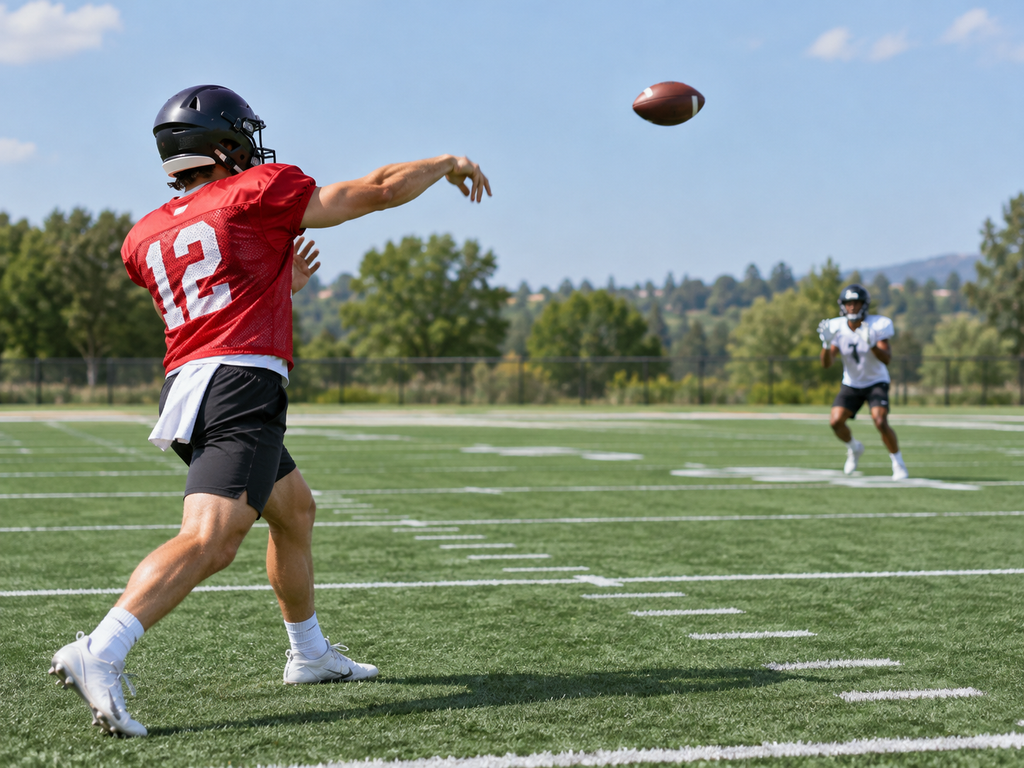
Throwing a football accurately is one of the most important skills a quarterback can develop. A strong arm can send the ball downfield, but strength alone does not guarantee that a pass will reach the intended target. Accurate passing requires balance, controlled footwork, consistent mechanics and the ability to adjust ball placement based on a receiver’s movement.
If you already understand how to throw a football but struggle to hit your targets consistently, improving your football throwing accuracy should become a regular part of your practice. Small improvements in foot positioning, release timing and body control can make a noticeable difference in how reliably you deliver passes.
Whether you’re practicing short throws, working with moving receivers or developing your intermediate passing game, the goal is the same: deliver a catchable football to the right location, at the right time, with repeatable technique.
This guide explains what affects throwing accuracy, how to correct common mistakes and which practical drills can help you become a more consistent passer.
What Makes a Football Pass Accurate?
An accurate football pass reaches a location where the intended receiver has a reasonable opportunity to catch it without making an unnecessary adjustment.
That does not always mean throwing directly at the receiver’s current position. When a receiver is moving across the field, the quarterback generally needs to throw toward the location where the receiver is expected to arrive.
For example, imagine a receiver running a short crossing route from left to right. If the quarterback throws directly toward the receiver’s current position, the ball may arrive behind them. An accurate throw accounts for the receiver’s movement and arrives where the receiver can continue running.
Accuracy also involves ball placement.
A receiver standing still may prefer a pass delivered around chest height. A receiver running toward the sideline may need the ball placed ahead of their movement. Different situations call for different placements, but the underlying objective remains consistent.
Three qualities contribute to reliable passing:
- Direction: The football travels toward the intended target rather than unnecessarily left or right.
- Distance: The throw carries far enough without consistently falling short or sailing beyond the receiver.
- Timing: The ball arrives when the receiver can reasonably make the catch.
When these three qualities work together, the quarterback becomes more dependable across different passing situations.
Build a Consistent Throwing Stance
An accurate pass begins before the throwing arm moves.
Your stance provides the foundation for balance, weight transfer and controlled rotation. When your feet are poorly positioned, your upper body often compensates, making the throwing motion harder to repeat.
Start With a Balanced Base
Begin in a comfortable athletic stance with your feet approximately shoulder-width apart and your knees slightly bent.
Keep your body relaxed enough to move naturally. Avoid standing with locked knees or placing so much weight on one foot that you struggle to adjust.
For a right-handed quarterback, the right foot generally serves as the rear foot during a conventional throw, while the left foot leads toward the target. Left-handed quarterbacks normally reverse this arrangement.
Your exact stance may vary depending on your throwing style and the situation, but the important principles are balance and control.
A useful self-check is whether you can move in any direction without first having to recover your balance.
Keep Your Feet Ready to Throw
During passing drills, quarterbacks sometimes pay so much attention to their arms that they neglect their feet.
A quarterback might catch the snap, take several steps backward and attempt a throw while the feet are still moving into position. The result is often a poorly controlled pass.
Practice settling into a stable throwing position before releasing the ball during basic accuracy drills.
As your mechanics improve, you can gradually reduce the time needed to prepare your feet.
The objective is not to stop moving completely during actual gameplay. It is to develop footwork that allows you to throw accurately without unnecessary repositioning.
Use Your Lower Body to Support the Throw
Your throwing arm releases the football, but it should not provide all the force independently.
Effective passing uses coordinated movement through the legs, hips, torso and throwing arm.
Transfer Your Weight Smoothly
During a conventional throw, your weight shifts from the rear leg toward the lead leg.
This movement helps connect your lower body to the throwing motion.
The key is to transfer weight with control rather than lunging forward. An exaggerated step can make it difficult to maintain balance and may interfere with the release.
Try the following sequence during an easy practice throw:
- Establish a comfortable athletic stance.
- Keep your head and upper body balanced.
- Take a short, controlled step toward the intended target.
- Allow your hips and torso to rotate naturally as the throwing motion develops.
- Release the ball without forcing your upper body forward.
- Finish in a balanced position.
Practice the movement slowly before attempting full-speed throws.
Coordinate Hip and Shoulder Rotation
Your hips and shoulders contribute to the transfer of energy through the throwing motion.
When these movements are poorly coordinated, a quarterback may compensate by swinging the arm harder or changing the release angle.
Rather than trying to rotate as quickly as possible, focus on a smooth, connected movement.
A coach can help determine whether your mechanics are efficient for your body and throwing style.
Avoid forcing your shoulder or elbow into uncomfortable positions merely to imitate another quarterback.
Improve Your Release and Follow-Through
The release influences the direction, trajectory and consistency of the football.
Two throws can begin from nearly identical stances but travel differently because of changes in release timing, hand position or arm movement.
Maintain a Comfortable Grip
Hold the football securely without squeezing it excessively.
Your grip should allow control during the throwing motion while still permitting a smooth release.
Hand size affects how comfortably players position their fingers around the ball. Experiment within a comfortable range rather than forcing a grip that creates tension.
A football that repeatedly slips or releases unpredictably may indicate that the grip needs adjustment.
Develop a Repeatable Release
A consistent release helps reduce unnecessary variation between throws.
During practice, observe whether you are changing your arm motion depending on how far you want the football to travel.
For example, a player might use a controlled motion for short passes but suddenly exaggerate the arm movement for intermediate throws.
Such changes can make the release harder to repeat.
Instead, maintain a comfortable throwing pattern while learning to adjust the required effort.
The exact release mechanics vary among quarterbacks. The goal is a repeatable, efficient motion that allows you to deliver the football without discomfort.
Finish With Control
Your arm should continue naturally through the throwing motion after the ball leaves your hand.
Avoid abruptly stopping the arm or forcing an exaggerated follow-through.
Pay attention to where your body finishes. If you regularly fall to one side, twist uncontrollably or step across your body, your balance or timing may need adjustment.
The finish offers useful information about what happened earlier in the throw.
Practice Accurate Short Passes First
Short passing drills are useful because they allow you to concentrate on mechanics without the added challenge of throwing long distances.
Begin with a partner or stationary target placed at a comfortable distance.
You might start approximately 5 to 10 yards away, depending on your experience and available space.
Choose a specific target area rather than simply trying to throw the football somewhere near your partner.
For example, aim for a comfortable chest-level catching window.
Throw several passes at a controlled pace and observe where they arrive.
If most throws reach the intended location, gradually increase the challenge.
If the football consistently misses in the same direction, review your stance and release before moving farther away.
Improve Placement Before Distance
One common training mistake is increasing throwing distance too quickly.
A quarterback may begin with accurate short passes but immediately move back until the ball becomes difficult to control.
Longer throws are useful, but greater distance should not automatically become the measure of improvement.
Establish a repeatable motion at shorter distances, then gradually extend the range while maintaining reasonable ball placement.
This progression allows you to identify when distance begins to affect your mechanics.
Learn to Throw Accurately to Moving Receivers
Throwing to a stationary target develops directional control, but game situations frequently require passing to receivers who are moving.
This introduces an additional challenge: the quarterback must account for where the receiver will be when the football arrives.
Lead the Receiver
Imagine a receiver running horizontally across the field.
A pass thrown directly at their current location may arrive behind them.
Instead, the quarterback needs to anticipate where the receiver will be and deliver the ball into an appropriate catching area.
The required lead depends on several factors, including:
- Receiver speed and direction.
- Passing distance.
- Football travel time.
- Route timing.
- The receiver’s expected catching position.
There is no single amount of lead that works for every throw.
Developing this skill requires practice with moving targets and feedback from receivers.
Begin With Predictable Movement
Ask a receiver to jog along a clearly defined path.
Start with short passes and have the receiver maintain a consistent speed.
Focus on delivering the football into a comfortable catching area without forcing the receiver to stop abruptly or reach far behind.
After several successful repetitions, vary the receiver’s starting position or movement speed.
Only add more complex patterns after you can consistently deliver catchable throws during predictable movement.
This helps isolate ball-placement accuracy without introducing unnecessary tactical complexity.
Five Drills to Improve Football Throwing Accuracy
Drills are most effective when each one addresses a specific skill. Rather than throwing repeatedly without a goal, choose an exercise based on the problem you want to improve.
Drill 1: Stationary Target Accuracy
Purpose: Improve directional consistency and release control.
Place a clearly visible target at a comfortable throwing distance. A marked target net or other suitable training target works well.
Complete 10 controlled throws, aiming for the same target area.
Record how many attempts reach the intended zone.
After completing the first set, rest briefly and repeat.
If your accuracy remains consistent, try making the target slightly smaller or increasing the distance.
Avoid increasing both difficulty factors at once.
Drill 2: Short-Step Passing
Purpose: Coordinate foot positioning and weight transfer.
Start in your usual throwing stance with a partner positioned at a comfortable distance.
Make a short, controlled lead step as you begin the throwing motion.
Focus on transferring your weight smoothly while maintaining balance.
Complete several throws, checking that the lead step does not become exaggerated.
This drill can help identify whether inconsistent foot placement is influencing your throws.
Drill 3: Moving Receiver Placement
Purpose: Improve timing and directional ball placement.
Have a receiver jog across a defined section of the field.
Begin with short, predictable movements.
Deliver the pass toward an appropriate catching position ahead of the receiver’s movement.
Ask the receiver whether the ball arrived comfortably or required a major adjustment.
Repeat in both directions to expose differences in your mechanics or timing.
Drill 4: Multiple Target Zones
Purpose: Develop accuracy when changing intended targets.
Set up three visible target locations at safe distances, such as left, center and right.
Begin from a balanced stance and have a partner or coach call the next target.
Move your feet into a suitable throwing position before releasing the football.
Prioritize accurate body alignment over throwing as quickly as possible.
As you improve, gradually reduce the preparation time while preserving throwing quality.
Drill 5: Distance Progression
Purpose: Maintain accuracy as passing distance increases.
Start at a distance where you can consistently deliver a catchable pass.
Throw a set of 10 passes and record your results.
Move slightly farther away for another set.
Continue only while your mechanics remain controlled and your accuracy is reasonably consistent.
If your technique deteriorates, return to a shorter distance and rebuild consistency.
This exercise helps identify your current reliable passing range rather than your maximum throwing distance.
Common Football Throwing Mistakes and How to Correct Them
Improving accuracy often involves identifying a recurring pattern rather than changing every part of your throwing motion.
Throwing While Off-Balance
A quarterback who throws while falling backward or leaning excessively to one side may struggle with consistent ball placement.
During controlled practice, focus on setting your feet and maintaining balance through the release.
Once you establish consistency, gradually introduce movement before the throw.
Taking an Overly Long Step
An exaggerated lead step can interfere with weight transfer and throwing rhythm.
If your front foot lands too far ahead, you may find it difficult to move naturally through the throw.
Use a shorter, controlled step that allows your body to remain balanced.
Relying Too Much on Arm Strength
Trying to force every pass with your arm can create unnecessary tension and inconsistent mechanics.
Work on coordinating your lower body and torso instead of simply increasing throwing effort.
Releasing the Ball Too Early or Too Late
Poor release timing may send the football away from the intended target.
If your misses follow a predictable pattern, record several throws and review your mechanics with a qualified coach.
The correct adjustment depends on your throwing motion. Do not assume every high, low, left or right miss has the same cause.
Changing Mechanics for Every Distance
Some players significantly alter their throwing motion whenever the target moves farther away.
Develop a consistent foundation and adjust effort appropriately rather than completely rebuilding your mechanics for each throw.
Practicing Without Feedback
Repeating the same movement does not guarantee improvement.
Without observing where passes land or understanding why they miss, a quarterback may reinforce an ineffective habit.
Use a target chart, partner feedback or video review to identify patterns and make informed adjustments.
How to Measure Your Throwing Accuracy
A practical measurement system can help you recognize progress over time.
Instead of counting only completed passes, track how consistently the football reaches a specific target area.
Use a Simple Accuracy Percentage
During a controlled target drill, divide the number of accurate throws by your total attempts.
For example, if 14 out of 20 throws reach the intended target zone:
14 ÷ 20 × 100 = 70% accuracy
This percentage represents performance within that drill, not an official football passing statistic.
Track results separately for different distances because a short stationary-target drill is not equivalent to throwing to a moving receiver downfield.
Record the Type of Miss
A simple training record might look like this:
| Drill | Attempts | Accurate Throws | Accuracy |
|---|---|---|---|
| Short stationary target | 20 | 16 | 80% |
| Intermediate stationary target | 20 | 13 | 65% |
| Moving receiver | 20 | 12 | 60% |
These figures are illustrative, not performance standards.
You can also note whether the football regularly arrives high, low, behind or ahead of the receiver.
Over several sessions, these observations may reveal which aspects of your passing need the most attention.
Compare Similar Conditions
To make your results meaningful, keep the target distance, target size and drill conditions reasonably consistent when comparing sessions.
Weather, fatigue and receiver movement can affect results.
Your progress becomes easier to evaluate when you compare similar drills rather than mixing unrelated situations.
Build a Practical Football Throwing Routine
You do not need to turn every practice session into an exhausting passing workout.
A short, organized routine with clear objectives can be more useful than a large number of unfocused throws.
Here is an example for a developing quarterback.
| Practice Phase | Activity | Suggested Time |
|---|---|---|
| Warm-up | Gentle movement and progressive easy throws | 5–10 minutes |
| Mechanics | Balanced stance and short-step throws | 5 minutes |
| Target accuracy | Stationary target drills | 5–10 minutes |
| Moving targets | Passes to a jogging receiver | 5–10 minutes |
| Review | Record results and identify improvements | 5 minutes |
Adjust the duration and throwing volume to your age, conditioning, training schedule and coach’s guidance.
Throwing sessions should not continue through arm, elbow or shoulder pain. If discomfort develops, stop and seek appropriate guidance rather than attempting to correct it by throwing harder.
Focus on One Main Improvement at a Time
If you identify several problems, resist the temptation to correct them all during one practice.
For example, you might dedicate one session to improving foot positioning.
During the next session, you could focus on leading moving receivers.
This makes practice more manageable and helps you recognize whether a particular adjustment improves your results.
Review Progress Regularly
At the end of each week, compare your results from similar drills.
Look for improvement in both accuracy and repeatability.
A quarterback who delivers eight accurate throws in one session but only three in the next may need more consistent mechanics, even if the best individual throws are excellent.
Reliable performance matters more than occasional perfect passes.
When to Increase the Difficulty of Your Passing Drills
Once your technique becomes consistent, gradually introduce additional challenges.
You might begin by increasing throwing distance, narrowing the target zone or having receivers vary their movement speed.
Another progression involves preparing your feet after controlled movement.
For example, start from a position slightly away from your throwing spot, move into the appropriate stance and deliver the football toward the target.
The purpose is to preserve accuracy while introducing more realistic preparation.
Avoid adding multiple challenges at the same time. If distance, movement, target size and timing all change together, identifying the cause of missed throws becomes difficult.
Progress gradually and use your recorded results to determine when you’re ready.
Final Thoughts: Build Accuracy Through Consistency
Improving football throwing accuracy requires more than throwing the football harder or completing countless passes.
Reliable passing develops through a combination of balanced footwork, coordinated body movement, controlled release mechanics and practice that produces useful feedback.
Start with accurate short throws. Develop consistent ball placement before increasing distance. Practice with moving receivers and use structured drills to identify the specific areas that need improvement.
Most importantly, measure progress over time rather than judging your ability based on a few successful or unsuccessful passes.
When you make accuracy a deliberate part of your training, you build a foundation for more dependable quarterback performance.
Continue developing your game by exploring our other Intermediate American Football Guides, or visit the American Football Learning Path for structured courses covering the skills and knowledge needed at each stage of development.