
A Beginner’s Guide
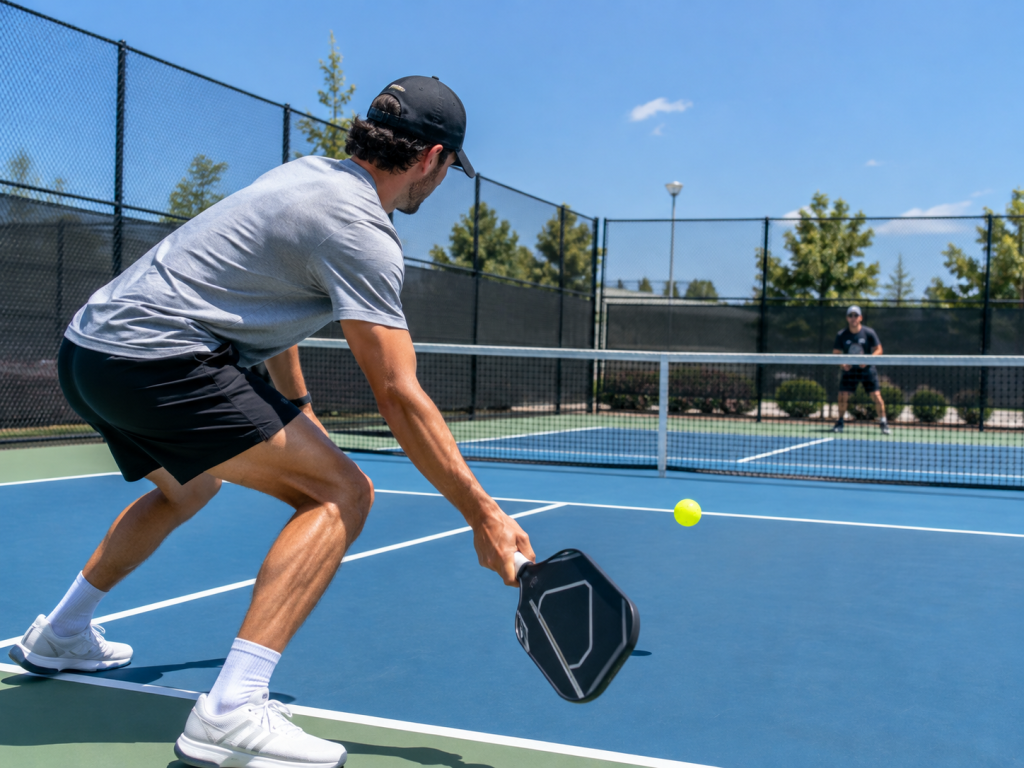
Returning serve is one of the first skills every pickleball player needs to develop. A good return does more than simply put the ball back over the net. It gives you time to move forward, helps you establish a strong court position and makes it harder for the serving team to take control of the rally.
For beginners, the goal is not to hit a spectacular return. The goal is to hit a deep, controlled and consistent shot that gives you enough time to advance toward the non-volley zone line, commonly called the kitchen line.
This guide explains how to return serve in pickleball, where to stand, how to move, where to aim and how to avoid the mistakes that make returns unnecessarily difficult.
What Is a Return of Serve in Pickleball?
The return of serve is the shot hit by the receiving team immediately after the serve.
A typical rally begins like this:
- The serving player serves diagonally into the correct service court.
- The receiver lets the serve bounce.
- The receiver hits the return.
- The serving team must let that return bounce before hitting it.
This sequence is part of pickleball’s two-bounce rule.
Because the serving team must allow your return to bounce, the returner has an important opportunity: you can hit the ball deep and use the extra time to move toward the kitchen line.
That makes the return of serve an important positional shot rather than simply a way to keep the rally alive.
The Main Goal of the Return
For most beginners, the best return has three qualities:
- It lands deep in the opponent’s court.
- It clears the net safely.
- It gives you time to move forward.
You usually do not need to hit the return as hard as possible.
A high-percentage return that lands near the baseline is often more useful than a fast shot that barely clears the net.
Think of the return as a setup shot.
Your return should help you establish better court position for the next phase of the rally.
Where to Stand When Returning Serve
Your starting position matters because you must allow the serve to bounce before hitting it.
Most players should begin behind the baseline.
Exactly how far behind depends on factors such as:
- How hard the opponent serves
- How deep their serves usually land
- Your speed and mobility
- Your preferred contact point
A common beginner mistake is standing directly on the baseline.
If the serve lands deep, you may be forced to hit the ball while moving backward or crowding yourself.
Instead, give yourself some room.
Starting roughly one to three feet behind the baseline is often a comfortable position, although you may adjust depending on the server.
Against a Deep or Powerful Server
Move farther behind the baseline.
This gives you more time to react and allows the ball to come into a comfortable hitting zone.
Against a Shorter or Slower Server
You can stand slightly closer.
However, avoid creeping too far forward because the opponent may suddenly hit a deeper serve.
Get Into a Ready Position
Before the serve is hit, use a balanced athletic stance.
Your feet should be approximately shoulder-width apart with your knees slightly bent.
Keep your paddle in front of your body rather than hanging at your side.
Your weight should feel light and balanced on the balls of your feet.
This position allows you to move quickly in either direction.
Watch the server closely and stay relaxed.
You want to react to the direction of the serve rather than guessing too early.
Track the Ball From the Serve
As the server makes contact, watch the ball carefully.
Try to identify:
- Direction
- Speed
- Depth
- Height after the bounce
- Spin, if any
Move your feet early so that you can position your body behind the ball.
Avoid reaching with only your arm whenever possible.
Good footwork makes the return easier because it allows you to contact the ball from a balanced position.
Let the Serve Bounce
The receiver must allow the serve to bounce before returning it.
Do not volley the serve out of the air.
After the ball bounces, allow it to rise into a comfortable hitting zone.
For many players, contact somewhere between knee and waist height is easier than trying to hit the ball immediately after it bounces.
Exactly where you contact it depends on your timing and the type of serve.
Use a Compact Swing
A return of serve does not require an enormous backswing.
For most beginners, a simple and controlled motion works best.
Start with your paddle prepared early.
Turn your shoulders slightly as the ball approaches and move the paddle smoothly through the ball.
Your swing should feel relaxed rather than forced.
Focus on sending the ball toward your target rather than trying to produce maximum speed.
A compact swing improves control and makes it easier to recover after contact.
Contact the Ball in Front of Your Body
Try to make contact slightly in front of your body.
This helps you direct the ball and transfer your weight forward.
Contacting the ball too far behind you often results in weak or uncontrolled shots.
If you continually find yourself hitting late, you may be:
- Standing too close to the baseline
- Preparing your paddle too late
- Taking too large a backswing
- Failing to move your feet early enough
Give yourself enough room to make comfortable contact.
Hit Through the Ball
Instead of flicking only with your wrist, use your body and arm together.
Transfer your weight gently from your back foot toward your front foot as you swing.
Your paddle should continue toward your target after contact.
A smooth follow-through helps control direction and depth.
You do not need an exaggerated finish.
The key is a controlled forward motion.
Where Should You Aim Your Return?
For beginners, the safest target is usually deep toward the opponent’s baseline.
A deep return creates several advantages.
It keeps the serving player farther away from the kitchen and gives you additional time to move forward.
There are several useful targets.
Deep Through the Middle
Returning through the middle is one of the safest options in doubles.
It gives you more court to work with and can create hesitation between opponents.
It also reduces the risk of hitting wide.
For beginners, this is often an excellent default target.
Deep Crosscourt
A crosscourt return gives you more distance because the diagonal length of the court is longer.
That can provide extra margin for error.
It can also make the serving player move sideways before hitting the next shot.
Deep to the Backhand
If you notice that an opponent has a weaker backhand, you can direct returns toward that side.
However, beginners should prioritize consistency over trying to exploit every weakness.
First learn to return the ball reliably.
Placement can become more specific as your control improves.
Should You Hit the Return Hard?
Usually, you do not need maximum power.
A return that is moderately paced, deep and controlled is often more effective.
Hitting too hard creates several problems:
- Less margin over the net
- Greater chance of hitting long
- Less time for you to move forward
- More difficult recovery after the shot
Remember that one of your main goals is to reach the kitchen line.
A return with some height and depth may actually be more useful than a fast, flat return.
Give Yourself Net Clearance
Beginners often try to hit returns too low over the net.
This creates unnecessary errors.
There is usually no reason to skim the net with your return.
Give yourself comfortable clearance.
A slightly higher trajectory makes it easier to hit the ball deep while reducing the chance of hitting into the net.
The return does not need to be a perfect attacking shot.
It needs to stay in play and help you advance.
Move Forward After the Return
This is one of the most important parts of returning serve.
After hitting your return, begin moving toward the non-volley zone line.
In doubles, the receiver’s partner will normally already be positioned near the kitchen line.
The returner’s job is to join them as quickly and safely as possible.
Do not stand at the baseline watching your return.
Recover immediately.
Your ideal sequence is:
Return → move forward → establish position near the kitchen line → prepare for the next shot.
Why Moving Forward Matters
Most doubles rallies eventually become more favorable to the team that establishes position near the kitchen line.
From there, you can:
- Volley balls before they drop
- Reduce the angles available to your opponents
- Apply pressure
- Play dinks more effectively
- Cover the court with your partner
Remaining deep near the baseline gives your opponents more time and more open court.
That is why the return is often designed to buy you enough time to move forward.
Do Not Run Blindly Toward the Kitchen
Moving forward is important, but you still need to stay under control.
If the serving team hits the next ball before you reach the kitchen line, you may need to stop and prepare for contact.
Use a balanced split step as the opponent is about to hit.
This helps you react to the incoming ball instead of being caught running.
If necessary, play the next shot from the transition area and continue advancing afterward.
You do not have to reach the kitchen line in one uncontrolled sprint.
Forehand Return of Serve
If the ball comes to your forehand side, turn your shoulders and prepare the paddle early.
Move behind the ball and establish a balanced stance.
After the bounce, swing smoothly forward and make contact in front of your body.
Aim deep and finish toward your target.
Then begin moving forward.
The forehand return often feels more natural for beginners because many players can generate depth easily from this side.
However, avoid overswinging simply because the forehand feels stronger.
Backhand Return of Serve
When the serve comes to your backhand, prepare early.
Turn your shoulders and keep the paddle relatively close to your body.
Move your feet so that you do not become crowded by the ball.
Use a compact forward swing and make contact in front.
You do not need to hit an aggressive backhand.
A controlled return that lands deep is enough.
If your backhand return feels inconsistent, focus first on balance, preparation and contact rather than power.
One-Handed or Two-Handed Backhand?
Either can work.
Some players prefer a one-handed backhand because it offers reach and simplicity.
Others use two hands because the second hand can provide additional stability and control.
Beginners should use whichever technique allows them to make clean, repeatable contact.
Consistency matters more than copying a particular style.
Returning a Fast Serve
Against a fast serve, your biggest priority is preparation.
Give yourself extra space behind the baseline.
Shorten your backswing and use the server’s pace rather than trying to generate even more power.
Focus on:
- Early preparation
- Stable contact
- Controlled direction
- Safe net clearance
Trying to swing harder against a powerful serve often makes timing more difficult.
Returning a Deep Serve
If the serve repeatedly lands close to the baseline, move farther back.
Do not allow yourself to become trapped against the line.
Giving yourself another step of space can make the return much easier.
From the deeper position, hit a controlled return and then immediately begin moving forward.
Returning a Short Serve
If the serve lands short, move forward quickly but under control.
Get your body into position before swinging.
Avoid lunging at the ball.
A short serve may allow you to contact the ball farther inside the court, but remember that you still need to keep the return deep if possible.
After hitting, continue moving toward the kitchen line.
Returning a Serve With Spin
Spin can change the way the ball moves after the bounce.
If you are facing a server who uses significant spin, watch the ball carefully instead of predicting where it will go.
Give yourself enough space to react after the bounce.
Keep your swing simple.
Trying to counter spin with a complicated stroke often creates more errors.
As you gain experience, you will become better at recognizing how different spins affect the bounce.
Common Pickleball Return Mistakes
Understanding common errors can help you improve faster.
Standing Too Close to the Baseline
This leaves little room for deep serves.
Fix: Move slightly farther behind the baseline and adjust based on the server’s depth.
Trying to Hit a Winner
Beginners sometimes treat the return like an attacking opportunity.
This leads to unnecessary errors.
Fix: Prioritize depth and consistency.
Hitting Too Low Over the Net
Low returns have very little margin for error.
Fix: Give yourself more net clearance.
Returning Too Short
A short return allows the serving team to move forward easily.
Fix: Aim toward the back third of the court.
Using Too Much Backswing
Large swings make timing harder.
Fix: Use a compact, controlled motion.
Staying at the Baseline
Hitting a good return and then remaining deep wastes one of the biggest advantages of the receiving team.
Fix: Move forward immediately after contact.
Running Through the Next Shot
Players sometimes rush forward without preparing for the opponent’s next hit.
Fix: Split step as the opponent prepares to strike the ball.
Watching Your Shot
It is tempting to admire or evaluate the return after hitting it.
Fix: Start your recovery immediately.
How Deep Should a Pickleball Return Be?
You do not need to land every return directly on the baseline.
A practical target is the deeper portion of the court while leaving yourself some margin before the line.
Trying to paint the baseline every time creates unnecessary errors.
Aim for depth without sacrificing consistency.
A ball landing several feet inside the baseline can still be an excellent return if it prevents the opponent from moving forward quickly.
Is a High Return Okay?
Yes.
A moderately high return can be very useful, especially for beginners.
The extra height can help you hit deeper and give you more time to reach the kitchen line.
The ball should not be an uncontrolled lob, but there is no requirement that your return travel low over the net.
Controlled height is often a smart choice.
Return of Serve in Singles
The fundamental technique remains similar in singles.
You still want to:
- Let the serve bounce
- Hit a controlled return
- Aim deep
- Recover quickly
However, court positioning is different because you must cover the entire court by yourself.
Placement becomes particularly important.
A deep return toward a corner can make the opponent move and may create open space for the next shot.
Return of Serve in Doubles
In doubles, the returner’s movement toward the kitchen is especially important.
The receiver’s partner usually begins near the non-volley zone line.
Once the return is hit, the receiver should work toward joining their partner.
This allows both players to establish a strong forward position.
Communication also matters.
Partners should understand who will cover balls through the middle and move together rather than creating large gaps.
Simple Return-of-Serve Technique
Beginners can remember the return using five simple steps:
- Start behind the baseline.
- Watch the serve and move your feet.
- Let the ball bounce.
- Hit a controlled return deep into the court.
- Move toward the kitchen line.
If you can perform those five actions consistently, you already have a strong foundation.
Beginner Drill: Deep Return Targets
Place several cones or markers approximately three to five feet inside the opposite baseline.
Have a partner serve repeatedly.
Try to land your returns beyond the markers.
Do not worry about speed.
Track how many out of 10 returns reach the target zone.
Your goal is consistency.
Once you can regularly hit deep returns, begin alternating between:
- Middle
- Crosscourt
- Backhand side
Beginner Drill: Return and Advance
This drill combines the shot with the movement that follows it.
Have a partner serve.
Return the ball deep and immediately move toward the kitchen line.
As your partner prepares to hit the next ball, perform a split step.
The goal is not to play out the rally.
Focus on developing the habit:
hit → move → split step → prepare.
This movement pattern is extremely important in doubles.
Beginner Drill: Forehand and Backhand Returns
Ask your partner to alternate serves between your forehand and backhand.
Hit five forehand returns followed by five backhand returns.
Focus on hitting every ball deep.
Do not try to produce more power from one side than the other.
The objective is to develop confidence returning from both wings.
Beginner Drill: 20-Ball Consistency Challenge
Have someone serve 20 balls to you.
Count how many returns land in the court.
Your first goal might be 15 out of 20.
Once you reach that consistently, add a depth target.
Then aim for 15 out of 20 returns to land in the deeper portion of the court.
This creates measurable progress without requiring advanced technique.
What Makes a Good Return of Serve?
A good return does not need to be flashy.
For most recreational players, a successful return:
- Lands in bounds
- Travels deep
- Gives safe net clearance
- Keeps the serving team back
- Allows the receiver to advance
- Leaves the returner balanced for the next shot
A return that accomplishes those goals is doing its job.
Return Placement vs. Power
As your game improves, you may be tempted to increase return speed.
Power can be useful, but placement usually matters more.
A controlled ball deep to an awkward location can create more difficulty than a hard shot hit directly to an opponent’s preferred side.
Build your game in this order:
Consistency → depth → placement → pace.
Do not reverse that order.
When Should You Try a More Aggressive Return?
Once your basic return is reliable, you can experiment with more offensive options.
For example, you might hit:
- A lower drive
- A return toward a weak backhand
- A sharp crosscourt return
- A ball designed to move the server sideways
These strategies can be useful, but they should not come at the expense of consistency.
A missed return immediately ends the rally.
There is little value in attempting a difficult attacking return when a simple deep return would put you in a strong position.
A Simple Strategy for Beginners
When you are unsure what to do, use this strategy:
Return the serve deep through the middle and move forward.
It is simple, repeatable and effective.
You do not need a large collection of return strategies when you first start playing.
Develop one reliable pattern first.
Then expand your options as your control improves.
Frequently Asked Questions
Does the return of serve have to bounce in pickleball?
Yes. Under the two-bounce rule, the receiving team must let the serve bounce before returning it.
Can you volley a serve in pickleball?
No. The serve must bounce before the receiver hits it.
Where should I stand to return serve?
Most players should start behind the baseline so they have enough room to handle deep serves.
Where should I aim my return?
For beginners, aim deep into the opponent’s court. Returning through the middle or deep crosscourt are both reliable options.
Should I hit the return hard?
Not necessarily. Depth, control and consistency are usually more important than maximum speed.
Why should I move toward the kitchen after returning?
The serving team must let your return bounce, giving you time to advance. Establishing position near the non-volley zone line can put you in a stronger position for the rally.
What if I cannot reach the kitchen line before the next shot?
Stop under control and prepare to hit from the transition area. After your next shot, look for another opportunity to continue moving forward.
Is a high return bad?
No. A moderately high, deep return can give you extra margin over the net and more time to move toward the kitchen.
Final Thoughts
Learning how to return serve in pickleball is less about hitting an impressive shot and more about starting the rally from a strong position.
Give yourself room behind the baseline, watch the ball carefully and allow it to bounce. Use a compact swing, make clean contact and send the ball deep into the opponent’s court.
Then move forward.
For beginners, that final step is just as important as the return itself.
If you remember only one strategy, make it this:
Return deep, stay controlled and move toward the kitchen line.
Master that pattern and you will make fewer errors, improve your court position and give yourself a much stronger start to every receiving rally.