
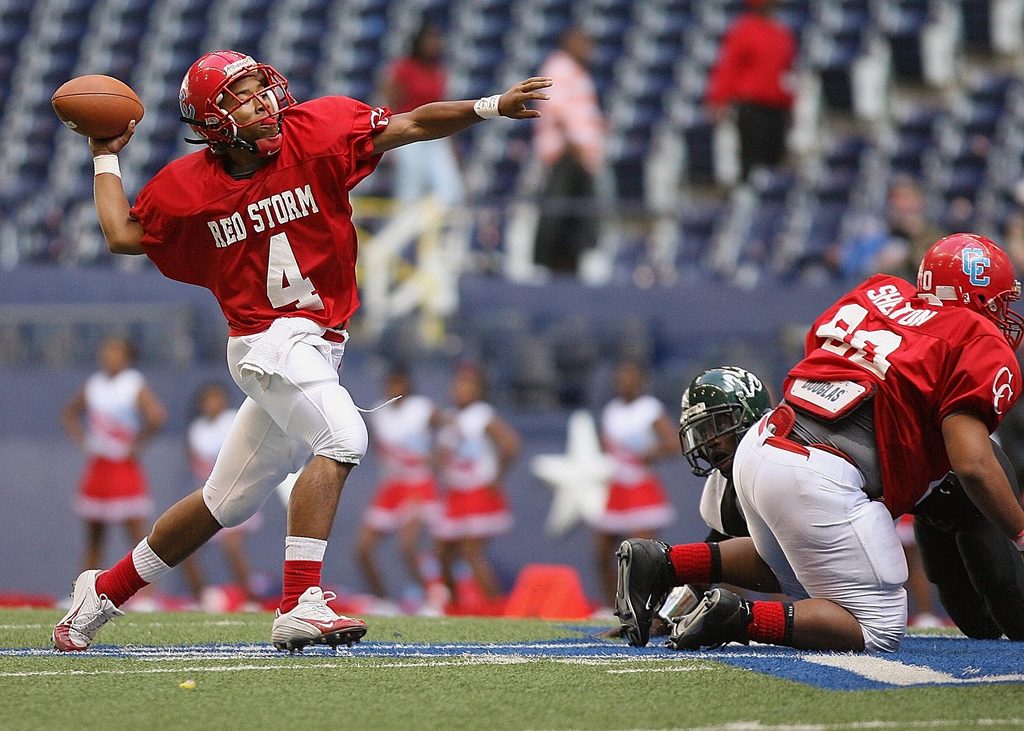
The quarterback takes the snap with a running back positioned beside him. Two wide receivers are aligned to the right, while a tight end stands just outside the offensive tackle.
The defense expects a running play.
At the snap, the offensive line moves as though preparing to block for the running back. The quarterback extends the football toward the runner before pulling it back and looking downfield.
Meanwhile, the tight end moves into an available passing area.
The quarterback delivers a short pass, and the tight end gains several yards before being tackled.
The success of this play depends on more than the quarterback’s throw or the tight end’s catch.
The offensive line, running back, quarterback and receiver all have coordinated responsibilities. Their movements are designed to influence how the defense responds.
This is an example of an offensive play concept.
Understanding offensive play concepts in football helps players recognize how individual assignments combine to create opportunities for the entire offense.
Rather than memorizing isolated running and passing plays, developing players can learn why certain blocking movements, routes and formations work together.
This guide explains common offensive running and passing concepts, the role of timing and spacing, and how coaches combine different plays to challenge a defense.
What Is an Offensive Play Concept?
An offensive play concept is a coordinated design that organizes player responsibilities to achieve a particular objective.
In the running game, the concept describes how blocking assignments, backfield movement and ball-carrier decisions work together.
In the passing game, it often describes how receiver routes combine to create opportunities against defensive coverage.
A concept may be used from different formations and personnel groupings.
For example, an offense can run a zone-based rushing concept with the quarterback under center or in shotgun formation.
Likewise, a curl-flat passing concept can be adapted to different receiver alignments.
The underlying idea remains recognizable even when the presentation changes.
Play Concept Versus Individual Assignment
An individual assignment describes what one player must do.
A wide receiver might be instructed to run a curl route.
A running back might be responsible for carrying the football toward a particular landmark.
An offensive lineman might have a blocking responsibility determined by the defensive front.
The play concept explains how these responsibilities fit together.
A curl route becomes part of a larger passing concept when another receiving option challenges a nearby defender.
A running back’s path becomes part of a rushing concept when it works with the blocking scheme.
Understanding this relationship helps players see the complete play rather than only their individual movement.
Why Offensive Concepts Matter
Football offenses must move the ball against defenders who are actively trying to stop them.
A successful play design attempts to create an advantage through positioning, movement, timing or player matchups.
Creating Space
An offense might spread players across the field to challenge how defenders distribute their responsibilities.
A passing concept can place receivers at different depths, making it difficult for one defender to influence multiple throwing areas.
A running concept may create space by moving blockers toward a particular part of the defense.
Creating Conflicts
Some offensive concepts force a defender to respond to two threats.
For example, a defender may need to account for a receiver running toward the sideline while another receiver breaks into an intermediate area.
If the defender moves toward one route, the other may become more accessible.
However, a good defense can respond through coordinated coverage responsibilities.
An offensive concept creates a challenge, not a guaranteed successful play.
Coordinating Timing
A receiver may become available at a particular moment.
If the quarterback is not ready to throw, the opportunity can disappear.
Similarly, a running back may reach the intended area before the blocking develops.
Good offensive execution requires players to coordinate their movements.
Understand the Main Families of Offensive Plays
Most offensive systems organize their plays into recognizable families.
These families can overlap, and terminology varies among coaches.
| Concept family | Primary idea |
|---|---|
| Zone runs | Coordinated blocking based on areas, leverage and defensive movement |
| Gap or man-scheme runs | Blocking designs that commonly create defined running lanes through specific assignments |
| Quick passing | Short routes coordinated with rapid quarterback timing |
| Dropback passing | Passing concepts designed to develop as the quarterback sets up to throw |
| Play-action | Passing plays that use a simulated running action |
| Screens | Plays that invite or influence defensive movement before delivering the ball to a receiver behind or near blockers |
| Run-pass options | Plays with a coached run-or-pass decision governed by designated defensive indicators |
Knowing the basic purpose of each family provides a foundation for understanding specific offensive concepts.
Understanding Zone Running Concepts
Zone running is a common approach to organizing the rushing attack.
Rather than having every blocker pursue an individual defender regardless of movement, zone schemes use coordinated assignments that account for defensive alignment and leverage.
The running back reads the developing blocks according to the team’s coaching system.
Inside Zone
Inside zone generally attacks interior running areas.
The offensive line works together using zone-blocking principles to create a usable lane.
The running back follows the coached path and reads the relevant blocking relationships.
The runner may continue toward the original landmark or make an appropriate cut when the blocking develops.
Example:
The offense calls inside zone to the right.
The running back initially approaches the assigned interior landmark.
As the play develops, the defensive line closes one area while another lane becomes available.
The running back makes the coached cut and accelerates through the opening.
The success depends on coordinated line movement and the runner’s timing.
Outside Zone
Outside zone generally stretches the defense toward the edge of the formation.
Blockers work to establish favorable positioning while the running back presses an outside landmark.
Depending on how defenders respond, the runner may continue toward the edge or cut into an available lane.
Outside zone does not mean the ball carrier must run all the way to the sideline.
The intended path depends on blocking and defensive movement.
Why Zone Runs Require Patience
A running back who cuts too early may leave the intended blocking structure before a lane develops.
Waiting too long can also allow defenders to close the available space.
Successful zone rushing requires coordinated timing, vision and decisive movement.
The exact reads should be taught within the team’s offensive system.
Understanding Gap Running Concepts
Gap schemes use specific blocking assignments to create favorable running paths.
These concepts frequently involve down blocks, pulling linemen or combinations of blockers working toward particular defenders.
However, not every gap-scheme play uses a pulling blocker.
Power Running Concept
Power is a familiar gap-scheme concept.
A common version includes offensive linemen blocking down toward the interior while a pulling guard moves across the formation to block a designated defender.
The running back follows the designed path behind the blocking structure.
The details vary according to formation and coaching system.
Example:
The offense runs power toward the right.
Blockers near the play side establish the necessary interior movement.
A guard from the opposite side pulls toward the intended running lane.
The running back follows the blocking design and attacks the available space.
The play aims to create a favorable blocking relationship at the point of attack.
Counter Running Concept
Counter commonly uses backfield action or initial movement that influences defensive reactions before the rushing play develops toward another area.
Some counter schemes include pulling blockers.
For example, the running back may take an initial step suggesting one direction before following blocks toward the opposite side.
The objective is to influence defensive movement while maintaining coordinated blocking.
The play requires precise timing.
If the backfield action and blocking develop at different speeds, the intended advantage may disappear.
Comparing Zone and Gap Schemes
| Feature | Zone running | Gap running |
|---|---|---|
| Blocking emphasis | Coordinated area and leverage principles | Specific blocking paths and assignments |
| Runner’s role | Read developing blocking relationships | Follow the designed blocking structure and coached reads |
| Common examples | Inside zone, outside zone | Power, counter |
| Important skill | Timing the read and cut | Coordinating the runner with the blocking design |
Neither family is automatically better.
Teams often use both because they challenge defenses in different ways.
Understanding Quick Passing Concepts
Quick passing concepts are designed to create receiving opportunities through short routes and coordinated timing.
They can help an offense move the football efficiently.
However, short passes are not automatically safe or successful.
Defensive positioning, route execution and ball placement still matter.
Slant-Flat Concept
A slant-flat combination commonly pairs an inside-breaking slant route with another player moving toward the flat.
The routes challenge nearby underneath coverage responsibilities.
Example:
An outside receiver runs a slant toward the middle.
A running back or inside receiver moves toward the flat.
An underneath defender must respond to the available threats according to the defensive coverage.
The quarterback uses the team’s prescribed read to determine which passing option is appropriate.
The concept may create a useful window, but a defender could still cover either route.
Stick Concept
A stick concept commonly places an inside receiver on a short route that breaks or settles according to the system, with another route threatening the flat and often a vertical route providing additional spacing.
The combination can challenge an underneath defender’s responsibility.
A quarterback may identify whether the stick route or flat option becomes available.
The exact route depths and progression depend on the team’s playbook.
Why Quick Passing Depends on Timing
A quick route may be open for only a brief period.
If the quarterback waits too long, a defender can close the passing window.
If the receiver reaches the break point late, the quarterback may release the ball before the target is prepared.
Quick passing works best when the route design and quarterback timing are coordinated.
Understanding Intermediate Passing Concepts
Intermediate passing concepts often combine routes at different depths or across related areas of the field.
They may require more development time than quick passing plays.
Curl-Flat Concept
A curl-flat concept commonly combines a receiver breaking back toward the quarterback at an intermediate depth with another player moving toward the flat.
The combination can challenge an underneath coverage defender.
Example:
The outside receiver runs a curl.
An inside receiver moves toward the flat.
If an underneath defender reacts strongly toward the flat, an appropriate window may develop for the curl.
If the defender gains depth beneath the curl, the flat option may become more attractive.
Other defenders can influence both throws, so the quarterback must evaluate the actual coverage.
Levels Concept
A levels concept commonly features in-breaking routes at different depths.
For example, one receiver may run a shallow route while another crosses the field at an intermediate depth.
This creates layered receiving threats.
The offense may challenge how linebackers and other underneath defenders distribute coverage responsibilities.
The objective is not merely to place multiple receivers in the middle.
The spacing and timing between routes are important.
Flood Concept
A flood concept places multiple receiving threats at different depths toward one side of the field.
A common version includes a deep route, an intermediate route and a short flat option.
This can stress defenders responsible for the same side of the field.
However, coverage rotations and coordinated defensive responsibilities may counter the concept.
The routes must maintain the intended spacing rather than converging into one crowded area.
Understanding Crossing Route Concepts
Crossing routes move receivers across the formation.
They can challenge defensive coverage through horizontal movement and coordinated route spacing.
Mesh Concept
Mesh commonly uses two shallow crossing routes traveling in opposite directions.
The receivers cross near the middle of the field at coached depths and spacing.
Additional routes may provide vertical or intermediate options.
The concept can challenge man coverage because defenders must track crossing receivers.
It can also create opportunities against zone coverage through the positioning of receivers and defenders.
Why Spacing Matters in Mesh
If the crossing routes are too far apart, the intended relationship may be lost.
If receivers cross incorrectly or crowd the same space, they may interfere with the play.
The offense should execute the designed route spacing and timing.
Receivers must not create illegal picks or initiate prohibited contact to obstruct defenders.
Shallow Cross Concept
A shallow cross often sends one receiver across the field at a relatively short depth, with complementary routes creating additional opportunities.
The shallow receiver may gain space as defenders react to other passing threats.
The concept works as a coordinated design rather than simply telling one player to run across the field.
Understanding Play-Action Passing
Play-action is a passing concept that uses a simulated running action.
The quarterback and running back may perform movements resembling a normal rushing play before the quarterback attempts a pass.
The objective is to influence defenders who are responding to the possibility of a run.
How Play-Action Creates Opportunities
Imagine an offense that has successfully used inside zone.
The quarterback receives the snap and presents the football toward the running back.
Some defenders may react to the apparent running action.
Meanwhile, receivers execute the assigned routes.
If defensive movement creates an appropriate passing window, the quarterback may have an opportunity to throw.
However, play-action does not require every defender to believe the fake.
Its effectiveness depends on the overall play design and defensive response.
The Offensive Line’s Role
The line may use blocking techniques designed to support the play-action presentation while legally protecting the quarterback.
The exact assignments vary.
Offensive linemen must understand that play-action remains a passing play.
They cannot simply block downfield without regard to rules restricting ineligible receivers beyond the line of scrimmage before a forward pass.
Common Play-Action Mistake
A quarterback may exaggerate the fake so much that the passing play becomes late.
A running back may also move at a pace inconsistent with the designed timing.
The fake should support the passing concept without disrupting execution.
Understanding Screen Pass Concepts
A screen pass is designed to deliver the football to a receiving player who may have blockers positioned ahead.
Unlike a conventional passing concept that primarily tries to protect the quarterback until a downfield route develops, some screens allow defenders to advance before the offense delivers the football into another area.
Running Back Screen
A running back may initially appear to be involved in protection before moving into the intended receiving area.
Offensive linemen may release according to the screen design and applicable blocking rules.
The quarterback delivers the pass at the proper moment.
If the timing works, the running back can catch the ball with blockers nearby.
Wide Receiver Screen
A wide receiver screen delivers the football quickly to a receiver near the line of scrimmage.
Teammates may provide legal blocking support.
The play attempts to create a favorable arrangement of offensive players and defenders.
However, the receiving player must still secure the pass and identify the available space.
Why Screens Can Fail
Screens are sensitive to timing.
If blockers move too early, the defense may recognize the play.
If the quarterback waits too long, defenders may disrupt the throw.
Poor receiver positioning can also reduce the effectiveness of the blocking design.
A screen works when the movement of the quarterback, receiver and blockers is coordinated.
Understanding Run-Pass Options
A run-pass option, commonly called an RPO, gives the offense a structured choice between a running play and a forward pass based on a designated defensive read.
The quarterback makes the decision according to the team’s rules.
An RPO is not simply an ordinary passing play followed by improvisation.
How an RPO Works
Imagine the offensive line blocking for an inside-zone run.
The quarterback observes a designated defender.
Depending on that defender’s positioning or movement, the quarterback may hand the football to the running back or deliver a quick forward pass.
The intended read and available throws vary by system.
Why Timing Is Important
Because the offensive line may be executing run-blocking assignments, the passing option must account for restrictions on ineligible players downfield.
Those limits vary by competition.
This is one reason many RPO designs use quick decisions and short passing concepts.
RPO Versus Play-Action
These concepts can appear similar to a spectator, but their structures differ.
In a conventional play-action pass, the play is designed as a pass with simulated rushing action.
In an RPO, the quarterback has a defined choice between the running and passing branches of the play.
Both require coordinated execution, but the decision structure is different.
How Formations Support Offensive Concepts
Formations determine where offensive players begin before the snap.
A concept may be executed from different formations, but the alignment can influence how the defense responds.
Using Spread Formations
A formation with several receivers distributed across the field may require the defense to account for multiple receiving threats.
This can change defensive spacing.
The offense may then use a running or passing concept suited to the available structure.
However, spreading the defense does not guarantee an easy run.
The defense may use personnel and alignments capable of defending both run and pass.
Using Tight Formations
An offense may align receivers or tight ends closer to the offensive line.
This can change blocking angles, route releases and defensive positioning.
Tight formations are not necessarily running formations.
They can support crossing routes, play-action and other passing concepts.
Using Motion
Pre-snap motion changes a player’s position before the ball is snapped.
It can influence defensive alignment or establish a more favorable starting point for a player’s assignment.
Motion should support the play design rather than serve as unnecessary movement.
It must also comply with formation and motion rules.
Understand Complementary Offensive Plays
One of the most important intermediate concepts is that offenses frequently use related plays to challenge a defense.
A complementary play builds on a familiar look while attacking a different defensive response.
Run and Play-Action Pairing
An offense may use an established running concept and a play-action pass with similar initial backfield movement.
If defenders react aggressively to the rushing action, the passing play may create an opportunity.
However, the offense should not assume that running success automatically guarantees play-action success.
The defensive response still matters.
Run and Screen Pairing
An offense may establish a rushing look before using a screen designed to take advantage of defensive movement.
The screen should fit the team’s blocking and passing rules.
Same Formation, Different Concept
Two plays can begin with identical personnel and formation but attack different areas.
For example, an offense may run inside zone from a shotgun formation.
Later, the team may use the same formation for a quick slant-flat combination.
The defense must account for both possibilities.
Using familiar presentations helps an offense avoid revealing its intentions too early.
How Coaches Choose Offensive Concepts
Choosing a play involves more than identifying a concept that appears effective on a diagram.
A coach must consider whether the team can execute it against the expected defense.
Personnel Strengths
A team with reliable offensive linemen and an effective running back may emphasize certain rushing concepts.
An offense with receivers who consistently execute short routes may use quick passing more frequently.
However, relying on one strength exclusively can make the offense predictable.
Defensive Alignment
A defense may place additional defenders near the line of scrimmage or use personnel suited to defending several receivers.
The offense must consider how its concept interacts with those alignments.
This does not mean every defensive look requires changing the play.
Many offensive concepts include coached rules for different fronts and coverages.
Down and Distance
Third-and-short often creates different priorities from second-and-long.
An offense may choose a concept designed to gain a small amount of reliable yardage or one that develops farther downfield.
The decision depends on the complete game situation.
Execution Reliability
A complicated concept may be effective in theory but difficult for inexperienced players to execute consistently.
Coaches should consider how well players understand their assignments.
A familiar concept executed accurately may be more useful than a sophisticated design performed poorly.
Practical Examples of Offensive Concepts Working Together
Example 1: Inside Zone Followed by Play-Action
The offense runs inside zone several times from a shotgun formation.
Later, the quarterback presents a similar handoff action but keeps the football.
A tight end runs into a designed passing area.
The play attempts to influence defenders through a familiar rushing presentation.
Concept lesson: Related running and passing plays can create uncertainty for the defense.
Example 2: Slant-Flat Against Underneath Coverage
An outside receiver runs a slant.
A second player moves toward the flat.
The routes place related threats into the defense’s underneath structure.
The quarterback follows the intended progression to evaluate the available option.
Concept lesson: Receiver routes should work together rather than function as unrelated movements.
Example 3: Power Against a Defensive Front
The offense aligns with a tight end beside the right tackle.
At the snap, blockers execute a designed power-running concept.
A pulling guard moves toward the assigned blocking area while the running back follows the play’s intended path.
Concept lesson: A running play depends on coordinated blocking and ball-carrier movement.
Example 4: Flood Passing Concept
The offense runs three receiving routes toward the right side at different depths.
The defense must distribute coverage responsibilities across those receiving areas.
The quarterback evaluates the available option according to the play design.
Concept lesson: Route spacing and depth can challenge defenders responsible for related parts of the field.
Common Mistakes When Learning Offensive Concepts
Memorizing Routes Without Understanding the Play
A receiver knows the assigned route but does not understand how it relates to teammates.
Improvement: Study how the route contributes to the complete passing concept.
Assuming a Concept Guarantees an Open Player
A quarterback expects a slant-flat combination to produce a completion regardless of coverage.
Improvement: Understand what the concept attempts to challenge while evaluating the actual defensive response.
Ignoring Blocking Responsibilities
A running back focuses only on the intended rushing direction.
Improvement: Learn how the blocking scheme influences the running lane and required timing.
Confusing Similar-Looking Plays
A player assumes every simulated handoff is an RPO.
Improvement: Identify whether the play is a designed pass with a fake or includes a true run-pass choice.
Changing Assignments Independently
A player alters the designed route or blocking responsibility because another option seems more attractive.
Improvement: Follow the team’s established rules and approved adjustments.
Learning Too Many Concepts at Once
A developing player studies dozens of plays without understanding their basic structures.
Improvement: Begin with a manageable selection and learn how each concept works from different formations.
Five Drills to Understand Offensive Play Concepts
Drill 1: Concept Identification
Purpose: Recognize common running and passing concepts.
A coach displays several play diagrams.
Players identify the broad concept family and explain how the assignments work together.
Begin with inside zone, power, slant-flat and curl-flat.
Drill 2: Route Combination Walkthrough
Purpose: Understand how passing routes create related threats.
Set up receivers in a basic formation.
Have them walk through a familiar passing concept.
Pause at different points to examine spacing and timing.
The quarterback identifies the intended receiving options.
Drill 3: Run-Blocking Coordination
Purpose: Understand the relationship between blockers and the ball carrier.
Use a non-contact walkthrough of inside zone or a basic gap scheme.
The running back follows the coached path.
Offensive linemen demonstrate their assignments against a stationary defensive front.
Drill 4: Complementary Play Comparison
Purpose: Recognize how related plays use similar presentations.
A coach demonstrates a basic running concept followed by a complementary play-action pass.
Players compare the initial backfield movement and final responsibilities.
Discuss how the defense may react differently.
Drill 5: Concept Recognition on Film
Purpose: Apply concept knowledge to recorded plays.
Review short game clips.
Identify the offensive formation and broad play family.
Describe how the main player movements support the intended objective.
Avoid assigning specific play-call terminology without sufficient evidence.
Build a Weekly Offensive Concept Learning Routine
A simple training routine can help intermediate players connect diagrams with on-field execution.
| Session | Focus | Activity |
|---|---|---|
| Day 1 | Zone running | Review and walk through inside and outside zone |
| Day 2 | Gap running | Study power and counter concepts |
| Day 3 | Quick passing | Practice slant-flat and stick combinations |
| Day 4 | Intermediate passing | Review curl-flat, levels and flood |
| Day 5 | Complementary concepts | Compare play-action, screens and run-pass options |
These sessions can be incorporated into regular team practice.
Players should prioritize their actual playbook and coaching terminology.
The objective is not to memorize every possible offensive system.
It is to understand how common concepts are organized and how individual assignments contribute to the complete play.
How to Measure Your Understanding
Recognizing a concept name is only the beginning.
A player should be able to explain how the concept works and execute the relevant assignment.
Useful questions include:
- Can you explain the purpose of the concept?
- Do you understand your assignment within the design?
- Can you identify how nearby teammates support the play?
- Do you recognize the intended timing and spacing?
- Can you explain how a defender might respond?
- Do you know which adjustments are permitted by your team’s system?
These questions help reveal whether the player understands the complete offensive structure.
For example, a receiver who can name the curl-flat concept but consistently runs the wrong depth still needs additional instruction.
Likewise, a running back who recognizes power but fails to coordinate movement with the pulling blocker has not yet mastered the concept.
Understanding must eventually translate into correct execution.
Final Thoughts: Understand the Play, Not Just Your Assignment
Learning offensive play concepts in football helps developing players see how individual movements contribute to the entire offense.
Zone and gap running schemes coordinate blockers and ball carriers to create rushing opportunities. Passing concepts combine routes to challenge defensive positioning and coverage responsibilities.
Play-action, screens and run-pass options add different ways to influence defensive reactions.
But no concept succeeds automatically.
Effective execution requires players to understand their responsibilities, maintain proper timing and respond according to the offensive system.
Begin with familiar run and pass concepts, study how teammates work together and use controlled walkthroughs to reinforce the design.
As your understanding improves, the offense becomes easier to recognize as a coordinated system rather than a collection of unrelated assignments.
Explore more Intermediate American Football Guides to continue developing your playing skills, or visit the American Football Learning Path for structured instruction in offensive and defensive fundamentals.