
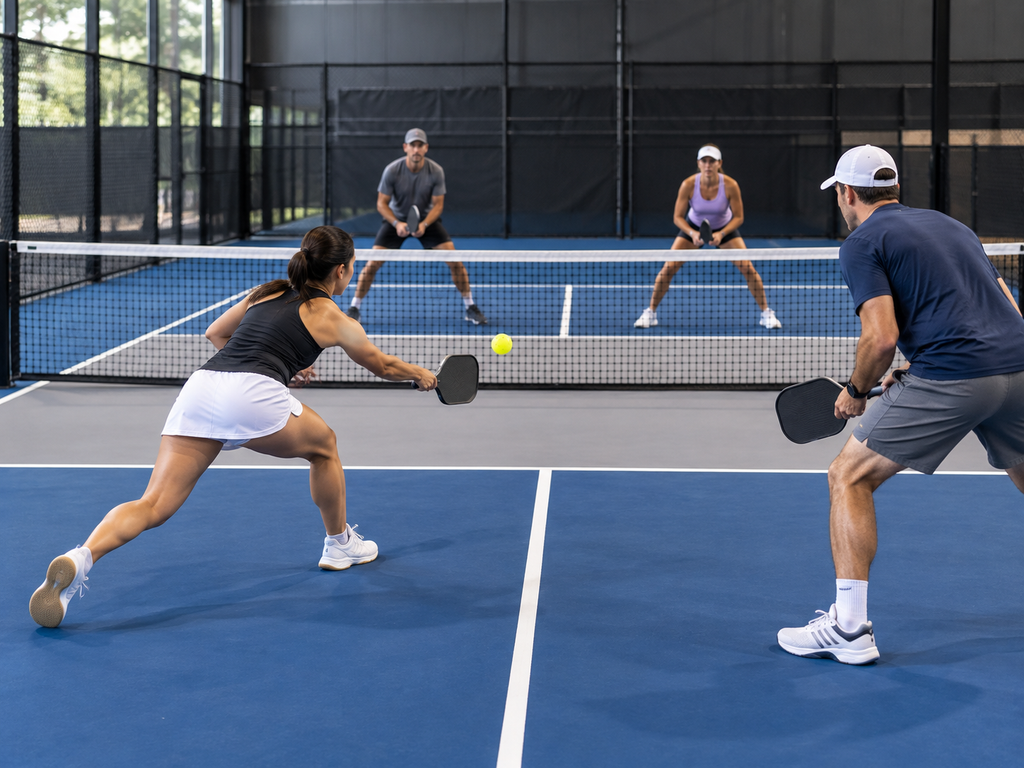
Fast exchanges are a normal part of competitive pickleball. When an opponent attacks with pace, the instinctive response is often to hit the ball back just as hard. However, matching power with power is not always the most effective decision, especially when you are defending from the transition zone or contacting the ball below net height.
Pickleball reset shots provide another option. By absorbing incoming pace and returning a controlled, softer ball, players can reduce immediate pressure and create an opportunity to regain a stronger court position.
A successful reset does not necessarily win the point. Instead, it changes the nature of the exchange, forcing opponents to generate their own pace or play another controlled shot.
For advanced players, knowing when and how to reset is essential for surviving difficult rallies and turning defensive situations into neutral ones.
What Is a Pickleball Reset Shot?
A reset is a defensive shot intended to reduce an opponent’s attacking advantage.
It is commonly played against a fast ball, particularly when the defending player is positioned between the baseline and the non-volley zone line.
Rather than attempting a powerful counterattack, the player uses a compact motion to control the incoming ball and send it softly over the net.
The preferred result is a low, descending shot that lands in or near the opponent’s non-volley zone.
A well-executed reset can make it difficult for an opponent to continue attacking downward.
Reset vs. Block vs. Counterattack
These three defensive responses have different tactical purposes.
| Shot | Primary Purpose | Typical Execution |
|---|---|---|
| Reset | Reduce pressure and restore a neutral rally | Soft contact with controlled pace |
| Block | Deflect an incoming ball with minimal swing | Stable paddle and compact movement |
| Counterattack | Respond offensively to an opponent’s attack | Short, controlled attacking stroke |
A block can sometimes function as a reset if it reduces pace and produces a suitably low return.
The distinction is primarily tactical rather than a rigid difference in technique.
A counterattack becomes more appropriate when the incoming ball and your court position allow you to redirect pace effectively.
Why Reset Shots Matter in Advanced Pickleball
At higher levels of play, opponents are generally more capable of recognizing and attacking elevated balls.
A poorly positioned player who receives a fast shot may struggle to respond aggressively without making an error.
Resetting provides a way to manage that disadvantage.
Reduce the Opponent’s Attacking Advantage
A fast ball directed toward your feet can be difficult to attack because the contact point is low.
Trying to drive the ball back may produce an elevated return.
A controlled reset allows you to use a softer trajectory intended to land below your opponent’s preferred attacking height.
If the shot is successful, the opponent may need to lift the next ball rather than strike downward.
Create Time to Regain Balance
Fast attacks frequently disrupt body positioning.
A reset can reduce the immediate speed of the exchange, giving you a better opportunity to recover your balance.
However, a soft ball does not automatically guarantee additional time.
An opponent may intercept a floating reset early or attack it aggressively.
The benefit comes from producing a low, difficult-to-attack response.
Support a Safer Transition to the Kitchen
One of the biggest challenges in advanced doubles pickleball is moving from the baseline toward the non-volley zone.
Opponents already established at the kitchen may direct fast volleys toward advancing players.
Reset shots help the advancing team manage those attacks without repeatedly retreating or attempting risky counters.
Several successful resets may be necessary before reaching the kitchen line.
Recognize When to Use a Reset Shot
The decision to reset should depend on the incoming ball, your balance, and the available attacking options.
When Contacting the Ball Below Net Height
Low contact points can make aggressive responses difficult.
If an opponent directs the ball toward your feet, consider using a controlled reset rather than forcing a hard return.
The goal is to lift the ball enough to clear the net while keeping its trajectory low.
When Defending from the Transition Zone
The transition zone is the area between the baseline and the non-volley zone line.
Players in this area may be particularly vulnerable to opponents who are established at the kitchen.
When a fast ball arrives while you are moving forward, stop or establish balance before contact whenever possible.
A reset may allow you to remain in the rally and prepare for a more favorable opportunity to advance.
When Your Body Position Is Compromised
Reaching wide, moving backward, or contacting a ball close to your feet can limit offensive options.
In these situations, a controlled defensive shot may be more reliable than an attempted winner.
Not every difficult ball can be reset into the kitchen. When necessary, prioritize returning the ball safely and recovering your position.
When Counterattacking Would Be Too Risky
A counterattack can be effective when the ball arrives at a favorable height and you are prepared to respond.
When those conditions are absent, attempting to match an opponent’s pace can increase errors.
Experienced players recognize that a neutral rally is often preferable to a low-percentage attack.
Develop the Proper Reset Shot Technique
Effective pickleball reset shots rely on stability, controlled paddle movement, and careful management of incoming pace.
The technique should remain compact because fast balls allow little preparation time.
1. Establish a Balanced Position
Keep your knees comfortably bent and your weight supported through an athletic stance.
Position the paddle in front of your body where you can react quickly.
Avoid taking a large backswing while preparing for a reset.
When possible, establish your balance before the opponent contacts the ball.
2. Use a Compact Paddle Movement
A reset generally requires less swing than a drive or conventional groundstroke.
Bring the paddle toward the contact point using a short, controlled motion.
The exact amount of movement depends on the incoming ball’s speed, height, and spin.
A very fast ball may require minimal additional forward force.
A slower ball may require a small lifting motion to clear the net.
3. Control the Paddle Face
The paddle face influences the ball’s outgoing trajectory.
A slightly open paddle face may help lift a low ball over the net.
However, excessive upward angle can cause the ball to float high enough for an opponent to attack.
Make small adjustments rather than exaggerated changes.
Your contact point and paddle orientation should work together to produce a controlled trajectory.
4. Manage Incoming Pace
The purpose of a reset is to reduce the speed of the exchange.
Avoid accelerating aggressively through the ball.
Instead, use a stable grip and controlled contact to regulate how much pace is returned.
Grip pressure should be secure enough to prevent the paddle from twisting but not so tense that the paddle becomes difficult to control.
A relaxed, responsive grip can help with touch, although excessive looseness may produce inconsistent contact.
5. Recover Immediately After Contact
A reset is only one part of the defensive sequence.
After returning the ball, bring the paddle back into a ready position and prepare for the next shot.
Do not assume that the opponent will respond softly.
A reset that sits slightly high may produce another fast attack.
Stay balanced and ready to repeat the defensive action.
Choose Effective Reset Shot Targets
Placement matters as much as touch.
A reset that lands in a difficult location can discourage an opponent from attacking aggressively.
Aim for the Opponent’s Kitchen
One common target is the opponent’s non-volley zone.
A soft ball that descends below net height can make it difficult for the opponent to generate a strong downward shot.
The objective is not necessarily to land the ball as close to the net as possible.
A ball that travels too short may strike the net, while one that travels too high may be attacked.
Seek a reliable combination of clearance, depth, and low arrival height.
Use the Middle in Doubles
A controlled reset toward the middle can sometimes reduce the angles available to opponents.
It may also require doubles partners to communicate about responsibility for the next ball.
However, a middle reset can be dangerous when an opponent is positioned centrally and ready to attack.
Consider the opposing team’s alignment before selecting this target.
Avoid Unnecessary Extreme Angles
Attempting a sharp angle while defending a fast shot increases the demand on your paddle control.
A safer target with sufficient margin may be more productive.
When you are under pressure, prioritize a reliable shot that reduces the opponent’s advantage.
Master Reset Shots in the Transition Zone
The transition zone presents one of the most demanding situations for advanced pickleball players.
As you move forward from the baseline, opponents at the kitchen may direct volleys toward your feet.
Your ability to reset those balls can determine whether you reach the non-volley zone successfully.
Advance in Controlled Stages
Moving directly from the baseline to the kitchen is not always possible.
After a third shot, evaluate the ball’s quality and move forward only as far as the situation allows.
Before an opponent makes contact, establish a balanced position.
If the opponent attacks, respond with a reset or another appropriate defensive shot.
Once you produce a sufficiently low return, look for an opportunity to advance again.
The process may involve several controlled exchanges.
Do Not Reset While Rushing Forward
One common problem is attempting to play a soft reset while the body is still moving rapidly toward the net.
Forward momentum can make it difficult to control the paddle and the ball’s outgoing speed.
Establishing balance before contact improves consistency.
This does not mean stopping completely after every shot. It means controlling movement so that contact remains stable.
Coordinate with Your Doubles Partner
Both partners should recognize when the team is transitioning.
If one player advances while the other remains deep, opponents may exploit the resulting space.
Communicate and adjust positioning according to the incoming ball and each player’s ability to advance.
Perfectly synchronized movement is not always possible, but coordinated recovery and court coverage reduce unnecessary gaps.
Resetting Against Different Types of Attacks
Advanced players should practice responding to several attacking situations.
Fast Volleys Directed at the Feet
These balls are particularly challenging because the contact point is low.
Bend through the knees, lower the paddle, and use a controlled lifting response.
Avoid exaggerated wrist action that can send the ball too high.
Attacks Toward the Body
When a ball travels directly toward your body, a compact block may be the most practical response.
Keep the paddle in front of you and minimize unnecessary movement.
If the block reduces pace and sends the ball softly into a difficult area, it may successfully reset the rally.
Wide Attacking Shots
Wide balls require additional movement before contact.
Prioritize reaching a balanced position and keeping the ball in play.
A controlled crosscourt reset may offer more usable court distance, depending on the angle.
Avoid attempting an excessively precise target while stretched outside your comfortable hitting position.
Common Pickleball Reset Shot Mistakes
Several errors can prevent players from neutralizing attacks effectively.
Using too much backswing: A large motion makes timing difficult and may return excessive pace.
Holding the paddle too rigidly: Excessive tension can reduce touch and make it harder to control the outgoing ball.
Leaving the paddle face too open: This can produce floating returns that opponents can attack.
Attempting difficult resets while off balance: Poor body positioning makes precise contact less reliable.
Advancing before the reset is effective: Moving forward after a high reset can expose you to another attack.
Expecting every reset to end the pressure: Strong opponents may continue attacking, requiring multiple defensive responses.
The objective is consistency rather than attempting a perfect reset on every difficult ball.
Advanced Pickleball Reset Shot Drills
Practicing resets in realistic conditions develops the touch and decision-making required for competitive matches.
Drill 1: Transition Zone Reset Practice
Setup: Position one player in the transition zone and another at the opposite kitchen line.
Execution:
- The kitchen-line player sends controlled attacking volleys toward the transition player.
- The transition player attempts soft resets into the opponent’s kitchen.
- After each shot, the transition player returns to a balanced stance.
- Continue for a set number of repetitions before switching roles.
Goal: Develop consistent touch and balance against incoming pace.
Drill 2: Reset and Advance
Setup: One player starts near the baseline while the other feeds balls from the opposite kitchen line.
Execution:
- The baseline player begins with a controlled drop.
- The feeding player sends a manageable attacking ball.
- The advancing player attempts a reset.
- If the reset is effective, the player moves forward into a stronger position.
- Continue until the player reaches the kitchen line or the rally ends.
Goal: Improve the connection between defensive shot quality and forward movement.
Drill 3: Consecutive Reset Challenge
Setup: One player defends from the transition zone while a partner delivers controlled attacks.
Execution:
- Attempt three consecutive reset shots.
- Keep each return low and directed toward a designated target.
- Maintain balance after every contact.
- Increase the difficulty only after achieving consistent control.
Goal: Build patience and reliability during repeated defensive exchanges.
Drill 4: Doubles Transition Scenarios
Setup: Four players begin a normal doubles rally, with the serving team practicing the transition toward the kitchen.
Execution:
- Begin with a serve, return, and third shot.
- Allow the receiving team to apply controlled pressure.
- The serving team uses resets when necessary.
- Both partners coordinate their movement toward the kitchen.
- Continue the point under normal rules.
Goal: Apply reset techniques within realistic team positioning and tactical situations.
Know When Not to Reset
Although resets are valuable, they should not become an automatic response to every attacking ball.
If an opponent sends a high ball toward you and you are balanced at the kitchen line, a controlled counterattack may be more effective.
Similarly, a ball that sits comfortably above net height may allow a more offensive response.
Constantly choosing soft defensive shots from advantageous positions can allow opponents to regain control.
The decision should reflect the incoming ball and your tactical situation.
Use a reset when reducing pressure is the strongest option. Attack when the opportunity is favorable and your position supports it.
Build Reset Shots into Your Competitive Game
Improving pickleball reset shots involves more than developing soft hands.
Players must learn to recognize defensive situations, manage their movement, and choose targets that reduce the opponent’s attacking advantage.
During practice, evaluate three questions:
- Was I balanced when I contacted the ball?
- Did the reset make the next attack more difficult?
- Was I prepared for the opponent’s response?
These questions shift attention from simply returning the ball to understanding whether the shot improved your tactical situation.
As consistency develops, incorporate resets into third-shot transitions, defensive doubles exchanges, and match-specific training.
Final Thoughts
Pickleball reset shots allow competitive players to manage fast attacks without relying entirely on power.
Through compact paddle movement, controlled contact, careful placement, and balanced recovery, players can reduce pressure and create opportunities to regain stronger court positioning.
The most effective reset is not necessarily the softest shot. It is the shot that makes the opponent’s next attack more difficult while keeping you prepared for the following exchange.
Developing this skill can make your defensive game more reliable, improve your transition toward the kitchen, and help you compete more effectively against aggressive opponents.