
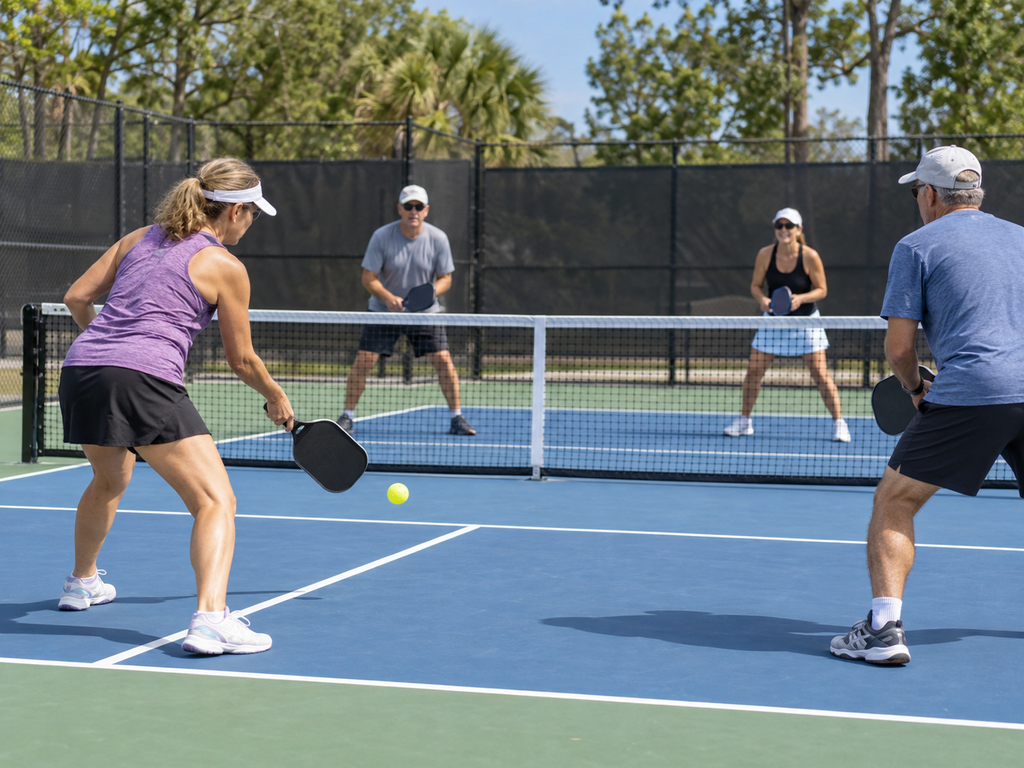
Learning pickleball rules is one thing. Putting them together during an actual game is another. You may understand how to serve, return the ball, and keep score, but it can still be difficult to know where to stand, whose turn it is to serve, or what to do after each rally.
The best way to connect these skills is to play a complete guided pickleball game. Instead of concentrating only on winning, you follow the game from the opening serve to the final point, paying attention to positioning, scoring, shot selection, and teamwork.
This guide walks you through a beginner doubles game using standard side-out scoring. You’ll see how the rules apply during play, how teams change servers, and how to make simple decisions as the game progresses.
1. Prepare for Your First Game
A standard doubles pickleball game has four players, with two players on each team.
For this walkthrough, we’ll use two teams:
- Team A: Alex and Jamie
- Team B: Chris and Taylor
Both teams play on a standard pickleball court measuring 20 feet wide and 44 feet long. The net divides the court, and the non-volley zone, commonly called the kitchen, extends 7 feet from the net on either side.
Before beginning, make sure you have appropriate paddles, a pickleball, suitable court shoes, and a clear playing area.
Agree to play to 11 points, with a winning margin of at least two points. Use traditional side-out scoring, where only the serving team can earn points.
Choose the first serving team using a fair method, such as a coin toss or paddle spin.
For our example, Team A will serve first.
2. Set Up Your Starting Positions
Alex begins behind the right-hand baseline, preparing to serve diagonally to Chris.
Jamie stands on the left side of Team A’s court.
On Team B, Chris positions behind the baseline in the diagonally opposite service court, ready to receive the serve. Taylor waits closer to the kitchen line, ready to participate once the opening two-bounce sequence is completed.
Alex’s first responsibility is straightforward: put the serve legally into play.
Check Before Serving
Confirm the following:
- Alex is behind the baseline and within the correct serving area.
- Chris is ready to receive diagonally.
- Jamie knows that Team A must let the return of serve bounce before hitting it.
- Everyone understands that the serve must clear the kitchen, including its line.
Because Team A serves first, the game begins with the score call:
“Zero, zero, two.”
The first number is Team A’s score, the second is Team B’s score, and the third identifies the server number.
The opening serving team starts with server number two, meaning only one player serves during the first service turn. After Team A loses that turn, the serve passes to Team B.
3. Begin the First Rally
Alex calls the score and serves diagonally into Chris’s service court.
The ball clears the net and lands beyond the kitchen line. Chris lets it bounce before returning it deep toward Team A’s baseline.
Alex and Jamie must now respect the two-bounce rule.
The serve has already bounced on Team B’s side. The return must bounce on Team A’s side before either Alex or Jamie can hit it.
Jamie allows the return to bounce, then sends a controlled shot back toward the middle of Team B’s court.
Now that the ball has bounced once on each side, both teams may volley or hit the ball after a bounce, provided they follow the non-volley zone rules.
Chris moves forward and returns the ball. Alex responds with a gentle shot that clears the net and lands inside Team B’s kitchen.
Taylor moves toward the ball but hits it into the net.
Team A wins the rally.
Because Team A served, it earns one point.
New score: 1–0–2.
Alex and Jamie switch left-right service positions. Alex serves again, this time from the left side.
What You Practiced
This opening rally introduced several essential parts of pickleball:
- Serving diagonally into the proper service court.
- Allowing the serve and return to bounce.
- Moving into better court positions after the return.
- Using a controlled shot instead of always hitting hard.
- Recognizing when a serving team earns a point.
These actions form the foundation of a normal pickleball rally.
4. Learn What Happens When the Serving Team Loses
Alex prepares for another serve and calls:
“One, zero, two.”
The serve lands correctly, and Chris returns the ball.
After the required bounces, Jamie attempts a firm groundstroke down the sideline. The ball lands outside the boundary.
Team A has committed a fault and loses the rally.
Since Team A was the opening serving team and started with server number two, Team B receives the serve immediately.
This change of possession is called a side-out.
Team B does not receive a point for winning the rally because it was receiving.
The score remains Team A 1, Team B 0.
Chris begins serving from the right-hand side of Team B’s court, calling:
“Zero, one, one.”
Notice that the serving team’s score is always announced first. The same game score now sounds different because Team B is serving.
5. Follow Both Servers on a Team
Chris serves successfully, and Team B wins the rally when Alex’s return goes into the net.
Team B earns a point.
Chris switches sides and calls:
“One, one, one.”
On the next rally, Chris sends a shot beyond Team A’s baseline.
Team B loses the rally, but its serving turn is not finished.
Taylor now becomes Team B’s second server.
Because Team B has not scored another point, the team does not switch positions. Taylor serves from the right-hand side and announces:
“One, one, two.”
Taylor wins the next rally when Jamie fails to return a low shot.
Team B earns another point, and Taylor moves to the left serving court.
The next call is:
“Two, one, two.”
This is how a normal doubles serving turn works. The first server continues until the team loses a rally. The second server then gets an opportunity to serve until another lost rally causes a side-out.
Important: Server numbers identify the first and second server during a team’s current serving turn. They are not permanent labels assigned to individual players throughout the entire game.
6. Move Into Better Positions During Rallies
As the game continues, the players begin settling into a more comfortable rhythm.
Team A serves deep, Team B returns deep, and the players gradually move closer to the kitchen line when they have a safe opportunity.
This movement matters because court positioning affects the shots you can reach.
After Your Team Serves
Stay behind the baseline long enough to allow the return of serve to bounce. Avoid charging forward immediately because your team must play that returning ball after it lands.
Once the third shot has been played, move forward when the quality of your shot gives you enough time.
A high, easily attacked shot may require you to stay back and prepare to defend.
After Your Team Returns the Serve
The receiver can begin moving forward after hitting the return, ideally working toward the kitchen line.
The receiver’s partner may already be positioned closer to the net.
As both players establish their positions, they should maintain enough space to cover their respective areas without leaving a large opening between them.
During Exchanges at the Kitchen
Keep your knees slightly bent, your paddle in front of your body, and your eyes on the ball.
Use compact movements to return soft shots. Avoid unnecessary backswing when the ball is moving quickly.
If a ball bounces inside the kitchen, you may step into the area to play it. However, you cannot volley the ball while touching the kitchen or its boundary line. Your momentum after a volley must not carry you into the area either.
These positioning habits become easier when you practice them in full rallies rather than as isolated movements.
7. Use Simple Shots to Keep the Game Going
As Alex, Jamie, Chris, and Taylor continue playing, each team begins choosing shots based on the situation.
Alex receives a deep return and sends a soft third shot toward the opponents’ kitchen. This gives Team A time to move forward.
Chris reaches the ball after it bounces and sends a gentle dink across the net.
Jamie replies with another dink, keeping the ball low.
Taylor then lifts a shot too high, giving Alex an opportunity to attack. Instead of hitting with maximum power, Alex directs a controlled volley into an open area of the court.
The shot lands in bounds, and Team A wins the rally.
This exchange demonstrates several useful beginner decisions.
Use a deep return to keep the serving team farther from the net.
Use a third-shot drop when you need time to advance from the baseline.
Use a dink to keep the ball low and make attacking difficult.
Use a controlled volley when the ball is high enough to attack legally.
You do not need an advanced shot collection to complete a pickleball game. Reliable serves, returns, groundstrokes, and a few soft shots are enough to start developing proper gameplay.
8. Keep Track of the Score as the Game Develops
The teams continue exchanging serves and rallies.
For the remainder of our example, imagine that both teams have successfully completed several service turns.
Team A now leads 4–3.
After a few more rallies, Team B takes the lead 6–5.
Later, Team A regains the advantage at 8–7.
These changing scores show why consistent scorekeeping matters. Players need to identify the correct server, the correct service court, and whether a rally produces a point or simply transfers the serve.
A Simple Scorekeeping Routine
Before each serve, confirm three things:
- Which team is serving?
- What is the current score?
- Is this the first or second server in the serving turn?
Remember that after a side-out, the team receiving the serve begins with server number one from the right-hand court.
Each point won by the serving team causes the server to switch between the right and left serving courts.
The receiving team does not switch sides simply because it wins a rally.
If you become confused, stop before the next serve and review the score and player positions with everyone on the court.
For a beginner game, taking a moment to clarify positions is more useful than continuing with an incorrect serving order.
9. Recognize Common Faults During Play
A complete guided pickleball game should also include learning to recognize mistakes.
Several faults occur as the teams continue playing.
Hitting Out of Bounds
Jamie hits a crosscourt shot that lands beyond the sideline.
The rally ends. The opposing team wins that rally.
A ball touching a boundary line is generally in, but remember that a serve touching the kitchen line is a fault.
Hitting Into the Net
Chris attempts a low return but fails to clear the net.
The rally ends, and Team A wins it.
Breaking the Two-Bounce Rule
Taylor accidentally volleys the third shot before Team B’s return has bounced on Team A’s side.
That would be a fault because the serving team must let the return bounce.
Volleying Inside the Kitchen
Alex hits the ball out of the air while standing on the kitchen line.
This is a non-volley zone fault, even if the volley itself lands successfully.
Allowing Two Bounces
A soft shot lands near the sideline, and Jamie reaches it only after its second bounce.
The rally is over.
As you learn, focus on recognizing these faults accurately. Do not treat every mistake as a failure. Understanding why a rally ended is an important part of improving.
10. Play the Final Points
The game reaches its closing stage.
Team A leads 10–9 and has the serve.
Alex is serving as server number two. Before serving, Alex calls:
“Ten, nine, two.”
Team A needs only one more point to reach 11 and win the game. Team B needs to stop the serving team, regain possession, and score additional points.
Alex serves deep into the correct service court.
Chris returns the ball toward Jamie, who waits for the required bounce and sends a controlled third shot over the net.
Chris and Taylor move toward the kitchen line.
The players exchange several shots. Taylor sends a low ball toward Alex’s backhand, and Alex returns it with a soft crosscourt shot.
Chris reaches forward and attempts a sharp angle. The ball clears the net but lands outside the sideline.
Team A wins the rally while serving.
The final score is:
Team A: 11 | Team B: 9
Team A wins because it has reached 11 points with a two-point lead.
If the score had reached 10–10, the game would have continued until one team established a two-point advantage. For example, a team could win 12–10 or 13–11.
11. Review Your Game Before Playing Again
Once the game ends, take a few minutes to review what happened.
You do not need to analyze every rally. Focus on the basic skills and decisions that affected your play.
Ask yourself:
- Did I serve from the correct position?
- Did I remember to let the serve and return bounce?
- Was I able to keep track of the serving order?
- Did I move forward at appropriate opportunities?
- Did I maintain a ready position near the kitchen?
- Did I communicate clearly with my partner?
- Did I use controlled shots instead of hitting every ball hard?
You may find that serving was comfortable but remembering the score was difficult. Or perhaps you understood the rules but struggled to move forward after returning the ball.
Identify one or two areas to improve during your next game.
12. Practice Another Game With Less Guidance
Now that you have completed a guided pickleball game, try playing another game with fewer pauses.
Keep the standard rules and scoring system, but allow the game to flow more naturally.
For your second game, concentrate on three objectives:
First, keep the ball in play. Consistency helps you develop timing and confidence. A well-placed, controlled shot is often more useful than a powerful shot that misses the court.
Second, maintain good court positioning. Move with your partner, avoid leaving large gaps, and approach the kitchen when the situation allows.
Third, communicate throughout the game. Call the score clearly, decide who will play balls traveling between partners, and discuss positioning when necessary.
As these habits become more automatic, you can begin paying greater attention to strategy, placement, and the tendencies of your opponents.
Final Thoughts
Your first complete pickleball game does not have to be fast, competitive, or mistake-free. Its purpose is to bring together everything you have learned about serving, returning, scoring, positioning, and rallying.
A guided pickleball game helps you understand not only what the rules are, but how they work from one point to the next.
With regular play, the three-number scoring system becomes more familiar, serving transitions become easier to follow, and your movement around the court becomes more natural.
The next step is simple: play another game, apply what you learned, and build your confidence one rally at a time.