
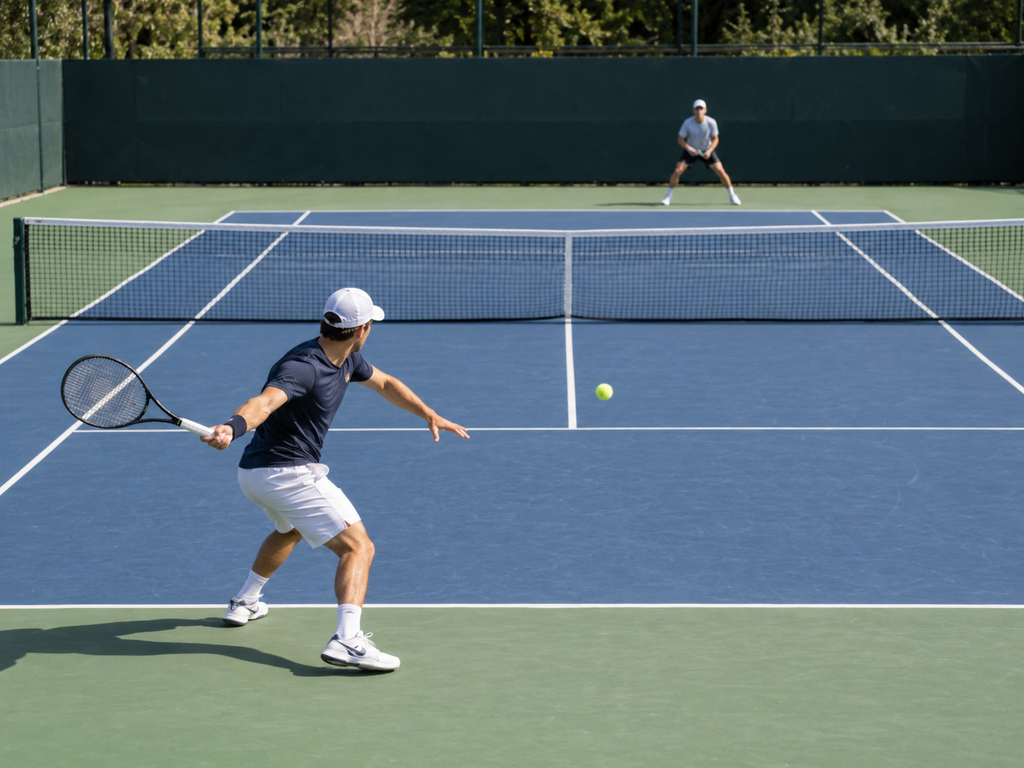
Winning more singles matches requires more than hitting powerful forehands, reliable backhands, and accurate serves. Players also need to understand how to use those shots effectively. Without a clear plan, rallies can become a series of reactive exchanges in which every ball receives the same response, regardless of the opportunity it presents.
Developing a practical singles tennis strategy helps intermediate players construct points with greater purpose. By choosing appropriate targets, recognizing when to attack, and understanding how to create openings, you can make better decisions during rallies without relying on difficult shots or unnecessary risks.
What Is Singles Tennis Strategy?
Singles tennis strategy is the overall approach a player uses to win points against one opponent. It involves deciding where to direct shots, when to play aggressively, when to defend, and how to respond as a rally develops.
Strategy differs from technique.
Technique determines how you execute a forehand, backhand, volley, or serve. Strategy determines which shot you choose and why.
For example, a player may have an effective down-the-line backhand but gain little advantage by using it from a poor position. The same shot may become valuable when the opponent is out of position and the player has time to prepare.
At the intermediate level, effective strategy usually begins with three priorities:
- Maintain enough consistency to stay in points.
- Use placement and depth to create manageable attacking opportunities.
- Recognize when the rally situation favors attacking, neutral play, or defense.
The objective is not to hit a winner on every opportunity. It is to make decisions that increase your chances of winning the point over several exchanges.
Understand the Three Main Rally Situations
One of the simplest ways to improve tactical decision-making is to identify whether you are in a neutral, offensive, or defensive position.
These situations can change several times during a single rally.
Neutral Rally Situations
A neutral situation occurs when neither player has a clear advantage.
Both players can reach the ball comfortably and produce reasonably controlled groundstrokes.
During neutral exchanges, focus on maintaining useful depth, choosing manageable targets, and avoiding unnecessary errors.
A neutral rally does not require passive hitting. You can still use directional changes and controlled pace to influence the exchange.
However, attempting a difficult winner from a routine ball may create more risk than advantage.
Offensive Rally Situations
An offensive opportunity develops when the incoming ball and your court position allow you to apply pressure.
Examples include receiving a short ball, contacting a slower ball inside the baseline, or facing an opponent who has been pulled significantly out of position.
In these situations, you may be able to:
- Direct the ball toward an open area.
- Increase pace while maintaining control.
- Move forward behind an effective approach shot.
- Force the opponent into a difficult defensive response.
An offensive shot does not have to end the point immediately.
A well-placed attacking groundstroke may create an easier opportunity on the following ball.
Defensive Rally Situations
A defensive situation occurs when the opponent places you under pressure.
You may be stretched wide, pushed well behind the baseline, or forced to contact a ball while moving.
Your priority is to return a shot that gives you a chance to recover.
Depending on the situation, this might involve sending the ball deep, using additional height, or directing it toward a larger target area.
Trying to produce a difficult winner while off balance often increases the chance of an immediate error.
Good defensive play is about improving your position in the rally, not simply returning the ball without purpose.
How to Build a Tennis Point
Point construction means using a sequence of shots to create a favorable opportunity rather than attempting to finish the rally immediately.
A practical approach for intermediate players is to think in three stages: establish control, create pressure, and use the opportunity.
Stage 1: Establish Control
Begin by putting the ball into play with a reliable shot.
During baseline rallies, consistent depth can help prevent the opponent from stepping forward comfortably.
Aim toward targets that suit your current level of control rather than attempting narrow corners.
The first objective is to avoid giving away the advantage through an unnecessary mistake.
Stage 2: Create Pressure
Once the rally is stable, look for ways to make the opponent’s next shot more difficult.
You might direct a controlled groundstroke away from their central position or send a deep ball that forces them to remain behind the baseline.
Pressure can come from placement, pace, depth, or changes in direction.
The key is to select a shot that you can execute reliably.
Stage 3: Use the Opportunity
If your opponent produces a shorter or weaker reply, evaluate whether you can attack.
A manageable ball inside the baseline may allow you to direct a firmer groundstroke toward an open area or approach the net.
However, a short ball does not automatically justify attempting a winner.
Your balance, contact height, and the opponent’s position should influence the decision.
Successful point construction often involves creating one additional difficult shot for the opponent rather than trying to finish the point immediately.
Use Crosscourt Rallies to Establish Control
Crosscourt groundstrokes provide a useful foundation for singles strategy.
The diagonal court distance is longer, and the net is lower near the center than near the posts. These characteristics can make crosscourt shots more forgiving than comparable down-the-line shots.
Crosscourt exchanges also allow players to maintain a relatively predictable rally direction while waiting for an opportunity.
When Crosscourt Is the Better Choice
A controlled crosscourt shot is often appropriate when:
- You are in a neutral baseline exchange.
- The incoming ball does not provide an obvious attacking opportunity.
- You want to maintain depth without taking excessive directional risk.
- Your opponent is well positioned to cover a down-the-line shot.
This does not mean you should hit crosscourt automatically.
Instead, recognize it as a dependable option when the rally does not favor a more demanding direction.
When to Change Direction
Changing direction can be effective when an opponent moves too far toward one side or leaves an accessible area open.
However, redirecting a fast incoming ball may be more difficult than returning it along a similar direction.
Consider your preparation, balance, contact position, and the opponent’s recovery before attempting a directional change.
A controlled down-the-line shot may create pressure. An unnecessary down-the-line attempt from a difficult position may simply produce an error.
How to Create Open Court Space
One way to construct a point is to make the opponent cover more court.
A player standing near the center can often reach moderate shots toward either side. When that player is forced toward a sideline, other areas may become more difficult to defend.
Move Your Opponent With Purpose
Rather than attempting extreme angles, use reliable placement to encourage lateral movement.
For example:
- Begin with a deep crosscourt groundstroke.
- Continue toward the same general area if the opponent remains comfortable.
- Recognize when the opponent is late or stretched.
- Consider changing direction on a suitable incoming ball.
The goal is to create an opening without compromising your own shot reliability.
Recognize When an Opening Is Actually Available
An apparently open court does not guarantee an easy winner.
Your opponent may have enough time to recover, particularly if your shot travels slowly or lands short.
Before attempting an aggressive change of direction, consider whether you can reach the ball in balance and produce enough pace or placement to make the shot effective.
A large opening is useful only if the attempted shot is realistic.
Avoid Becoming Predictable
Repeatedly directing every ball to the same location may allow an opponent to anticipate your choices.
You do not need to vary every shot, but you should recognize when a repeated pattern stops creating pressure.
Sometimes a deeper ball to the same area is more effective than an immediate change of direction. At other times, redirecting the ball may exploit the opponent’s movement.
Choose based on the rally rather than following an automatic sequence.
How to Recognize the Right Ball to Attack
Many intermediate players lose points because they attack from unsuitable positions.
The ability to recognize a good attacking opportunity is often more important than the ability to hit one powerful shot.
Look for a Manageable Short Ball
A ball that lands short may provide an opportunity to step forward.
However, consider its height, speed, spin, and your distance from the ball.
A low, heavily spinning short ball can still be difficult to attack.
A higher, slower ball that you can reach comfortably may offer a better opportunity.
Check Your Balance
Before choosing an aggressive shot, evaluate whether you can establish stable contact.
If you are still running, reaching, or recovering from a previous movement, a controlled approach may be safer than a full-power attempt.
Consider the Opponent’s Position
An attacking opportunity becomes more valuable when the opponent is poorly positioned.
If your opponent is already covering the intended target, hitting harder toward that area may accomplish little.
Look for placement that creates a difficult next shot rather than simply increasing pace.
Choose Between Attacking and Finishing
Not every attacking ball should be treated as a finishing opportunity.
A controlled aggressive shot can force a defensive reply and allow you to finish the point on the following ball.
This approach is often more reliable than attempting an extremely difficult winner from the first short ball.
When to Approach the Net in Singles
Approaching the net can shorten the time available for an opponent to react and create opportunities to finish points with volleys.
However, net approaches work best when supported by an effective preceding shot.
Approach Behind a Suitable Ball
A short, manageable ball may allow you to move forward and direct an approach shot deep or toward an area that limits the opponent’s comfortable passing options.
The objective is to make the opponent hit a difficult reply while you establish a useful volleying position.
Avoid Approaching Behind Weak Shots
Moving toward the net after hitting a short, slow ball can provide the opponent with time to choose a passing shot or lob.
Before advancing, consider whether your approach creates enough pressure to justify the movement.
Prepare for the Next Shot
After an approach shot, continue into a suitable net position when possible and prepare for the opponent’s reply.
Do not assume that the approach itself will win the point.
Be ready for a volley, passing-shot attempt, or lob.
Detailed approach-shot execution is covered separately in our planned intermediate guide on approaching the net and finishing points.
How to Adjust Your Strategy During a Match
A singles tennis strategy should respond to the match rather than remain fixed regardless of the opponent.
Intermediate players can make useful adjustments without performing complicated opponent analysis.
Recognize Repeated Rally Outcomes
Pay attention to patterns.
Are you making more errors when changing direction? Are your short balls giving the opponent easy attacking opportunities? Are long crosscourt rallies generally working in your favor?
Identify one recurring situation rather than attempting to analyze every point.
Make One Adjustment at a Time
If you repeatedly lose points after attacking too early, try maintaining a neutral rally for an additional shot before increasing risk.
If you consistently leave balls short, focus on producing more useful depth.
Changing one decision at a time makes it easier to determine whether the adjustment helps.
Match Your Strategy to Your Strengths
A player with reliable baseline groundstrokes may benefit from constructing points through consistency and placement.
Another player with strong volleys may look for suitable opportunities to approach the net.
Use tactics that match the shots you can execute consistently.
A strategy that looks effective for another player may not be appropriate for your own skills.
Four Practical Singles Tennis Strategy Drills
These drills help intermediate players apply tactical decisions during realistic point situations.
Drill 1: Crosscourt Control and Direction Change
Objective: Develop patience during neutral rallies and recognize appropriate directional opportunities.
Setup: Two players begin a cooperative crosscourt rally.
Instructions:
- Exchange at least four controlled crosscourt shots.
- After the minimum exchange, allow a player to redirect a suitable ball down the line.
- Continue the point using normal singles play.
- Repeat for ten points.
- Review whether the direction change came from a balanced position.
Practice focus: Recognize an opportunity rather than changing direction simply because the drill permits it.
Drill 2: Neutral, Attack, and Defend
Objective: Improve recognition of different rally situations.
Setup: A partner feeds balls of varying depth and difficulty.
Instructions:
- Respond to a manageable deep feed with a neutral groundstroke.
- Attack a comfortable short feed toward a generous target area.
- Return a difficult wide or deep feed with a controlled defensive shot.
- Continue alternating the situations.
- Explain the intended response after each sequence.
Practice focus: Make the shot selection match the difficulty of the incoming ball.
Drill 3: Build the Point Challenge
Objective: Practice creating an opportunity before attempting a finishing shot.
Setup: Play baseline points with a practice partner.
Instructions:
- Begin with a controlled feed or serve.
- Establish a neutral rally.
- Use depth and direction to create pressure.
- Attack when a manageable opportunity develops.
- Play the point to completion.
- Review whether the attack was appropriate.
Practice focus: Avoid forcing a winner before creating a suitable opportunity.
Drill 4: Directional Target Match
Objective: Apply placement decisions during competitive play.
Setup: Mark generous deep target zones toward both sides of the court.
Instructions:
- Play normal singles points.
- Award one bonus practice point when a player deliberately reaches a designated target zone during a rally.
- Continue the rally until the point ends.
- Keep regular point scores separately from bonus practice points.
- Review which targets created useful pressure without increasing errors excessively.
Practice focus: Reward purposeful placement instead of relying only on shot power.
Common Singles Strategy Mistakes
Trying to Hit Winners Too Early
Attempting difficult shots from neutral positions can produce unnecessary errors.
Correction: Build the rally until an appropriate attacking opportunity develops.
Attacking Every Short Ball
Not all short balls are easy to attack.
Correction: Consider ball height, spin, movement, and balance before committing to an aggressive shot.
Changing Direction Without Preparation
Redirecting a difficult incoming ball can reduce control.
Correction: Use safer targets when rushed and change direction when your position allows reliable execution.
Ignoring the Opponent’s Position
A powerful shot may be ineffective when directed toward an opponent who is already well positioned.
Correction: Evaluate the available court space before selecting an attacking target.
Following the Same Pattern Regardless of Results
Repeating an unsuccessful sequence may allow the opponent to control the rally.
Correction: Recognize recurring outcomes and adjust one tactical choice at a time.
Confusing Aggression With Good Strategy
Aggressive play is useful when it creates an advantage, but unnecessary risk can undermine otherwise reliable tennis.
Correction: Choose the level of aggression that matches the opportunity.
How to Measure Your Singles Strategy Improvement
Tactical progress is not always reflected by the number of winners you hit.
A better measure is whether your decisions create useful opportunities while keeping avoidable errors manageable.
Track Unforced Errors During Neutral Rallies
Observe how often you miss routine balls while neither player has a clear advantage.
A reduction in these errors may indicate improved shot selection and patience.
Review Attacking Decisions
After practice points, identify whether you attacked from a suitable position.
You do not need to win every attacking point. Instead, evaluate whether the decision itself was reasonable.
Count Successful Point Constructions
Record points in which you established a rally, created pressure, and earned a manageable attacking opportunity.
This helps distinguish purposeful play from points won through isolated difficult shots.
Evaluate Direction Changes
Notice whether down-the-line shots and other changes in direction create useful pressure or produce unnecessary errors.
Review the quality of the incoming ball before judging the result.
Use Short Match Reviews
After a practice set, answer three questions:
- Which rally situations did I handle effectively?
- Which tactical decisions repeatedly caused problems?
- What one adjustment should I practice next?
This provides a focused approach to tactical improvement without overwhelming yourself with statistics.
Develop a More Purposeful Singles Game
A reliable singles tennis strategy begins with understanding the situation before choosing the shot.
Learn to recognize neutral, offensive, and defensive rallies. Use controlled placement and depth to establish pressure, and attack when your position and the incoming ball provide a realistic opportunity.
During practice, concentrate on constructing points rather than trying to finish every rally immediately. Pay attention to how your opponent responds and adjust your decisions when a repeated pattern stops working.
As your tactical awareness improves, you can make better use of the techniques you already possess and approach singles matches with a clearer, more adaptable plan.