
How to Hit Pickleball Forehand –
A Controlled and Consistent Shot
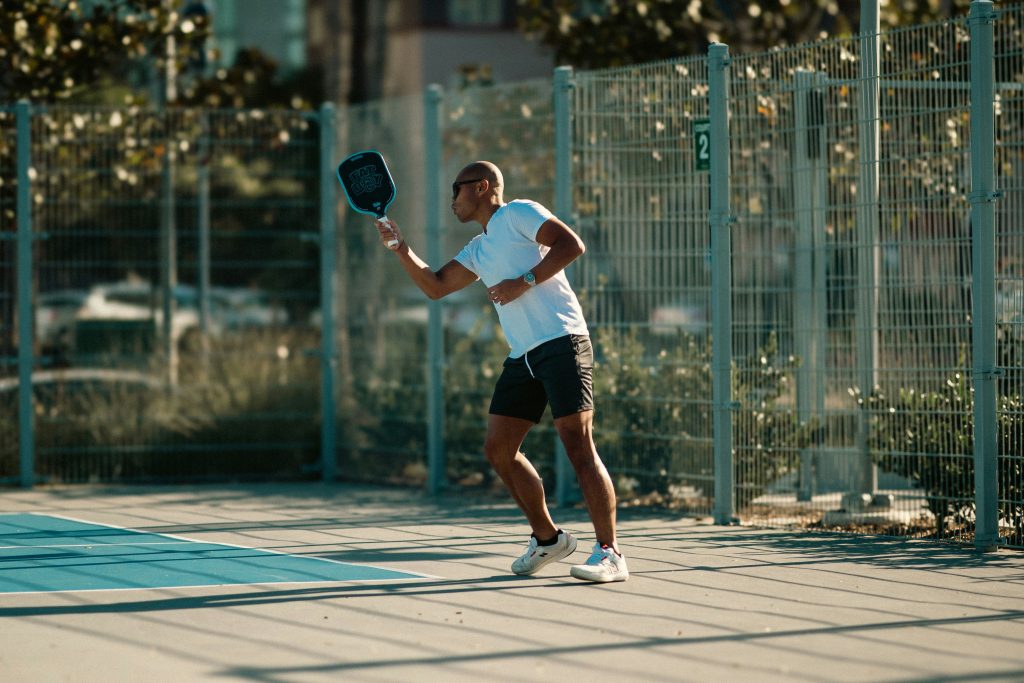
The pickleball forehand is one of the first shots every new pickleball player should learn. It is used from the baseline, around the middle of the court and near the kitchen line, making it one of the most useful strokes you will develop.
A good beginner forehand is not about hitting the ball as hard as possible. The goal is to create a simple, repeatable swing that allows you to make clean contact, control where the ball goes and recover quickly for the next shot.
Once you can consistently hit a forehand into the court, rallies become easier to sustain and you can begin using placement, depth and controlled pace instead of simply trying to keep the ball in play.
This guide explains how to hit a pickleball forehand step by step, including your grip, stance, preparation, contact point, swing path, follow-through and common mistakes to avoid.
What Is a Forehand in Pickleball?
A forehand is a shot played on the same side of your body as the hand holding your paddle.
For a right-handed player, the forehand is normally played on the right side of the body.
For a left-handed player, it is normally played on the left side.
The forehand is commonly used when returning balls that bounce within comfortable reach on your dominant side.
Beginners often find the forehand more natural than the backhand because the movement resembles throwing or gently swinging the arm forward.
However, consistency still depends on learning the correct fundamentals.
Why the Forehand Is Important for Beginners
Your forehand can be used in many different situations during a pickleball game.
You may use it to:
- Return a serve.
- Rally from the baseline.
- Hit a groundstroke after the ball bounces.
- Send the ball deep into your opponent’s court.
- Pass an opponent who is moving toward the net.
- Play controlled shots while transitioning toward the kitchen.
- Hit volleys or attacking shots when positioned closer to the net.
Learning a reliable forehand gives you a foundation that can later be adapted to many different types of shots.
For beginners, consistency should come before speed.
A forehand that repeatedly lands inside the court is much more useful than a powerful swing that produces frequent errors.
Start With a Comfortable Pickleball Grip
Before working on the swing itself, make sure you are holding the paddle comfortably.
Many beginners use a continental or slightly eastern-style grip for their basic forehand. The exact grip does not need to be complicated when you are first learning.
A simple starting point is to hold the paddle as though you were shaking hands with the handle.
Your grip should feel secure without being excessively tight.
Avoid squeezing the paddle as hard as possible.
A tight grip can create unnecessary tension in your forearm and wrist, making it more difficult to control the paddle face.
Think of holding the paddle firmly enough that it will not move in your hand while still allowing your arm to swing freely.
Use a Balanced Ready Position
Before the ball arrives, begin in an athletic ready position.
Keep your:
- Feet approximately shoulder-width apart.
- Knees slightly bent.
- Weight balanced toward the balls of your feet.
- Upper body relaxed.
- Paddle in front of your body.
Avoid standing upright with your paddle hanging beside you.
A good ready position allows you to react more quickly and move in either direction.
When you recognize that the ball is coming toward your forehand side, begin preparing your body rather than waiting for the ball to reach you.
Turn Your Shoulders Early
One of the most important forehand habits is preparing early.
As soon as you identify the incoming ball as a forehand, turn your shoulders slightly toward the side.
For a right-handed player, this usually means rotating the right shoulder backward.
For a left-handed player, the left shoulder moves backward.
This movement is sometimes called a unit turn because your shoulders and upper body rotate together instead of your arm simply pulling the paddle behind you.
The turn does not need to be large.
Pickleball courts are relatively small and the ball often arrives quickly, so compact preparation is usually more effective than a long backswing.
Keep the Backswing Compact
Beginners sometimes copy the large forehand swings used in tennis.
That can cause problems in pickleball.
A very large backswing takes longer to complete and can make controlling the ball more difficult.
Instead, bring the paddle slightly behind your body while keeping the motion compact.
You should have enough preparation to swing forward smoothly without wrapping the paddle far behind your back.
A shorter backswing gives you more time to adjust to the incoming ball.
It also helps you stay balanced.
Move Into Position Before You Swing
Good forehands begin with your feet.
Whenever possible, move so the ball reaches a comfortable position beside and slightly in front of your body.
Avoid reaching too far away from yourself.
Small adjustment steps can help you create the correct spacing.
If you are too close to the ball, your arm may become cramped.
If you are too far away, you may stretch and lose control.
Try to position yourself so your arm has enough space to swing naturally.
Your goal is not to stand perfectly still while the ball comes toward you.
Move first, then swing.
Let the Ball Bounce Into Your Hitting Zone
For a standard forehand groundstroke, allow the ball to bounce before making contact.
Beginners usually find it easiest to strike the ball somewhere between approximately knee and waist height.
Very low or very high balls are more difficult to control.
Whenever possible, use your footwork to meet the ball at a comfortable height rather than waiting until it drops extremely low.
Learning to judge the bounce is an important part of developing a dependable forehand.
Make Contact in Front of Your Body
The contact point is one of the most important parts of the forehand.
Try to meet the ball slightly in front of your body rather than directly beside you or behind you.
For a right-handed player, contact normally occurs in front of the right hip.
For a left-handed player, it occurs in front of the left hip.
Making contact slightly in front gives you more control over the direction of the paddle face.
If the ball gets too far behind you, your swing often becomes rushed and the shot may travel sideways or float unpredictably.
Early preparation makes it much easier to create a good contact point.
Watch the Ball Onto the Paddle
Keep your eyes focused on the ball as it approaches.
Beginners often look toward the target too early because they want to see where the ball will go.
Doing this can cause off-center contact.
Instead, track the ball through the bounce and toward the paddle.
You do not need to stare at the paddle itself, but your attention should remain on the ball during contact.
After the ball leaves your paddle, you can look toward your opponent and prepare for the next shot.
Use a Smooth Low-to-High Swing
A basic pickleball forehand normally uses a slightly low-to-high swing path.
Start with the paddle somewhat below the expected contact point and swing forward and slightly upward through the ball.
The upward movement helps provide enough lift to send the ball over the net.
The swing should feel smooth rather than explosive.
Imagine guiding the paddle through the ball instead of trying to slap it.
The paddle should continue moving toward your intended target after contact.
For beginners, controlled acceleration is usually much easier to manage than sudden wrist-driven speed.
Keep the Paddle Face Controlled
Where the paddle face is pointing at contact strongly influences where the ball travels.
If the paddle face is excessively open, the ball may travel too high.
If it is closed too much, the ball may go into the net.
Try to keep the paddle face relatively stable during contact.
Avoid rapidly flipping or rolling your wrist.
A stable wrist and simple swing path make your forehand more predictable.
As your technique improves, you can learn to intentionally change the paddle angle to create different trajectories and spins.
For now, prioritize clean contact.
Transfer Your Weight Forward
Your forehand should involve more than just your arm.
When you have enough time, allow your body weight to move slightly forward as you swing.
For example, a right-handed player may prepare with some weight on the right leg and then shift toward the left leg during the forward swing.
The exact footwork will depend on where you are moving and how much time you have.
You do not need a dramatic weight transfer.
The important idea is to avoid leaning backward while trying to hit forward.
Balanced body movement makes it easier to generate controlled pace.
Rotate Your Body Through the Shot
Your hips and shoulders can help support the swing.
As the paddle moves forward, allow your torso to rotate naturally toward the court.
This helps create power without forcing your arm to do all the work.
Beginners often try to generate speed by swinging only their arm.
That can lead to inconsistent timing and unnecessary tension.
A coordinated movement involving your legs, torso and arm usually produces a smoother stroke.
Follow Through Toward the Target
Do not stop your paddle immediately after hitting the ball.
Allow it to continue forward and upward.
A comfortable beginner follow-through may finish somewhere around chest or shoulder height.
The exact finish can vary depending on the height of the ball and the type of shot.
What matters most is that the paddle continues smoothly through contact.
Stopping suddenly can make the swing feel jerky and reduce your control.
Think about sending the paddle toward your target rather than simply making contact with the ball.
Recover After Every Forehand
The forehand does not end when you hit the ball.
You must prepare for the opponent’s response.
After the follow-through:
- Regain your balance.
- Return the paddle toward your ready position.
- Watch your opponent.
- Begin adjusting your position for the next shot.
Avoid standing still and admiring your shot.
Pickleball rallies can develop quickly.
Recovering immediately gives you more time to respond to the next ball.
How Hard Should Beginners Hit a Forehand?
You do not need maximum power.
For most beginners, approximately moderate effort is enough.
Your first goal should be hitting a ball that comfortably clears the net and lands inside the court.
Once you can repeat that shot consistently, you can gradually increase pace.
Trying to hit every forehand hard often creates three problems:
- The swing becomes too large.
- Timing becomes more difficult.
- Unforced errors increase.
Control provides the foundation for power.
You can always add more speed later.
Aim for Safe Targets First
Beginners should avoid trying to paint the sidelines with every forehand.
Give yourself room for error.
When rallying from the baseline, aiming several feet inside the sidelines and beyond the middle of the service area gives you a larger target.
If your opponent is positioned deep, a controlled shot toward the middle of the court can be perfectly effective.
You do not need to hit a winner every time.
Keeping the rally alive often creates better opportunities later.
How to Hit a Forehand Groundstroke Step by Step
Here is the complete movement in a simple sequence.
Step 1: Start Ready
Stand balanced with your knees slightly bent and the paddle in front of you.
Step 2: Recognize the Ball
Identify that the incoming shot is traveling toward your forehand side.
Step 3: Turn
Rotate your shoulders and prepare the paddle with a compact backswing.
Step 4: Move
Use small adjustment steps to create comfortable space between your body and the ball.
Step 5: Watch the Bounce
Track the ball carefully and judge where it will rise.
Step 6: Swing Forward
Begin with the paddle slightly below the ball and swing forward and upward.
Step 7: Contact the Ball
Strike the ball slightly in front of your body.
Step 8: Follow Through
Continue the paddle toward the target and finish naturally.
Step 9: Recover
Return to a balanced position and prepare for the next shot.
Practicing these steps slowly can help you create a repeatable movement before you begin increasing the speed of your rallies.
Forehand Footwork for Beginners
A good swing cannot compensate for poor positioning.
Your feet help determine whether you reach the ball at the correct time and distance.
Try to stay light enough that you can make small adjustments.
When the ball travels toward your forehand:
- Turn first.
- Move toward the expected bounce.
- Use smaller steps as you approach the ball.
- Establish balance when possible.
- Swing without falling sideways.
Avoid crossing your feet unnecessarily when the ball is close.
For balls farther away, larger movement may be required.
Once you reach the hitting area, smaller adjustment steps help refine your spacing.
Open Stance vs. More Traditional Stance
You may notice experienced players hitting forehands using different foot positions.
Sometimes the feet are more sideways to the net.
Other times the player remains relatively open toward the court.
Both approaches can work.
Beginners do not need to obsess over placing their feet in one exact position.
The more important priorities are:
- Reach the ball comfortably.
- Stay balanced.
- Create enough space to swing.
- Avoid falling backward.
- Recover after the shot.
As you become more experienced, your stance will naturally adapt to different situations.
Common Pickleball Forehand Mistakes
Many beginners struggle with similar forehand problems.
Understanding these mistakes can help you correct them earlier.
Taking Too Large a Backswing
A large backswing may feel powerful, but it often makes timing more difficult.
Fix: Shorten your preparation and focus on a compact swing.
Swinging Only With the Arm
Using only the arm can make the stroke feel forced.
Fix: Allow your shoulders and torso to rotate naturally.
Hitting the Ball Too Late
Contact beside or behind your body makes directional control difficult.
Fix: Prepare sooner and try to meet the ball slightly in front.
Standing Too Close to the Ball
If the ball gets too close to your body, your arm has nowhere to swing.
Fix: Use adjustment steps to maintain comfortable spacing.
Reaching for the Ball
Stretching your arm instead of moving your feet reduces control.
Fix: Move toward the ball whenever possible.
Gripping the Paddle Too Tightly
Excessive grip pressure creates tension.
Fix: Hold the paddle securely but comfortably.
Using Too Much Wrist
Rapid wrist movement can change the paddle angle during contact.
Fix: Keep the wrist relatively stable and let your arm and body create the swing.
Trying to Hit Too Hard
Power magnifies timing mistakes.
Fix: Practice at a comfortable pace until you can reliably hit the court.
Looking Up Too Early
Watching your target before contact can cause mishits.
Fix: Track the ball through the bounce and into your hitting zone.
Forgetting to Recover
Standing where you finished the previous swing leaves you vulnerable.
Fix: Return to a ready position immediately after every shot.
Why Your Forehand Keeps Going Into the Net
If your forehands repeatedly hit the net, several things may be happening.
Your paddle may be too closed at contact.
You may also be contacting the ball late or failing to swing upward enough.
Another possibility is that you are trying to hit too hard and flattening the shot excessively.
Try reducing your swing speed.
Start the paddle slightly lower and let the swing travel gently forward and upward.
Aim well above the top of the net during practice instead of trying to barely clear it.
Why Your Forehand Keeps Going Long
If the ball repeatedly lands beyond the baseline, check your paddle angle and swing power.
A paddle face that is too open can send the ball high and deep.
You may also be swinging harder than necessary.
Reduce your pace and aim for a larger target closer to the middle of the court.
Another common mistake is leaning backward while hitting.
Try staying balanced and allowing your weight to move slightly toward the shot.
Why You Keep Hitting the Ball Off the Paddle Frame
Frame hits usually come from timing or spacing problems.
You may be standing too close to the ball, reaching too far or moving your head away during contact.
Practice slower rallies and concentrate on watching the ball.
The goal is to contact the center area of the paddle consistently.
You do not need to swing faster to fix a mishit.
You normally need better positioning and timing.
Simple Forehand Drills for Beginners
You can improve your forehand with basic repetition.
Drop-and-Hit Drill
Stand several feet behind the kitchen line or near the baseline.
Drop the ball beside you, let it bounce and hit a controlled forehand toward the opposite court.
Focus on:
- Contact in front.
- Smooth swing path.
- Balanced finish.
- Clean contact.
Repeat until the movement feels comfortable.
Partner Forehand Rally
Stand across the net from a partner.
Try to rally using mostly forehands.
Start slowly.
Count how many consecutive shots you can keep in the court.
Instead of trying to beat each other, work together to extend the rally.
Crosscourt Forehand Drill
Hit forehands diagonally across the court.
Crosscourt shots travel over a longer portion of the court and can provide a larger target for practice.
Aim safely inside the sideline.
Forehand Direction Drill
Choose two large targets, such as the left half and right half of the opposite court.
Alternate between them.
This teaches you to control direction without trying to hit extremely precise locations.
Depth Drill
Place a visual target several feet inside the opposite baseline.
Practice landing your forehands beyond the service line without hitting them out.
This helps develop controlled depth.
How Often Should Beginners Practice the Forehand?
Short, focused practice sessions are usually more productive than trying to hit hundreds of balls while tired.
You might spend 10 to 20 minutes during a practice session concentrating entirely on forehands.
Focus on quality rather than speed.
A useful progression is:
- Practice drop-and-hit forehands.
- Rally slowly with a partner.
- Practice hitting toward large targets.
- Increase movement.
- Gradually increase pace.
- Use the forehand during normal games.
The goal is to make the basic swing feel automatic enough that you can focus on your opponent and positioning rather than thinking about every part of the technique.
Should Beginners Use Topspin?
Topspin can become a valuable part of your forehand.
It helps the ball travel forward while dipping toward the court.
However, beginners do not need to immediately concentrate on generating heavy spin.
Start with a simple low-to-high swing and clean contact.
A small amount of natural topspin may develop from that motion.
Once you can consistently control your basic forehand, you can work on increasing spin deliberately.
Trying to create excessive topspin too early can encourage beginners to flick their wrists or exaggerate the swing.
Consistency should still come first.
Forehand Placement Matters More Than Power
As you improve, begin thinking about where your forehand lands.
You might direct the ball:
- Deep toward the baseline.
- Toward an opponent’s weaker side.
- Through the middle between doubles opponents.
- Into open court.
- Away from a player who is moving.
These choices can make a moderate forehand much more effective.
A well-placed ball often creates more difficulty than a faster ball hit directly toward an opponent.
Forehands From Different Areas of the Court
The basic forehand mechanics remain similar, but the size and purpose of the swing can change depending on your court position.
Baseline Forehand
From the baseline, you generally have more time and space to use a fuller swing.
The goal may be depth, control or moving your opponent.
Transition-Area Forehand
When you are between the baseline and kitchen line, you often have less reaction time.
Keep your preparation compact.
Depending on the incoming ball, you may need to reduce pace and prioritize control.
Forehand Near the Kitchen
Near the non-volley zone, you usually need shorter movements.
Balls may arrive quickly, so long swings become inefficient.
Forehand volleys and dinks use different variations of the basic forehand concept and should be practiced separately.
When Should You Use Your Forehand Instead of Your Backhand?
You do not need to run around every ball simply because you prefer your forehand.
Doing so can pull you badly out of position.
Use your forehand when the ball naturally arrives on your forehand side or when you have enough time and space to reposition without compromising your court coverage.
Balanced players eventually need both forehand and backhand skills.
The goal is not to avoid your backhand completely.
It is to develop a dependable forehand you can confidently use when the situation calls for it.
How to Make Your Forehand More Consistent
If you want one priority while practicing, choose consistency.
A repeatable forehand usually comes from doing several simple things well:
- Prepare early.
- Keep the backswing compact.
- Move your feet.
- Maintain comfortable spacing.
- Watch the ball.
- Contact it slightly in front.
- Swing smoothly forward.
- Keep the paddle face stable.
- Finish balanced.
- Recover immediately.
None of these movements needs to be dramatic.
Pickleball rewards efficiency.
Simple strokes are often easier to repeat under pressure.
A Simple Beginner Forehand Checklist
Before your next practice session, remember these cues:
Ready: Stay balanced with your paddle in front.
Turn: Rotate your shoulders early.
Move: Position yourself instead of reaching.
Space: Keep the ball comfortably away from your body.
Watch: Track the ball through the bounce.
Contact: Meet it slightly in front.
Swing: Move smoothly forward and slightly upward.
Finish: Follow through naturally.
Recover: Get ready immediately for the next shot.
You do not need to consciously think about every cue forever.
Use them during practice until the movement becomes more natural.
Build Control Before Chasing Power
The best beginner forehand is not necessarily the fastest one.
It is the forehand you can repeat.
If you can consistently move into position, contact the center of the paddle and send the ball safely into the court, you already have the foundation for developing a much stronger game.
From there, you can gradually improve your depth, placement, pace and spin.
Keep your swing compact, use your feet and give yourself enough margin over the net.
As your timing improves, the forehand will begin to feel less like a collection of technical steps and more like one smooth movement.
That is when you can begin using it confidently during real rallies instead of simply hoping the ball goes in.