
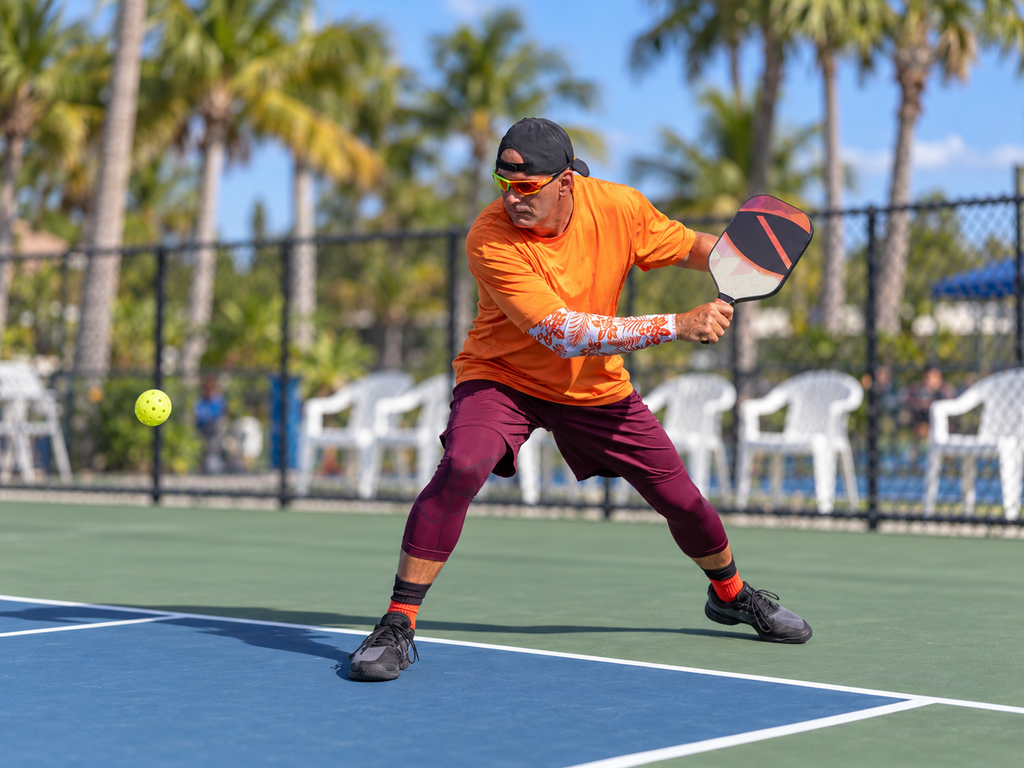
How to Hit a Pickleball Backhand: A Beginner’s Guide
The pickleball backhand can feel awkward when you first start playing pickleball.
Unlike the forehand, which often feels more natural because it uses the dominant side of your body, the backhand requires you to control the paddle across the opposite side of your body. For many beginners, this makes timing, spacing and paddle control more difficult at first.
The good news is that you do not need a complicated swing to develop a dependable backhand.
A good beginner backhand is compact, balanced and controlled. The goal is not to create maximum power. It is to make clean contact, send the ball where you intend and recover quickly for the next shot.
Once you become comfortable with the basic movement, your backhand can become one of the most reliable parts of your game.
This guide explains how to hit a pickleball backhand step by step, including grip, stance, preparation, contact point, swing path, footwork, follow-through and common mistakes.
What Is a Backhand in Pickleball?
A backhand is a shot played on the side of your body opposite your paddle hand.
For a right-handed player, the backhand is normally played on the left side of the body.
For a left-handed player, it is normally played on the right side.
The paddle moves across the front of the body to meet the ball.
Backhands can be used after the ball bounces or before it bounces, depending on the situation.
For beginners, it is useful to first learn a basic one-handed backhand groundstroke after the bounce.
Once that movement becomes comfortable, it becomes easier to learn other backhand shots such as volleys, dinks and blocks.
Why the Backhand Is Important
You cannot rely entirely on your forehand during a pickleball game.
Opponents will naturally send balls to both sides of your body.
If you constantly try to run around your backhand, you may:
- Move yourself out of position.
- Leave large areas of the court open.
- Arrive late to the ball.
- Lose balance.
- Create unnecessary movement.
- Make the next shot harder.
A dependable backhand lets you respond to balls that naturally arrive on your non-dominant side without having to reposition excessively.
The goal is not to make your backhand your strongest attacking shot immediately.
Your first goal is simply to make it reliable.
Start With a Comfortable Grip
Many beginners can use a continental-style grip for a basic pickleball backhand.
Imagine holding the paddle handle as though you were shaking hands with it.
The grip should feel secure but relaxed.
Avoid squeezing the handle too tightly.
Excessive grip pressure can create tension in your hand, wrist and forearm, making the paddle harder to control.
You should be able to maintain a stable paddle face without feeling rigid.
A neutral grip can also make it easier to transition between forehand and backhand shots during fast rallies.
One-Handed or Two-Handed Backhand?
Pickleball players use both one-handed and two-handed backhands.
Either can work.
For many beginners, a one-handed backhand is a straightforward place to start because it requires fewer grip changes and can be used in many basic situations.
A two-handed backhand can provide additional stability and support, especially for players who are comfortable with that movement from tennis or another racket sport.
There is no rule requiring beginners to use one style.
The important thing is to develop a stroke that feels controlled and repeatable.
This guide focuses mainly on the basic one-handed backhand groundstroke.
Start in a Balanced Ready Position
Before the ball reaches you, begin in a ready position.
Keep your:
- Feet approximately shoulder-width apart.
- Knees slightly bent.
- Weight balanced toward the balls of your feet.
- Paddle in front of your body.
- Shoulders relaxed.
Avoid letting the paddle hang beside your leg.
Keeping it in front shortens the distance it needs to travel when you recognize a backhand.
The sooner you identify where the ball is going, the easier it becomes to prepare.
Recognize the Backhand Early
Early recognition is especially important on the backhand side.
As soon as you see that the ball is traveling toward your backhand, begin turning your body.
Do not wait until the ball is beside you.
For a right-handed player, the left shoulder will generally turn toward the incoming ball.
For a left-handed player, the right shoulder turns toward it.
This shoulder turn helps position the paddle and prepares your body for the forward swing.
Use a Compact Shoulder Turn
The backhand does not require a huge backswing.
Rotate your shoulders and bring the paddle slightly across and behind your body.
Your chest will become more sideways to the net.
Keep the movement compact.
A long backswing takes more time and increases the chance that you will make contact late.
Pickleball often involves quick exchanges, so efficient preparation is valuable.
Think of turning your body and bringing the paddle into position together rather than pulling the paddle backward using only your arm.
Keep the Paddle in Front of Your Body
One of the most common beginner mistakes is letting the paddle move too far behind the body.
This makes it difficult to reach the correct contact point.
Your preparation should give you enough room to swing forward without creating a large loop.
The paddle should remain relatively close to your body and ready to move toward the ball.
Compact preparation helps you stay on time.
Move Your Feet Into Position
Good backhand technique depends heavily on spacing.
You want the ball to arrive far enough from your body that you can extend your arm comfortably.
If you stand too close, your elbow may become cramped against your body.
If you stand too far away, you may have to stretch.
Use your feet to adjust your position before swinging.
Take larger steps when the ball is far away and smaller adjustment steps as you approach the hitting area.
Whenever possible, position yourself first and then swing.
Let the Ball Bounce Into a Comfortable Hitting Zone
For a basic backhand groundstroke, allow the ball to bounce.
Beginners usually find it easiest to strike the ball somewhere between knee and waist height.
If you wait too long and let the ball drop extremely low, you may need to lift it sharply.
If you contact it too high, controlling the paddle may become more difficult.
Try to move into position so you can meet the ball at a comfortable height.
Make Contact Slightly in Front
The contact point is one of the most important parts of the backhand.
You want to meet the ball slightly in front of your body.
For a right-handed player, the ball should normally be contacted in front of the left side.
For a left-handed player, contact usually occurs in front of the right side.
Avoid letting the ball travel behind you.
Late contact makes it much harder to direct the shot.
Preparing early gives you more time to position the paddle correctly.
Keep Your Arm Comfortable
Your arm should extend naturally toward the ball.
Avoid locking your elbow completely straight.
At the same time, do not keep the elbow tightly tucked against your side.
You need enough space between your body and the ball for the paddle to move freely.
A relaxed but controlled arm position usually produces cleaner contact.
Watch the Ball Through Contact
Keep your attention on the ball as it bounces and approaches your paddle.
Do not look toward your target too early.
Beginners sometimes turn their head toward the opposite court before actually hitting the ball.
This can lead to mishits and frame contact.
Watch the ball carefully until you make contact.
Then shift your attention toward your opponent and the developing rally.
Swing Forward and Slightly Upward
A basic backhand groundstroke usually follows a gentle low-to-high path.
Begin with the paddle slightly below the expected contact point.
Swing forward through the ball while allowing the paddle to rise naturally.
You do not need a dramatic upward motion.
The objective is to give the ball enough lift to clear the net while still traveling forward.
Think smooth rather than forceful.
Keep the Paddle Face Stable
Paddle angle plays a major role in controlling the backhand.
If the paddle face is too open, the ball may float high or travel long.
If it is closed too much, the ball may go directly into the net.
Try to keep the paddle face relatively stable as it moves through the ball.
Avoid excessive wrist movement.
A quiet wrist makes the shot easier to repeat.
You can learn more advanced paddle manipulation later.
For now, focus on clean and predictable contact.
Do Not Flick the Wrist
Many beginners try to create backhand power by flicking the wrist.
This usually creates inconsistency.
The paddle face can change angle immediately before contact, sending the ball in unpredictable directions.
Instead, keep the wrist relatively firm and allow the movement to come from your shoulder, arm and body rotation.
The wrist does not need to be completely rigid.
It simply should not be the main source of the swing.
Use Your Body, Not Just Your Arm
A backhand becomes easier when your body supports the stroke.
During preparation, your shoulders turn.
As you swing forward, allow them to rotate naturally back toward the court.
This creates momentum without requiring a hard arm swing.
Your legs and balance also contribute.
A coordinated stroke generally produces more control than trying to muscle the ball with your arm.
Transfer Your Weight Naturally
When you have enough time, allow your weight to move slightly toward the direction of the shot.
A right-handed player may begin with more weight toward the left or back side and then move forward during the swing depending on stance and movement.
The exact footwork varies from shot to shot.
The main point is to avoid falling backward while trying to hit the ball forward.
Stay balanced through contact.
Follow Through Toward the Target
Do not stop the paddle immediately after making contact.
Let it continue forward and slightly upward.
Your follow-through may finish around chest or shoulder height depending on the ball and swing.
The finish should feel natural.
Avoid forcing the paddle into a specific position.
A smooth follow-through is usually a sign that you did not decelerate suddenly during contact.
Recover Immediately
Once you finish the shot, prepare for the next ball.
Bring the paddle back toward the front of your body.
Reestablish your balance.
Watch your opponent.
Begin moving toward the best position for the next shot.
Do not remain turned sideways after hitting your backhand.
The faster you recover, the better prepared you will be for the next exchange.
How to Hit a Pickleball Backhand Step by Step
Here is the basic movement in a simple sequence.
Step 1: Start Ready
Stand balanced with your knees slightly bent and the paddle in front of you.
Step 2: Read the Ball
Recognize that the incoming ball is traveling toward your backhand side.
Step 3: Turn Your Shoulders
Rotate your upper body and bring the paddle into a compact prepared position.
Step 4: Move Your Feet
Adjust your position so the ball will not become cramped against your body.
Step 5: Watch the Bounce
Track the ball and judge where it will rise.
Step 6: Swing Forward
Move the paddle smoothly forward and slightly upward.
Step 7: Contact in Front
Meet the ball slightly in front of your body.
Step 8: Follow Through
Allow the paddle to continue naturally toward your target.
Step 9: Recover
Return the paddle to the ready position and prepare for the next shot.
Practice the sequence slowly before trying to add speed.
How Hard Should You Hit a Beginner Backhand?
You do not need to hit hard.
Moderate pace is usually enough when learning.
The objective is to clear the net and land the ball comfortably inside the court.
Once you can do that consistently, you can gradually add more speed.
Trying to create too much power too early often causes:
- Late contact.
- Excessive wrist movement.
- Overswinging.
- Loss of balance.
- Balls hit into the net or beyond the baseline.
Control should come first.
Where Should Beginners Aim?
Give yourself a large target.
Avoid aiming directly at the sidelines.
Aiming toward the middle portion of the court gives you more room for error.
You can also aim several feet inside the baseline rather than trying to hit extremely deep shots immediately.
As your consistency improves, you can begin working on more specific targets.
A safe ball in the court is more useful than an ambitious shot that misses.
Backhand Footwork for Beginners
Your feet determine whether you can reach the correct contact point.
When a ball travels toward your backhand side:
- Turn your shoulders.
- Move toward the expected bounce.
- Use adjustment steps to create space.
- Establish balance when possible.
- Swing without falling sideways.
- Recover after the shot.
Do not remain rooted to one spot and simply stretch toward the ball.
Move whenever possible.
Good footwork can make an average swing work much better.
Closed, Neutral and Open Backhand Stances
You may see players hit backhands from different stances.
Sometimes the body is more sideways to the net.
Sometimes the player remains more open because there is not enough time to fully turn.
Beginners do not need to memorize every stance.
Instead, prioritize:
- Comfortable spacing.
- Balance.
- Early preparation.
- Contact in front.
- Quick recovery.
Your stance will naturally vary depending on how much time you have.
Common Pickleball Backhand Mistakes
Several mistakes appear frequently when beginners learn the backhand.
Preparing Too Late
Waiting until the ball is beside you makes clean contact difficult.
Fix: Turn your shoulders as soon as you recognize the backhand.
Taking Too Large a Backswing
A long swing makes timing harder.
Fix: Keep preparation compact.
Letting the Ball Get Too Close
A cramped backhand limits your swing.
Fix: Move your feet and maintain space between your body and the ball.
Reaching Instead of Moving
Stretching toward the ball reduces control.
Fix: Use your feet to get into position whenever possible.
Hitting the Ball Behind Your Body
Late contact often sends the ball in an unintended direction.
Fix: Prepare earlier and meet the ball slightly in front.
Flicking the Wrist
Too much wrist movement changes the paddle angle.
Fix: Keep the wrist relatively stable and use the arm and body together.
Gripping Too Tightly
A tight grip creates tension.
Fix: Hold the paddle securely without squeezing excessively.
Swinging Too Hard
Maximum effort makes timing difficult.
Fix: Slow the swing down and prioritize clean contact.
Leaning Backward
Leaning away from the shot reduces control.
Fix: Stay balanced and allow your weight to move naturally toward the ball.
Forgetting to Recover
Remaining sideways after the shot leaves you vulnerable.
Fix: Return to your ready position immediately.
Why Your Backhand Keeps Going Into the Net
If your backhand repeatedly hits the net, look at your paddle angle and swing direction.
The paddle face may be too closed.
You may also be contacting the ball too late or swinging too horizontally.
Try starting with the paddle slightly below the ball.
Use a gentle forward-and-upward motion.
Reduce your swing speed and give yourself more clearance over the net.
During practice, do not try to skim the tape.
Aim safely above it.
Why Your Backhand Keeps Going Long
Backhands that repeatedly travel beyond the baseline may be caused by an overly open paddle face or excessive swing speed.
You may also be leaning backward during contact.
Try reducing the pace.
Keep your paddle angle more neutral.
Stay balanced and aim several feet inside the baseline until your control improves.
Why Your Backhand Feels Weak
A backhand may feel weak when you rely entirely on your arm or wrist.
Try turning your shoulders during preparation and allowing your body to rotate through the shot.
Also check your contact point.
If the ball is too close to your body or behind you, it becomes difficult to transfer energy efficiently.
Clean contact often creates more useful pace than simply swinging harder.
Why You Keep Hitting the Paddle Edge
Mishits often come from poor spacing or timing.
You may be:
- Too close to the ball.
- Too far away.
- Swinging too quickly.
- Looking up too early.
- Contacting the ball late.
Slow down during practice.
Focus on moving your feet and meeting the ball in front.
Center contact is more important than swing speed.
Simple Backhand Drills for Beginners
You do not need complicated drills to improve your backhand.
Drop-and-Hit Backhands
Stand in the court with several balls.
Drop one on your backhand side.
Let it bounce and hit a controlled shot over the net.
Focus on:
- Shoulder turn.
- Comfortable spacing.
- Contact in front.
- Smooth follow-through.
- Balanced finish.
Repeat slowly.
Partner Backhand Rally
Ask a partner to feed balls toward your backhand.
Hit controlled backhands back to them.
Count how many consecutive shots you can keep in play.
Do not try to win the rally.
Work together to make it last.
Crosscourt Backhand Drill
Practice hitting backhands diagonally across the court.
Aim well inside the sideline.
Crosscourt practice can give you a larger area to work with and help develop directional control.
Backhand Target Drill
Choose a large target area on the opposite side of the court.
Try to land several consecutive backhands in that area.
Once that becomes easy, make the target smaller.
Backhand Depth Drill
Aim beyond the opponent’s service line while keeping the ball comfortably inside the baseline.
This helps you learn controlled depth without overswinging.
How Often Should Beginners Practice the Backhand?
Because the backhand often feels less natural than the forehand, giving it dedicated practice time is useful.
Even 10 to 15 focused minutes can help.
A simple progression is:
- Practice drop-and-hit backhands.
- Receive easy feeds from a partner.
- Rally slowly.
- Practice direction.
- Practice depth.
- Add movement.
- Gradually increase rally speed.
- Use the shot naturally during games.
Do not judge progress by how hard you can hit.
Judge it by how often you can make clean contact and keep the ball in play.
Should Beginners Learn Backhand Topspin?
Topspin can eventually help you create more aggressive backhands.
However, beginners do not need to focus on heavy spin immediately.
Start with a simple forward-and-upward swing.
If a small amount of natural topspin develops, that is fine.
Avoid exaggerated wrist movement in an attempt to create spin.
Once your basic backhand is reliable, you can begin experimenting with more advanced spin techniques.
What About Backhand Slice?
Some players use slice or underspin on backhand shots.
A slice changes the ball’s flight and bounce and can be useful in certain situations.
However, it requires a different paddle path from the basic beginner backhand.
If you are still learning to make consistent contact, focus first on a simple neutral or slightly topspin-oriented groundstroke.
You can add slice after you have established better paddle control.
Backhands From Different Areas of the Court
The basic principles remain similar, but the swing changes depending on where you are standing.
Baseline Backhand
From the baseline, you generally have more time to prepare.
You can use a slightly fuller swing and focus on depth and direction.
Transition-Area Backhand
Between the baseline and the kitchen, balls may reach you faster.
Keep your preparation shorter.
Balance and control become especially important.
Backhand Near the Kitchen
Near the non-volley zone, movements become much more compact.
Backhand volleys, blocks and dinks use shorter strokes than a baseline groundstroke.
Do not try to use a large groundstroke swing when the ball arrives quickly near the net.
When Should You Use a Backhand Instead of Running Around It?
Use the backhand when the ball naturally arrives on that side of your body and repositioning for a forehand would make you late or pull you out of position.
There are situations where experienced players deliberately run around a backhand to hit a forehand.
Beginners should not make this a habit.
Constantly avoiding the backhand slows your development and can create poor court positioning.
Learning to trust both sides of your body makes you a more complete player.
How to Make Your Backhand More Consistent
A dependable backhand comes from simple fundamentals repeated well.
Focus on:
- Recognizing the ball early.
- Turning your shoulders.
- Keeping preparation compact.
- Moving your feet.
- Creating comfortable spacing.
- Watching the ball.
- Contacting it slightly in front.
- Keeping the wrist stable.
- Swinging smoothly.
- Staying balanced.
- Recovering immediately.
You do not need a beautiful or powerful stroke.
You need one that works repeatedly.
A Simple Beginner Backhand Checklist
Use these cues during practice.
Ready: Keep the paddle in front.
Turn: Rotate your shoulders early.
Move: Position your feet before swinging.
Space: Avoid letting the ball crowd your body.
Watch: Track the ball through the bounce.
Contact: Meet it slightly in front.
Swing: Move smoothly forward and slightly upward.
Stable: Avoid excessive wrist movement.
Finish: Follow through naturally.
Recover: Return immediately to your ready position.
Over time, these individual steps will begin to blend into one comfortable movement.
Build Reliability Before Power
The backhand is often one of the shots beginners avoid because it initially feels unfamiliar.
Avoiding it usually makes the problem worse.
Instead, give the shot regular practice at a comfortable pace.
Learn to prepare early, move into position and meet the ball in front of your body.
Keep the swing compact and use your shoulders and arm together rather than relying on your wrist.
Once you can consistently send the ball over the net and into the court, you can gradually work on greater depth, direction, pace and spin.
A reliable backhand does not need to be spectacular.
It simply needs to give you confidence that when the ball comes to that side of your body, you have a controlled answer.