
Beginner’s Guide to Kitchen Positioning
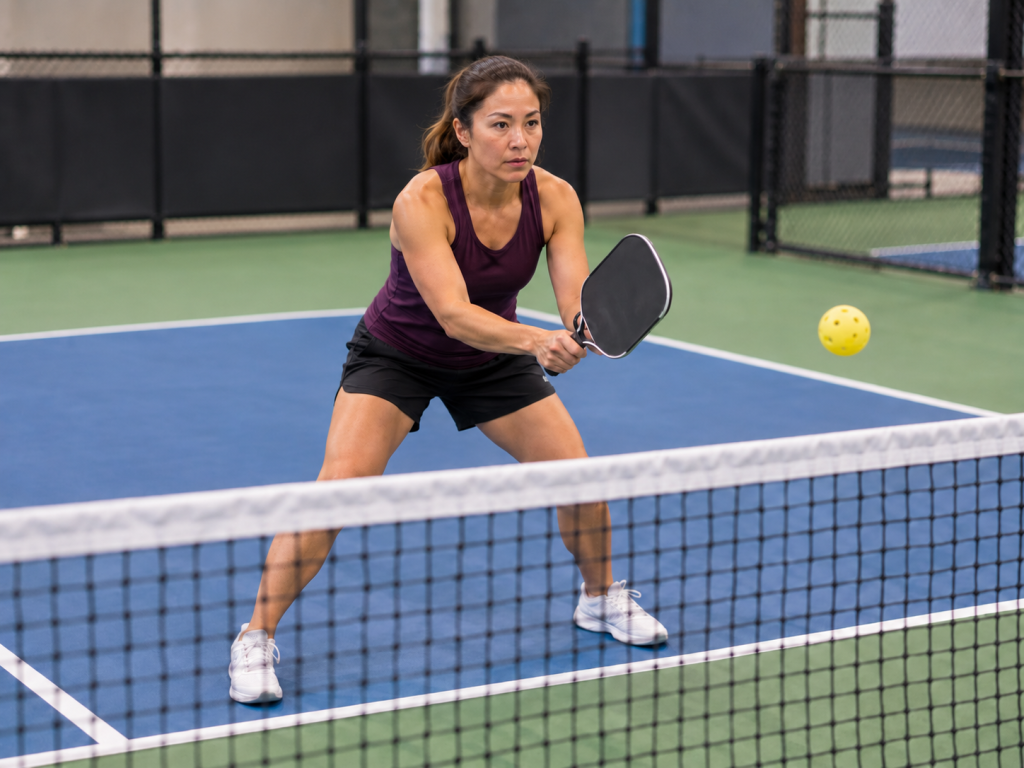
Learning where to stand on a pickleball court can make almost as much difference as learning how to hit the ball.
For beginners, one of the most important positions to understand is the Kitchen line, officially called the Non-Volley Zone line. Much of pickleball strategy revolves around reaching this area, maintaining a strong position there and moving effectively with your partner.
Standing near the Kitchen line gives you opportunities to control more of the court, react to shorter balls and put pressure on opponents. However, simply getting to the line is not enough. You also need to know where to stand, how close to stand, when to move and how to stay balanced.
This guide explains the fundamentals of Kitchen positioning so you can feel more comfortable and confident near the net.
What Is the Kitchen in Pickleball?
The Kitchen is the informal name for the Non-Volley Zone, or NVZ.
It extends 7 feet from the net on each side of the court, creating a 14-foot-wide area surrounding the net. Players cannot volley a ball while standing inside the Kitchen or touching the Kitchen line.
A volley means hitting the ball out of the air before it bounces.
You are allowed to enter the Kitchen whenever the ball has bounced. You simply cannot volley while touching the Kitchen area or its boundary line.
That distinction is important because good Kitchen positioning usually means standing just outside the Non-Volley Zone, rather than standing inside it.
Why Kitchen Positioning Matters
Once the required bounces at the beginning of the rally have occurred, one of the strongest positions on the pickleball court is generally near the Kitchen line.
USA Pickleball teaches beginners to prioritize reaching the Non-Volley Zone line because being farther forward gives players greater control over many rallies.
There are several reasons.
You Reduce the Space in Front of You
Imagine standing near the baseline while your opponent hits a soft ball.
There may be a large amount of court between you and the net.
Now imagine standing near the Kitchen line.
You have already moved forward, so there is much less open court in front of you for your opponent to target.
This allows you to cover many short shots more easily.
You Can Reach More Balls Before They Drop
Standing close to the Kitchen line allows you to intercept certain balls with volleys rather than waiting for them to bounce.
That can help you maintain pressure and prevent opponents from gaining control of the rally.
Your Opponents Have Less Reaction Time
The closer you are to the net, the sooner the ball travels back toward your opponents.
You do not necessarily need to hit harder.
Good positioning alone can make your shots more difficult to handle.
You Create Better Angles
Moving forward also allows you to use sharper angles than you typically have from the baseline.
This becomes particularly useful during dinking and controlled net exchanges.
Where Should You Stand at the Kitchen?
A good beginner starting position is just behind the Kitchen line.
You want to be close enough to take advantage of the net position while leaving enough room to avoid accidentally stepping onto the line during a volley.
Most volleys are played from just behind the Non-Volley Zone line.
You do not need to stand several feet behind it.
Doing so gives away valuable court space.
At the same time, beginners should avoid placing their toes directly against the line if doing so makes them nervous or causes frequent foot faults.
Start perhaps a small comfortable distance behind the line and gradually become more comfortable positioning yourself closer.
Think:
Close to the line, but balanced and under control.
Do Not Stand Inside the Kitchen Waiting for the Ball
Beginners sometimes misunderstand the Kitchen rule and assume the Kitchen is an area they should completely avoid.
That is not true.
You can stand in the Kitchen.
You can walk through it.
You can enter it to play a ball after the ball bounces.
The restriction applies specifically to volleys.
However, there is usually little advantage to simply standing inside the Kitchen while waiting for the next shot because you cannot legally volley from there.
After playing a bounced ball from inside the Kitchen, try to recover behind the Kitchen line when you safely can.
Be Careful With the Kitchen Line
The Kitchen boundary line is considered part of the Non-Volley Zone.
That means if your foot is touching the Kitchen line while you volley the ball, the shot is a fault.
This is one reason footwork matters so much near the net.
Beginners often concentrate entirely on the ball and forget where their feet are.
Over time, you should develop awareness of the Kitchen line without constantly looking down.
Momentum Matters Too
Avoiding the Kitchen during the moment of contact is not enough.
If you volley a ball from outside the Kitchen but your momentum carries you into the Kitchen afterward, it is still a fault.
For example:
You are standing just behind the line.
A high ball comes toward you.
You reach forward and hit a volley.
Your body continues moving forward and your foot steps into the Kitchen.
That is a fault even though you contacted the ball while standing outside the Kitchen.
This is why balance is part of positioning.
A player who is slightly farther from the line but balanced may be in a better position than someone standing extremely close while constantly falling forward.
Use an Athletic Ready Position
Once you reach the Kitchen line, avoid standing upright with your paddle hanging beside your body.
Instead, use a relaxed athletic position.
Keep:
- your knees slightly bent
- your feet comfortably apart
- your weight balanced
- your paddle in front of your body
- your elbows relaxed
- your eyes on the opponent preparing to hit
USA Pickleball recommends keeping the paddle up near the chest and maintaining a balanced position so you can react quickly to both forehand and backhand shots.
You should feel ready to move in either direction.
Not tense.
Not frozen.
Just prepared.
Keep Your Paddle in Front
Kitchen exchanges can become very fast.
If your paddle is hanging by your hip, you must first raise it before you can react.
That extra movement costs time.
Instead, keep the paddle comfortably in front of your torso.
You do not have to hold it rigidly.
The goal is simply to reduce unnecessary movement when the next ball arrives.
At the Kitchen line, compact preparation is usually much more useful than a large backswing.
Stay Low and Balanced
A slightly lower stance helps you react to balls traveling near your feet or below net height.
USA Pickleball emphasizes bending the knees and maintaining a lower center of gravity at the Kitchen line because it improves balance and helps players avoid falling into the Non-Volley Zone.
Instead of bending heavily from your waist, try bending through your knees.
This keeps your body more stable.
You should still feel comfortable enough to move quickly.
Move Sideways With the Ball
Kitchen positioning is not static.
You should not reach the Kitchen line and then remain glued to one spot.
As the ball moves across the court, your position should adjust.
One useful beginner habit is to follow the movement of the ball.
If the ball moves toward one sideline, both partners generally shift in that direction.
When it moves back toward the other side, they shift back together.
This helps your team protect the most likely angles of return.
USA Pickleball specifically recommends following the ball and staying linked with your partner when positioning near the Kitchen.
Shuffle Rather Than Crossing Your Feet
For small lateral movements along the Kitchen line, use short shuffle steps.
Avoid repeatedly crossing one foot over the other.
Crossing your feet can temporarily place you off balance and make it harder to change direction quickly.
USA Pickleball recommends shuffling side to side as a fundamental Kitchen-line movement pattern because it helps players remain centered and balanced.
Think:
Move your feet instead of stretching your arms.
If you constantly lean or reach for the ball, your body position will eventually break down.
Whenever possible, move your feet so your body is better aligned with the shot.
Positioning With a Doubles Partner
Kitchen positioning becomes especially important in doubles because you are not responsible for the entire width of the court yourself.
You and your partner should function more like a connected unit.
One of the biggest beginner mistakes is allowing one player to move while the other stays in the same place.
This creates a large gap between them.
Opponents will quickly learn to hit through that opening.
Instead, imagine that you and your partner are connected by an invisible rope.
When your partner moves left, you usually move left.
When your partner moves right, you usually move right.
When one player moves forward, the other should usually avoid remaining far behind without a tactical reason.
The exact spacing changes throughout a rally, but USA Pickleball suggests roughly 6 to 8 feet between partners as a useful positioning reference.
The goal is not to maintain an exact measurement.
The goal is to avoid creating a large, obvious hole between you.
Avoid One-Up, One-Back Positioning
A common beginner formation occurs when one player reaches the Kitchen while the other remains near the baseline.
This creates several problems.
The opposing team can:
- hit into the large gap between you
- angle balls away from either player
- attack the deeper player’s feet
- move the forward player around
- force confusion over who should take the middle ball
Whenever possible, partners should work toward establishing similar court depth.
If one player cannot safely move forward yet, the player already at the Kitchen should remain aware of the temporary gap.
Do not move backward simply because your partner is behind you unless the rally requires it.
Instead, give your partner time to advance safely.
Protect the Middle
Many beginners worry too much about the sidelines.
That often causes them to move too far apart.
The middle of the court is especially important in doubles because balls hit there can create hesitation between partners.
Each player may think:
“Is that mine or yours?”
Good positioning reduces that uncertainty.
Stay close enough to your partner that you can protect the middle while still covering your side of the court.
Communication helps too.
Simple calls such as:
“Mine.”
“Yours.”
“Leave.”
can prevent confusion.
Face the Ball and the Hitter
Beginners sometimes stand square to the net regardless of where the ball is located.
Instead, adjust your body so you are ready for the player who is actually hitting the ball.
USA Pickleball advises players to face the hitter because doing so improves reaction and positioning.
You do not need to dramatically turn your entire body.
Small adjustments are usually enough.
Keep the ball and your opponent within a comfortable field of vision.
Do Not Back Away From the Kitchen Without a Reason
Another common beginner habit is retreating whenever the ball comes quickly.
You reach the Kitchen line.
The opponent prepares to hit.
You become nervous.
You step backward.
Then another ball comes.
You step backward again.
Before long, you are several feet away from the Kitchen line and have surrendered the advantage you worked to gain.
Instead, try to hold your position whenever the ball allows it.
There are situations where moving backward is appropriate, particularly when defending a lob or creating space for a difficult ball.
But do not retreat automatically.
Your default goal should be to maintain your Kitchen-line position once you have earned it.
Know When to Step Back
Holding the Kitchen line does not mean you should never move backward.
There are times when creating space is necessary.
For example:
When a Lob Goes Over Your Head
If an opponent successfully lobs behind you, you may need to turn and retreat safely.
Avoid backpedaling rapidly for a long distance.
Turning your body and moving normally is generally safer.
When You Need More Reaction Time
If an opponent has an obvious high attacking ball, a small step backward can occasionally provide additional reaction time.
However, do not automatically retreat every time your opponent attacks.
When Recovering Balance
If you have been pulled wide or are badly off balance, recovering your body position may be more important than holding the exact Kitchen-line position.
Positioning should always support balance and control.
When to Step Into the Kitchen
Entering the Kitchen is legal when the ball has bounced.
For example, your opponent may hit a very short dink.
If the ball lands inside the Kitchen, you can step forward and hit it after the bounce.
The mistake beginners often make is staying there afterward.
Once you have played the ball, recover behind the Kitchen line when there is enough time.
That restores your ability to volley the next ball.
Remember that if you have been standing in the Kitchen, you cannot simply jump from inside the Kitchen, volley the ball and land outside.
Before volleying again, both feet must re-establish contact with the court completely outside the Non-Volley Zone.
Kitchen Positioning After Returning Serve
The return team has an important positioning advantage.
Because the serve must bounce and the return must also bounce before the serving team can volley, the receiver can usually hit the return and begin moving toward the Kitchen.
The receiver’s partner will often already be positioned near the Kitchen line.
USA Pickleball teaches beginners to return the serve and move forward toward the Kitchen because this allows the receiving team to establish strong court position early in the rally.
Your goal is not to sprint blindly toward the net.
Hit a controlled return first.
Then move forward while watching what happens next.
Kitchen Positioning for the Serving Team
The serving team must approach differently.
After serving, you generally need to remain near the baseline because the return of serve must bounce before your team can hit it.
If you rush toward the Kitchen immediately after serving, the return may land behind you.
Instead:
- Serve.
- Stay prepared near the baseline.
- Let the return bounce.
- Play the third shot.
- Begin working forward when your shot gives you an opportunity.
This is why the receiving team often reaches the Kitchen first.
The serving team has to earn its way forward.
Do Not Rush Forward Into Trouble
Beginners are often told:
“Get to the Kitchen.”
That advice is useful, but it can also be misunderstood.
It does not mean:
Run toward the Kitchen after every shot regardless of what is happening.
If you hit a high, weak ball that your opponents can attack, sprinting forward may put you directly in the path of a hard shot.
Move forward when your shot gives you time and opportunity.
Sometimes that means reaching the Kitchen in one movement.
Other times it means moving forward in stages.
The Transition Zone Is Part of the Journey
The area between the baseline and Kitchen is often called the transition zone.
Players commonly pass through this area while advancing toward the Kitchen.
It can be a difficult place because opponents may be able to direct balls toward your feet. USA Pickleball describes it as an area players generally want to move through rather than remain in unnecessarily.
However, beginners should not interpret this as meaning they must sprint through it.
If your opponent is about to hit while you are moving forward, it can be better to stop briefly, regain balance and prepare for the shot.
Then continue forward when you have another opportunity.
Controlled advancement is better than uncontrolled rushing.
Use the Split Step
One useful movement habit when approaching or playing at the Kitchen is the split step.
A split step is a small balancing movement made just before your opponent contacts the ball.
You briefly settle your feet into a ready position so you can react in either direction.
USA Pickleball includes the split step among its recommendations for effective movement toward the Kitchen line.
You do not need a dramatic jump.
For beginners, think of it simply as:
Stop moving while the opponent hits, get balanced and then react.
Trying to hit while still running often leads to poor control.
Common Kitchen Positioning Mistakes
Standing Too Far From the Kitchen Line
If you regularly stand three or four feet behind the Kitchen line without a reason, you give opponents additional space to place the ball at your feet.
Fix: Move closer to the line once you are established and balanced.
Standing on the Kitchen Line
Beginners sometimes unknowingly touch the line while volleying.
Fix: Leave a small safety margin until your foot awareness improves.
Reaching Instead of Moving
Constantly stretching sideways produces weak shots and poor balance.
Fix: Use short shuffle steps to move your body toward the ball.
Crossing Your Feet
Crossing your legs during small lateral movements can make changing direction difficult.
Fix: Shuffle whenever practical.
Dropping the Paddle
Fast exchanges can happen quickly at the Kitchen.
Fix: Keep the paddle comfortably in front of your chest.
Standing Upright
Straight legs make quick reactions and low balls harder.
Fix: Maintain a slight bend in the knees.
Moving While the Opponent Hits
Running through the opponent’s contact often leaves you unable to change direction.
Fix: Settle your feet as the opponent prepares to strike.
Leaving a Large Gap Between Partners
Two doubles partners standing far apart invite balls through the middle.
Fix: Shift together as the ball moves.
Watching Your Own Shot
Beginners often admire their shot instead of recovering.
Fix: After contact, immediately prepare for the next ball.
Automatically Backing Away
Giving up the Kitchen line unnecessarily reduces your court advantage.
Fix: Hold your position unless the incoming shot requires you to move.
A Simple Kitchen Positioning Checklist
When you reach the Kitchen line, ask yourself:
Where are my feet?
Stay outside the Kitchen when preparing to volley.
Am I balanced?
Keep your knees slightly bent and your weight controlled.
Where is my paddle?
Keep it in front of your body.
Where is my partner?
Avoid leaving a large gap between you.
Where is the ball?
Shift your position as the ball moves.
Is my opponent about to hit?
Settle your feet and prepare to react.
That simple checklist can solve many positioning problems before you need more advanced strategy.
Beginner Drill 1: Kitchen-Line Shadow Movement
You do not even need a ball for this drill.
Stand just behind the Kitchen line in your ready position.
Have a partner point:
- left
- right
- center
Shuffle in the indicated direction while staying parallel to the Kitchen line.
After each movement, return to a balanced ready position.
Focus on:
- keeping your feet from crossing
- remaining low
- keeping your paddle up
- stopping under control
This develops basic Kitchen-line movement without worrying about hitting the ball.
Beginner Drill 2: Move Instead of Reach
Stand across the net from a partner.
Have your partner gently toss or hit balls a short distance to your left and right.
Instead of stretching your arm toward each ball, move your feet first.
Get your body closer to the ball and make contact in front of you.
USA Pickleball uses a similar progression to teach players to move into position instead of relying on reaching.
Start slowly.
Good habits matter more than speed.
Beginner Drill 3: Partner Mirror Drill
Both doubles partners stand behind the Kitchen line on the same side of the court.
One player leads.
Move several steps:
- left
- right
- forward slightly
- backward slightly
The second player mirrors the movement while maintaining reasonable spacing.
Then switch leaders.
This teaches the idea that doubles partners move together instead of acting independently.
Beginner Drill 4: Kitchen Recovery Drill
Start just behind the Kitchen line.
Have a partner softly send a ball that bounces inside the Kitchen.
Step forward.
Play the ball after the bounce.
Then recover behind the Kitchen line and return to your ready position.
Repeat from several positions.
The objective is not to hit difficult shots.
The objective is to develop the habit:
step in → hit → recover → prepare.
Beginner Drill 5: Return and Move Forward
Start near the baseline as if receiving serve.
Have a partner send you an easy serve.
Return the ball deep.
Then move toward the Kitchen.
As you approach, have your partner prepare another shot.
Settle into your ready position before the partner hits.
This teaches you to combine forward movement with balance instead of simply sprinting toward the Kitchen.
What Good Kitchen Positioning Should Feel Like
You do not need to feel aggressive.
You do not need to stand perfectly still.
And you do not need advanced footwork.
Good Kitchen positioning should feel balanced, compact and controlled.
You are close to the line.
Your paddle is ready.
Your feet are active.
Your partner is nearby.
When the ball moves, you move.
When your opponent hits, you become balanced.
When a short ball forces you into the Kitchen, you play it and recover.
Those habits create the foundation for almost everything else you will eventually learn near the net.
Final Thoughts
Reaching the Kitchen line is only the first part of good pickleball positioning.
The real skill is learning how to stay effective once you get there.
Stand just behind the Non-Volley Zone line, keep your paddle ready and maintain a balanced athletic stance. Move laterally with short steps, adjust with the ball and avoid creating large gaps between you and your partner.
Most importantly, do not treat the Kitchen line as a place where you simply stand.
Think of it as a position you are constantly maintaining.
As your footwork and awareness improve, you will begin reaching more balls comfortably, making fewer positioning errors and feeling far more confident during rallies near the net.