
A Beginner’s Guide to the Pickleball Kitchen
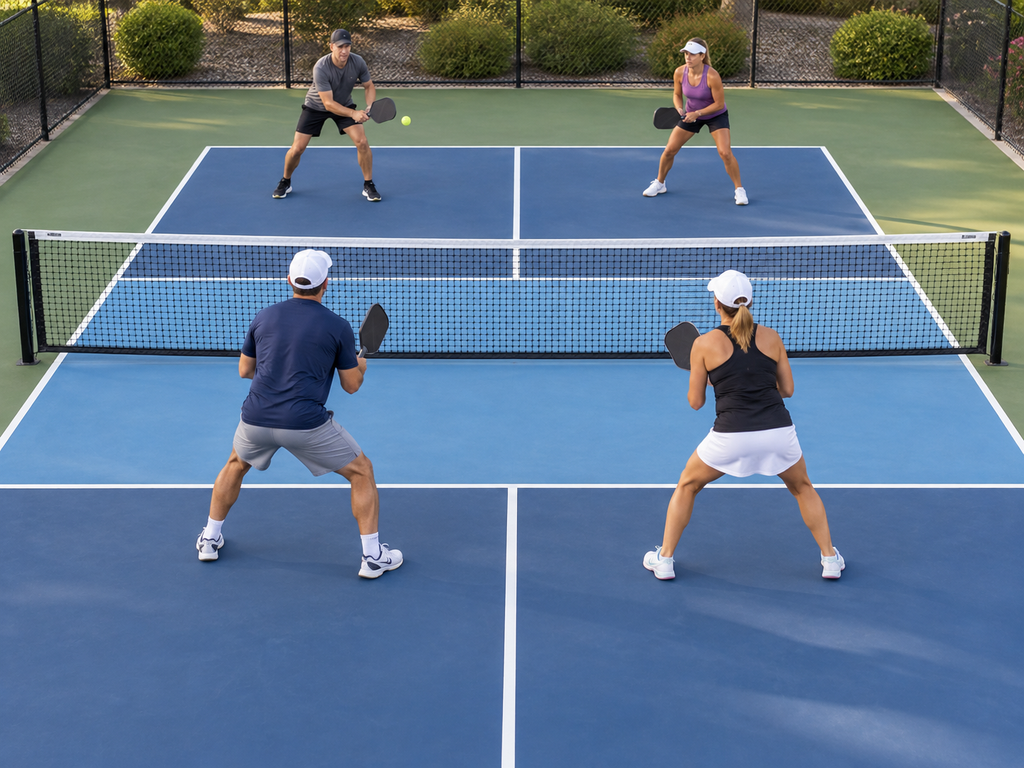
If you are new to pickleball, the kitchen can be one of the most confusing parts of the game.
You may hear players say things like:
“Stay out of the kitchen.”
“Get to the kitchen line.”
“Don’t step in after your volley.”
At first, those instructions can sound contradictory. Are you supposed to stay away from the kitchen or move toward it?
The answer is both.
The kitchen is an important part of the pickleball court, and understanding how it works will help you avoid faults, improve your positioning and make better decisions during rallies.
What Is the Kitchen in Pickleball?
The kitchen is the informal name for the Non-Volley Zone, often shortened to NVZ.
It is the area directly beside the net on both sides of a pickleball court.
Each kitchen extends 7 feet from the net and spans the entire 20-foot width of the court.
Together, the two non-volley zones create a 14-foot-wide area centered around the net.
The line marking the back edge of the kitchen is called the non-volley zone line or, more commonly, the kitchen line.
Importantly, the line itself is considered part of the kitchen.
Why Does Pickleball Have a Kitchen?
Without the kitchen, players could stand directly beside the net and hit almost every ball out of the air.
That would give players at the net an enormous advantage and could turn many rallies into quick overhead smashes.
The non-volley zone limits that advantage.
You can still move close to the net, but you cannot legally volley the ball while touching the kitchen.
This helps create one of pickleball’s defining tactical battles: players want to move forward and control the area near the net while still respecting the non-volley zone.
What Is a Volley?
To understand the kitchen rule, you first need to understand what a volley is.
A volley happens when you hit the ball before it bounces on your side of the court.
For example, imagine your opponent hits the ball toward you while you are standing near the net.
If you strike the ball out of the air before it touches the court, you have hit a volley.
If you wait for the ball to bounce first and then hit it, you have not hit a volley.
That distinction is the key to understanding almost every kitchen rule.
Can You Stand in the Kitchen?
Yes.
This surprises many beginners.
There is no general rule saying that players are not allowed to enter the kitchen.
You may step into the kitchen during a rally.
You may stand there.
You may run through it.
You may hit a ball while standing there as long as the ball has bounced before you hit it.
The restriction applies specifically to volleys.
If the ball bounces inside the kitchen, you are allowed to step in and play it.
For example, your opponent may hit a soft shot that lands close to the net. You can step forward into the kitchen, allow the ball to bounce and then return it.
That is completely legal.
When Are You Not Allowed to Be in the Kitchen?
You cannot be touching the kitchen when you volley the ball.
That includes standing:
- Completely inside the kitchen
- With one foot inside the kitchen
- On the kitchen line
- With part of a foot touching the kitchen line
If you volley the ball while touching the non-volley zone or its line, it is a fault.
The safest beginner habit is to establish your feet just behind the kitchen line before attempting a volley.
The Kitchen Line Is Part of the Kitchen
One of the easiest mistakes for beginners is standing directly on the kitchen line.
It may feel as though you are outside the kitchen because most of your body is behind the line.
However, the line belongs to the non-volley zone.
If your shoe is touching the line while you volley the ball, you have committed a kitchen fault.
Try to position your feet slightly behind the line rather than directly on top of it.
You do not need to stand several feet away. Just give yourself enough space to remain balanced and avoid accidentally stepping forward during your shot.
The Momentum Rule
The kitchen rule does not end the instant your paddle contacts the ball.
Your momentum matters too.
Suppose you are standing legally behind the kitchen line and hit a volley.
Your feet are outside the kitchen when you make contact, but the force of your movement carries you forward afterward.
If you step into the kitchen because of that momentum, the volley is still a fault.
Even if your shot has already landed on the opponent’s side, your momentum cannot carry you into the non-volley zone after the volley.
This is why balance is so important near the kitchen line.
Instead of lunging aggressively toward every ball, try to remain stable enough to stop your body after making contact.
Can You Reach Over the Kitchen?
Yes.
Your paddle and upper body can extend over the kitchen while you volley.
You do not have to keep the paddle behind the kitchen line.
For example, imagine you are standing behind the kitchen line and a ball is floating just in front of you.
You can lean forward and reach across the non-volley zone to volley it.
As long as you remain legally established outside the kitchen and your momentum does not carry you into it, the shot can be legal.
Beginners sometimes give up playable balls because they think their paddle cannot cross the kitchen line. The rule is primarily about your contact with the non-volley zone while volleying, not an invisible vertical wall rising from the line.
What Happens After You Step Into the Kitchen?
Another important situation occurs when you enter the kitchen to play a ball that has bounced.
Suppose your opponent hits a short ball.
You step into the kitchen, let it bounce and return it.
Your opponent then sends the next ball toward you before it bounces.
You cannot simply jump backward from inside the kitchen and volley the next ball while airborne.
Before volleying again, you need to re-establish yourself outside the non-volley zone.
For beginners, the practical lesson is simple:
After playing a bouncing ball from inside the kitchen, recover completely behind the kitchen line before trying to volley the next shot.
The Kitchen and the Serve
The kitchen also matters during the serve.
A legal serve must travel beyond the kitchen and land in the correct diagonal service court.
A serve that lands in the non-volley zone is a fault.
The non-volley zone line is also considered part of the kitchen for the serve, so a serve landing on that line is short.
Do not confuse the kitchen line with the other court lines. Pickleball has specific rules about the non-volley zone line on serves.
Why Players Want to Get Close to the Kitchen
After hearing all the rules about the kitchen, a beginner may assume it is safer to stay far away from it.
Usually, that is not the goal.
In many rallies, one of the strongest court positions is just behind the kitchen line.
From there, you are closer to the net and can often:
- Take the ball earlier
- Reduce your opponent’s reaction time
- Cover more of the court efficiently
- Hit volleys without allowing the ball to drop
- Play soft shots into the opponent’s kitchen
- Apply pressure without needing excessive power
This is why experienced players frequently work their way toward the kitchen line during a rally.
They are not trying to stand inside the kitchen.
They are trying to control the space right behind it.
Why Staying at the Baseline Can Be Difficult
Beginners often remain near the baseline because that position feels familiar and gives them more time to react.
But staying deep while your opponents control the kitchen line can make rallies much harder.
Your opponents can hit balls downward toward your feet and create sharper angles.
You may also find yourself repeatedly hitting difficult shots from farther away while they comfortably control the net.
Learning when and how to move forward is therefore an important part of developing as a pickleball player.
The goal is not to rush recklessly toward the kitchen.
It is to advance when the ball gives you an opportunity and eventually establish a balanced position near the non-volley zone line.
What Is the Ready Position at the Kitchen Line?
Once you reach the kitchen line, use a balanced athletic position.
Keep your feet approximately shoulder-width apart, bend your knees slightly and keep your weight balanced rather than leaning heavily forward or backward.
Hold the paddle in front of your body where you can react quickly.
Avoid standing completely upright with the paddle hanging beside your leg.
You also do not want your toes directly on the line.
Leaving a small amount of space between your feet and the kitchen line gives you some protection against accidentally stepping into the zone during a volley.
The Kitchen Is About Control, Not Just Rules
The kitchen is more than a restricted area of the court.
It shapes much of pickleball strategy.
When players reach the kitchen line, rallies often involve shorter and more controlled shots.
Instead of hitting every ball hard, players may use soft shots to make opponents hit upward from low positions.
One important example is the dink, a soft shot designed to land inside the opponent’s kitchen.
A good dink can make it difficult for your opponent to attack because the ball stays low after the bounce.
You do not need to master dinking immediately to understand the kitchen, but you should recognize why this area becomes so important as your game develops.
Common Kitchen Mistakes Beginners Make
1. Thinking You Can Never Enter the Kitchen
You are allowed to enter the kitchen.
The restriction is on volleying while touching the non-volley zone.
If the ball bounces there, you can step in and play it.
2. Standing on the Kitchen Line
The kitchen line is part of the non-volley zone.
Leave a little space between your shoes and the line when preparing to volley.
3. Stepping Forward After a Volley
You may contact the ball outside the kitchen but accidentally step over the line afterward.
If your momentum from the volley carries you into the kitchen, it is a fault.
Work on balance rather than reaching too aggressively.
4. Being Afraid to Approach the Kitchen
Some beginners learn the kitchen rule and respond by staying several feet away from the line.
That gives opponents additional space and can make volleys more difficult.
Once you are able to move forward safely, try to establish your position near the kitchen line.
5. Jumping Out of the Kitchen to Volley
If you were standing inside the kitchen, you cannot simply leap into the air and volley the ball before re-establishing yourself outside the non-volley zone.
Recover outside first.
6. Watching Only the Ball
Near the kitchen, you need awareness of both the ball and your position.
You do not need to stare at the kitchen line throughout the rally, but learning where your feet are relative to it is an important court-awareness skill.
A Simple Kitchen Exercise for Beginners
You can practice kitchen positioning without even playing a full game.
Stand just behind the kitchen line in your ready position.
Have a partner gently send balls toward you.
When the ball stays high enough to volley comfortably, return it while remaining behind the line.
When the ball lands short inside the kitchen:
- Let it bounce.
- Step into the kitchen.
- Return the ball.
- Move back behind the kitchen line.
- Re-establish your balance and ready position.
Start slowly.
The goal is not to hit hard. Focus on recognizing when you can volley and when you need to let the ball bounce.
Over time, these movements will begin to feel natural.
A Simple Way to Remember the Kitchen Rule
When you are unsure what to do, remember this:
Bounce in the kitchen? You can go in.
Volley the ball? Stay out.
There are additional details involving momentum and foot position, but this simple rule gives beginners a strong starting point.
Why Understanding the Kitchen Makes Pickleball Easier
The kitchen may seem complicated during your first few games, but the basic idea becomes much easier once you connect it to the meaning of a volley.
You are allowed to enter the kitchen.
You are allowed to hit balls that have bounced there.
You are allowed to move back out and continue playing.
What you cannot do is use the non-volley zone as a position from which to hit the ball out of the air.
Once that distinction becomes clear, the kitchen stops feeling like a strange restricted area and starts becoming an important part of your strategy.
Learn to recognize the kitchen line, stay balanced when volleying and become comfortable moving into and out of the zone when necessary.
Eventually, you will discover that some of the most important points in pickleball are won not by staying away from the kitchen, but by learning how to play intelligently around it.