
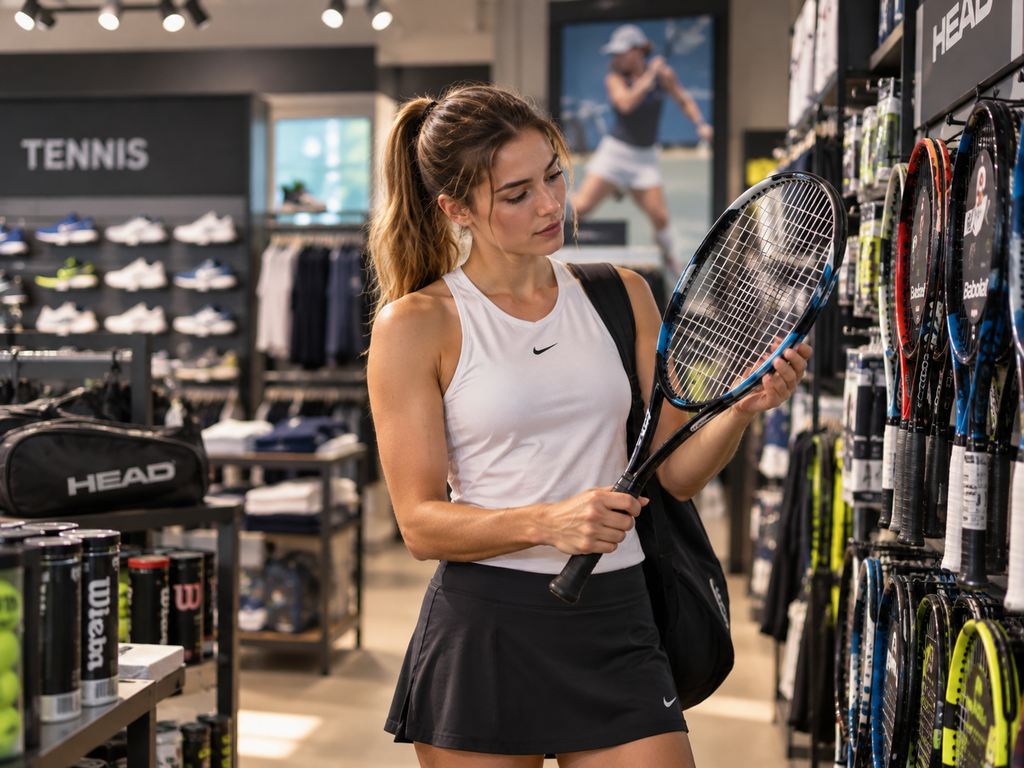
Choosing your first tennis racquet can feel more complicated than it needs to be. Racquets are sold with measurements for head size, weight, balance, stiffness, string pattern and several other specifications that may not mean much when you are just starting to play.
The good news is that beginners do not need to understand every technical detail.
Your first racquet mainly needs to be comfortable, easy to swing and forgiving when you do not hit the ball perfectly in the center of the strings. You want equipment that helps you learn rather than something that demands advanced technique before it performs well.
This guide explains the basic characteristics that matter when choosing a beginner tennis racquet and which specifications you can largely ignore until you have more playing experience.
What Should a Beginner Look for in a Tennis Racquet?
For most adult beginners, a good first racquet should have:
- A reasonably large head
- A manageable weight
- A comfortable grip size
- A standard adult length
- Enough stability to feel controlled
- A forgiving response on off-center hits
You do not need the exact racquet used by a professional player. In fact, many racquets designed for advanced players can make tennis unnecessarily difficult for beginners.
Professional-level racquets are often heavier, less forgiving and designed for players who already generate their own power through developed technique.
A beginner racquet should make learning easier.
Start With Racquet Head Size
The racquet head is the oval frame containing the strings.
Head size affects how much hitting area you have available when trying to contact the ball.
A larger head generally gives beginners a larger effective hitting area and more forgiveness when the ball does not strike the exact center of the strings.
You will commonly see adult racquets somewhere around:
- 100 square inches
- 102 square inches
- 105 square inches
- 110 square inches or larger
For a beginner, something around 100 to 110 square inches is usually a practical range.
A racquet near 100 square inches can work well for a beginner who wants something they can continue using as their skills develop.
A racquet closer to 105 or 110 square inches provides a little more forgiveness and may feel easier when you are first learning to make consistent contact.
You do not automatically need the largest racquet available.
Extremely oversized racquets can provide plenty of assistance, but your goal should be to find a racquet that feels comfortable and manageable rather than simply choosing the biggest head.
Why Forgiveness Matters
Beginners rarely hit every ball directly in the center of the racquet.
You might contact the ball:
- Slightly toward the top of the strings
- Near one side of the frame
- Lower than intended
- Too early or too late in the swing
A forgiving racquet helps produce a more usable shot even when your contact is imperfect.
That makes it easier to practice without feeling as though every small mistake completely ruins the shot.
Choose a Weight You Can Swing Comfortably
Weight is one of the most important characteristics of a first racquet.
A racquet that is too heavy can make learning uncomfortable. It may feel difficult to prepare quickly, especially when practicing repeatedly.
A racquet that is extremely light may be easy to move but can sometimes feel less stable when contacting the ball.
For most beginners, the goal is somewhere in the middle: light enough to swing easily but substantial enough to feel controlled.
Many beginner-friendly adult racquets fall roughly within the 9.5 to 11 ounce range when strung, although there is no single correct weight for everyone.
Instead of becoming obsessed with the number, pay attention to how the racquet feels.
You should be able to:
- Hold it comfortably
- Prepare your swing without struggling
- Move it into position quickly
- Swing several times without excessive effort
- Maintain reasonable control of the racquet throughout the motion
If the racquet immediately feels cumbersome, it probably is not the best choice for your first racquet.
Avoid Choosing the Lightest Racquet Just Because You Are a Beginner
It can be tempting to assume that lighter always means better.
That is not necessarily true.
Very lightweight racquets can certainly be useful, particularly for players who need something extremely easy to maneuver. However, reducing weight too far may also reduce stability.
When the ball contacts the strings, you want the racquet to feel reasonably solid rather than as though it is being pushed around by the ball.
A beginner should generally look for a comfortable compromise between maneuverability and stability.
The racquet should feel easy to swing without feeling flimsy.
Make Sure You Choose the Correct Grip Size
Grip size refers to the circumference of the racquet handle.
Unlike some racquet specifications that beginners can safely ignore at first, grip size deserves attention because you will be holding the racquet throughout every practice session.
A grip that is noticeably too small or too large can feel awkward.
Adult tennis racquets are typically available in several grip sizes. The exact labeling can vary depending on the manufacturer or country.
If you can test a racquet in person, hold it naturally using a basic tennis grip.
You should be able to wrap your fingers comfortably around the handle without feeling that you need to squeeze excessively.
The goal is simple:
The handle should feel secure but comfortable in your hand.
If you are between two grip sizes, many players choose the slightly smaller option because grip size can be increased later with an overgrip.
Making a grip substantially smaller is more difficult.
What Is an Overgrip?
An overgrip is a thin layer of material wrapped around the existing handle.
Players commonly use overgrips to:
- Improve grip
- Absorb sweat
- Change the feel of the handle
- Slightly increase grip thickness
This means your initial grip size does not always need to be absolutely perfect.
However, starting reasonably close to the correct size will make the racquet more comfortable to use.
Choose a Standard Adult Racquet Length
Most adult tennis racquets are approximately 27 inches long.
For a typical adult beginner, a standard-length racquet is usually the simplest choice.
Longer racquets exist and can provide additional reach and leverage, but beginners do not need extra length to start learning the game.
Unless you have a specific reason for choosing something different, a standard adult racquet keeps the decision simple.
Children and younger players may need junior racquets designed for their height and age rather than a full-size adult racquet.
Do You Need to Understand Racquet Balance?
You may see racquets described as:
- Head light
- Even balance
- Head heavy
This describes where the racquet’s weight is distributed.
A head-light racquet carries more of its weight toward the handle. A head-heavy racquet carries more toward the racquet head.
Balance can affect how heavy a racquet feels when you swing it even when two racquets have similar total weights.
For your first racquet, you do not need to analyze balance measurements in detail.
Simply ask yourself whether the racquet feels easy to move.
If two racquets have similar specifications but one feels much easier to swing, balance may be part of the reason.
For a beginner, comfort and maneuverability are more useful than trying to find a particular balance number.
Do You Need to Worry About String Patterns?
Racquets are commonly listed with string patterns such as:
- 16 × 19
- 16 × 18
- 18 × 20
These numbers describe the number of main and cross strings in the racquet.
Different patterns can influence characteristics such as spin, control and string movement.
Those differences can become more meaningful as your strokes develop.
For your first racquet, however, string pattern should not be a major decision.
A common pattern such as 16 × 19 works perfectly well for beginner tennis and is widely available.
There is little reason for a new player to reject an otherwise comfortable racquet because another model has a different string pattern.
What About Racquet Stiffness?
Another specification you may encounter is frame stiffness.
Stiffness influences how much the racquet frame bends when it contacts the ball.
This can affect feel, power and comfort.
It is useful information for experienced players comparing specific racquet characteristics, but it does not need to become one of your main concerns when buying your first racquet.
You should pay more attention to whether the racquet feels comfortable when you hit with it.
If a racquet produces an unpleasant or harsh feeling during contact, try something else rather than worrying about interpreting technical stiffness ratings.
You Do Not Need an Expensive Racquet to Start
A higher price does not automatically make a racquet better for a beginner.
Premium racquets may use more advanced materials, manufacturing methods or designs, but none of those features will replace learning how to:
- Prepare correctly
- Track the ball
- Make clean contact
- Control the racquet face
- Finish the stroke
A reasonably priced beginner or intermediate racquet from a reputable tennis brand can be more than enough for learning.
The important distinction is between buying an inexpensive real tennis racquet and buying equipment that feels more like a toy.
You want something durable enough to practice with regularly and stable enough to hit normal tennis balls comfortably.
Pre-Strung Racquets Are Fine for Beginners
Many beginner racquets are sold already strung.
That is convenient and usually perfectly adequate when you are learning.
Advanced players may carefully select strings based on:
- Material
- Gauge
- Tension
- Spin potential
- Feel
- Durability
- Power
You do not need to make those decisions yet.
For a first racquet, the factory strings are normally enough to start practicing.
Eventually the strings will lose tension or break and need replacing. At that point, you can discuss beginner-friendly string options with a tennis shop or stringer.
But custom string selection should not stop you from buying your first racquet.
Comfort Matters More Than the Specification Sheet
Two racquets can look nearly identical on paper but feel very different when you actually swing them.
That is why testing a racquet can be helpful.
If possible, hold several racquets before buying.
Even better, see whether a tennis shop, club or coach offers demo racquets you can hit with.
Pay attention to simple questions:
- Does the racquet feel comfortable in my hand?
- Can I swing it without struggling?
- Does it feel reasonably stable when I hit the ball?
- Does the grip feel natural?
- Can I imagine practicing with it for an hour?
You do not need enough tennis experience to judge tiny performance differences.
You are simply trying to eliminate racquets that immediately feel uncomfortable or difficult to use.
Do Not Buy a Racquet Only Because a Professional Uses It
Professional tennis players help sell a lot of racquets.
You may see a racquet associated with your favorite player and assume it must be an excellent choice.
The problem is that professional players have completely different needs from beginners.
They typically have:
- Highly developed strokes
- Excellent timing
- Significant racquet-head speed
- Strong physical conditioning
- Years of experience controlling the ball
They may prefer equipment that rewards precise technique but offers much less help on imperfect contact.
There is also an important difference between a racquet marketed as part of a professional player’s product line and the exact customized equipment that player actually uses.
Choose a racquet for your current level, not the player pictured in the advertisement.
Do Not Choose Based on Power Alone
Beginner racquets are sometimes marketed primarily around power.
Some assistance can certainly be useful because new players usually do not generate large amounts of racquet-head speed.
But more power is not automatically better.
Your objective as a beginner is to develop controlled strokes that allow you to keep the ball in play.
You need enough assistance to make hitting comfortable without feeling as though the ball launches unpredictably from the strings.
Comfort, control and forgiveness should remain the priority.
Should You Buy a Beginner Racquet or an Intermediate Racquet?
You do not necessarily need a racquet labeled specifically for beginners.
Some beginner-friendly intermediate racquets can also be excellent first racquets.
In fact, buying something slightly above the most basic beginner category may allow you to continue using the same racquet for several years as your game improves.
A sensible first racquet should not require advanced technique, but it also does not need to be something you will immediately outgrow.
Look for a forgiving adult racquet with moderate weight and a reasonably generous head size.
That combination can serve many recreational players well beyond their first few months.
Buying Online vs. Buying in Person
Buying online gives you access to more models and sometimes better prices.
The disadvantage is that you cannot hold the racquet first.
If you already know your preferred grip size and have a good idea of the weight and head size you want, buying online can work well.
If you have never held a tennis racquet before, visiting a tennis shop can make the decision easier.
You can quickly compare several models and notice differences that are difficult to understand from specifications alone.
Even holding a few racquets for several minutes can help you identify what feels comfortable.
A Simple Beginner Racquet Checklist
When comparing racquets, keep the process simple.
For most adult beginners, start by looking for:
Head size: Approximately 100–110 square inches
Length: Around 27 inches
Weight: Manageable enough to swing comfortably, often somewhere around 9.5–11 ounces strung
Grip: Comfortable for your hand size
Feel: Stable without feeling difficult to move
Strings: Factory-installed strings are fine
Price: Something that comfortably fits your budget
You do not need to perfectly optimize every measurement.
If a racquet falls within reasonable beginner-friendly ranges and feels comfortable, it is probably capable of helping you learn tennis.
Specifications You Can Worry About Later
As your tennis improves, you may eventually develop preferences about:
- Exact racquet weight
- Swingweight
- Balance point
- Frame stiffness
- Beam width
- String pattern
- String material
- String tension
- Custom weighting
These details can matter.
They simply do not need to dominate your first racquet purchase.
You may not even know what you prefer until you have played enough tennis to compare different equipment.
Trying to optimize advanced specifications before developing your strokes often creates more confusion than benefit.
When Should You Upgrade Your First Racquet?
You do not need to replace your beginner racquet simply because you improve.
If the racquet remains comfortable and you play well with it, keep using it.
You might consider trying different racquets later if you begin noticing specific limitations.
For example, after developing more consistent strokes, you may want:
- Greater stability
- More control
- A different weight
- A smaller or larger head
- A different feel
- Easier spin generation
At that stage, your own playing experience gives you something useful to base the decision on.
Instead of asking, “What is the best racquet?”
You can ask something much more useful:
“What do I want my next racquet to do differently from the one I already have?”
That is when detailed racquet specifications become much more valuable.
The Best Beginner Racquet Is One You Can Learn With
There is no single tennis racquet that is perfect for every beginner.
Players have different hand sizes, strength levels, budgets and personal preferences.
Fortunately, beginners also do not need perfect equipment to start improving.
Look for a racquet with a forgiving head size, manageable weight, comfortable grip and standard adult length. Make sure it feels easy enough to swing while still feeling stable when you contact the ball.
Then stop worrying about equipment and start playing.
Your first racquet does not need to be the racquet you use forever.
It simply needs to give you a comfortable, reliable platform for learning how to play tennis.