
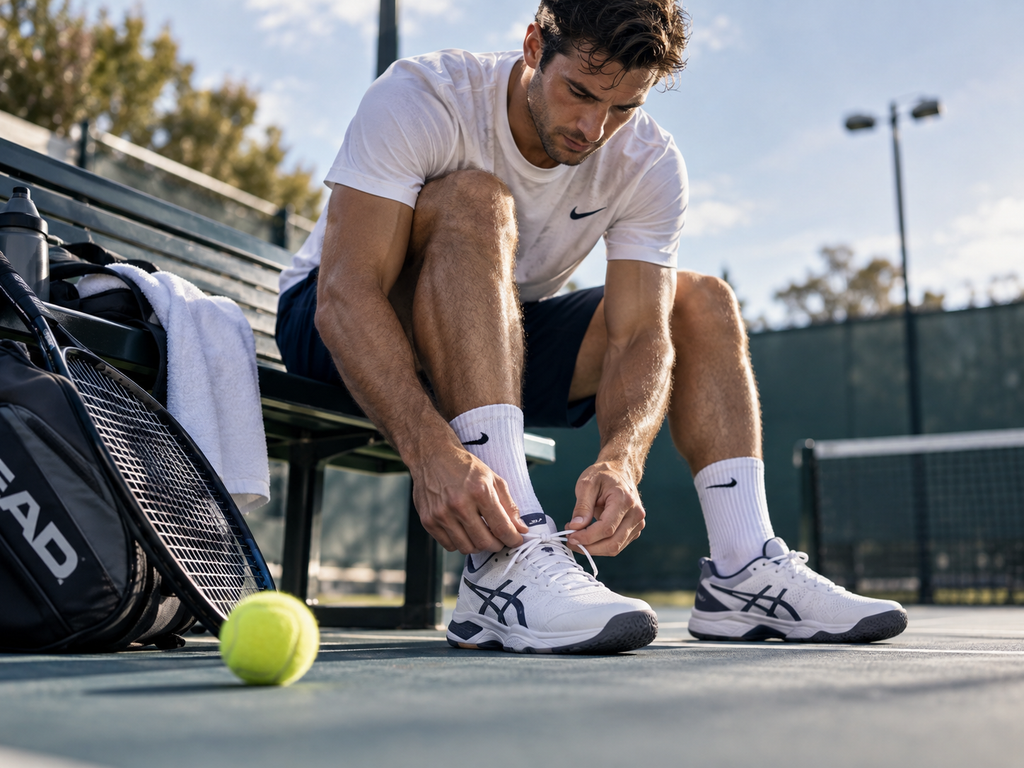
When you are new to tennis, shoes can seem like one of the simplest pieces of equipment to choose. You may already own comfortable running shoes or general athletic sneakers and wonder whether you really need something designed specifically for tennis.
The difference becomes clearer once you start moving around a tennis court.
Tennis requires frequent sideways movement, quick changes of direction, short sprints, sudden stops and repeated pushes off the ground. Those movements place different demands on your shoes than running or everyday exercise.
You do not need the most expensive tennis shoes available when you are starting. You do, however, want footwear that gives you enough stability, traction, comfort and durability to move confidently around the court.
This guide explains what makes tennis shoes different and what beginners should consider when choosing their first pair.
Why Tennis Shoes Are Different
Most running involves primarily forward movement.
Tennis movement happens in almost every direction.
During a rally, you might move sideways toward a forehand, recover toward the center, move forward for a short ball and then suddenly change direction when your opponent sends the next shot behind you.
Your footwear must handle those movements repeatedly.
Tennis shoes are generally designed with more lateral support and a more stable base than typical running shoes. The outsole is also designed to provide useful traction while tolerating the repeated stopping, sliding and direction changes that happen on a court.
The goal is not simply to make the shoe comfortable.
The shoe needs to help keep your foot supported while you move.
The Movements Your Shoes Need to Handle
Even beginner tennis involves several types of movement.
You may:
- Shuffle sideways along the baseline
- Push aggressively toward one side of the court
- Stop after a short sprint
- Change direction quickly
- Move forward toward the net
- Backpedal or reposition for a high ball
- Recover toward the center after each shot
These movements place stress on the sides of the shoe as well as the bottom.
That is one reason a soft running shoe can feel comfortable while standing or jogging but less secure during lateral tennis movement.
When choosing tennis shoes, think about how securely the shoe controls your foot while moving sideways rather than judging it only by how soft it feels when walking.
Stability Matters
Stability is one of the most important characteristics of a tennis shoe.
When you push sideways or change direction, you want your foot to remain reasonably secure inside the shoe.
A tennis shoe with good lateral stability helps prevent your foot from shifting excessively over the edge of the sole during movement.
Look for a shoe that feels planted rather than unusually tall, narrow or unstable.
Try making a few gentle side-to-side movements while testing shoes. Your heel should stay relatively secure and your foot should not feel as though it is sliding around inside the shoe.
For beginners, predictable stability is usually more valuable than having the lightest possible shoe.
Look for a Secure Fit
Your tennis shoes should fit snugly enough to hold your foot in place without creating uncomfortable pressure.
There should generally be some room in front of your toes so they do not repeatedly hit the front of the shoe when you stop.
At the same time, the shoe should not be so large that your foot slides forward or sideways inside it.
Pay particular attention to three areas.
Heel
Your heel should feel secure without excessive lifting when you walk or move.
A small amount of movement may be normal depending on the shoe, but noticeable slipping can become distracting on court.
Midfoot
The middle of the shoe should hold your foot comfortably.
It should feel supportive rather than loose, but not so tight that it creates pressure or numbness.
Toe Box
Your toes should have enough space to sit naturally.
Your feet can move slightly forward during sudden stops, so a shoe that already feels cramped while standing may become uncomfortable during play.
Different brands and models can fit differently even when the printed shoe size is the same.
The number on the box matters less than how the shoe actually fits your foot.
Traction Should Feel Controlled
Tennis shoes need enough traction to help you start, stop and change direction confidently.
More grip is not automatically better.
A shoe that grips appropriately for the court allows controlled movement without constantly feeling slippery or excessively stuck to the surface.
The outsole pattern and rubber compound influence how the shoe interacts with the court.
The correct amount of traction can also depend on the surface where you play.
If you regularly use the same courts, choosing shoes designed for that type of surface can make sense.
Consider the Court Surface
Tennis can be played on several surfaces, and footwear is sometimes designed around those differences.
Hard Courts
Hard courts are common at public parks, clubs and recreational facilities.
The surface can be abrasive, particularly on the outsole.
Shoes made for hard courts generally balance traction with durability and support.
If you are unsure what type of shoe you need and expect to play mainly on typical hard courts, an all-court or hard-court tennis shoe is often a practical starting point.
Clay Courts
Clay allows players to slide more than hard courts.
Clay-court shoes typically use outsole patterns designed to provide traction while helping prevent excessive clay buildup.
If you play almost exclusively on clay, a clay-specific shoe may be worth considering.
Grass Courts
Grass requires footwear that can provide traction on a surface that may become slippery.
Grass-specific shoes exist, although most beginners are far less likely to regularly play on grass than on hard courts.
Unless you frequently play on a specialized surface, you usually do not need to overcomplicate your first purchase.
Choose footwear that works well on the court where you actually expect to play.
Cushioning and Comfort
Tennis includes repeated impacts from running, stopping and changing direction.
Some cushioning can make those movements more comfortable.
However, cushioning should not come at the expense of stability.
A very soft shoe may feel excellent when you first put it on but can sometimes feel less controlled when moving aggressively from side to side.
Beginners should look for a balance.
You want enough cushioning to feel comfortable during a session while still feeling connected to the court.
Different players prefer different amounts of cushioning, so there is no single correct level.
The best choice is a shoe that remains comfortable when you move rather than one that simply feels soft when standing still.
Weight
Tennis shoes range from relatively light models to heavier shoes built around additional stability or durability.
A lighter shoe may feel faster and less restrictive.
A slightly heavier shoe may provide more structure and protection.
Beginners usually do not need to chase extremely lightweight footwear.
As your movement improves, you can decide whether you personally prefer lighter shoes or more supportive models.
For your first pair, fit, comfort and stability should take priority over small differences in shoe weight.
Durability
Tennis can be demanding on shoes.
Hard courts in particular can gradually wear down the outsole as you stop, change direction and push against the surface.
Some players also drag part of the shoe during certain movements or strokes, which can increase wear around the toe or sides.
Shoes designed specifically for tennis usually reinforce areas that commonly experience this type of stress.
How quickly a pair wears out depends on several factors, including:
- How frequently you play
- The court surface
- Your body weight
- Your movement style
- The construction of the shoe
A beginner who plays once each week may get much more use from a pair than someone playing several times per week.
You do not necessarily need the most durable shoe available. You simply want something appropriate for the amount and type of tennis you expect to play.
Breathability
Your feet will generate heat as you move around the court.
Breathable upper materials can improve comfort, especially during longer sessions or warm weather.
There is sometimes a tradeoff between a very lightweight, ventilated upper and the additional structure used to improve support and durability.
Again, balance matters more than finding the maximum amount of any single feature.
The shoe should keep your foot reasonably comfortable while still feeling secure during movement.
Your Playing Frequency Matters
How often you plan to play can influence how much you should invest in tennis shoes.
If you are trying tennis for the first time and expect only occasional recreational sessions, you probably do not need a premium competition-level shoe.
A basic tennis-specific model with proper fit and support may be enough.
If you already know that you will be playing several times each week, durability and long-session comfort become more important.
Think realistically about how often you will be on court.
You can always become more particular about footwear once you have enough playing experience to understand your preferences.
Do Beginners Need Expensive Tennis Shoes?
No.
Price does not automatically determine whether a shoe is suitable for you.
Higher-priced models may use premium materials, advanced cushioning systems or specialized construction, but those features will not compensate for poor fit.
A reasonably priced tennis shoe that fits your foot properly can be a better beginner choice than an expensive model that feels uncomfortable or unstable.
Prioritize:
- Correct fit
- Lateral stability
- Court-appropriate traction
- Adequate cushioning
- Reasonable durability
- Overall comfort
Those characteristics matter much more than buying the most advanced shoe available.
Can You Play Tennis in Running Shoes?
You technically can step onto a tennis court wearing running shoes, but they are generally not designed for repeated tennis movement.
Running shoes are primarily built around forward motion. Many models have relatively soft cushioning and construction that does not provide the same lateral support as tennis footwear.
During gentle beginner hitting, the difference might not immediately feel dramatic.
As rallies become longer and your movement becomes faster, the advantages of tennis-specific footwear become more noticeable.
If you plan to continue playing regularly, tennis shoes are a worthwhile part of your basic court setup.
What About General Training Shoes?
Cross-training or general athletic shoes may provide more side-to-side support than some running shoes.
However, they are still not necessarily designed around the traction, durability and movement patterns of tennis.
They can sometimes work for very casual beginner activity, but regular players will generally benefit from shoes designed specifically for the court.
Try Shoes With Tennis Movement in Mind
When trying on tennis shoes, do more than simply walk around.
If possible, make a few controlled movements similar to what you will actually do during tennis.
Try:
- A gentle lateral shuffle
- A small forward step
- A controlled stop
- A few side-to-side direction changes
You are not testing your athletic ability.
You are checking whether your foot stays secure.
Notice whether your heel lifts, your toes hit the front or your foot slides sideways.
A shoe that feels comfortable during realistic movement is much more useful than one that only feels comfortable while standing.
Wear the Socks You Normally Play In
Sock thickness can affect how a shoe fits.
If possible, try tennis shoes while wearing the type of socks you expect to use on court.
A shoe that fits perfectly with thin socks may feel too tight with thicker athletic socks.
Similarly, sizing up to compensate for extremely thick socks can make the shoe too loose if you later switch to thinner ones.
Testing your shoes under realistic conditions makes choosing the correct fit easier.
Avoid Choosing Shoes Only by Appearance
There are plenty of good-looking tennis shoes.
There is nothing wrong with choosing a style or color you like once you have found suitable options.
Just avoid allowing appearance to override fit and function.
A shoe may match your racquet, clothes or favorite professional player perfectly and still be a poor choice for your feet.
Your shoes spend every point supporting your movement.
Comfort and stability deserve priority.
Signs Your Tennis Shoes May Need Replacing
Shoes gradually lose performance even before they completely fall apart.
Look at the outsole periodically.
If the tread in important areas has worn smooth, traction may be reduced.
You may also notice:
- Uneven outsole wear
- Reduced cushioning
- Less stability than when the shoes were new
- Damage around the upper or sides
- Your foot moving more inside the shoe
- New discomfort during or after playing
There is no universal replacement schedule because players wear shoes at very different rates.
Judge their condition based on how they look and perform rather than simply how many months you have owned them.
A Simple Beginner Buying Checklist
When choosing your first tennis shoes, ask yourself:
Do they fit securely?
Your heel and midfoot should stay controlled without painful pressure.
Do your toes have enough room?
Your toes should not feel compressed or repeatedly hit the front of the shoe.
Do they feel stable when moving sideways?
This is one of the biggest differences between tennis footwear and many other athletic shoes.
Are they suitable for the court where you play?
Most recreational beginners playing on hard courts can start with hard-court or all-court tennis shoes.
Is the cushioning comfortable?
You want enough impact protection without feeling unstable.
Are they appropriate for how often you play?
Occasional beginners do not necessarily need premium shoes designed for heavy competition use.
Can you move naturally in them?
Your shoes should help you feel confident rather than make you constantly think about your feet.
Start With the Basics
Your first tennis shoes do not need to be perfect.
As a beginner, you probably do not yet know whether you prefer a lightweight shoe, maximum cushioning, additional stability or a particular outsole feel.
That knowledge comes from playing.
For now, choose a genuine tennis shoe that fits properly, feels stable during lateral movement and provides appropriate traction for your normal court surface.
Then get on court and use it.
As your movement improves and you spend more time playing, you will develop a much better understanding of what you personally want from your next pair.
The purpose of beginner tennis shoes is simple: give your feet a secure, comfortable foundation so you can concentrate on learning how to move and play.