
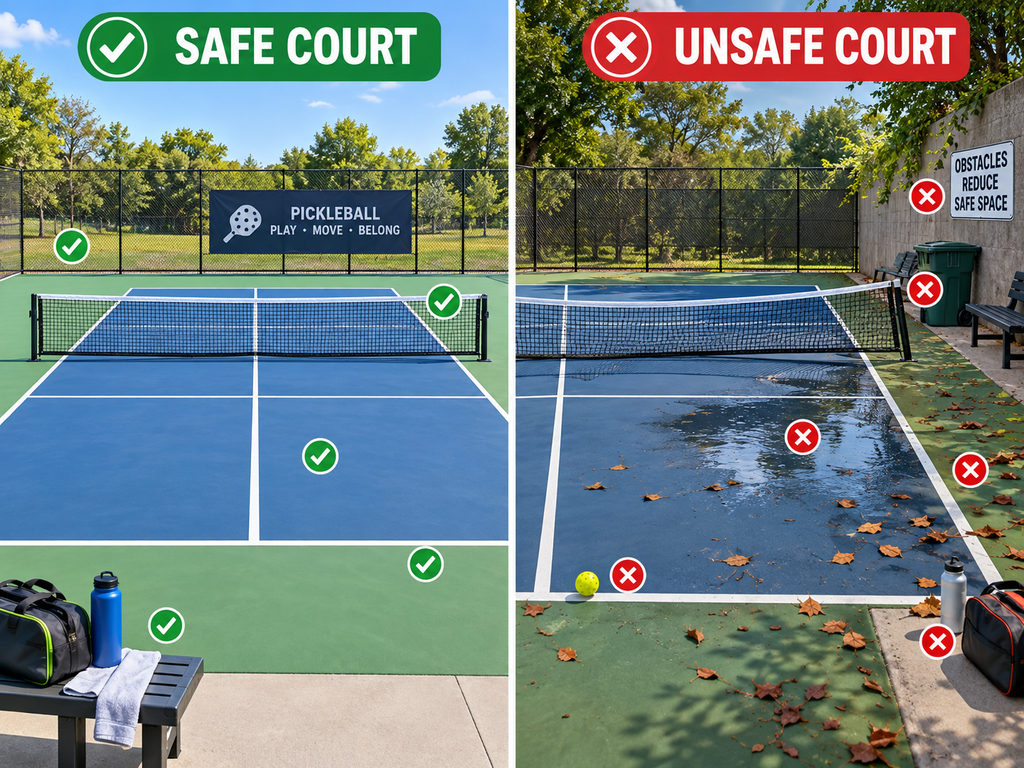
Having your paddle, ball and other equipment ready does not automatically mean the playing area is ready. Before you begin warm-up movements, drills or recreational play, Check the Court and Net Before Playing with a short, repeatable inspection. The goal is to identify obvious problems with the playing surface, surrounding space and net area before those problems become hazards during movement.
Remember:
A beginner does not need to perform a technical facility inspection. You are simply looking for conditions you can reasonably see: wet or slippery areas, debris, loose objects, damaged surfaces, nearby obstacles and obvious problems with the net or its supports. The approved lesson specifically treats this as a beginner pre-play inspection rather than court construction or maintenance work.
This inspection should happen before active movement begins. If you find a simple problem that can be corrected safely, correct it. If you find a meaningful hazard that cannot be safely corrected, do not treat the court as ready simply because you planned to play there.
How to Check the Court and Net Before Playing
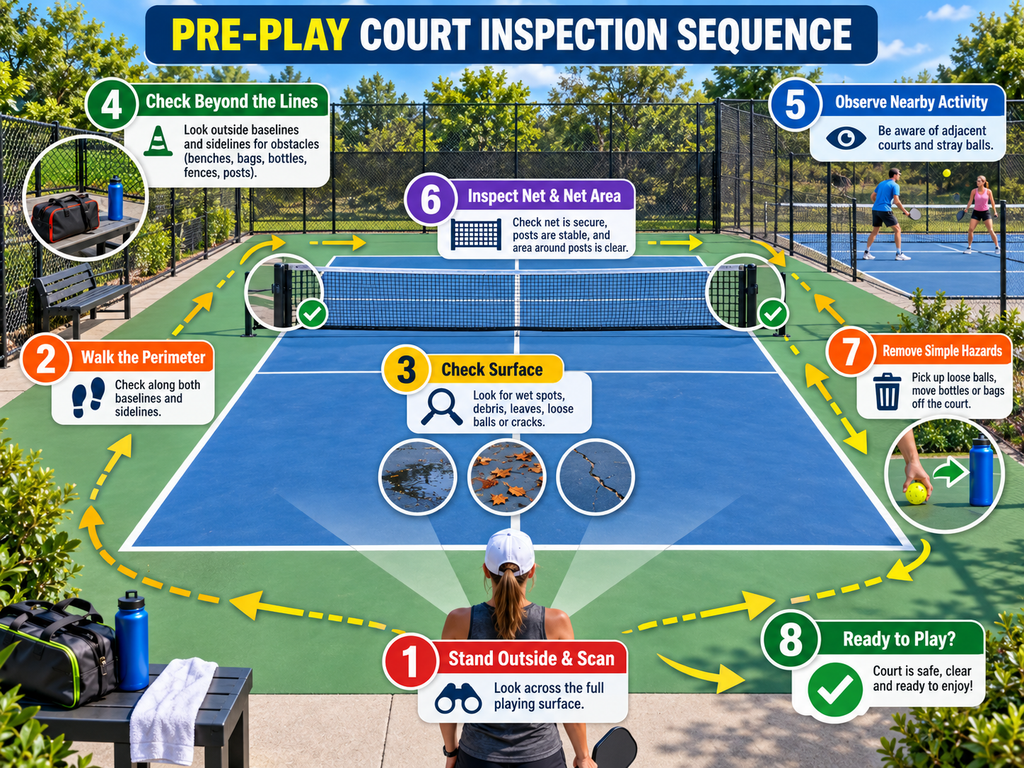
Begin your pre-play court check while standing outside the marked playing area. From there, look across the whole court before walking onto it. This gives you a broad view of the surface and makes it easier to notice anything unusual.
Next, walk around the court perimeter. Look at the surface, the spaces outside the baselines and sidelines, neighboring activity and the net area. Finish by making a simple decision: does the court appear reasonably ready for ordinary recreational practice, or is there a problem that needs to be corrected first?
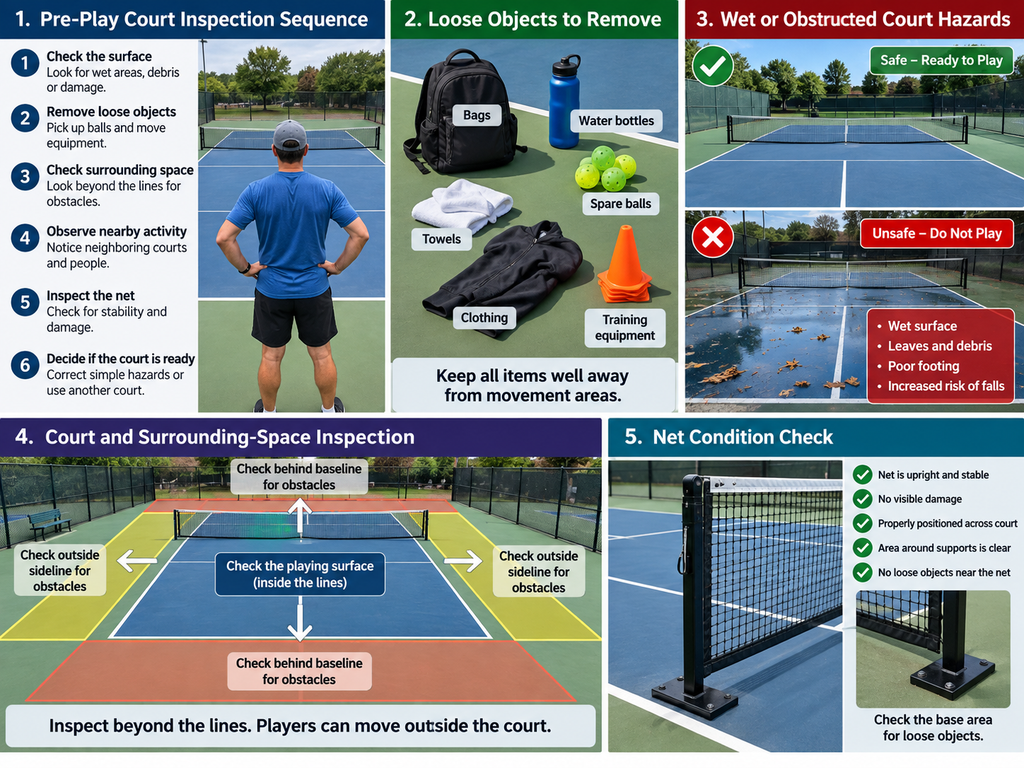
A useful sequence is:
surface → loose objects → surrounding space → nearby activity → net area → ready-or-not-ready decision
This is practical safety guidance for recreational players. Formal court and net specifications are contained in USA Pickleball’s official rules and facility guidance. USA Pickleball currently identifies its 2026 Official Rulebook as the governing rules document, and its court guidance also addresses playing-surface and net specifications.
Inspect the Playing Surface
Look across the entire marked playing area rather than checking only the spot where you expect to stand.
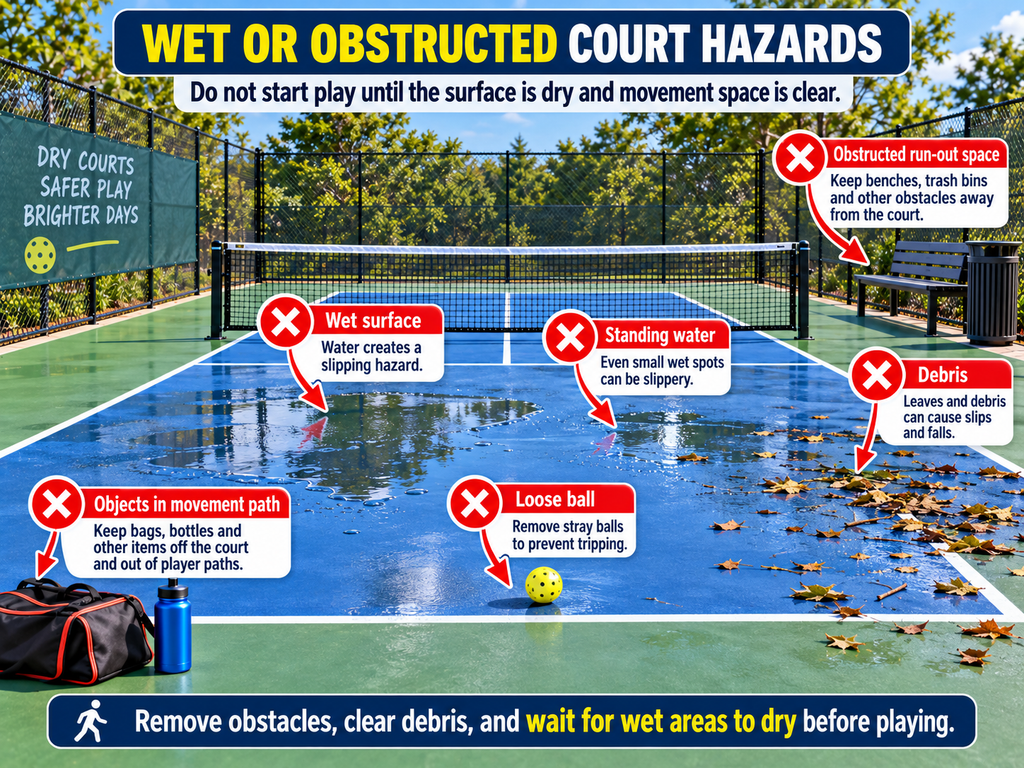
Start by looking for wet or slippery areas. Water from rain, cleaning, condensation, a spilled drink or another source can change how securely your shoes contact the surface. A patch that appears small while you are standing still may matter much more when you are stopping, turning or changing direction.
Also look for loose material such as leaves, dirt, sand or other debris. USA Pickleball’s court guidance notes that a playing surface should be free of debris. For a beginner, the practical question is simple: is there anything on the surface that could interfere with normal footing or movement?
Scan for visible surface irregularities as well. An obvious crack, raised section, broken area or other damage should not be ignored merely because most of the court appears usable. Pay particular attention to areas where players are likely to stop or change direction.
You are not being asked to diagnose the condition of the surface or repair it. You are deciding whether what you can see is compatible with normal recreational movement.
Remove Loose Balls and Other Objects
A pickleball is small, light and familiar, which can make it seem harmless when it is lying on the ground. During movement, however, a loose ball can become an obvious tripping hazard.
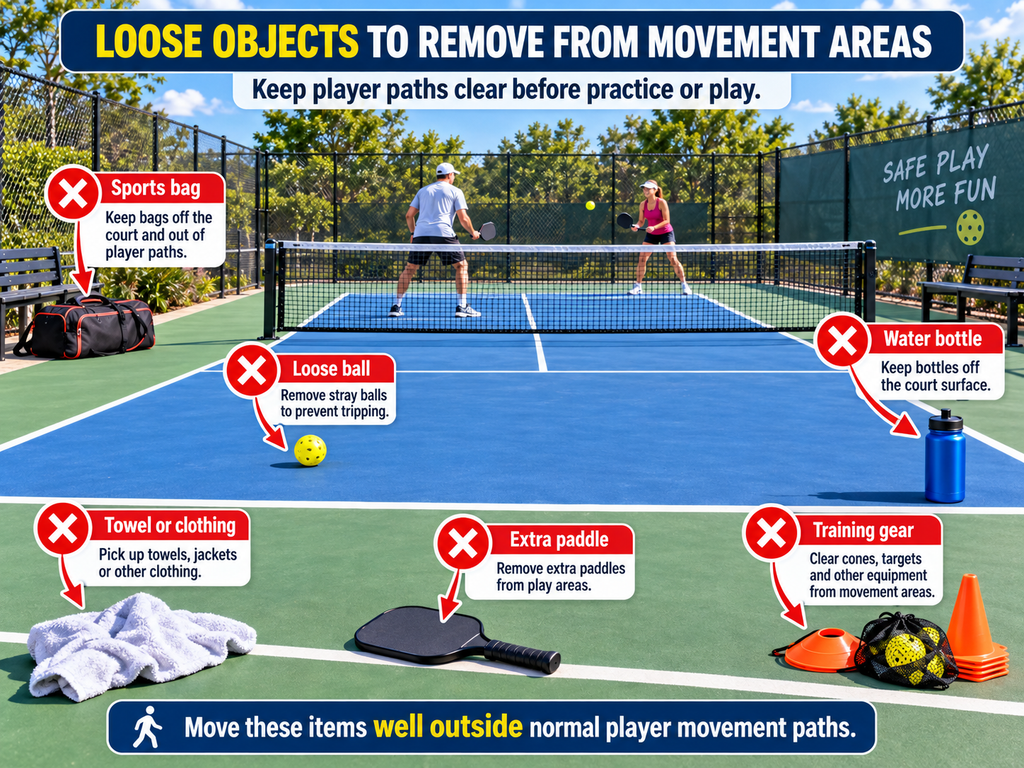
Before play begins, look for stray pickleballs anywhere players may move. Do the same for water bottles, bags, clothing, towels, cones, training equipment or other personal items.
Move unnecessary objects well away from ordinary movement paths. Do not simply place them immediately outside a sideline or baseline if a player could still step into that space while following a ball.
Spare pickleballs should be kept together in an organized location rather than scattered around the court. Water bottles and bags should also have a consistent place outside the active movement area.
This is one of the easiest parts of a pickleball court inspection to correct. If an object can be moved safely, move it before practice begins rather than expecting players to remember that it is there.
Check the Space Beyond the Court Lines
The painted court is not the only area a player may use.
During recreational play, a player may move beyond a baseline to play a deeper ball or step outside a sideline while reaching a ball that pulls them wide. For that reason, your inspection should continue beyond the marked boundaries.
Look behind both baselines. Check outside both sidelines. Notice fences, walls, benches, posts, stored equipment or other obstacles.
The important question is not simply, “Is the object outside the court?” Ask instead, “Could a player reasonably move toward this object during ordinary play?”
An obstacle can be outside the painted boundary and still affect usable movement space. This is why the marked pickleball court and the surrounding playing area should not be treated as the same thing.
Do not try to solve inadequate space by assuming everyone will remain inside the lines. If the area outside the court is unusually restricted, players should recognize that limitation before starting.
Observe Nearby Courts and Activity
Many recreational pickleball facilities place several courts close together. Before playing, look beyond your own court and notice what is happening nearby.
Are neighboring courts already active? Are players moving near the shared spaces between courts? Are spare balls or equipment positioned where they could enter your playing area? Is there a reasonable chance that a ball from another court could roll onto yours?
The purpose is awareness, not prediction. You cannot know everything that will happen once play begins, but noticing a busy shared environment helps you understand that conditions may change.
At a crowded facility, the court may be physically clear when you inspect it but require greater awareness because people and balls are moving nearby.
This lesson’s pre-play inspection does not require you to learn formal procedures for retrieving stray balls or managing interrupted rallies. At this stage, simply recognize that activity around your court can affect the safety of your playing environment.
Inspect the Net and Net Area
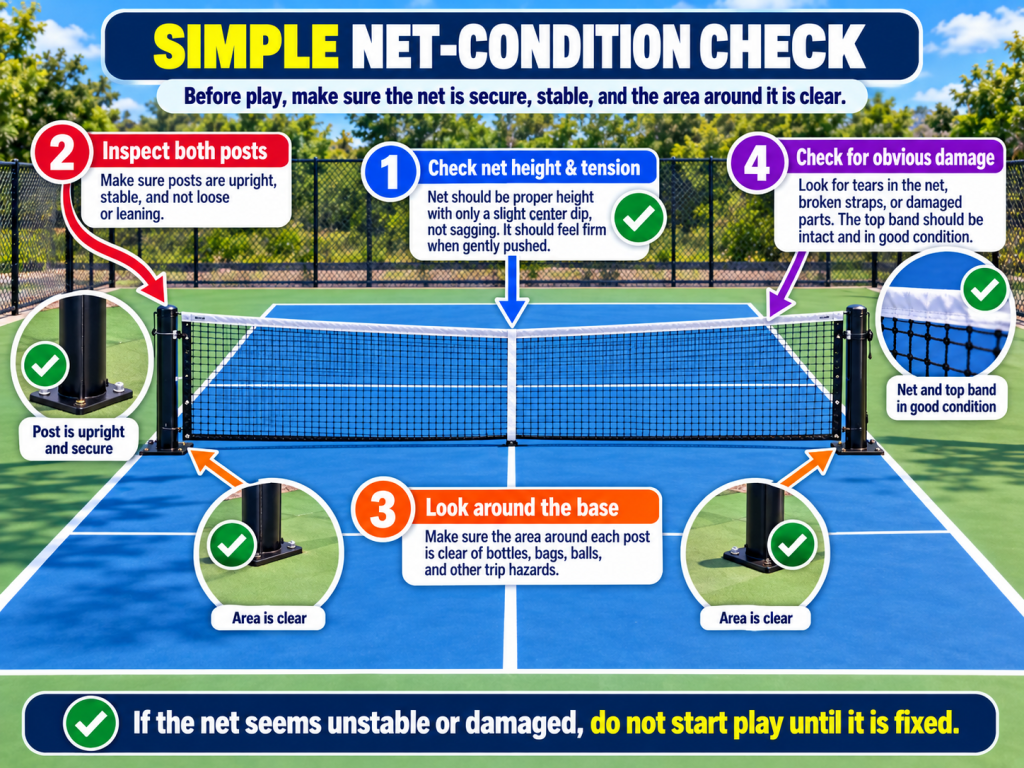
After checking the surface and surrounding space, look at the net.
View it from both sides where practical. It should appear stable, normally positioned and suitable for ordinary recreational play. You do not need to perform detailed measurements as part of this beginner inspection.
Look for obvious problems such as loose supports, visibly damaged components or a net system that appears unstable. Portable nets may have support structures close to the ground, so also look around the base of the system.
Check for unrelated objects beside or underneath the net. A spare ball, bottle or piece of equipment near a support can become a hazard when players move close to the net.
USA Pickleball’s official materials contain formal specifications for net dimensions and net posts, but this beginner inspection is deliberately simpler: you are looking for obvious conditions that suggest the net or support area may not be suitable for normal play.
Do not attempt an unfamiliar repair simply because you want to continue the session. A net problem requiring tools, facility access or technical knowledge should be handled by someone appropriate to the facility.
Decide Whether a Hazard Can Be Corrected
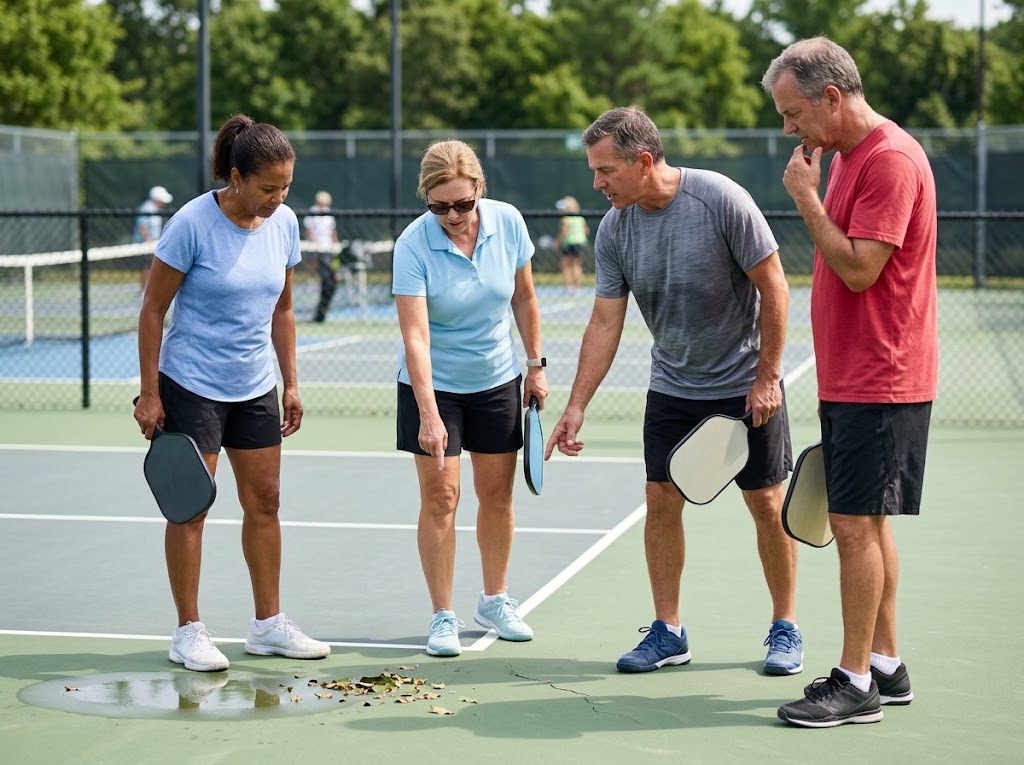
Not every problem requires abandoning the court.
Some hazards are simple and easily corrected. A loose pickleball can be picked up. A bag can be moved away from the baseline. A few harmless leaves may be cleared if doing so can be done safely.
Other conditions require a different decision.
A visibly wet or slippery playing area may require waiting for conditions to improve or moving to another court. Significant surface damage should not be treated as acceptable simply because it cannot be fixed immediately. An unstable net or damaged support should not be ignored because everyone has already arrived.
A useful beginner question is:
Can this problem be corrected safely and completely enough for normal recreational movement?
If yes, correct it and recheck the area.
If no, use another suitable court, report the problem to the appropriate facility staff or postpone play until the condition has been addressed.
The curriculum specifically directs beginners not to perform repairs requiring tools, facility access or technical knowledge simply to make a court usable.
Safety takes priority over maintaining a planned practice schedule.
Recheck the Court When Conditions Change
A pre-play inspection is not a guarantee that conditions will remain unchanged for the entire session.
Outdoor courts can become wet after rain begins. Wind can blow leaves or other debris onto the surface. A player may spill water. Someone may move equipment beside the court. A ball from another area may roll into the playing space.
Indoor environments can change too. Bottles, bags or practice equipment may be relocated, and activity on neighboring courts may become busier.
When something changes, recheck the affected area before continuing.
You do not have to repeat the entire inspection after every small event. The important habit is to respond when a change could affect the playing surface, movement space or net area.
For example, if water spills near a sideline, inspect that area instead of simply stepping around it and continuing. If strong wind brings debris onto the court, clear it where safe and look again before restarting.
The approved lesson specifically calls for another inspection when conditions change during a session.
Common Beginner Safety Oversights
Looking Only at the Painted Court
A beginner may inspect the rectangle inside the lines and assume the job is finished. The visible problem is that obstacles behind the baseline or outside a sideline remain unnoticed.
The correction is to include surrounding movement space every time you inspect a court.
Leaving Spare Balls Near the Baseline
A spare ball may seem conveniently placed near the edge of play. The problem is that players can move beyond the baseline while watching the incoming ball rather than the ground.
Keep spare balls together and away from normal movement paths.
Beginning on a Visibly Wet Surface
Players sometimes assume a small wet area can simply be avoided.
Normal play does not always allow you to choose exactly where you step. If moisture makes part of the court slippery, deal with the condition before beginning instead of planning to remember its location during a rally.
Ignoring a Bag or Bottle Beside the Sideline
An object can be outside the painted boundary and still occupy usable playing space.
Move belongings farther away instead of treating the sideline as an invisible wall that players will never cross.
Assuming the Net Is Good Enough
If the net appears damaged or unstable, do not automatically accept it because another group used it earlier.
Inspect its visible condition for yourself and address an obvious problem before beginning.
Trying to Repair Something Without the Right Knowledge
A player may want to tighten, reposition or repair equipment immediately so the session can continue.
Simple, familiar adjustments are different from technical repairs. Do not work on damaged equipment, supports or facility components when the task requires tools or knowledge you do not have.
Skipping the Check Because You Used the Court Earlier
Conditions can change between sessions or even during the same session.
A court that was clear earlier may now contain moisture, debris, equipment or other hazards. Treat the inspection as a short routine, not something performed only on unfamiliar courts.
Practice: Perform a Court-and-Net Safety Inspection
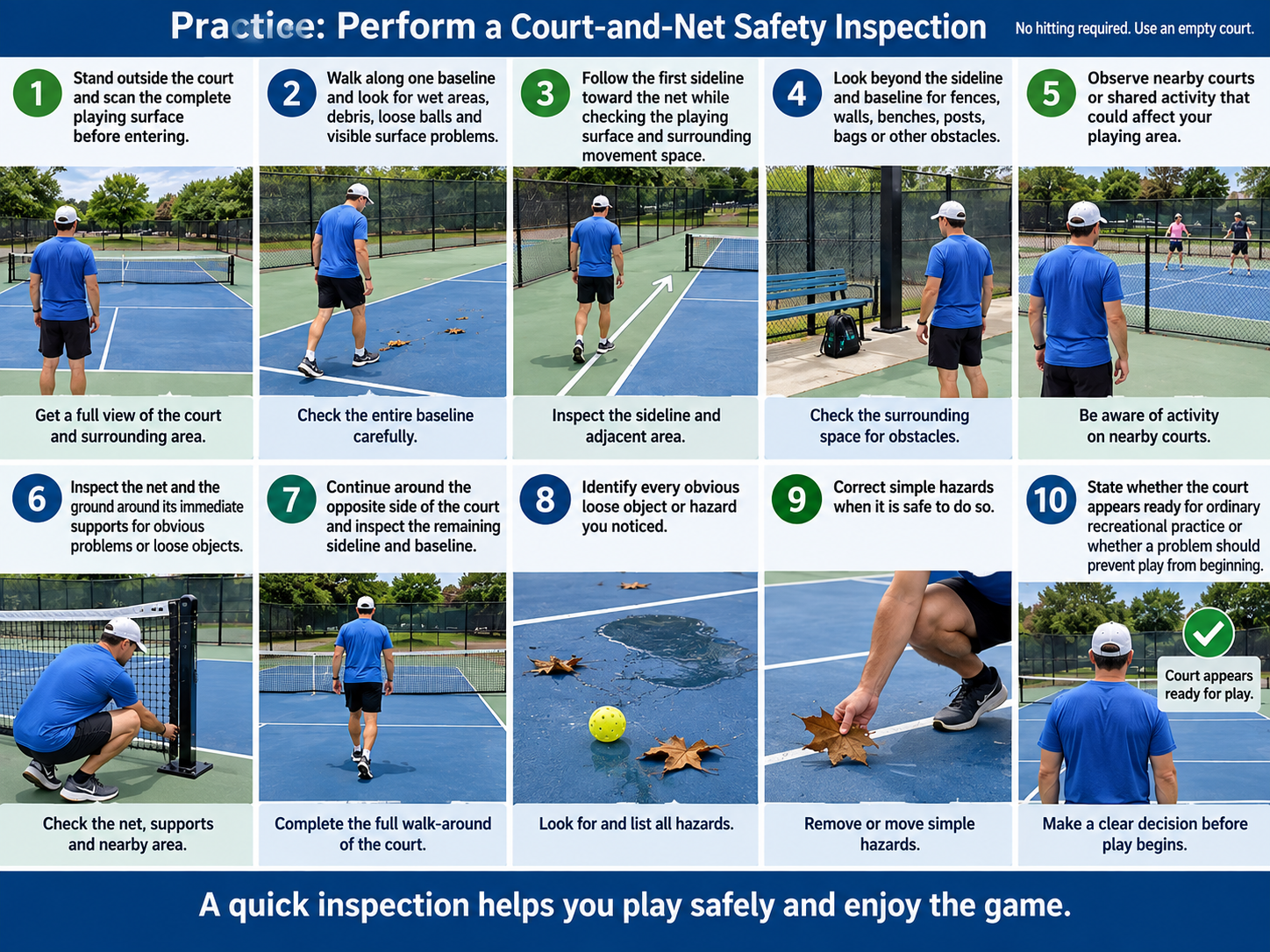
Use an empty pickleball court. No hitting is required. One learner can complete the activity independently, although another person may observe.
- Stand outside the court and scan the complete playing surface before entering.
- Walk along one baseline and look for wet areas, debris, loose balls and visible surface problems.
- Follow the first sideline toward the net while checking the playing surface and surrounding movement space.
- Look beyond the sideline and baseline for fences, walls, benches, posts, bags or other obstacles.
- Observe nearby courts or shared activity that could affect your playing area.
- Inspect the net and the ground around its immediate supports for obvious problems or loose objects.
- Continue around the opposite side of the court and inspect the remaining sideline and baseline.
- Identify every obvious loose object or hazard you noticed.
- Correct simple hazards when it is safe to do so.
- State whether the court appears ready for ordinary recreational practice or whether a problem should prevent play from beginning.
Once you can perform the sequence comfortably, repeat it on another court. You can also practice hazard recognition by having another person place a few harmless objects in obvious locations before you begin, such as a pickleball near a baseline, a water bottle beside a sideline, a bag in surrounding movement space or an object near the net.
Remember:
Do not create a slippery surface, unstable equipment or another genuine hazard for practice. The purpose is to improve observation, not to make the environment dangerous.
The success standard is straightforward: you should be able to inspect the playing surface, surrounding area and net systematically, identify obvious problems and decide whether play should begin without another person guiding every step.
Summary
Check the Court and Net Before Playing before beginning active drills or recreational play. Scan the playing surface for wet areas, debris, loose objects and visible damage. Check beyond the baselines and sidelines because player movement can extend outside the painted boundaries. Notice neighboring activity, inspect the net and its immediate support area, and remove simple hazards when this can be done safely.
Do not begin normal play while a meaningful correctable hazard remains. If a problem cannot be safely corrected, use another suitable playing area, report the condition or wait until it has been addressed. Recheck the court whenever conditions change during the session.
Previous: Know the Basic Pickleball Equipment
Next: Prepare Your Body for Pickleball