
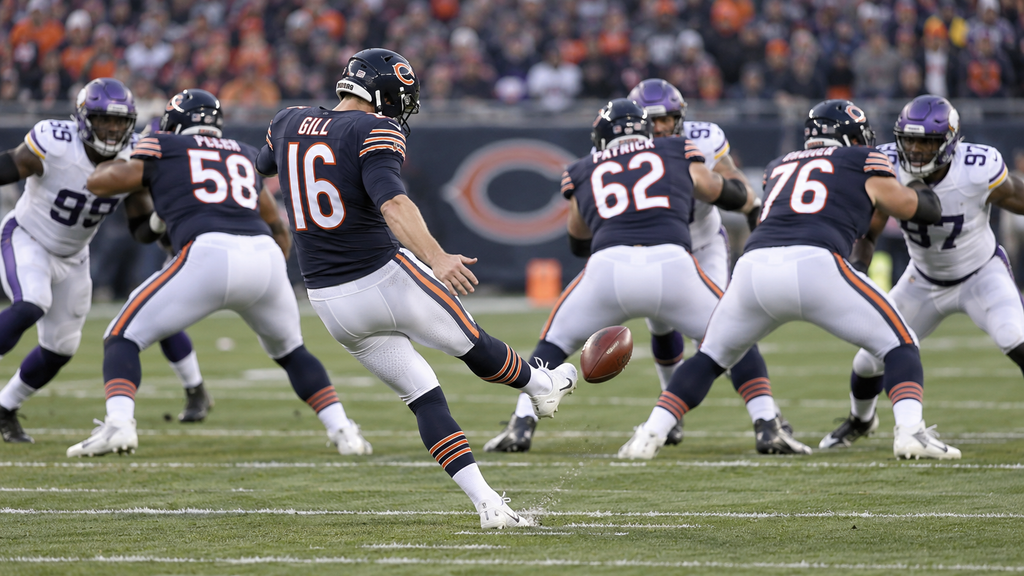
A punt is a type of kick used in American football to give the ball to the opposing team while trying to make that team start its next possession as far from the end zone as possible.
Teams usually punt on fourth down when they do not believe they can safely gain the yards needed for a first down and are too far away to attempt a field goal. Instead of risking a failed fourth-down attempt and giving the opponent excellent field position, the offense sends in its punting unit and kicks the ball downfield.
That may sound like voluntarily giving the ball away, but punting is an important part of football strategy. A good punt can force the opposing offense to begin deep in its own territory, making it much harder to score.
Understanding what is a punt in football also makes fourth-down decisions, field position, fair catches, and punt returns much easier to follow while watching a game.
How Does a Punt Work?
A punt begins like a normal play from scrimmage.
The kicking team lines up with a specialist called the punter standing well behind the line of scrimmage. Instead of snapping the football a short distance to a quarterback, the center or long snapper sends the ball backward to the punter.
The punter catches the snap, takes a short series of steps, drops the ball toward his foot, and kicks it before it touches the ground.
Unlike a field goal, the punter is not trying to kick the ball through the goalposts. The goal is usually to send the ball high and far downfield while giving teammates enough time to run toward the returner.
Once the punt travels downfield, the receiving team normally gains possession.
A simple punt sequence might look like this:
- The offense reaches fourth down.
- The long snapper snaps the ball to the punter.
- The punter kicks the ball downfield.
- Players from the kicking team run toward the receiver.
- The receiving team either returns the punt, makes a fair catch, lets the ball go out of bounds, or allows the play to end in another legal way.
- The receiving team’s offense takes possession.
The exact starting point of the next possession depends on what happens to the punt.
Why Do Teams Punt on Fourth Down?
To understand why teams punt, it helps to understand fourth down.
An offense normally has four downs, or attempts, to advance the ball far enough to earn another first down. If the offense reaches fourth down and still needs several yards, it must decide what to do.
It can attempt another offensive play. If it gains enough yards, the drive continues. But if it fails, the other team takes possession near the spot where the play ended.
That can be a major risk.
Suppose a team faces fourth-and-8 from its own 30-yard line. If it runs an offensive play and gains only four yards, the opponent could take over around the 34-yard line with a short distance to travel before reaching scoring range.
If the team punts instead, it might send the ball 40 or 50 yards downfield before the return. The opponent could then begin much farther away from the kicking team’s end zone.
That is why a punt is not simply surrendering possession. The team knows possession will probably change, so it uses the punt to try to improve the situation before that happens.
Field Position Is the Main Reason Teams Punt
Field position describes where the ball is located on the football field.
In general, an offense would rather start close to the opponent’s end zone than close to its own. A team backed up near its own goal line has much farther to travel before it can score.
Punting can dramatically change field position.
Imagine Team A has the ball at its own 25-yard line and faces fourth down. Rather than risk losing the ball there, Team A punts. After the kick and return, Team B starts at its own 30-yard line.
Team A still gave up possession, but Team B now has about 70 yards to travel to reach the opposite goal line.
That extra distance gives Team A’s defense more opportunities to stop the drive.
This battle over field position is one reason punters can have an important role even though they may only appear for a limited number of plays.
What Does the Punter Do?
The punter is the player primarily responsible for punting the football.
Punters are usually special-teams specialists. Their job involves much more than simply kicking the ball as hard as possible.
A punter may need to balance several goals:
- Kick the ball a useful distance.
- Keep the ball in the air long enough for teammates to run downfield.
- Place the ball away from a dangerous returner.
- Kick toward a sideline when appropriate.
- Avoid sending the ball unnecessarily into the end zone.
- Give the coverage team a chance to stop the return quickly.
The amount of time the ball stays in the air is often called hang time. A high punt with good hang time can give the coverage players more time to reach the returner.
A very long but low punt may be easier to return because the receiver has more space before defenders arrive.
What Is a Long Snap on a Punt?
The punt usually begins with a long snap.
A long snap is a backward snap over a greater distance than the typical snap to a quarterback. The player who specializes in making this snap is called the long snapper.
The punter stands deep behind the line so there is enough room to receive the football and kick it before opposing players can reach him.
The snap must be quick and accurate. A poor snap can disrupt the punter’s timing and may give the defense an opportunity to block the kick.
The rest of the punting unit also protects the punter while preparing to run downfield and cover the kick.
What Can the Receiving Team Do With a Punt?
Once the ball is punted, the receiving team has several possible responses.
The most aggressive option is a punt return.
A returner catches the punt and runs toward the kicking team’s end zone while teammates block defenders. The return continues until the runner is tackled, goes out of bounds, scores, or the play otherwise ends.
A long punt return can quickly reverse field position. If the returner reaches the end zone with the live ball, it is a touchdown.
Because returning the ball carries some risk, however, the returner does not always try to run.
What Is a Fair Catch?
A returner can signal for a fair catch when the punt is in the air.
In the NFL, a valid fair-catch signal involves extending one arm above the helmet and waving it from side to side. Once a valid signal is made and the returner catches the punt, the returner cannot advance the ball, and opponents cannot legally tackle the player as part of the catch.
Why would a returner willingly give up the opportunity to run?
Usually because defenders are already close.
Suppose a punt is coming down at the receiving team’s 20-yard line and several coverage players are approaching. Trying to return the kick might gain only a few yards while increasing the risk of a hard tackle or losing control of the ball.
A fair catch safely ends the return opportunity and gives the receiving team’s offense possession at the appropriate spot.
What Happens if a Punt Goes Out of Bounds?
A punt does not have to be caught.
If the ball goes out of bounds between the goal lines, the play ends and the receiving team gets possession at the appropriate out-of-bounds spot under NFL scrimmage-kick rules.
Punters sometimes deliberately aim toward a sideline.
Doing so can reduce or eliminate the returner’s opportunity to run. The tradeoff is that an inaccurate kick may travel out of bounds sooner than intended and give the receiving team better field position.
This type of placement is another example of why punting involves accuracy as well as distance.
What Happens if a Punt Goes Into the End Zone?
If an untouched punt travels across the receiving team’s goal line and becomes dead in the end zone, the usual result is a touchback.
A touchback ends the punt and gives the receiving team possession at the league’s designated touchback spot rather than at the point where the ball entered the end zone. In the NFL, the dead-ball spot for a scrimmage-kick touchback is the 20-yard line.
That is why a punter near the opponent’s end zone does not necessarily want maximum distance.
Suppose a team punts from around midfield. A powerful kick that sails deep into the end zone may create a touchback. A shorter, well-placed punt that stops near the 5-yard line could leave the opponent in much worse field position.
Touchback placement and related details can differ between levels of football, so NFL, college, and high school games should not automatically be assumed to use identical procedures.
What Does It Mean to Down a Punt?
Sometimes players from the kicking team reach the football before the receiving team tries to pick it up.
They may attempt to stop, or down, the punt near the opponent’s goal line.
For example, a punt might bounce toward the 2-yard line. A coverage player could reach the ball and legally end the play before it reaches the end zone, depending on the situation.
The receiving team’s offense would then have to begin very close to its own goal line.
This can be an excellent result for the punting team because the opponent has poor field position.
Coverage players must be careful around the goal line, however. Under NFL rules, specific restrictions govern how the kicking team can touch or possess a scrimmage kick near or in the receiving team’s end zone.
Why Not Go for It on Every Fourth Down?
If keeping possession is valuable, beginners may wonder why teams do not simply attempt every fourth down.
The answer is risk.
Failing on fourth down normally gives the opponent possession near the end of that play. If the offense is deep in its own territory, that could give the opposing team an extremely short field.
The decision often depends on several factors, including:
- How many yards are needed for a first down.
- Where the ball is on the field.
- The score.
- How much time remains.
- The strength of the offense.
- The likelihood of converting the fourth down.
- Whether a field goal attempt is realistic.
Teams sometimes choose to go for it on fourth down, especially when only a short distance is needed or the game situation demands an aggressive decision.
But when the risk of failure is too costly, punting can be the safer strategic choice.
Punt vs. Kickoff
A punt and a kickoff both send the football to the opposing team, but they happen in different situations.
A punt is a scrimmage kick commonly used on fourth down. The play begins with a snap, and the punter kicks the ball after receiving it.
A kickoff is a free kick used to begin certain periods of play and to restart play after specified scores. Its formation and rules are different from those of a punt.
One easy way for a beginner to recognize the difference is to watch the start of the play.
If a player receives a long snap behind the line of scrimmage and then drops and kicks the ball, you are probably watching a punt.
Punt vs. Field Goal
A punt is also different from a field goal.
The purpose of a field goal is to score points. The kicker attempts to send the ball over the crossbar and between the uprights. A successful field goal is worth three points.
The purpose of a punt is normally field position, not scoring.
Both plays can happen on fourth down, which is why new viewers sometimes confuse them.
The team’s location on the field often helps explain the decision. When a team is close enough to the opponent’s goalposts, it may attempt a field goal. When it is farther away and does not want to attempt another offensive play, it may punt.
A Simple Punt Example
Imagine a team starts with the ball at its own 20-yard line.
After three plays, it reaches its own 28-yard line. It now faces fourth-and-2.
The coach could attempt to gain the remaining two yards, but failure would give the opponent the ball at roughly the 28-yard line—already close to scoring territory.
Instead, the team punts.
The punter receives the long snap and kicks the ball downfield. The punt travels to the opponent’s 30-yard line, where the returner makes a fair catch.
Possession changes, but the opponent must now begin around its own 30 rather than near the kicking team’s 28.
The punting team gave up the ball, but it gained a major field-position advantage.
That is the basic logic behind punting.
Frequently Asked Questions
Does a Punt Mean the Other Team Gets the Ball?
Usually, yes. A punt is normally used when a team expects possession to change. The goal is to make the receiving team begin its possession in unfavorable field position.
Unusual plays can occur if the receiving team touches the football and then fails to secure it, but the basic expectation is that the receiving team will possess the ball after a punt.
Is a Punt Usually on Fourth Down?
Yes. Teams most commonly punt on fourth down because it is normally their final down before they would lose possession by failing to gain the required distance.
Punts can occur in other situations, but fourth-down punts are by far the situation beginners will see most often.
Can a Punt Be Returned for a Touchdown?
Yes. If a returner catches or legally recovers the punt and carries the ball into the kicking team’s end zone, the receiving team scores a touchdown.
Can a Player Return a Punt After Calling for a Fair Catch?
No. Once a valid fair-catch signal has been made, the receiver cannot catch the punt and then advance it.
Why Do Punters Try to Kick the Ball High?
A high punt can produce more hang time, giving coverage players additional time to run downfield before the returner begins advancing the ball.
Distance still matters, but a useful punt combines distance, hang time, placement, and coverage.
Key Takeaways
- A punt is a kick normally used to give possession to the opposing team while trying to improve field position.
- Teams most often punt on fourth down when attempting another offensive play would be too risky.
- The punter receives a long snap and kicks the ball downfield before it touches the ground.
- The receiving team may return the punt, call for a fair catch, or let the ball go out of bounds or into the end zone.
- A punt that becomes dead in the receiving team’s end zone can result in a touchback.
- The kicking team may try to down a punt close to the opponent’s goal line.
- A punt is different from a kickoff and a field goal.
- Punting is not simply giving up the football. It is a strategic decision designed to make the opponent’s next possession more difficult.
For a beginner asking what is a punt in football, the easiest way to remember it is this: a punt trades possession for field position. The kicking team expects to give the ball away, but it tries to make the opponent start as far from the end zone as possible.