
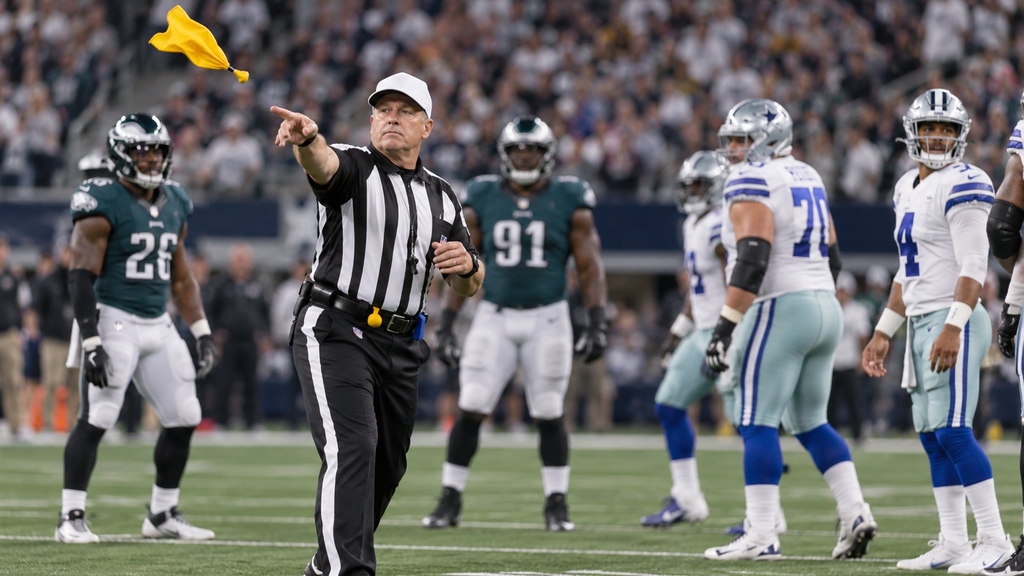
Penalties are one of the most confusing parts of American football for new fans. A play can look completely normal, only for a referee to throw a yellow flag and announce that one team has broken a rule.
This guide provides common football penalties explained in simple terms, focusing on the calls beginners are most likely to see during a game rather than every possible rule violation.
Most penalties result in a team gaining or losing yards, but some can also produce an automatic first down, a loss of down, or other consequences. Once you understand the most frequent penalties and why they are called, following a football game becomes much easier.
What Is a Penalty in Football?
A penalty is the consequence for breaking one of football’s rules.
Officials watch each play for illegal actions by the offense, defense, and special teams. When an official sees a foul, the official will usually throw a bright yellow penalty flag onto the field.
The flag does not always stop the play immediately. Depending on the foul, the play may continue until it naturally ends. The referee then announces the penalty, identifies the team that committed it, and explains how it will be enforced.
Penalties can happen before the snap, during a play, or even after the play has ended.
For example, an offensive lineman who moves too early may be called for a false start before the ball is snapped. A defender who illegally grabs a receiver while a pass is in the air may be called for pass interference. A player who hits an opponent unnecessarily after the play may receive a personal foul.
How Yardage Penalties Work
Many football penalties move the ball a specified number of yards.
If the offense commits certain fouls, the ball normally moves backward toward its own end zone. If the defense commits certain fouls, the offense normally receives yardage toward the defense’s end zone.
Common NFL penalties include five-yard, 10-yard, and 15-yard penalties. The exact enforcement depends on the foul and where it occurred.
Imagine the offense has the ball at its own 40-yard line.
If it commits a five-yard false start, the ball normally moves back to the 35-yard line before the next play.
Penalties are not always enforced from the original line of scrimmage. Some are enforced from the location of the foul or another designated enforcement spot. Beginners do not need to calculate every enforcement rule themselves. The referee’s announcement usually explains the result.
Automatic First Downs and Loss of Down
Some penalties affect more than field position.
An automatic first down means the offense receives a new first down because of the penalty even if the penalty yardage itself would not have carried the ball far enough to reach the normal line to gain.
Certain defensive fouls can carry an automatic first down. Roughing the passer is a common NFL example.
A loss of down works in the opposite direction. The offense loses the opportunity represented by that down in addition to any other enforcement.
Loss-of-down penalties are less common among the basic penalties discussed here. Intentional grounding and certain illegal forward passes are examples of NFL fouls that can include a loss of down.
The important beginner concept is that a penalty does not always mean simply adding or subtracting yards.
False Start
A false start happens when an offensive player makes an illegal movement that simulates the beginning of the play before the ball is snapped.
Offensive linemen are frequent offenders because they must remain set before the snap. A sudden movement that looks like the start of the play can result in a false start.
In the NFL, a false start normally carries a five-yard penalty.
Because the foul happens before the snap, officials stop the play immediately.
For example, suppose the offense faces 2nd and 6. An offensive lineman moves early and is called for a false start. After the five-yard penalty, the offense would normally face 2nd and 11.
Offside
Offside is commonly associated with the defense.
Before the snap, the line of scrimmage separates the two teams, with the football creating part of an area called the neutral zone. Defensive players cannot be illegally positioned across that boundary when the ball is snapped.
An NFL offside penalty normally costs the defense five yards.
Offside can sometimes look similar to a false start, but the basic distinction is simple:
A false start normally involves the offense moving illegally before the snap. Offside normally involves a player being illegally across the line when the ball is snapped.
There are related pre-snap defensive fouls, such as encroachment and neutral zone infractions, with slightly different definitions.
Holding
Holding happens when a player illegally restricts an opponent, usually by grabbing or hooking the player rather than using a legal block.
Holding can be called on either team.
Offensive Holding
Offensive holding is especially common around the line of scrimmage. An offensive lineman may be trying to protect the quarterback or open a running lane but illegally grab a defender who is attempting to get past.
In the NFL, offensive holding generally carries a 10-yard penalty.
For an offense trying to gain 10 yards for a first down, losing 10 yards can make the next play considerably more difficult.
Defensive Holding
Defensive holding usually occurs when a defender illegally restricts an eligible offensive receiver before a pass is thrown.
NFL defensive holding generally carries a five-yard penalty and can also result in an automatic first down.
Holding rules contain many technical details, but beginners mainly need to recognize that players are allowed to block and make certain types of contact without being allowed simply to grab and restrain opponents.
Pass Interference
Pass interference occurs when a player illegally interferes with an eligible opponent’s opportunity to catch a forward pass.
It can be committed by either the offense or defense.
Defensive pass interference often occurs when a defender makes prohibited contact with a receiver while the ball is traveling toward the receiver rather than legally playing the ball.
For example, a defender might grab a receiver or significantly restrict the receiver before the ball arrives.
In the NFL, defensive pass interference can be especially costly because the ball is generally placed at the spot of the foul and the offense receives a first down. Special enforcement applies near and inside the end zone.
College football handles defensive pass interference differently in important respects, including how the yardage is enforced. That is one reason NFL penalty enforcement should not automatically be assumed to apply at every level of football. The NCAA maintains its own playing rules.
Offensive pass interference can also occur when an offensive player illegally prevents a defender from making a play on the pass.
Delay of Game
A delay of game penalty commonly occurs when the offense does not snap the ball before the play clock expires.
The play clock limits how long a team has to begin the next play. In the NFL, situations generally use either a 40-second or 25-second play clock depending on how the previous play or stoppage ended. Failing to snap the ball in time normally results in a five-yard delay-of-game penalty.
This is why you may see a quarterback urgently calling for the snap as the play clock approaches zero.
Delay of game can also arise from other actions that improperly delay play, but an expired play clock is the version beginners will see most often.
Personal Foul
A personal foul is a serious violation involving prohibited physical conduct.
Many NFL personal fouls carry a 15-yard penalty.
Personal fouls cover several different illegal actions, including some dangerous hits and unnecessary contact.
You may hear the referee announce “personal foul” and then identify the specific violation, such as roughing the passer or grabbing the face mask.
Flagrant actions can have consequences beyond ordinary yardage, including possible disqualification depending on the foul and circumstances.
Roughing the Passer
Quarterbacks receive specific protection from certain types of illegal contact while passing.
Roughing the passer occurs when a defender makes prohibited contact with a passer in circumstances covered by the roughing rules.
This does not mean defenders are forbidden from tackling quarterbacks. A defender can legally tackle or hit the quarterback within the rules. The penalty concerns prohibited contact, including certain late or otherwise illegal hits.
In the NFL, roughing the passer carries a 15-yard penalty and can give the offense an automatic first down.
For example, if a quarterback releases the ball and a defender then makes avoidable prohibited contact after the pass is clearly away, officials may call roughing the passer depending on the circumstances.
Unnecessary Roughness
Unnecessary roughness covers prohibited physical contact considered unnecessary under the rules.
In the NFL, unnecessary roughness is generally a 15-yard penalty.
One common example is unnecessarily hitting a player who is already out of bounds or clearly out of the play.
Timing matters. Football allows significant legal contact during a play, so a hard tackle is not automatically a penalty. Officials consider whether the contact itself violates the rules.
Beginners will often hear “unnecessary roughness” used as a general description, followed by more information about what the player did.
Face Mask Penalty
A player’s face mask is the protective cage attached to the front of the helmet.
Players may make incidental contact with an opponent’s face mask during normal football action, but grasping and twisting, turning, or pulling an opponent’s face mask is prohibited.
In the NFL, this foul carries a 15-yard penalty.
The rule helps protect players from dangerous force being applied to the head and neck.
If you see a ball carrier’s head suddenly pulled sideways because a defender has grabbed the face mask, a penalty flag will often follow.
Illegal Formation
Football has rules controlling how players may line up before the snap.
An illegal formation occurs when a team does not meet the required formation rules when the ball is snapped.
For beginners, the important point is that offensive players cannot simply stand anywhere they want. A legal formation must place the required number of players in appropriate positions relative to the line of scrimmage.
In the NFL, an illegal formation on a normal scrimmage down generally carries a five-yard penalty.
You do not need to memorize every formation requirement to understand the call. When the referee announces an illegal formation, it means the team’s alignment did not satisfy the rules at the snap.
Illegal Motion
Some offensive players are allowed to be moving before the snap, but that movement must follow specific rules.
An illegal motion penalty occurs when a player’s pre-snap movement does not satisfy those requirements.
In the NFL, illegal motion normally carries a five-yard penalty.
Illegal motion should not be confused with a false start. A player can legally be in motion before a play, while a false start involves movement that illegally simulates the start of the play.
The exact distinction can look subtle to a new viewer, so listening to the referee’s announcement is often the easiest way to identify what happened.
What Does It Mean to Decline a Penalty?
The team that benefits from a penalty does not always have to accept it.
It may decline the penalty, meaning it chooses the result of the play instead of having the penalty enforced.
Imagine the defense commits a five-yard penalty, but the quarterback completes a pass for 25 yards.
If enforcing the penalty would produce a worse result than keeping the completed pass, the offense may decline the penalty and take the result of the play.
This is why referees sometimes announce, “The penalty is declined.”
Declining a penalty does not mean the foul never happened. It means the team entitled to the penalty has chosen not to use its enforcement.
What Are Offsetting Penalties?
Sometimes both teams commit fouls during the same play.
Depending on the specific fouls and enforcement rules, the penalties may offset each other.
When penalties offset, the yardage from one foul does not simply get subtracted from the yardage of the other. In many situations, the down is replayed instead.
The NFL rulebook calls fouls by both teams during the same down double fouls and provides specific enforcement rules for them.
The details can become complicated, so beginners mainly need to understand what the referee means when announcing that penalties “offset.”
Why Penalty Enforcement Can Vary
One of the most important things to understand about common football penalties explained is that the name of a foul does not always tell you exactly what will happen next.
Enforcement can depend on several factors, including:
- Which team committed the foul
- Where the foul occurred
- When the foul occurred
- Whether the ball was live or dead
- What happened during the rest of the play
- Whether multiple penalties occurred
- The league’s specific rules
The NFL, NCAA college football, high school football, and other competitions do not use identical rulebooks. A penalty may have the same general purpose but different enforcement at different levels. The SPS article requirements specifically call for league-specific differences to be identified rather than treating NFL rules as universal.
For a beginner watching a game, the easiest approach is to learn the basic meaning of the common penalties first and listen to the referee’s announcement for the exact enforcement.
Frequently Asked Questions
What Does the Yellow Flag Mean in Football?
A yellow penalty flag means an official has identified a possible rule violation. After the play, the referee announces the foul and explains the penalty.
Does Every Penalty Stop the Play?
No. Some fouls cause officials to stop play immediately, such as a false start. Other penalties occur during a live play, so the action may continue before the penalty is enforced.
What Is the Most Common Penalty Yardage?
Five-, 10-, and 15-yard penalties are common in the NFL, but the amount depends on the specific foul. Some penalties use other enforcement methods, such as placing the ball at the spot of the foul.
Can a Penalty Give a Team a First Down?
Yes. Certain defensive penalties include an automatic first down. Other penalties may produce enough yardage to reach the line to gain and earn a first down normally.
Can Both Teams Be Penalized on the Same Play?
Yes. Both teams can commit fouls during the same play. Depending on the circumstances, the penalties may offset or be enforced according to rules governing multiple fouls.
Are NFL and College Football Penalties the Same?
Not always. Many fouls have similar names and purposes, but their definitions or enforcement can differ. Pass interference is a well-known example of a penalty whose enforcement differs between NFL and NCAA football.
Key Takeaways
Penalties are called when a team or player breaks a football rule, and officials normally signal a foul by throwing a yellow flag.
Common penalties such as false start, offside, holding, pass interference, delay of game, roughing the passer, unnecessary roughness, face mask, illegal formation, and illegal motion appear regularly during games.
Most penalties affect field position, but some also create an automatic first down or loss of down. Teams can sometimes decline penalties, while fouls committed by both teams may offset.
The exact result depends on the type of foul, when and where it occurred, and the rules used by the competition. Once you recognize these basic calls, common football penalties explained during a broadcast become much easier to understand.