
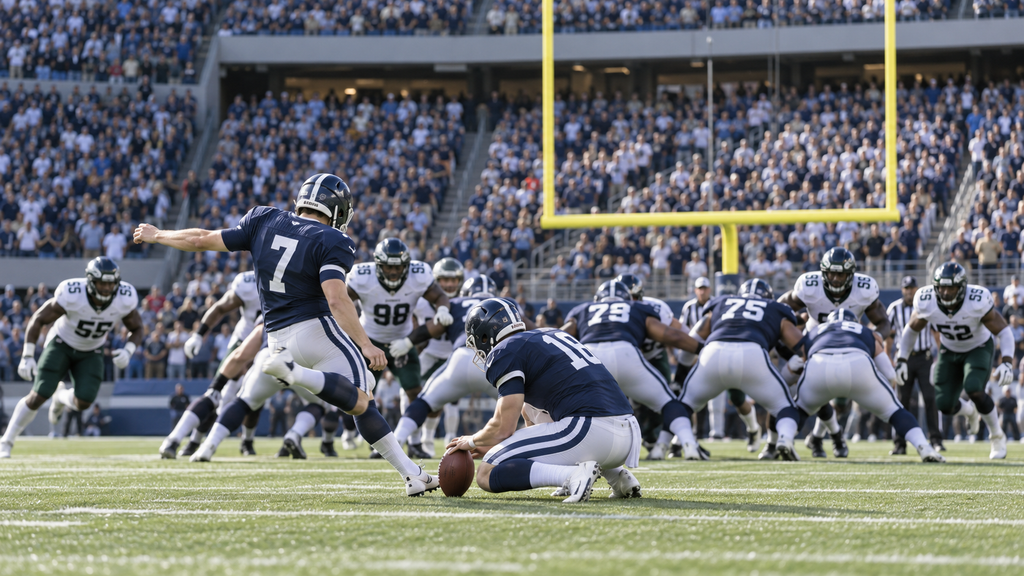
In American football, a field goal is one of the main ways a team can score points. Instead of carrying or passing the ball into the end zone for a touchdown, the team sends its kicker onto the field to kick the ball through the goalposts. If the kick is successful, the team scores three points.
Teams usually attempt a field goal when they are close enough to the goalposts to have a realistic chance of making the kick, but continuing the drive may be too risky. This makes field goals an important part of both scoring and game strategy.
Field goals are an important part of football because an offense does not always need to reach the end zone to score. If a team gets close enough to the opponent’s goalposts but cannot continue its drive, it may send its kicker onto the field and attempt to turn its field position into three points.
Understanding field goals becomes much easier once you know what counts as a successful kick, how the snap and hold work, and why the distance of the attempt matters.
What Is a Field Goal in Football?
A field goal is a kick that scores three points when the ball travels above the crossbar and between the uprights of the opponent’s goalposts. The NFL officially defines a successful field goal as a kick that passes through the plane of the opponent’s goal in the required area.
The team attempting the field goal is normally the offensive team. Instead of running or passing the ball on that play, it brings a specialized kicking unit onto the field.
Field goals are most commonly attempted on fourth down, especially when the offense is close enough for its kicker to have a realistic chance of making the kick but does not want to risk failing on a normal offensive play.
For example, suppose a team reaches fourth down at its opponent’s 25-yard line. The team could attempt another offensive play and try to gain the yards needed for a first down. However, if it fails, the opponent would take possession. The team may instead attempt a field goal and try to score three points.
How Many Points Is a Field Goal Worth?
A successful field goal is worth three points.
That is fewer than the six points awarded for a touchdown, but three points can still have a major effect on the score.
For example, imagine a team is losing 17–14 late in the game. A successful field goal would add three points and make the score 17–17.
A team that is leading 20–17 could also kick a field goal to increase its lead to 23–17.
Because football scores often remain relatively close, field goals can matter at any stage of a game.
After a successful field goal, play normally restarts with a kickoff to the team that was scored against. The NFL rules specifically provide for the scored-upon team to receive the following free kick.
What Do the Goalposts Have to Do With a Field Goal?
The goalposts are located at the back of each end zone. They include a horizontal crossbar and two vertical uprights extending upward.
For the kick to count, the football must travel:
- Above the crossbar
- Between the two uprights
If the ball travels outside either upright or fails to clear the crossbar, the field goal is unsuccessful.
NFL goalposts have a crossbar 10 feet above the ground, with the two uprights 18 feet 6 inches apart. Other levels of football may use different goalpost specifications, so those NFL measurements should not be assumed to apply universally.
When watching a game, you will normally see two officials standing beneath or near the goalposts during the kick. If the field goal is successful, they raise both arms straight above their heads.
How Does a Field Goal Attempt Work?
A normal field goal attempt involves several players working together in a carefully timed sequence.
The three most noticeable roles are the snapper, holder, and kicker.
The Snap
The play begins with a snap.
A specialized player called the long snapper sends the football backward between his legs toward the holder. Unlike a normal snap to a quarterback, this snap must travel several yards backward to the spot where the kick will take place.
The snap needs to be fast and accurate. A poor snap can disrupt the timing of the entire kick.
The Hold
The holder catches the snap and quickly places the football on the ground.
The holder normally positions the ball upright or at a slight angle and keeps it steady with one hand so the kicker can strike it cleanly.
This happens extremely quickly. The kicker is already moving toward the ball while the snap is traveling to the holder.
The NFL describes the holder as the player who catches and sets the ball for field-goal and extra-point attempts.
The Kick
The kicker, sometimes called a placekicker, takes several steps toward the ball and kicks it toward the goalposts.
At the same time, the kicking team’s blockers try to prevent defenders from reaching the kicker or the ball.
The entire operation depends on timing. The snap must reach the correct location, the holder must position the football correctly, and the kicker must make solid contact before the defense can interfere.
What Does the Kicker Do?
The kicker is the player responsible for actually kicking the field goal.
Kickers are specialists. They practice the mechanics of kicking from different distances, field positions, and conditions so they can perform the same motion consistently.
Accuracy is only part of the job. The kicker also needs enough leg strength to send the football over the crossbar from longer distances.
A long kick requires more power than a short one, but power alone is not enough. The ball still has to travel between the uprights.
Weather can also affect a kick. Strong wind, rain, snow, or poor field conditions can make a field goal more difficult even from a distance a kicker would normally handle comfortably.
When Do Teams Usually Attempt a Field Goal?
Teams most commonly attempt field goals when they are on fourth down and are within their kicker’s effective range.
The offense normally receives four downs to gain the required yardage for another first down. If fourth down arrives and the team does not expect to gain the remaining distance, it has several choices.
It can attempt the fourth-down play, punt the ball, or attempt a field goal if it is close enough to the goalposts.
The decision depends heavily on field position.
A team deep in its own territory is normally much too far away for a field goal. A team close to its opponent’s end zone has a much more realistic kicking opportunity.
Teams may also attempt field goals near the end of a half when there is not enough time to run many additional plays. If only a few seconds remain and the offense is within range, attempting a kick may provide one final opportunity to score before the clock expires.
Game situation matters too. A team that needs exactly three points may have a strong reason to attempt a field goal, while a team that desperately needs a touchdown may choose to keep its offense on the field.
What Is Field Goal Range?
Field goal range refers to the area of the field from which a team believes its kicker has a reasonable chance of making the kick.
There is no single yard line that automatically becomes field goal range for every team.
Different kickers have different levels of leg strength and accuracy. Conditions such as wind and weather also matter. Coaches therefore consider both the distance and the individual kicker when deciding whether an attempt is realistic.
A kicker may comfortably make kicks from one distance while another kicker might have a shorter or longer effective range.
Field goal range can even change during the same game. A strong wind behind the kicker might increase the possible distance in one direction while making the same kick more difficult when the team changes ends of the field.
How Is Field Goal Distance Calculated?
A field goal is longer than the distance from the line of scrimmage to the goal line because the kick happens several yards behind the line of scrimmage and the goalposts are at the back of the 10-yard end zone.
In a typical professional or college field goal formation, the holder is positioned about seven yards behind the line of scrimmage.
That means you can usually estimate field goal distance by adding approximately 17 yards to the yard line from which the offense is attacking.
For example, imagine the offense is at the opponent’s 30-yard line.
The approximate kick distance would be:
30 yards to the goal line + 10 yards through the end zone + about 7 yards behind the line of scrimmage = about a 47-yard field goal.
The exact setup can vary, so this is a practical estimate rather than a universal rule.
This is also why hearing that a team has reached the “30-yard line” does not mean it is facing only a 30-yard kick.
Why Does Field Goal Distance Matter?
The farther away the kicker is from the goalposts, the harder the attempt generally becomes.
A longer kick requires more power, and the football has more distance over which it can drift away from the center of the uprights.
Distance also affects the coach’s decision.
Suppose a team faces fourth down at the opponent’s 15-yard line. That is normally a much easier field goal situation than fourth down near midfield.
From farther away, the coach may decide that the chance of making the kick is not good enough to justify the attempt. The team might punt instead or keep the offense on the field and try to convert the fourth down.
This relationship between distance and scoring opportunity is why field position matters so much when asking what is a field goal in football.
What Happens When a Field Goal Is Missed?
A field goal is missed when the ball fails to pass correctly through the goalposts.
A kick may:
- Travel wide left
- Travel wide right
- Fall short of the crossbar
- Hit part of the goal structure without successfully passing through
- Be disrupted or blocked by the defense
When a normal field goal attempt on fourth down is unsuccessful, the kicking team does not receive three points, and the opposing team normally gains possession.
Exactly where the opponent receives the ball can depend on the league, the location of the kick, whether anyone touched the ball, and what happened during the play.
For example, NFL rules contain specific provisions for where the ball is placed following unsuccessful field-goal attempts. Those details should not automatically be treated as universal rules for college or high school football.
For a beginner, the important point is simple: missing a field goal usually ends the offense’s scoring opportunity and gives the other team possession.
What Is a Blocked Field Goal?
A blocked field goal happens when a defensive player gets a hand or another legal part of the body on the kick and prevents the ball from traveling normally toward the goalposts.
Defenders rush toward the kick as soon as the ball is snapped. Their goal is to get through or around the blockers quickly enough to reach the football.
Sometimes a defender jumps and gets a hand on the ball after the kicker strikes it. Other times a defender penetrates far enough to block the kick almost immediately.
A blocked kick can create a live-ball situation depending on where the ball travels and what happens next. Players may sometimes recover or advance the ball under the applicable rules.
Because those situations can become complicated, a blocked field goal should not automatically be treated exactly the same as an ordinary kick that simply goes wide.
Field Goal vs Extra Point
A field goal and an extra point may look very similar because both commonly involve a snap, hold, and kick through the goalposts.
The main difference is when they happen and how many points they are worth.
A field goal is normally attempted during a regular offensive possession and is worth three points.
An extra-point kick happens after a touchdown and is worth one point when successful.
In the NFL, the extra-point kick is currently snapped from the 15-yard line, making the kick approximately 33 yards long. Other football levels have their own rules for tries after touchdowns.
So although the kicking technique looks similar, a field goal and an extra point are different scoring plays.
Field Goal vs Touchdown
A field goal is worth three points, while a touchdown is worth six.
A touchdown normally requires the offense to get the football into the opponent’s end zone. A field goal allows the team to score without reaching the end zone.
Because a touchdown is worth more points and gives the scoring team an opportunity for an additional try afterward, offenses generally prefer touchdowns when they can get them.
A field goal often becomes the alternative when a drive stalls before the offense reaches the end zone.
For example, a team might move from its own 25-yard line all the way to the opponent’s 20-yard line. If it reaches fourth down without gaining another first down, it may decide that taking a realistic chance at three points is better than risking leaving the possession with no points at all.
A Simple Field Goal Example
Imagine an offense reaches its opponent’s 23-yard line.
It is fourth down, and the team still needs six yards for a first down.
The coach decides not to attempt a normal fourth-down play. Instead, the field-goal unit enters the game.
The long snapper sends the ball backward to the holder. The holder catches it and places it on the ground. The kicker approaches and strikes the football.
The ball rises above the crossbar and passes between the uprights.
The officials signal that the kick is good.
The team receives three points.
That basic sequence—snap, hold, kick, and the ball passing through the goalposts—is the key to understanding how field goals work.
Frequently Asked Questions
How Many Points Is a Field Goal in Football?
A successful field goal is worth three points.
Does the Ball Have to Go Between the Uprights?
Yes. The football must pass above the crossbar and between the uprights, or within the vertical plane defined by them, for the field goal to count.
Are Field Goals Usually Kicked on Fourth Down?
Yes. Most field goals are attempted on fourth down because the offense is about to use its final down and may choose to attempt three points instead of risking a failed fourth-down offensive play.
Can a Team Kick a Field Goal Before Fourth Down?
Yes. A team does not have to wait until fourth down. For example, a team may attempt a field goal on an earlier down near the end of a half or game when the clock is more important than saving downs.
What Happens After a Successful Field Goal?
The scoring team receives three points, and play normally resumes with a kickoff to the opposing team.
Can a Field Goal Be Blocked?
Yes. Defensive players can legally rush the kick and attempt to block the football before it reaches the goalposts, subject to rules governing how they may do so.
Is a Field Goal the Same as an Extra Point?
No. A field goal is normally attempted during a regular possession and is worth three points. An extra-point kick follows a touchdown and is worth one point.
Key Takeaways
A field goal is one of the main ways to score in American football. A team scores one by kicking the football above the crossbar and between the uprights of the opponent’s goalposts.
A successful field goal is worth three points.
Most field goals are attempted on fourth down when the offense is close enough to the goalposts for the kicker to have a realistic chance of scoring.
The play normally involves three important actions: the long snapper snaps the football, the holder positions it on the ground, and the kicker kicks it toward the goalposts.
Distance matters because longer kicks require more power and are generally more difficult. If the attempt is missed or blocked, the kicking team receives no points and possession will usually pass to the opponent, with the exact result depending on the rules and circumstances of the play.
Once you understand that basic sequence, the answer to what is a field goal in football is straightforward: it is a three-point kick that gives an offense another way to score when reaching the end zone is not practical.