
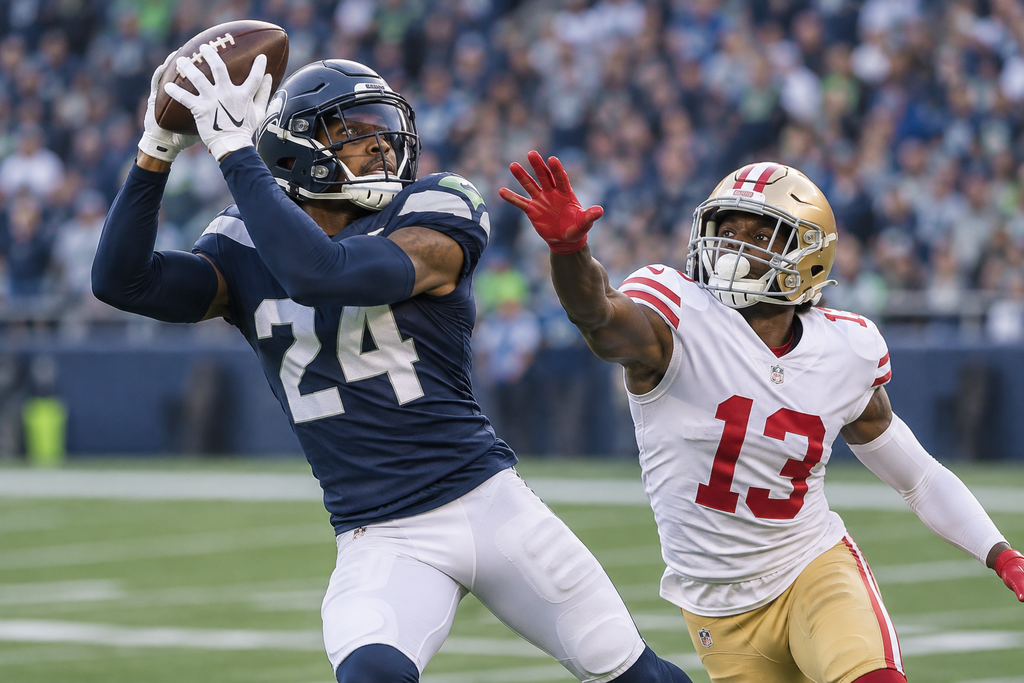
An interception happens when a defensive player catches a forward pass thrown by the opposing offense. Instead of the intended offensive receiver catching the ball, a defender gains possession, immediately creating a turnover.
For beginners, the simplest way to understand an interception is this: the quarterback throws the ball, but the defense catches it instead.
An interception can completely change a game because possession switches from one team to the other. The defender who makes the catch can also run with the ball and try to gain yards. If the defender returns the interception all the way to the opponent’s end zone, the defensive team scores a touchdown.
This guide explains what is an interception in football, how one happens, what a defender can do after making the catch, and how an interception differs from an incomplete pass or fumble.
What Is an Interception in Football?
An interception is a play in which a defensive player catches a legal forward pass thrown by the offense.
Most interceptions happen when a quarterback attempts to throw the football to a receiver. A defender reads the pass, gets into position, and catches the ball before it reaches the intended offensive player.
As soon as the defender completes the interception, possession changes.
The team that had been playing defense now has the football. The team that threw the pass loses possession and becomes the defending team during the return.
Because possession changes from one team to the other, an interception is considered a turnover.
How Does an Interception Happen?
To understand an interception, it helps to understand a basic passing play.
On a typical passing play, the quarterback receives the snap and looks for an eligible receiver, such as a wide receiver, tight end, or running back. The quarterback then throws a forward pass toward that player.
Defensive players try to stop the pass from being completed.
If a defender catches the pass instead of the offensive player, the result is an interception.
For example, imagine a quarterback tries to throw to a wide receiver 15 yards downfield. A cornerback covering that receiver anticipates where the ball is going, moves in front of the receiver, and catches the pass.
That is an interception.
The quarterback’s team immediately loses possession.
Who Can Make an Interception?
Any defensive player who legally catches a forward pass can make an interception.
Defensive backs make many interceptions because defending passes is a major part of their job. These players include:
- Cornerbacks
- Safeties
Linebackers can also intercept passes, particularly on shorter throws over the middle of the field.
Even defensive linemen can make interceptions. For example, a lineman might catch a short pass after reacting to the quarterback’s throw or securing a ball that has been legally deflected.
The position of the player does not determine whether the play is an interception. What matters is that a defensive player legally gains possession of the opponent’s forward pass.
Why Does an Interception Change Possession?
Football is built around possession of the ball. The offense attempts to move the ball down the field and score while the defense tries to stop it.
An interception allows the defense to take possession without waiting for the offensive team’s series of downs to end.
Once the defender catches the pass, the roles of the teams effectively reverse during the play.
The intercepting team now possesses the football and can advance it. The players who were on offense must try to tackle the defender and prevent a long return or touchdown.
When the play ends, the team that made the interception normally sends its offensive unit onto the field for the next play.
That immediate change of possession is one reason interceptions can have such a major effect on a game.
What Happens After an Interception?
Catching the pass does not necessarily end the play.
In most situations, the defender can immediately begin running with the football.
This is called an interception return.
The defender tries to advance the ball as far as possible toward the opponent’s end zone while players from the opposing team try to make a tackle.
The return ends when the defender is tackled, goes out of bounds, scores, or the play otherwise becomes dead under the applicable rules.
The intercepting team’s offense then generally begins its possession from the resulting field position.
For example, suppose a safety intercepts a pass at his own 30-yard line and returns the ball 20 yards before being tackled.
The return moves the ball to the 50-yard line. The safety’s team can then begin its offensive possession from around that location, subject to any penalties or other enforcement on the play.
What Are Interception Return Yards?
The yards a defender gains after intercepting a pass are called interception return yards.
Return yardage starts from the location of the interception and measures how far the player advances before the return ends.
Suppose a cornerback catches an interception at his own 25-yard line and is tackled at his own 40-yard line.
He has gained 15 interception return yards.
Return yards can be extremely important because they affect where the intercepting team’s offense begins its next possession.
An interception deep in a team’s own territory might prevent the opponent from scoring but still leave the new offense far from the other end zone.
A long return can produce much better field position.
What Is a Pick-Six?
A pick-six is an interception that the defender returns for a touchdown.
The word “pick” is a common nickname for an interception. The “six” refers to the six points awarded for a touchdown.
For example, a quarterback throws toward a receiver near the sideline. A cornerback steps in front of the pass, intercepts it, and runs all the way into the opposing end zone.
That play is a pick-six.
Because the defense scores directly on the interception return, its offense does not need to take the field before the touchdown is scored.
Pick-sixes can create dramatic swings because one team appears to be on offense trying to score, only for the defense to take the football in the opposite direction and score instead.
Why Do Interceptions Happen?
Interceptions can happen for many reasons. They are not always caused by one simple mistake.
An Inaccurate Throw
Sometimes the quarterback throws the ball too high, too low, too far inside, or too far outside.
An inaccurate pass can place the football closer to a defender than to the intended receiver.
A Defender Reads the Play
Defenders study offensive formations, receiver routes, and quarterback tendencies.
A defender who correctly anticipates where a pass is going may move into the throwing lane and intercept it.
The Quarterback Makes a Poor Decision
A quarterback may throw toward a receiver who is tightly covered.
If a defender is in a strong position to play the ball, attempting the pass can increase the chance of an interception.
Defensive Pressure Affects the Throw
A quarterback under pressure may have less time to read the defense or may be forced to throw before being fully prepared.
Pressure can contribute to inaccurate passes or rushed decisions.
The Ball Is Deflected
Sometimes a pass touches another player before being intercepted.
For example, the ball might hit an offensive receiver’s hands and bounce into the air, allowing a defender to catch it.
A defender might also deflect a pass toward a teammate who then makes the interception.
How Does Defensive Coverage Lead to Interceptions?
Defensive coverage refers to how defenders are assigned to protect areas of the field or cover eligible receivers during passing plays.
Good coverage can make passing difficult for the offense.
A cornerback might stay close to a wide receiver and position himself between the receiver and the ball. A safety might watch the quarterback from deeper downfield and move toward the pass once it is thrown.
Defenders often try to recognize where the quarterback wants to throw while still maintaining their coverage responsibilities.
When a defender anticipates the pass correctly and reaches the football before the intended receiver, the result can be an interception.
A defender does not necessarily have to be standing directly beside the receiver. Depending on the defensive scheme, the player may be responsible for an area of the field and react when the ball enters that area.
What Is the Difference Between an Interception and an Incomplete Pass?
An interception and an incomplete pass can begin in similar ways, but the results are very different.
An incomplete pass occurs when a legal forward pass is not caught in bounds by either team and the play ends without anyone gaining possession of the pass.
The offense keeps possession after an ordinary incomplete pass, although the play uses one of its downs.
An interception occurs when the defense catches the pass.
The defense gains possession, creating a turnover.
Imagine a quarterback throws toward a receiver and the ball hits the ground before anyone catches it. That is normally an incomplete pass.
Now imagine a defender catches that same pass before it reaches the ground. That can be an interception.
The key difference is possession: an incomplete pass leaves the ball with the offense for the next down, while an interception gives the ball to the opposing team.
What Is the Difference Between an Interception and a Fumble?
Interceptions and fumbles can both result in turnovers, but they happen differently.
An interception involves a forward pass. The offense throws the ball, and a defensive player catches it.
A fumble happens when a player who already possesses the ball loses control of it before the play is dead.
For example, a running back might be carrying the football when a defender knocks it loose. Either team may then be able to recover the live ball, depending on the situation and applicable rules.
With an interception, the defender gains possession by catching the opponent’s pass.
With a fumble, possession may change because the ball carrier loses control and the opposing team recovers the loose football.
Do Interceptions Count Against the Quarterback?
In standard football statistics, an interception thrown on a passing play is normally recorded against the passer, who is most often the quarterback.
You might see a quarterback’s passing statistics shown with a category labeled INT, meaning interceptions.
For example, a stat line might show that a quarterback threw two touchdown passes and one interception.
However, the statistic does not necessarily tell the entire story of the play.
A quarterback can make a poor throw directly toward a defender, but an interception can also happen after a well-thrown pass bounces off a receiver’s hands. In both situations, the interception can still be recorded against the passer statistically.
That is why interception totals are useful basic statistics but do not explain the exact cause of every intercepted pass.
Can an Interception Happen in the End Zone?
Yes.
A defender can intercept a pass in the defense’s own end zone.
This often happens when the offense is close to scoring and the quarterback throws toward a receiver in the end zone.
An interception there can stop the scoring threat immediately.
What happens next depends on how the play develops and the applicable rules. The defender may try to return the ball out of the end zone, or the play may end there.
The important point for beginners is that a pass does not become safe from interception simply because it is thrown into the end zone. A defender can still legally catch it and gain possession.
What Happens When the Interception Return Ends?
Once the interception return is over, the intercepting team takes over on offense.
If the defender was tackled at a particular spot, that location usually helps determine where the new offensive possession begins, subject to penalties and other rule enforcement.
The teams then change personnel.
The team that threw the interception sends its defensive unit onto the field, while the team that made the interception normally sends out its offensive unit.
A new series of downs begins for the team that gained possession.
This transition may appear complicated when you first watch football because many players leave and enter the field at once. The basic reason is simple: possession has changed, so the offensive and defensive roles have changed too.
A Simple Interception Example
Imagine Team A has the football.
Its quarterback takes the snap and attempts a pass to a wide receiver 12 yards downfield.
A cornerback from Team B recognizes the route and moves in front of the receiver.
The quarterback throws the ball.
Instead of reaching the receiver, the pass is caught by the cornerback.
The cornerback now has possession, so Team B has intercepted the pass.
He turns upfield and runs 18 yards before a Team A player tackles him.
The interception return is over at that spot. Team B’s offense then comes onto the field and begins its possession from the resulting field position.
If the cornerback had avoided every tackle and reached Team A’s end zone, the interception return would have resulted in a touchdown—a pick-six.
Why Are Interceptions Important?
An interception does more than stop one successful passing play.
It takes possession away from the offense.
An offense may have been moving toward the end zone, only to lose the ball before scoring. The intercepting team can then begin attacking in the opposite direction.
The value of an interception can also depend heavily on field position.
An interception followed by a long return might give the new offense an excellent chance to score. An interception near the defense’s own goal line can stop an opponent that was close to scoring.
And when the interception is returned for a touchdown, the defense scores immediately.
This combination of stopping the opponent, changing possession, and potentially improving field position makes interceptions one of the most important types of turnovers in football.
Frequently Asked Questions
Is an Interception a Turnover?
Yes. An interception changes possession from the team that threw the pass to the team that caught it, so it is a turnover.
Can a Defender Run After an Interception?
Usually, yes. Unless the play is already dead, the defender can return the interception and try to gain yards.
What Does “Pick” Mean in Football?
“Pick” is a common informal term for an interception. You may hear commentators say that a quarterback “threw a pick.”
What Is a Pick-Six?
A pick-six is an interception returned by the defense for a touchdown. The touchdown is worth six points.
Is Every Pass Caught by a Defender an Interception?
A defender must legally gain possession of a forward pass for the play to count as an interception. Whether a catch is completed is determined by the applicable league’s catch rules.
Does an Interception Always Mean the Quarterback Made a Bad Throw?
No. Some interceptions result from poor decisions or inaccurate throws, but others happen because of excellent defensive plays, pressure, deflections, or passes that bounce off an offensive player’s hands.
Does an Interception End the Play Immediately?
Not necessarily. After making an interception, the defender can normally attempt to return the ball until the player is tackled, goes out of bounds, scores, or the play otherwise ends.
Key Takeaways
- An interception happens when a defensive player catches an opponent’s forward pass.
- An interception immediately changes possession and is considered a turnover.
- The defender can usually return the intercepted ball and gain yards.
- An interception returned for a touchdown is called a pick-six.
- Cornerbacks and safeties frequently make interceptions, but any defensive player can potentially make one.
- Interceptions can result from inaccurate throws, poor decisions, defensive pressure, strong coverage, or deflected passes.
- An incomplete pass does not change possession, while an interception does.
- An interception involves a pass, while a fumble occurs when a player loses control of a ball already in possession.
- Interceptions thrown are commonly recorded in a quarterback’s passing statistics.
- Once the return ends, the intercepting team normally begins a new offensive possession from the resulting field position.