
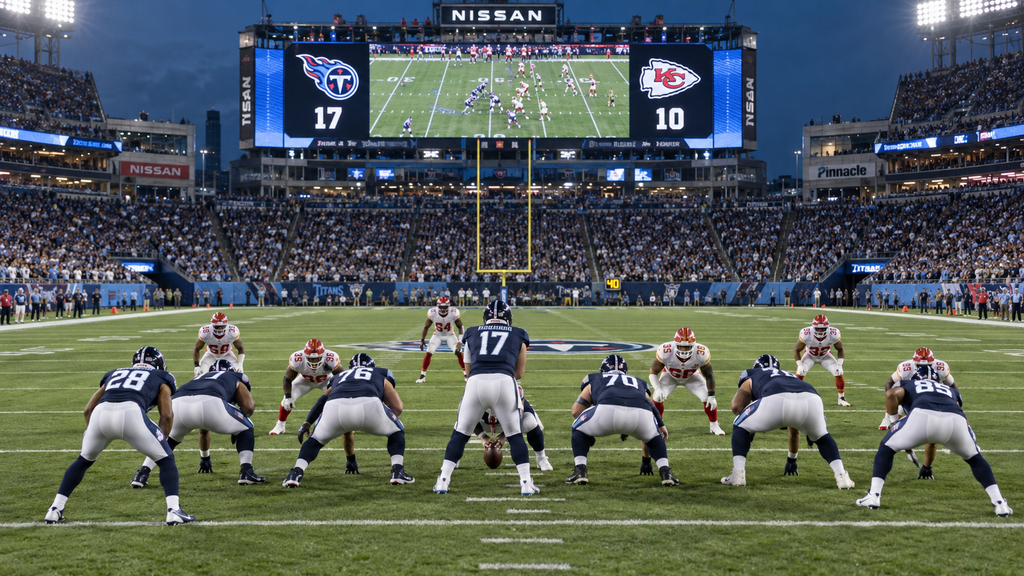
American football uses several clocks to control the pace and length of a game. For a new fan, this can be confusing because the clock on the scoreboard does not simply count down continuously from the beginning of the game to the end.
This american football game clock explained guide covers how the game clock and play clock work, why the clock stops during certain situations, and how quarters, timeouts, halftime, and overtime affect the timing of a game.
Once you understand when the clock runs and when it stops, the final minutes of a football game become much easier to follow.
How Long Is the Game Clock in American Football?
A regulation NFL or college football game contains 60 minutes of game-clock time, divided into four 15-minute quarters.
The basic structure is:
- First quarter: 15 minutes
- Second quarter: 15 minutes
- Halftime
- Third quarter: 15 minutes
- Fourth quarter: 15 minutes
High school football commonly uses 12-minute quarters, while youth leagues may use different quarter lengths.
Although an NFL or college game has only 60 minutes on the game clock, the actual event lasts much longer. That is because the game clock frequently stops between plays.
The first and second quarters make up the first half. The third and fourth quarters make up the second half.
At the end of the first and third quarters, the teams change which end of the field they are attacking. The game situation carries over to the next quarter. For example, if a team finishes the first quarter facing second down, it will still face second down when the second quarter begins.
What Is the Game Clock?
The game clock shows how much playing time remains in the current quarter.
If the scoreboard says:
3rd Quarter — 8:42
there are 8 minutes and 42 seconds left in the third quarter.
The game clock is different from the play clock. The game clock measures time remaining in the quarter, while the play clock controls how long the offense has to begin its next play.
Understanding that difference is one of the most important parts of learning football timing.
What Is the Play Clock?
The play clock is a separate countdown that tells the offense how much time it has to snap the football and start the next play.
At NFL level, the play clock is commonly either 40 seconds or 25 seconds, depending on what happened before the next play.
After an ordinary play ends, the 40-second play clock normally begins automatically. Certain administrative situations, such as a timeout or penalty enforcement, generally lead to a 25-second play clock once officials are ready for play.
The offense must snap the ball before the play clock reaches zero. Failing to do so normally results in a delay of game penalty.
For example, imagine the game clock shows 9:10 after a runner is tackled inbounds. The game clock may continue running while a separate 40-second play clock counts down. The offense does not have to snap the ball immediately, but it must do so before the play clock expires.
This allows teams to control the pace of the game.
When Does the Game Clock Run?
In a normal football sequence, the game clock often runs while the ball is live and may continue running after the play ends.
A simple example is a running play that ends with the ball carrier being tackled inbounds.
Suppose the offense snaps the ball with 10:00 remaining. The runner gains five yards and is tackled inbounds at 9:54.
In many ordinary situations, the game clock continues counting down while the players return to their positions and prepare for the next snap.
This is one reason running plays can consume significant amounts of time.
The exact restart rules can depend on why the previous play stopped, the league being played, and how much time remains in the half.
When Does the Game Clock Stop?
The game clock stops for several common reasons.
A beginner does not need to memorize every technical timing rule, but recognizing the major clock stoppages will make watching a game much easier.
Incomplete Passes Stop the Clock
When a legal forward pass hits the ground incomplete, the game clock stops.
Imagine a quarterback throws a pass with 1:25 remaining in the fourth quarter. The receiver cannot catch it, and the ball hits the ground with 1:20 showing.
The clock stops at approximately 1:20 instead of continuing to count down.
That is why passing toward the sidelines or throwing incomplete passes can become important when an offense is trying to score quickly near the end of a half.
The clock normally starts again when the next play begins.
Going Out of Bounds Can Stop the Clock
When a ball carrier goes out of bounds, the game clock stops initially.
What happens next depends on the league and the amount of time remaining.
In the NFL, for example, the clock generally restarts when officials make the ball ready for play after many out-of-bounds plays. However, after the two-minute warning of the first half and during the final five minutes of the second half, the clock generally remains stopped until the next snap.
This distinction becomes especially important late in games.
If an offense is behind with little time remaining, players may deliberately try to reach the sideline and get out of bounds rather than being tackled in the middle of the field.
Team Timeouts Stop the Clock
Each team receives a limited number of charged timeouts.
In the NFL, each team gets three timeouts per half.
When a team calls timeout, the game clock stops. Coaches and players can then discuss strategy before the next play.
Timeouts become particularly valuable near the end of a half.
For example, suppose a team trails by three points with 45 seconds remaining. A runner is tackled inbounds. Instead of allowing valuable seconds to disappear while everyone lines up again, the offense may call timeout immediately.
Teams leading late in games may also try to force opponents to use their remaining timeouts before intentionally running more time off the clock.
Penalties Can Cause Clock Stoppages
When officials call a penalty, the game clock may stop while they identify the foul and enforce the penalty.
However, a penalty does not automatically mean the clock will remain stopped until the next snap.
The restart depends on factors such as:
- What type of foul occurred
- When it occurred
- Whether the clock had been running
- Which team committed the foul
- How much time remains
- The rules of the league
Football also contains special timing rules designed to prevent teams from intentionally committing certain fouls simply to manipulate the clock.
For beginners, the important point is that a penalty usually creates an administrative stoppage while officials sort out what happened.
Scoring Plays Stop the Clock
The game clock stops when a scoring play is completed.
A touchdown, field goal, or safety creates a break before the next phase of the game.
After a touchdown, the scoring team normally attempts an extra point or two-point conversion. The game then continues with the appropriate restart procedure.
The regular game clock does not simply continue counting down while these events take place.
Replay Reviews Can Stop the Game
At levels of football that use instant replay, officials may stop the game while a play is reviewed.
For example, replay may be used to determine whether a receiver completed a catch or whether a runner crossed the goal line.
During the review, the game clock is stopped.
If the ruling changes, officials may also adjust the game clock when appropriate.
Replay reviews therefore add real-world time to the event even though no game-clock time is being used while the review takes place.
The Two-Minute Warning or Two-Minute Timeout
Professional and college football now both have an automatic stoppage near the end of each half, although the terminology can differ.
In the NFL, the two-minute warning occurs in the second and fourth quarters. It is an automatic official timeout associated with the two-minute point of the half.
College football uses a two-minute timeout in the second and fourth quarters. The NCAA introduced the automatic timeout as part of its timing rules.
The stoppage is important because it gives teams a guaranteed break near the end of each half and marks the point where several special timing rules may apply.
You will often see teams change their strategy significantly once the game reaches this stage.
Why Clock Management Matters
Football teams do not always want the clock to behave the same way.
A team that is behind usually wants to preserve time.
A team that is ahead often wants time to disappear.
Suppose Team A leads 24-21 with two minutes remaining and has possession.
If Team A keeps running the ball and its players are tackled inbounds, the game clock may continue running between plays. The offense can wait until the play clock is nearly exhausted before snapping again.
That can remove a large amount of game time without the opponent ever touching the ball.
Now reverse the situation.
If Team A trails 24-21, it may prefer incomplete passes, plays toward the sideline, quick snaps, and strategic timeouts because those techniques can preserve valuable seconds.
This battle over the clock is known as clock management.
What Happens at Halftime?
Halftime occurs between the second and third quarters.
It is a longer intermission than the breaks between the first and second quarters or between the third and fourth quarters.
The game clock for the second quarter reaches zero, the first half ends, and the teams leave the field for the halftime break.
The second half then begins with the third quarter.
Halftime does not count toward the 60 minutes of regulation playing time.
Broadcasts may make the break feel even longer because halftime programming, commercials, analysis, and other presentation elements occur while the teams are off the field.
Why Does a 60-Minute Football Game Take So Long?
This is one of the most common questions new fans ask.
A football game does not contain 60 uninterrupted minutes of action.
The game clock repeatedly stops for situations such as:
- Incomplete passes
- Players going out of bounds
- Team timeouts
- Penalties
- Scoring plays
- Replay reviews
- Changes between quarters
- The two-minute warning or timeout
- Other official stoppages
There is also considerable real-world time between plays even when the game clock continues running.
Commercial breaks can add more time during televised games.
As a result, an NFL or college game normally takes far longer to complete than the 60 minutes shown by the regulation game clock.
The key idea in this American Football Game Clock Explained guide is that game time and real time are not the same thing.
Sixty minutes refers to the official regulation playing time, not the amount of time spectators spend watching the event.
What Happens If the Game Is Tied?
If the score is tied after regulation, overtime rules may apply.
Overtime varies significantly between different levels of American football.
The NFL uses an overtime period with special possession and scoring rules. College football uses a very different system based on alternating possessions rather than simply continuing with another standard quarter. High school overtime procedures can also vary under applicable rules and state association procedures.
For a beginner, the important point is simple: reaching 0:00 in the fourth quarter does not necessarily end the game if the score is tied.
Overtime procedures determine how a winner is decided.
NFL, College, and High School Timing Rules Are Not Identical
The basic idea of football timing is similar across leagues, but some details differ.
NFL and college football normally use 15-minute quarters, while high school football commonly uses 12-minute quarters.
Clock restart procedures can also differ.
For example, NCAA football normally allows the game clock to continue after an inbounds first down outside the final two minutes of a half. During the final two minutes, the clock stops after a first down while the ball is made ready for play. College football also uses its two-minute timeout in both halves.
High school rules contain their own timing procedures. NFHS football also uses 40-second and 25-second play-clock situations, but its game-clock rules should not automatically be assumed to match NFL rules.
This is why a rule you see during an NFL game may not work exactly the same way during a college or high school game.
Simple Game Clock Example
Imagine there are 1:10 remaining in the fourth quarter, and the offense trails 20-17.
On first down, the quarterback throws an incomplete pass.
The clock stops at 1:04.
On second down, the quarterback completes a pass, and the receiver is tackled inbounds.
Now the clock may continue running.
The offense quickly gets lined up and snaps the next play rather than wasting time.
On third down, another pass is completed and the receiver gets out of bounds under circumstances where the clock remains stopped until the next snap.
The offense now has another opportunity to organize its next play without losing game-clock time.
This sequence shows why understanding the clock is essential to understanding late-game football. The number of yards gained matters, but so does how each play affects the remaining time.
Frequently Asked Questions
What Is the Difference Between the Game Clock and Play Clock?
The game clock shows how much time remains in the quarter. The play clock shows how long the offense has to start its next play.
Does the Football Clock Run Continuously?
No. It runs during certain situations and stops during others. Incomplete passes, timeouts, scoring plays, penalties, and other events can stop the clock.
Does Going Out of Bounds Always Stop the Clock Until the Next Play?
No. The exact restart rule depends on the league and the time remaining. In the NFL, an out-of-bounds play can stop the clock initially but the clock may restart before the next snap in many situations.
Why Do Teams Call Timeouts Near the End of Games?
A timeout stops the game clock. A team trying to score can use timeouts to preserve time, while defensive teams may also use them strategically to regain possession.
How Long Is the Play Clock?
In major forms of American football, 40 seconds is commonly used after ordinary plays, while 25 seconds is used after various administrative stoppages. The exact circumstances depend on the league.
Why Does Football Take More Than 60 Minutes to Watch?
Because the game clock stops repeatedly, and real-world time also passes during timeouts, penalties, reviews, breaks between quarters, halftime, and television stoppages.
Key Takeaways
The American Football Game Clock Explained simply comes down to understanding that football uses more than one clock and that the main game clock does not run continuously.
NFL and college regulation games contain four 15-minute quarters, while high school games commonly use 12-minute quarters. The game clock measures time remaining in a quarter, while the play clock determines how long the offense has to begin its next play.
Incomplete passes, timeouts, scoring plays, penalties, reviews, and some out-of-bounds plays can stop the game clock. League-specific rules determine exactly when it starts again.
Those frequent stoppages explain why a game containing 60 minutes of regulation time takes much longer than one hour to complete. Once you recognize when the clock should run, stop, or restart, following the pace and strategy of American football becomes much easier.