
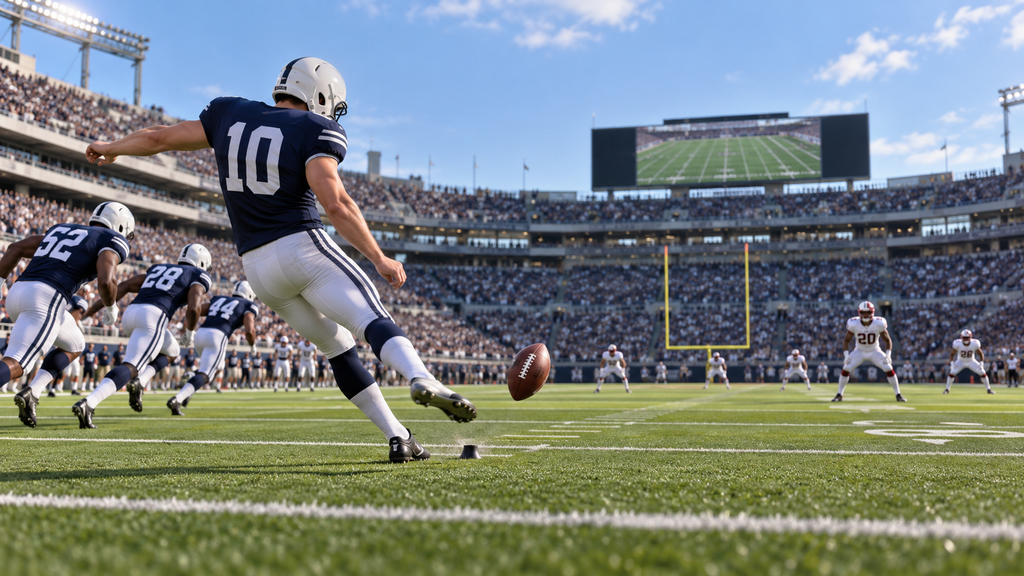
Kickoffs are some of the easiest plays to recognize in American football. A kicker sends the ball downfield, the receiving team tries to secure it, and a returner may run the ball back as far as possible.
What happens after the kick is not always as obvious. The ball may be returned, go out of bounds, enter the end zone, or result in a touchback. Modern leagues also use different kickoff rules, so what you see in an NFL game may not look exactly the same as a college or high school game.
Understanding American football kickoffs and touchbacks makes it much easier to follow how possession begins and why an offense starts a drive at a particular yard line.
What Is a Kickoff in American Football?
A kickoff is a special teams play used to begin or restart play.
Instead of snapping the football to start the play, the kicking team kicks the ball toward the opposing team. The other team receives the ball and normally gains possession.
Kickoffs create a transition between one team scoring or a new period beginning and the receiving team’s next offensive possession.
The players involved are part of special teams, the units that handle kicking plays such as kickoffs, punts, field goals, and extra points.
When Do Kickoffs Happen?
Kickoffs normally occur in several situations during a football game.
The game begins with a kickoff after the opening coin toss determines which team will receive the ball.
A kickoff also starts the second half. The team that receives the opening kickoff does not automatically receive the second-half kickoff. The coin-toss choices and deferrals determine which team receives at the beginning of each half.
Kickoffs also normally follow scoring plays.
After a touchdown and the following extra-point or two-point attempt, the scoring team kicks the ball to its opponent.
After a field goal, the team that scored also kicks off to the opposing team.
A safety creates a different free-kick situation, with details depending on the league, but the basic idea is the same: possession is restarted with a kick.
The Kicking Team and Receiving Team
Every kickoff involves two special teams units.
The kicking team is the team putting the ball into play. Its kicker strikes the football while the other players attempt to cover the kick and stop the return.
The receiving team is the team expecting to gain possession. It normally has one or more players positioned deep to receive the kick while teammates prepare to block for a possible return.
Once the returner has possession, the roles are simple.
The receiving team tries to move the ball toward the opponent’s end zone. The kicking team tries to tackle the returner as quickly as possible.
Where the return ends can have an immediate effect on field position.
What Is a Kickoff Return?
A kickoff return happens when a receiving player catches or recovers the kickoff and runs with the ball.
For example, imagine a returner catches a kick near his own 5-yard line. He runs forward and is tackled at the 28-yard line.
The receiving team’s offense would normally begin its possession around the 28-yard line, subject to any penalties on the play.
A longer return gives the offense better starting field position. If the returner reaches midfield, for example, the offense has much less distance to travel before reaching scoring range.
A returner can even run a kickoff all the way into the opposing end zone for a touchdown.
Catching a Kickoff
The receiving team must first secure the football before worrying about the return.
A returner may catch the ball cleanly and immediately begin running. If the ball lands before being controlled, the play may remain live depending on the rules and where the kick lands.
This is one reason kickoff coverage players sprint toward the receiving team. They are trying to reach the returner quickly while also being ready to react to a loose ball.
A returner therefore has to judge both the flight of the kick and the approaching coverage.
Sometimes the best decision is to return the ball. In other situations, the rules allow the receiving team to let the play end and accept a touchback.
What Is a Touchback?
A touchback is a ruling that ends the kicking play and gives the receiving team possession at a predetermined yard line instead of requiring the ball to be returned out of the end zone.
The exact yard line depends on the league and the circumstances of the kick.
For beginners, the most important idea is simple:
A touchback usually means the receiving team does not have to run the kickoff out of its own end zone. The play ends, and the offense starts from the yard line specified by that league’s rules.
A touchback is not a score. Neither team receives points.
It is simply a way of determining where the receiving team’s next offensive possession begins.
How Does a Kickoff Become a Touchback?
A common touchback occurs when a kickoff reaches the receiving team’s end zone and the rules allow the receiving team to end the play there.
For example, the kicker may send the ball deep into the end zone. Instead of attempting a return, the receiving team allows the play to end. Officials then place the ball at the appropriate touchback yard line.
The exact procedure matters because professional and college football do not use identical kickoff rules.
That is why a viewer should avoid assuming that every ball entering the end zone produces the same result in every league.
NFL Kickoffs and Touchbacks
The modern NFL uses a dynamic kickoff format that looks noticeably different from the traditional kickoff many fans remember.
The kicker still kicks from the kicking team’s 35-yard line, but most players begin much farther downfield than they did under the old format. The NFL introduced the system in 2024 and later made it permanent, with the goal of creating more returns while reducing the high-speed collisions associated with traditional kickoff coverage.
Under the current NFL structure, the positioning and movement of the coverage and receiving players are tightly controlled until the ball reaches the designated landing area or end zone.
The touchback rules also encourage teams to put the ball into returnable areas.
For a kick that travels directly into or beyond the end zone without first touching the ground or a player in the landing zone, the normal touchback spot is the receiving team’s 35-yard line. If the ball first touches the ground or a receiving-team player in the landing zone and then reaches the end zone, different treatment can apply under the NFL rule.
The NFL also made a specific 2026 adjustment for kickoffs from the 50-yard line: when such a kick results in a touchback, the dead-ball spot is the 20-yard line.
These details are NFL-specific and should not be treated as universal football rules.
College Football Kickoffs and Touchbacks
College football generally uses a more traditional-looking kickoff formation than the NFL’s dynamic kickoff.
In NCAA football, kickoffs are normally made from the kicking team’s 35-yard line.
A standard free-kick touchback gives the receiving team the ball at its 25-yard line.
College football also has an important fair-catch rule.
If a receiving player makes a valid fair catch of a kickoff inside the team’s 25-yard line, the result can be treated as a touchback, with the offense starting at the 25. That rule was introduced to reduce the need for players to return certain deep kickoffs.
As a result, college viewers may see a returner signal for a fair catch rather than attempt to run a kickoff out.
High School Rules Can Be Different
High school football rules should not automatically be assumed to match either the NFL or NCAA.
Rules can depend on the governing organization and competition. Kickoff placement, touchback procedures, fair catches, and other details may differ from the professional or college game.
For a beginner watching a particular league, the safest approach is to learn the general concept first: a kickoff restarts play, while a touchback ends certain kicks and establishes the receiving team’s starting field position.
The precise yard line is a league-specific detail.
What Happens If a Kickoff Goes Out of Bounds?
A kickoff that goes out of bounds before reaching the receiving team’s end zone can produce a penalty or give the receiving team favorable options.
The kicking team generally cannot simply kick the ball directly out of bounds to prevent a return without consequences.
In the NFL, for example, a kickoff going out of bounds between the goal lines gives the receiving team options under the free-kick rules, including field-position consequences for the kicking team.
This rule encourages the kicker to keep the ball in the field of play rather than deliberately sending it out of bounds.
Do not confuse this situation with a ball that is legally returned and then carried out of bounds by the returner. In that case, the offense normally begins from where the play ended, subject to penalties.
Why Field Position Matters on Kickoffs
The result of a kickoff determines where the receiving team’s offensive drive begins.
That makes kickoff strategy partly a battle for field position.
Imagine two returns.
On the first, the returner is tackled at his own 18-yard line. His offense must travel 82 yards to reach the opposing goal line.
On the second, the returner reaches his own 40-yard line. Now the offense needs only 60 yards to reach the goal line.
Those 22 yards can make a major difference.
The kicking team therefore wants to stop the return as deep as possible, while the receiving team wants to create enough space for its returner to gain valuable yards.
Touchback rules influence that decision. If accepting a touchback provides better field position than attempting a risky return, the receiving team may prefer the touchback.
What Is an Onside Kick?
An onside kick is a special type of kickoff designed to give the kicking team a chance to recover the ball rather than send it deep to the opponent.
Teams most commonly consider an onside kick when they need possession again quickly, especially late in a game.
Instead of kicking deep toward the returner, the kicker sends the ball a much shorter distance and teammates attempt to recover it legally.
The rules governing onside kicks are highly league-specific.
Under the NFL’s current rules, an onside kick must be declared, and the 2026 rules permit a team that is trailing to declare one at any point in the game.
An onside kick is therefore very different from a normal kickoff. The goal is not good coverage or deep field position. The kicking team is sacrificing field position for an opportunity to regain possession.
Kickoff vs Punt
Kickoffs and punts both involve one team kicking the ball to the other, but they happen for different reasons.
A kickoff begins or restarts play. It commonly occurs at the beginning of a half or after a scoring play.
A punt normally occurs during an offensive possession, most often on fourth down. The offense voluntarily kicks the ball away because it does not want to risk failing on fourth down and giving the opponent excellent field position.
Another major difference is how the play begins.
A kickoff is a free kick. A punt starts with a normal snap from the line of scrimmage to the punter.
Both plays can produce returns and touchbacks, but the exact rules and resulting field position are not necessarily the same.
A Simple Kickoff Example
Suppose Team A scores a touchdown and completes its extra-point attempt.
Team A then kicks off to Team B.
Team B’s returner receives the ball and runs to his own 31-yard line before being tackled.
The kickoff play is over. Team B sends its offense onto the field and begins its possession from around the 31-yard line, assuming no penalty changes the spot.
Now imagine the kick instead results in a touchback.
There is no return. Officials end the play and place the ball at the touchback spot required by that league’s rules.
That difference between a return and an automatic touchback spot is one of the main reasons kickoff strategy matters.
Frequently Asked Questions
Does a Touchback Give the Receiving Team Points?
No. A touchback does not score any points. It simply ends the kicking play and establishes where the receiving team’s offense will begin.
Can a Kickoff Be Returned for a Touchdown?
Yes. If the returner legally possesses the kickoff and carries it all the way into the opponent’s end zone, the receiving team scores a touchdown.
Does Every Kick Into the End Zone Automatically Become a Touchback?
No. The exact result depends on the league, how the ball entered the end zone, and what happens afterward. Current NFL rules in particular distinguish between different types of kicks reaching the end zone.
Is a Touchback the Same in the NFL and College Football?
No. Touchback rules and starting spots can differ. NCAA free-kick touchbacks generally place the ball at the 25-yard line, while the NFL’s current dynamic kickoff system uses different rules and spots depending on what happens to the kick.
Can the Kicking Team Recover a Kickoff?
Yes, in certain circumstances. Onside kicks are specifically designed to create a legal opportunity for the kicking team to recover the ball. The exact recovery requirements vary by league.
Key Takeaways
American football kickoffs and touchbacks determine how play begins or restarts and where the receiving team’s next possession starts.
A kickoff normally occurs at the beginning of a half and after certain scoring plays. The receiving team can often return the ball, with the offense beginning from the spot where the return ends.
A touchback ends the kick without a normal return and places the ball at a league-defined yard line.
The NFL currently uses its dynamic kickoff system, while college football retains different kickoff and touchback rules. Those league differences are important because the same-looking kick can produce different starting field position.
Once you understand the basic relationship between the kickoff, the return, the touchback, and field position, one of football’s most common special teams situations becomes much easier to follow.