
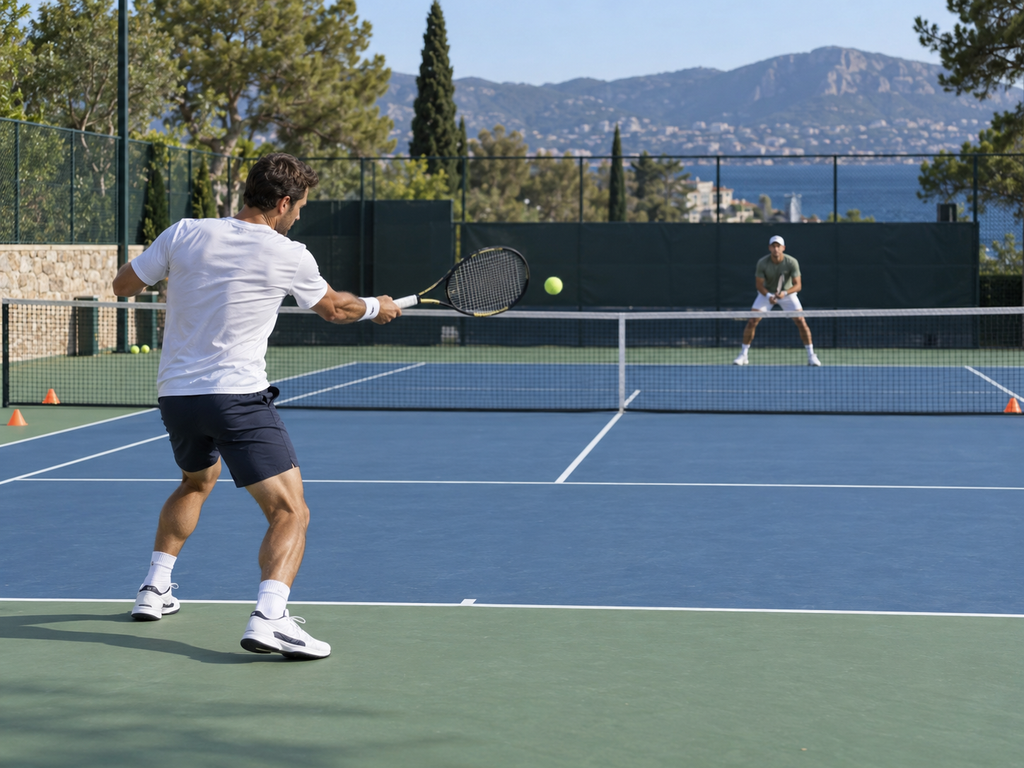
Advanced tennis players often spend considerable time practicing their serves, groundstrokes, volleys, and movement. However, technical improvement does not always translate directly into better match results. A player may perform consistently during controlled drills but struggle to execute the same skills against an opponent who changes pace, attacks weaknesses, or creates pressure during important points.
Effective advanced tennis training addresses this gap by organizing practice around the situations that actually occur during competition. Instead of repeating drills without a specific purpose, match-specific training connects technical execution, tactical decision-making, physical movement, and competitive pressure. The objective is to develop skills that remain reliable when the conditions become less predictable.
What Is Match-Specific Tennis Training?
Match-specific tennis training involves designing practice activities that reflect the demands of competitive play.
It focuses on the relationship between individual skills and the situations in which those skills must be used.
For example, practicing a serve into a target develops placement. Practicing the same serve against a live returner, followed by a first groundstroke, develops the ability to use that placement during an actual point.
Both exercises have value, but they serve different purposes.
Advanced training should include a combination of:
- Technical refinement for specific performance limitations.
- Tactical patterns that reflect match situations.
- Movement and recovery under realistic conditions.
- Decision-making against unpredictable shots.
- Practice under normal competitive scoring.
- Evaluation of measurable performance outcomes.
The goal is not to make every drill as difficult as possible.
It is to choose training conditions that develop the skill you need and gradually transfer that skill into competitive play.
Start With a Match Performance Assessment
Before designing a training session, identify what needs improvement.
Advanced players benefit from evaluating recurring match patterns rather than choosing drills based entirely on preference.
Review Recent Matches
Look for situations that repeatedly cause problems.
Examples include:
- Losing control after a strong first serve.
- Producing short returns against kick serves.
- Making errors when changing direction.
- Struggling to finish points after approaching the net.
- Losing rallies when opponents vary spin.
- Making poor decisions during important points.
Avoid treating every missed shot as a separate weakness.
Look for patterns that occur across several matches or practice sets.
Separate Technical and Tactical Problems
A technical problem involves difficulty executing a particular movement or shot.
A tactical problem involves choosing an unsuitable response or failing to recognize an opportunity.
For example, repeatedly missing down-the-line forehands may indicate inconsistent contact or an overly demanding tactical choice.
The distinction matters because the appropriate training response is different.
A technical issue may benefit from controlled repetitions.
A tactical issue may require realistic decision-making drills.
Identify the Highest-Priority Issue
Choose one primary objective for each session.
You may also include one secondary objective, but avoid attempting to improve every part of your game simultaneously.
A focused session allows you to evaluate whether the selected training activities are producing meaningful results.
Set Clear Training Objectives
A useful training objective should describe the skill, the situation, and the result you want to improve.
Instead of saying, “I want to serve better,” identify the specific match problem.
For example:
“Improve the percentage of first groundstrokes successfully returned after serving wide from the deuce court.”
This objective identifies a measurable skill and a relevant competitive situation.
Use Performance-Based Objectives
Effective objectives may involve:
- Increasing return accuracy against a particular serve type.
- Reducing errors during neutral baseline exchanges.
- Improving first-volley placement after an approach.
- Recognizing appropriate opportunities to change direction.
- Maintaining reliable shot selection during tiebreaks.
Choose measurements that reflect the intended skill.
A drill designed to improve decision-making should not be evaluated solely by the number of winners produced.
Establish a Starting Point
Before beginning a training block, record current performance.
For example, you may successfully return 11 of 20 kick serves toward a designated target.
This provides a baseline for comparison.
Repeat the assessment under similar conditions after several sessions to determine whether performance has changed.
Organize Practice From Controlled to Competitive
Match-specific training is most effective when the level of unpredictability matches the player’s current ability.
A practical session can progress through three stages.
Stage 1: Controlled Skill Repetition
Begin with predictable feeds or defined targets.
This allows you to focus on the technical or tactical element identified in your training objective.
For example, if you are improving your first groundstroke after serving, start with cooperative returns directed toward a manageable area.
Stage 2: Variable Practice
Introduce changes in ball direction, depth, pace, or spin.
The player must recognize the incoming ball and adjust.
For the serve-plus-one example, allow the returner to vary placement instead of sending every return to the same location.
Stage 3: Competitive Application
Apply the skill during scored points, service games, tiebreaks, or practice sets.
This introduces realistic uncertainty and consequences.
The objective is to maintain appropriate decisions and execution when the opponent is actively trying to win.
Progression should be based on performance rather than following fixed time intervals regardless of results.
Design Practice Around Specific Match Situations
Different match problems require different training structures.
Serve and First-Groundstroke Training
Players who serve effectively but lose control of the next shot should connect serving practice with return recognition and recovery.
A useful progression includes:
- Serve toward a designated target.
- Recover and prepare for the return.
- Respond to a cooperative first return.
- Introduce variable return direction.
- Continue the point competitively.
The key measurement may be the percentage of successful first groundstrokes after the serve.
Advanced serve-plus-one patterns can be added after reliable execution is established.
Return and Rally Transition Training
Players who struggle against strong serves need practice that reflects the actual serve types they face.
Begin with controlled returns against a specific variation.
Then introduce changes in placement and spin.
Finally, continue the point after the return to assess whether the player can recover into a competitive rally position.
Track return accuracy and the quality of the following shot.
Baseline Pattern Training
Players who struggle to maintain tactical control may benefit from drills involving specific rally patterns.
For example, practice establishing deep crosscourt pressure before changing direction on a suitable ball.
Begin with cooperative feeds and then allow the opponent to vary their response.
Evaluate whether the chosen pattern produces useful attacking opportunities without increasing unnecessary errors.
Net Transition Training
Players who hesitate when approaching the net can practice recognizing manageable short balls, executing approach shots, and preparing for passing shots.
Controlled feeds help establish timing.
Variable passing shots and lobs create more realistic decision-making demands.
Competitive points then test whether the player chooses appropriate approach opportunities.
Pressure-Point Training
Players who struggle during important points may benefit from repeated scoring situations.
Practice service games beginning at 30–40, tiebreaks, or short sets with normal rules.
Use a consistent between-point routine and evaluate whether shot selection changes unnecessarily under pressure.
The objective is not to eliminate nervousness but to maintain dependable decisions.
Five Match-Specific Tennis Training Drills
Drill 1: Match Pattern Reconstruction
Objective: Recreate a recurring match situation and develop a more effective response.
Setup: Identify a point pattern from a recent match.
Instructions:
- Describe the recurring situation.
- Have a partner reproduce the relevant ball sequence.
- Practice a controlled response.
- Introduce variation in the opponent’s next shot.
- Continue the point competitively.
- Evaluate whether the response produces a better rally position.
Practice focus: Train a documented match problem rather than an unrelated skill.
Drill 2: Tactical Decision Challenge
Objective: Improve shot selection under unpredictable conditions.
Setup: Have a partner vary ball placement, depth, and pace.
Instructions:
- Begin in a normal rally position.
- React to the incoming ball.
- Choose an attacking, neutral, or defensive response.
- Continue the rally.
- Review whether the decision matched the situation.
- Repeat for fifteen to twenty points.
Practice focus: Evaluate decision quality separately from execution.
Drill 3: Serve and Return Pattern Testing
Objective: Assess the effectiveness of planned serve and return combinations.
Setup: Play service points with a practice partner.
Instructions:
- Choose one serve placement and intended first-groundstroke pattern.
- Execute the serve.
- Respond to the live return.
- Continue the point.
- Record whether the intended opportunity developed.
- Repeat with a second serve pattern.
Practice focus: Determine whether the pattern creates practical advantages against a real receiver.
Drill 4: Match Pressure Simulation
Objective: Maintain performance routines during important scoring situations.
Setup: Play games beginning at deuce or 30–40.
Instructions:
- Use normal service and scoring rules.
- Complete the usual preparation routine.
- Select appropriate tactical targets.
- Play each point competitively.
- Record errors and decision-making patterns.
- Alternate serving roles and repeat.
Practice focus: Maintain reliable execution without making unnecessary tactical changes because of the score.
Drill 5: Competitive Performance Review
Objective: Evaluate whether training improvements transfer into match play.
Setup: Play a practice set under normal match conditions.
Instructions:
- Identify one performance objective before the set.
- Play without interrupting points for technical corrections.
- Record relevant statistics.
- Review recurring situations after the set.
- Compare the results with previous sessions.
- Select the next training priority based on the evidence.
Practice focus: Connect practice outcomes with competitive performance.
Sample 75-Minute Advanced Tennis Session
A session can combine technical preparation, tactical rehearsal, and competitive application.
The following example focuses on improving serve-plus-one performance.
| Activity | Duration |
|---|---|
| Dynamic warm-up and progressive hitting | 10 minutes |
| Controlled serve and first-groundstroke repetition | 15 minutes |
| Variable return placement practice | 15 minutes |
| Competitive serve-plus-one points | 15 minutes |
| Scored service games | 15 minutes |
| Cool-down and performance review | 5 minutes |
| Total | 75 minutes |
Allow short recovery periods within the activities and adjust intensity according to conditions.
A player training return performance or net transitions can retain the same general progression while replacing the central activities.
The session structure should serve the objective rather than become a rigid routine.
How to Plan a Weekly Advanced Tennis Training Schedule
A weekly plan should balance focused development, competitive practice, and recovery.
The appropriate workload depends on playing experience, conditioning, other training commitments, and recovery needs.
The following is an illustrative schedule, not a universal training requirement.
| Day | Training Focus |
|---|---|
| Monday | Technical refinement and targeted repetition |
| Tuesday | Tactical patterns and variable feeds |
| Wednesday | Recovery or light movement |
| Thursday | Serve, return, and first-groundstroke combinations |
| Friday | Match-specific competitive drills |
| Saturday | Practice set or match play |
| Sunday | Rest and performance review |
Players who cannot train on six days can combine priorities into fewer sessions.
Practice quality and recovery are more important than filling every available day.
Avoid increasing training volume sharply, particularly when adding repeated serves, overheads, or high-intensity movement drills.
Adjust Training for Different Opponent Styles
Match-specific practice becomes more valuable when it reflects the opponents you regularly face.
Against Aggressive Baseliners
Practice handling deep, fast groundstrokes while maintaining controlled responses.
Include variable feeds that require quick preparation and realistic recovery.
Against Defensive Players
Develop patience and purposeful point construction.
Use longer rally drills that require recognizing appropriate attacking opportunities rather than forcing winners.
Against Strong Servers
Increase exposure to realistic first-serve pace and spin.
Practice compact returns and the transition into the next rally shot.
Against Frequent Net Attackers
Practice passing-shot decisions, controlled lobs, and low returns.
Include unpredictable approach situations rather than feeding the same passing shot repeatedly.
The objective is to become better prepared for specific competitive demands without abandoning the fundamental skills that support your game.
How to Measure Advanced Tennis Training Progress
Training results become more meaningful when the measurements reflect the match problem being addressed.
Use Relevant Performance Indicators
Choose two or three measurements for each training objective.
Examples include:
- Successful first groundstrokes after serving.
- Return accuracy against kick serves.
- Unforced errors during neutral rallies.
- Points won after approaching the net.
- Successful tactical decisions during pressure points.
- Target accuracy under variable feeds.
Avoid collecting large amounts of data that you do not use.
Compare Similar Conditions
A result achieved against predictable feeds cannot be compared directly with performance against a strong competitive opponent.
Record the training conditions alongside the outcome.
Monitor Both Execution and Decisions
A tactically appropriate shot may still miss.
Conversely, an unsuitable choice may occasionally win a point.
Review execution quality and decision quality separately when possible.
Reassess After Several Sessions
One practice session may produce unusual results because of fatigue, weather, opponent differences, or normal performance variation.
Look for trends across multiple sessions before making major changes.
Transfer Improvements Into Matches
The ultimate test is whether the trained skill becomes more reliable during competitive play.
A player who improves serve placement during drills but continues losing control of the first groundstroke may need additional variable and competitive practice.
Training should evolve according to what happens in matches.
Common Advanced Tennis Training Mistakes
Practicing Without a Specific Objective
Repetition alone does not guarantee relevant improvement.
Correction: Define one primary performance issue before selecting drills.
Making Every Session Competitive
Constant match play may reveal weaknesses without providing enough controlled practice to correct them.
Correction: Combine focused repetitions, variable drills, and scored points.
Using Only Predictable Feeds
A player may become highly accurate against familiar ball sequences but struggle during unpredictable rallies.
Correction: Introduce variation once the intended skill becomes reliable.
Changing Too Many Elements at Once
Attempting to improve serve mechanics, return placement, footwork, and tactical patterns simultaneously can make progress difficult to evaluate.
Correction: Prioritize one major objective per session.
Ignoring Physical Recovery
Excessive training can reduce movement quality and increase injury risk.
Correction: Adjust workload to fitness, recovery, and the demands of other activities.
Measuring Only Match Wins
Winning a practice set does not necessarily mean the targeted skill improved.
Correction: Track specific performance indicators alongside competitive results.
Build a Training System That Improves Match Performance
Effective advanced tennis training begins with identifying the situations that influence your competitive results.
Review recent matches, select a clear development priority, and design practice activities that progress from controlled execution to variable and competitive conditions.
Use measurable objectives to evaluate whether the training is producing meaningful improvement. When a skill becomes reliable, introduce greater unpredictability or apply it against stronger opponents.
The goal is not simply to complete more drills or spend more hours on the court. It is to make each practice session serve a specific purpose, helping you apply your technical skills, tactical knowledge, and competitive experience more effectively when the match is on the line.