
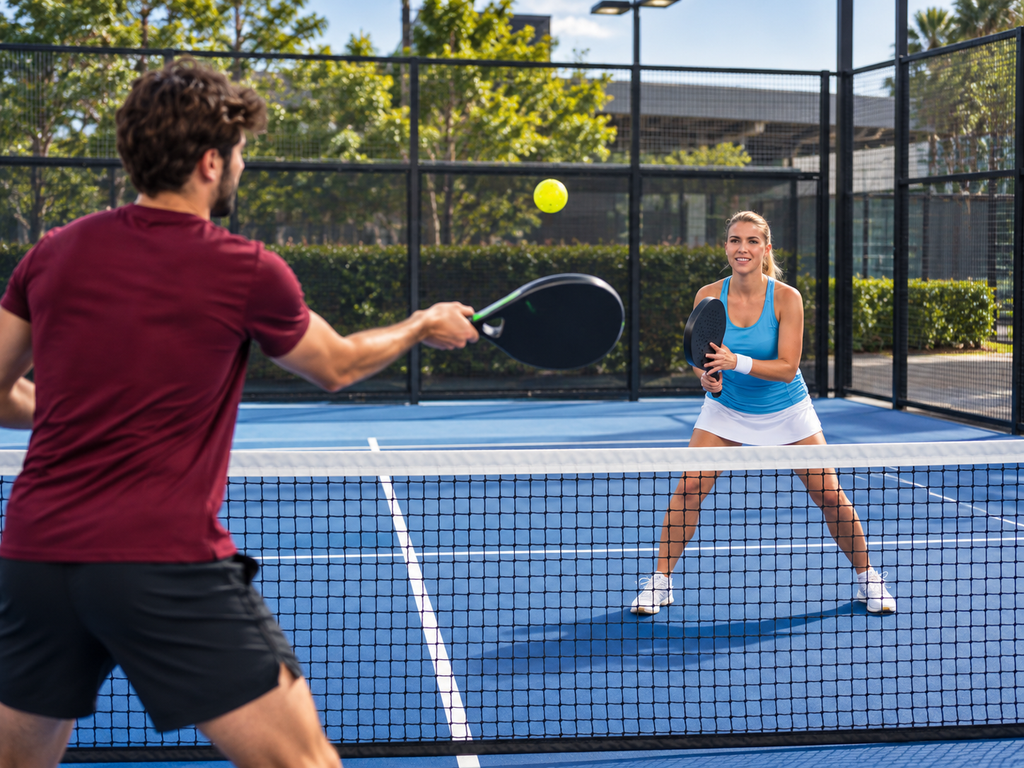
Competitive pickleball often involves long exchanges of controlled dinks near the non-volley zone. Both teams attempt to keep the ball low while waiting for an opportunity to gain an advantage. When the right ball arrives, a well-timed increase in pace can change the rally immediately.
These attacking shots, commonly called pickleball speed ups, allow players to shift from soft exchanges into faster, more aggressive play.
However, successful speed-ups require more than quick hands or powerful swings. Advanced players must recognize suitable attacking opportunities, choose effective targets, and prepare for the counterattack that may follow.
A poorly timed speed-up can give an opponent an easy offensive opportunity. A controlled attack delivered at the right moment can force a difficult response and create an opening for the next shot.
Understanding when to attack, where to aim, and how to manage the resulting exchange is essential for developing a reliable competitive kitchen game.
What Is a Pickleball Speed-Up?
A speed-up is an offensive shot that increases the pace of a rally, often during a soft exchange near the non-volley zone.
Rather than continuing with another dink, a player accelerates the ball toward a selected target.
The objective may be to force a weak block, create a pop-up, challenge an opponent’s reaction time, or win the point when a clear opening exists.
Speed-ups are particularly common during doubles rallies because players frequently exchange soft shots at the kitchen line before recognizing an opportunity to attack.
Speed-Up vs. Drive vs. Counterattack
Although these shots can involve similar speeds, their tactical purposes differ.
| Shot | Main Purpose | Typical Situation |
|---|---|---|
| Speed-up | Change a soft exchange into an attacking exchange | Dinking rally near the kitchen |
| Drive | Apply pace through a forceful groundstroke | Ball contacted after a bounce, often farther from the net |
| Counterattack | Respond aggressively to an opponent’s attack | Fast exchange or attacking volley |
A speed-up can be played after the ball bounces or taken out of the air when the player is legally positioned.
The key distinction is the deliberate change from a slower exchange into an offensive one.
Recognize When to Speed Up
One of the most important skills in advanced pickleball is knowing when an attacking opportunity is favorable.
Attempting to speed up every ball makes a player predictable and increases unnecessary errors.
Instead, evaluate the incoming ball’s height, trajectory, speed, and your position before attacking.
Attack When the Ball Is High Enough
An elevated dink may provide an opportunity to strike the ball forward while keeping its trajectory difficult to attack.
A ball contacted above net height often offers more offensive options than one contacted below the net.
However, height alone is not enough.
A ball slightly above net height may still be difficult to attack if you are reaching backward, moving off balance, or positioned poorly.
Look for a contact point that allows a compact, controlled stroke and a reliable target.
Attack When Opponents Are Out of Position
A speed-up can be especially effective when an opponent is moving or recovering.
For example, a wide dink may force a player to stretch toward the sideline.
If their return sits up and they remain off balance, a controlled attack toward an available area may create pressure.
The opportunity comes from the combination of ball quality and opponent positioning.
Avoid rushing an attack simply because an opponent has moved. Experienced players can recover quickly and respond effectively to fast balls.
Attack When You Are Balanced
Your own position matters as much as the opponent’s.
A successful speed-up requires enough stability to control the paddle and prepare for the next shot.
Before attacking, consider whether you can:
- Contact the ball comfortably.
- Maintain a balanced athletic stance.
- Control the shot’s height and direction.
- Recover the paddle quickly.
- React to a fast counterattack.
If these conditions are absent, continuing with a controlled dink may be the better decision.
Understand When Not to Speed Up
Strong advanced players recognize that refusing a poor attacking opportunity can be just as important as taking a good one.
Avoid Attacking Very Low Balls
A ball contacted well below net height often requires an upward trajectory to clear the net.
An aggressive speed-up from this position may rise into an opponent’s preferred attacking zone.
Skilled players can sometimes roll low balls with topspin, but this requires precise technique and favorable positioning.
For most situations, maintaining a low, controlled exchange is the safer option.
Avoid Attacking While Reaching
When stretched wide or forward, players often lose the stability needed for an accurate attacking shot.
Trying to accelerate the ball from this position can produce errors or weak attacks.
Recover control before attempting a demanding speed-up.
Avoid Predictable Attacking Patterns
Repeatedly attacking the same opponent or target can make your intentions easier to recognize.
An opponent who expects a speed-up may prepare their paddle early and counter aggressively.
Use variations in timing and placement, but do not sacrifice control merely to appear unpredictable.
Choose Effective Speed-Up Targets
Target selection has a major influence on whether an attack produces pressure or gives opponents an easy counter.
The best target depends on opponent positioning, paddle readiness, and the available court space.
Target the Paddle-Side Hip or Body
A controlled attack toward an opponent’s paddle-side hip can sometimes create an awkward contact point.
The player may need to adjust their paddle position quickly, particularly if the ball arrives near the elbow or hip.
The exact difficulty depends on grip, handedness, paddle preparation, and individual technique.
Body-targeted attacks should remain controlled and within the normal playing area. Avoid aiming at an opponent’s head or face.
Target an Unprepared Backhand
Some players are less comfortable countering fast shots on their backhand side.
A speed-up toward that side may force a weaker block.
However, advanced opponents may have excellent backhand counters.
Observe actual tendencies rather than assuming the backhand is always weaker.
Use the Middle in Doubles
Attacking between doubles partners can create uncertainty about who should take the ball.
This target may be effective when both players are shifting or when their responsibilities overlap.
A middle attack can also reduce the angles available for an immediate counter.
However, the middle may be well protected by a player who is prepared to intercept the shot.
Evaluate the opponents’ spacing before choosing this target.
Attack Open Court Space
When an opponent is significantly out of position, an attack toward open space may be appropriate.
For example, a player pulled wide by a dink may leave an opening toward the center or opposite side.
The attack should remain controlled enough to land within the court.
Avoid aiming for extremely narrow targets when a larger opening is available.
Use Compact Speed-Up Technique
A common mistake is treating a kitchen-line speed-up like a full groundstroke.
Because opponents are close to the net, large swings can make timing difficult and delay recovery.
Prepare the Paddle Early
Keep the paddle in front of your body during soft exchanges.
When an attacking opportunity appears, adjust the paddle position without an exaggerated backswing.
Early preparation allows you to contact the ball more consistently and recover more quickly.
Generate Controlled Acceleration
A speed-up should use enough acceleration to challenge the opponent without sacrificing placement.
The amount of wrist, forearm, and shoulder movement depends on the shot and contact position.
For many kitchen-line attacks, a compact motion provides greater control than a large swing.
Focus on a repeatable contact point and efficient movement.
Keep the Ball at a Difficult Height
A fast ball that sits high can be attacked.
Try to direct the ball through a trajectory that challenges an opponent’s reaction or contact position without creating an easy downward counter.
This requires adjusting the paddle face and swing path according to the incoming ball.
Recover Immediately
After accelerating the ball, bring the paddle back into a ready position.
Do not assume the shot will end the rally.
Strong opponents may block, redirect, or counterattack immediately.
The ability to handle the next ball is an essential part of an effective speed-up.
Understand the Importance of Disguise
At advanced levels, opponents often read paddle preparation and body movement to anticipate attacks.
An exaggerated backswing can signal an upcoming speed-up.
A more compact preparation may make it harder for opponents to distinguish between a dink and an attacking shot.
Maintain Similar Initial Preparation
During a soft rally, use a ready position that allows multiple shot options.
When a suitable attacking ball arrives, accelerate through a compact motion rather than making a large, obvious preparation change.
The objective is efficient execution, not deceptive movement at the expense of control.
Vary the Timing of Attacks
Players sometimes become predictable by attacking after the same sequence of dinks.
Instead, base the decision on the quality of the incoming ball and the available target.
A speed-up may occur early in a rally or after several patient exchanges.
The correct moment is determined by the opportunity, not by the number of previous shots.
Prepare for the Counterattack
One of the defining characteristics of advanced kitchen play is that an initial attack frequently produces another fast shot.
A successful speed-up may create pressure without immediately winning the point.
The attacker must be prepared for this possibility.
Expect the Ball to Return Quickly
After attacking, maintain a balanced stance and return the paddle to a central ready position.
Watch the opponent’s paddle and body position.
Avoid admiring the shot or moving prematurely.
Control the Next Exchange
If an opponent blocks the speed-up weakly, you may receive another attacking opportunity.
If they counter aggressively, respond according to the incoming ball.
A compact counter-volley may be appropriate when you are balanced.
A controlled block may be better when the ball arrives too fast or at an uncomfortable position.
Know When to Return to Soft Play
Not every speed-up results in a sustained fast exchange.
An opponent may neutralize the attack with a soft block.
When the rally returns to a neutral state, avoid forcing another attack from an unfavorable ball.
Resume controlled dinking until a better opportunity develops.
Combine Dinking Pressure With Speed-Ups
Effective pickleball speed ups often begin with purposeful soft play.
Rather than looking for a fast attack immediately, advanced players use dinks to influence court positioning and create favorable contact conditions.
Example: Wide Dink Followed by a Middle Attack
Consider a doubles exchange in which one opponent is positioned near the kitchen line.
- Direct a controlled dink toward the opponent’s outside foot.
- Observe whether the player moves wide and how their partner adjusts.
- If the return sits high, evaluate the space between the opponents.
- Execute a controlled speed-up toward the middle if a suitable opening exists.
- Recover immediately for a possible counter.
This sequence works only when the incoming ball and opponent positioning support the attack.
If the return remains low, continue the dink exchange rather than forcing the planned speed-up.
Example: Establish a Soft Pattern Before Changing Pace
Several consistent crosscourt dinks may encourage an opponent to anticipate another soft shot.
When an appropriate ball arrives, a compact speed-up toward a difficult defensive target can change the exchange.
The effectiveness comes from combining patience, suitable contact, and controlled acceleration.
The attack should remain a response to the opportunity rather than a predetermined action.
Recognize Different Types of Speed-Ups
Advanced players can use several attacking variations depending on contact height and available angles.
Flat Speed-Ups
A flatter attacking shot travels with relatively little arc.
It can challenge an opponent’s reaction time when executed from a favorable height.
However, a flat attack from a low contact point may have limited margin over the net.
Topspin Speed-Ups
Topspin can help the ball dip after clearing the net.
This may allow a player to attack certain balls that would be difficult to control with a flatter trajectory.
Topspin does not eliminate the need for a suitable contact point.
Poor balance or excessive acceleration can still produce errors.
Directed Body Attacks
A controlled shot toward an awkward body contact zone can challenge a player’s defensive preparation.
The goal is to produce a difficult paddle adjustment, not to strike an opponent unnecessarily.
Keep these attacks within normal competitive play and avoid dangerous head-level targeting.
Angled Speed-Ups
An angled attack may exploit an opponent who is positioned poorly.
However, sharp angles reduce the available target area and may expose the attacking player to a difficult return.
Use angles selectively when the court position and incoming ball support them.
Common Pickleball Speed-Up Mistakes
Several errors can reduce the effectiveness of attacking transitions.
Attacking Every Elevated Ball
Not every slightly high ball provides a suitable attacking opportunity.
Evaluate your balance, contact point, and opponent readiness before committing.
Using Too Much Power
Excessive power may reduce accuracy and make the ball easier to counter when it travels high.
Controlled acceleration and placement are often more effective.
Taking a Large Backswing
Large swings can delay contact and make recovery difficult.
Use compact preparation suited to the short reaction distances near the kitchen.
Choosing the Same Target Repeatedly
Predictable attacks allow opponents to anticipate and counter.
Observe their responses and vary targets when appropriate.
Failing to Prepare for a Counter
A speed-up may return quickly.
Recover immediately and remain prepared for another exchange.
Attacking From Poor Court Position
Attempting difficult attacks while reaching or off balance increases the risk of errors.
Restore control before choosing an aggressive response.
Advanced Pickleball Speed-Up Drills
Structured practice can improve timing, targeting, and the ability to handle fast counterattacks.
Drill 1: Attackable Ball Recognition
Setup: Two players position themselves opposite each other at the non-volley zone line.
Execution:
- Begin a cooperative dink rally.
- One player occasionally feeds a slightly elevated ball.
- The receiving player decides whether to continue dinking or execute a controlled speed-up.
- Play out the exchange after the decision.
- Switch roles after several repetitions.
Goal: Improve recognition of favorable attacking opportunities.
Drill 2: Speed-Up Target Practice
Setup: Two players stand on opposite sides of the net, with one acting as the attacker and the other as the defender.
Execution:
- The defender feeds a controlled, attackable ball.
- The attacker directs a speed-up toward a designated target area.
- The defender attempts a controlled block or counter.
- The attacker recovers immediately for the next shot.
- Rotate targets and switch roles.
Goal: Improve placement accuracy and recovery following an attack.
Drill 3: Speed-Up and Counter Exchange
Setup: Two players begin at their respective kitchen lines.
Execution:
- Begin with several controlled dinks.
- One player initiates a speed-up from a suitable ball.
- The opponent responds with a compact counter or block.
- Continue the rally until the point ends or returns to a neutral dink exchange.
- Repeat with each player taking turns initiating the attack.
Goal: Develop fast-hand coordination and preparation for counterattacks.
Drill 4: Doubles Attack Decision Training
Setup: Four players begin a normal doubles dink rally.
Execution:
- Maintain controlled soft exchanges.
- Look for an attackable ball or an opponent out of position.
- Initiate a speed-up only when a favorable opportunity appears.
- Both partners prepare for the resulting counterattack.
- Continue the point under normal rules.
After each rally, review whether the attack was appropriate for the ball and court position.
Goal: Apply attacking decisions within realistic doubles positioning and team coverage.
Build a Reliable Speed-Up Decision Process
Advanced players benefit from a repeatable approach to attacking decisions.
Before initiating a speed-up, consider four questions.
1. Is the ball attackable?
Evaluate height, trajectory, and your ability to make controlled contact.
2. Am I balanced?
Determine whether your stance and paddle position support an accurate attack.
3. Is there a useful target?
Look for an opponent who is unprepared, moving, or leaving an available opening.
4. Am I ready for the counter?
Prepare to defend or attack again immediately after contact.
If these conditions are favorable, a speed-up may be appropriate.
If they are not, a controlled dink can preserve the rally and create another opportunity.
Over time, this decision process should become increasingly automatic through repetition and match experience.
Final Thoughts
Effective pickleball speed ups depend on timing, placement, and disciplined shot selection.
The strongest attacks are not necessarily the fastest. They are the shots delivered from favorable positions toward targets that challenge an opponent’s ability to respond.
Advanced players understand how to use patient dinking to create openings, recognize attackable balls, and prepare for the fast exchanges that often follow.
By practicing controlled acceleration, accurate targeting, and immediate recovery, you can make your kitchen-line attacks more effective without sacrificing consistency.
The goal is to attack with purpose, maintain control when the opportunity is not favorable, and remain prepared for every response.