
How to Play Pickleball: A Complete Beginner’s Guide
Quick Answer
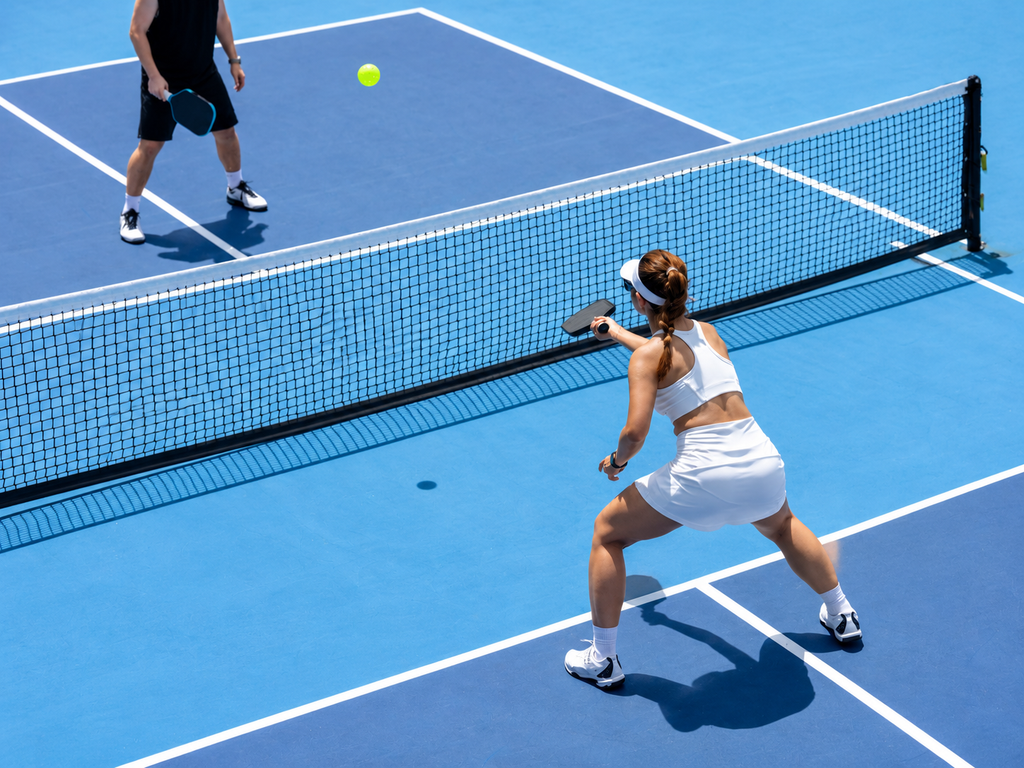
Pickleball is played by hitting a perforated plastic ball over a net using solid paddles. You can play singles or doubles, although doubles is more common. Serve underhand into the opposite service court, let the ball bounce once on each side and avoid volleying while standing in the kitchen. Most games are played to 11 points and won by two.
Pickleball Is Easier to Start Than It Looks
Pickleball may seem confusing when you first hear players calling three-number scores or warning each other to stay out of the kitchen. Once you understand a few basic rules, however, the game becomes surprisingly easy to follow.
You do not need years of training or expensive equipment to begin. A paddle, a pickleball, a suitable court and a few people are enough for your first game.
This guide will explain everything you need to know before stepping onto the court, including:
- The equipment you need
- How the court is arranged
- How to serve
- The two-bounce rule
- What the kitchen is
- How pickleball scoring works
- The basic shots beginners should practice
- Common mistakes to avoid
You probably will not remember every rule during your first game, and that is perfectly normal. Focus on keeping the ball in play, learning where to stand and enjoying the experience.
What Is Pickleball?
Pickleball is a paddle sport that combines familiar elements of tennis, badminton and table tennis.
Players use solid paddles to hit a lightweight plastic ball with holes over a net. The sport can be played indoors or outdoors as either:
- Singles: One player on each side
- Doubles: Two players on each side
Doubles is the most common format and is often easier for beginners because each player has less court to cover.
A standard pickleball court measures 20 feet wide by 44 feet long. The court dimensions are the same for singles and doubles. The net is 36 inches high at the sidelines and 34 inches high in the center.
The smaller court makes pickleball more approachable than some other racket sports, but the game can still become fast and highly strategic as your skills improve.
What You Need to Start Playing Pickleball
You do not need a large collection of equipment for your first game. Pickleball is easy to get into because the basic setup is simple and relatively affordable. All you really need is a paddle, the correct type of ball, access to a court and supportive athletic shoes.
Many recreation centers and pickleball clubs provide nets, balls and even loaner paddles for beginners. If you are trying the sport for the first time, consider borrowing or renting equipment before buying your own. This gives you a chance to learn what feels comfortable without spending too much upfront.
As you begin playing regularly, you can invest in your own paddle, court shoes and a few useful accessories. Start with the essentials and add equipment only when it improves your comfort, safety or enjoyment of the game.
Pickleball Paddle
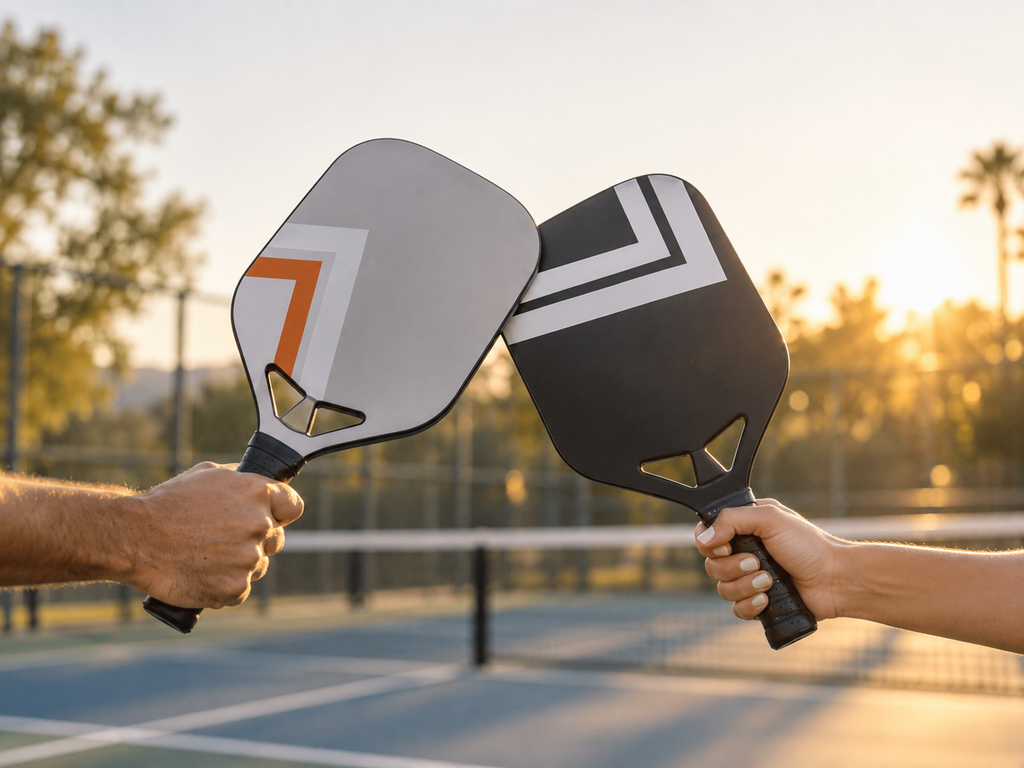
Pickleball paddles are larger than table tennis paddles but smaller than tennis rackets. They are commonly made from fiberglass, graphite, carbon fiber or composite materials.
Beginners should look for a paddle that feels comfortable and is not too heavy. A medium-weight paddle is usually a practical starting point because it offers a balance of control and power.
You do not need the most expensive paddle available. At the beginner level, comfort and control matter more than advanced paddle technology.
Pickleballs
Pickleballs are lightweight plastic balls with circular holes.
Indoor and outdoor pickleballs are slightly different:
- Indoor balls generally have fewer, larger holes and are designed for smoother indoor surfaces.
- Outdoor balls usually have more, smaller holes and are made to handle wind and rougher court surfaces.
Check whether you will be playing indoors or outdoors before buying balls.
Pickleball Net
Dedicated pickleball courts already have nets set at the correct height, so you can arrive and start playing without bringing your own.
A regulation pickleball net is 36 inches high at the sidelines and 34 inches at the center.
If you are setting up a temporary court in a driveway, gym or other suitable space, a portable pickleball net is the best option. These nets are designed to match official dimensions and can usually be assembled, moved and stored easily.
Make sure the net is stable, stretched evenly and positioned across the center of the playing area before you begin.
A tennis net may work for casual practice if it can be lowered to approximately 34 inches at the center. However, tennis nets are wider and are normally higher in the middle, so the ball may behave differently when it passes close to the net.
This setup is acceptable for learning basic rallies and practicing shots, but a proper pickleball net provides a more accurate playing experience.
Court Shoes
Wear athletic shoes that provide good side-to-side support and traction.
Running shoes are designed mainly for forward movement. Court shoes made for tennis, pickleball or similar sports are usually safer for the quick lateral movements required during a game.
Comfortable Clothing and Water
Choose clothing that allows you to move freely. Bring water, especially when playing outdoors or in warm conditions.
Optional beginner accessories include:
- Protective eyewear
- Sweatbands
- A paddle bag
- Extra balls
- Grip tape
- Sunscreen for outdoor play
Understanding the Pickleball Court
Knowing the main areas of the court will make the rules much easier to understand.
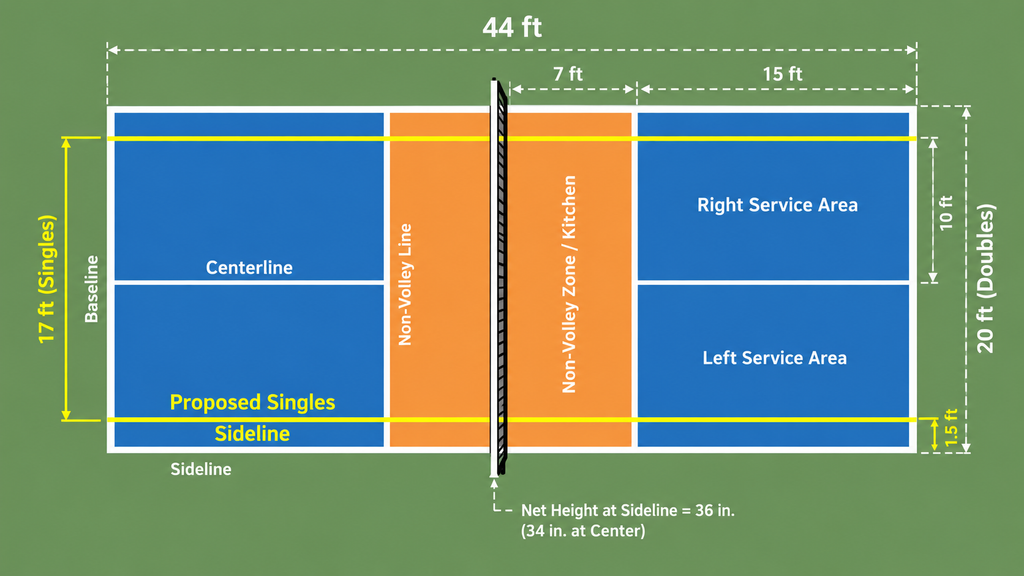
Baseline
The baseline is the line at the back of each side of the court. Servers must stand behind this line when striking the ball.
Sidelines
The sidelines run along the outer edges of the court.
Centerline
The centerline divides the right and left service courts. A serve must travel diagonally across the net into the opponent’s correct service court.
Non-Volley Zone or Kitchen
The non-volley zone is the seven-foot area on both sides of the net. It is commonly called the kitchen.
You cannot volley the ball while touching the kitchen or its boundary line. A volley means hitting the ball out of the air before it bounces.
You may enter the kitchen to return a ball that has already bounced. You may also stand there when you are not volleying, although remaining in the kitchen can put you in a poor playing position.
Before You Begin Your First Game
Take a few minutes to prepare before playing a full game.
Warm Up
Start with light movement and gentle stretching. Pay attention to your shoulders, wrists, hips, knees and ankles.
Then hit the ball back and forth from a short distance. You do not need to hit hard. The goal is to become comfortable tracking the ball and making contact with the center of the paddle.
Learn the Basic Grip
A simple continental grip works well for most beginners.
Imagine shaking hands with the paddle handle. The V shape between your thumb and index finger should rest near the top edge of the handle.
Hold the paddle securely but not too tightly. An excessively tight grip can make it harder to control the ball and may tire your hand and forearm.
Practice the Ready Position
Stand with your knees slightly bent, feet about shoulder-width apart and weight balanced on the front of your feet.
Keep the paddle in front of your body around chest height. This position helps you react to shots on either side.
Decide Who Serves First
For a casual game, you can use any fair method to choose the first serving team.
In doubles, the player positioned on the right side of the court serves first.
How to Play Pickleball Step by Step
Here is what happens during a typical pickleball rally.
Step 1: Serve Diagonally
The server stands behind the baseline and serves diagonally into the opponent’s service court.
A traditional volley serve must be made with an upward arm motion. Contact with the ball must be below the waist and the highest part of the paddle head must not be above the wrist when the ball is struck.
Players may also use a drop serve. For this type of serve, the player releases the ball without adding force, lets it bounce and then hits it.
The serve must:
- Travel over the net
- Land in the diagonally opposite service court
- Clear the kitchen and its boundary line
- Be made while the server is correctly positioned behind the baseline
Only one serve attempt is normally allowed.
A powerful serve can be useful later, but beginners should prioritize getting the ball into the correct service court consistently.
Step 2: Let the Serve Bounce
The receiving player must allow the serve to bounce before returning it.
Hitting the serve out of the air is a fault.
Step 3: Let the Return Bounce
After the receiving team returns the serve, the serving team must also allow that shot to bounce before hitting it.
This requirement is called the two-bounce rule because the ball must bounce once on each side before either team can begin volleying.
The rule applies to the first two shots of the rally:
- The serve bounces on the receiving side.
- The return bounces on the serving side.
After these two required bounces, players may hit the ball either before or after it bounces.
Step 4: Continue the Rally
Players continue hitting the ball over the net until one side commits a fault.
You may use groundstrokes, volleys, dinks, drives, lobs and other legal shots during the rally.
Beginners should focus on control and placement instead of trying to hit every ball with maximum power.
Step 5: End the Rally When a Fault Occurs
A rally ends when a player or team commits a fault.
Common faults include:
- Hitting the ball into the net
- Hitting the ball outside the court
- Allowing the ball to bounce twice
- Volleying before the two-bounce rule has been completed
- Volleying while touching the kitchen or kitchen line
- Being carried into the kitchen by momentum after hitting a volley
- Serving into the wrong court
- Serving into the kitchen or onto the kitchen line
If the serving team wins the rally under traditional scoring, it earns a point. If the receiving team wins, it gains the serve or moves the serve to the next server without earning a point.
How Pickleball Scoring Works
Scoring is usually the most confusing part for new players.
Most recreational games use traditional side-out scoring. Under this system:
- Only the serving team can score a point.
- Games are normally played to 11.
- A team must win by at least two points.
- If the score reaches 10–10, play continues until one team leads by two.
Some events and recreational groups use rally scoring, where a point is awarded after every rally. Ask which scoring system is being used before starting.
Scoring in Singles
Singles scores contain two numbers:
- The server’s score
- The receiver’s score
If your score is even, you serve from the right side. If your score is odd, you serve from the left side.
When the server loses the rally, the serve passes to the opponent.
Scoring in Doubles
Doubles scores contain three numbers:
- The serving team’s score
- The receiving team’s score
- The server number
For example, a score call of 4-2-1 means:
- The serving team has four points.
- The receiving team has two points.
- The team’s first server is serving.
Normally, both players on a team receive an opportunity to serve before the serve passes to the opposing team.
The exception happens at the beginning of the game. The first serving team receives only one service turn. For this reason, a traditional doubles game starts with the score called as 0-0-2.
This may feel strange at first, but it becomes easier after playing a few games.
The Kitchen Rule Explained Simply
The kitchen rule prevents players from standing directly beside the net and smashing every ball out of the air.
Remember these three points:
- You cannot volley while standing in the kitchen.
- You cannot touch the kitchen line while volleying.
- Your momentum cannot carry you into the kitchen after a volley.
You are allowed to step into the kitchen to hit a ball after it bounces.
For example, if your opponent hits a short shot that lands in the kitchen, you may step forward and return it after the bounce. Try to move back out afterward so you are prepared for the next shot.
A simple beginner reminder is:
No bounce in the kitchen means no volley. If the ball bounces first, you may enter and play it.
Five Basic Pickleball Shots for Beginners
You do not need to master every type of shot before playing. Start with these five fundamentals.
1. Serve
The serve starts each rally.
Use a smooth upward swing and aim deep into the opponent’s service court. Consistency is more valuable than speed during your first games.
2. Return of Serve
The return is the receiving team’s first shot.
Try to return the ball deep toward the opponent’s baseline. A deep return gives you more time to move forward and makes it harder for the serving team to attack immediately.
3. Groundstroke
A groundstroke is hit after the ball bounces.
Forehand and backhand groundstrokes are commonly used from the back of the court. Keep your swing controlled and make contact in front of your body.
4. Volley
A volley is a shot hit before the ball bounces.
Volleys are usually played near the kitchen line. Keep the paddle in front of your body and use a short, controlled motion rather than a large backswing.
Remember that you cannot volley while touching the kitchen.
5. Dink
A dink is a soft shot that travels over the net and lands in the opponent’s kitchen.
The goal is to make the ball difficult to attack. A successful dink stays low, forcing your opponent to hit upward.
Dinking may feel unusual at first, but it becomes an important part of pickleball strategy as you improve.
Where Should Beginners Stand?
Positioning makes the game easier even before you develop advanced technique.
When Returning the Serve
Stand behind the baseline so you have enough room to let the serve bounce.
Avoid standing on or inside the baseline because a deep serve may force you backward and leave you off balance.
After Returning the Serve
Move toward the kitchen line after hitting a deep return when it is safe to do so.
The kitchen line is often the strongest position because it allows you to take balls earlier and reduce the open space available to your opponents.
When Serving
Stay behind the baseline long enough to allow the return of serve to bounce. Moving forward too early can leave the ball at your feet and make the third shot difficult.
During Doubles Rallies
Try to move with your partner instead of leaving large gaps between you.
If your partner moves forward, look for an opportunity to move forward too. If one player stays back while the other stands at the kitchen line, opponents may target the space between them.
Common Beginner Pickleball Mistakes
Mistakes are part of learning, but recognizing these common problems can help you improve more quickly.
Trying to Hit Every Ball Hard
Power is exciting, but hard shots are difficult to control.
A slower ball that lands inside the court is more useful than a fast ball that goes into the net or beyond the baseline.
Forgetting the Two-Bounce Rule
New players often move forward and try to volley the third shot before allowing the return to bounce.
Remind yourself before each rally:
Serve bounce, return bounce, then volley.
Standing Too Close to the Baseline When Receiving
Give yourself space behind the line. Moving forward to a short serve is easier than backing up for a deep one.
Staying at the Back of the Court
Many beginners remain near the baseline throughout the rally.
When possible, work your way toward the kitchen line. You will have better angles and more opportunities to control the point.
Stepping Into the Kitchen After a Volley
Your momentum matters. Even if you contact the ball outside the kitchen, it is still a fault if your follow-through carries you into the zone.
Stay balanced and avoid reaching too far forward.
Using an Oversized Swing
The ball travels quickly on a small court. Large backswings take more time and reduce control.
Use compact swings, especially near the net.
Watching Your Opponent Instead of the Ball
Keep your eyes on the ball until it reaches your paddle. Looking up too early often causes mishits.
Buying Too Much Equipment Too Soon
You do not need a premium paddle, specialized bag and dozens of accessories before your first session.
Start with the essentials and upgrade when you understand your playing style and preferences.
A Simple First-Game Plan
Do not worry about advanced strategies during your first match. Use this basic approach:
- Serve the ball into the correct court.
- Return serves deep when possible.
- Remember the two-bounce rule.
- Keep the ball away from the net.
- Move toward the kitchen line when it is safe.
- Use controlled shots instead of maximum power.
- Communicate with your partner.
- Keep track of whose turn it is to serve.
- Call the score before serving.
- Focus on longer rallies and having fun.
Your goal is not to look like an experienced player. Your goal is to become comfortable with the flow of the game.
Recommended Gear for New Pickleball Players
A basic beginner setup should include:
- One comfortable medium-weight paddle
- Several indoor or outdoor pickleballs
- Supportive court shoes
- Comfortable athletic clothing
- A water bottle
- Sunscreen and a hat for outdoor games
- Protective eyewear if desired
If you are buying a paddle, consider:
- Weight: Lighter paddles are easier to move, while heavier paddles can provide more power.
- Grip size: The handle should feel secure without forcing you to squeeze tightly.
- Shape: A standard paddle shape offers a practical balance of reach and control.
- Surface material: Fiberglass and composite paddles can be affordable choices, while carbon-fiber paddles often emphasize control and feel.
- Approval status: Choose an approved paddle if you expect to participate in organized or tournament play.
The best beginner paddle is not necessarily the most expensive one. It is the paddle you can swing comfortably and control consistently.
How to Keep Improving
Improvement comes from practicing simple skills repeatedly.
Practice Your Serve
Set a target in the opposite service court and attempt to land several serves near it.
Begin with a comfortable pace. Once you can serve consistently, practice adding depth and placement.
Practice Groundstrokes
Hit forehand and backhand shots with a partner. Focus on contacting the ball in front of your body and keeping it inside the court.
Practice Dinking
Stand near the kitchen line with a partner and softly hit the ball back and forth into each other’s kitchen.
Try to keep the ball low over the net.
Practice Volleys
Start with gentle volleys from near the kitchen line. Keep your paddle up and use short movements.
Learn Through Recreational Play
Play with people who are willing to explain positioning and scoring as you go.
Most pickleball communities welcome beginners, but it is helpful to tell the group that you are learning before joining a game.
Focus on One Skill at a Time
Trying to fix every part of your game at once can become overwhelming.
Choose one goal for each session, such as:
- Serving consistently
- Returning deep
- Reaching the kitchen line
- Keeping your paddle up
- Reducing unforced errors
- Communicating with your partner
Small improvements add up quickly.
Frequently Asked Questions
Is pickleball difficult to learn?
Pickleball is relatively easy to start because the court is small and the basic rules can be learned quickly. Scoring and positioning may feel confusing during your first few games, but they become easier with practice.
Can you play pickleball with two people?
Yes. Two people can play singles, with one player on each side. You can also practice serves, dinks, volleys and groundstrokes with one partner.
Is pickleball normally played as singles or doubles?
Both formats are allowed, but doubles is more common. Doubles requires less court coverage and is often a comfortable way for beginners to start.
What is the kitchen in pickleball?
The kitchen is the seven-foot non-volley zone beside the net on each side of the court. Players cannot volley while touching this area or its boundary line.
Can the ball bounce in the kitchen?
Yes. The ball is allowed to bounce in the kitchen. A player may step into the kitchen and return it after the bounce.
How many times can the ball bounce?
The ball may bounce once before being returned. If it bounces twice on the same side, that team loses the rally.
The serve and the return of serve must each bounce once under the two-bounce rule.
How many points are needed to win?
Most traditional games are played to 11 points and must be won by two. Some games and tournaments may use different target scores or scoring formats.
Can the receiving team score a point?
Under traditional side-out scoring, only the serving team can score. If the receiving team wins the rally, it earns the opportunity to serve rather than a point.
Some venues and events use rally scoring, where every rally produces a point.
What does 0-0-2 mean?
In doubles, the first number is the serving team’s score, the second is the receiving team’s score and the third identifies the server.
A game begins at 0-0-2 because the first serving team receives only one service turn before the serve passes to the opponents.
Do you need special shoes for pickleball?
You can begin with supportive athletic shoes, but court shoes are recommended. They are designed to support the quick side-to-side movements used in pickleball.
Can you play pickleball on a tennis court?
Yes, a tennis court can be adapted for pickleball using temporary lines and a portable or adjusted net. The playing area should follow pickleball’s 20-by-44-foot court dimensions.
Start With the Basics and Enjoy the Game
You do not need perfect technique or a complete understanding of every rule to start playing pickleball.
Learn how to serve, remember the two-bounce rule, respect the kitchen and focus on keeping the ball in play. The scoring system will become more natural as you gain experience.
Your first few games may include missed serves, forgotten scores and accidental kitchen violations. Every player starts somewhere.
Grab a paddle, find a beginner-friendly court and enjoy learning one rally at a time.
Related Beginner Pickleball Guides
- Pickleball Rules Explained for Beginners
- How Pickleball Scoring Works
- What Is the Kitchen in Pickleball?
- How to Choose Your First Pickleball Paddle
- Essential Pickleball Gear for Beginners
- Beginner Pickleball Drills You Can Practice
- Singles vs. Doubles Pickleball
Ready to Start Playing Pickleball?
Explore more beginner pickleball guides, learn the essential skills and find the equipment you need to feel confident on the court.