
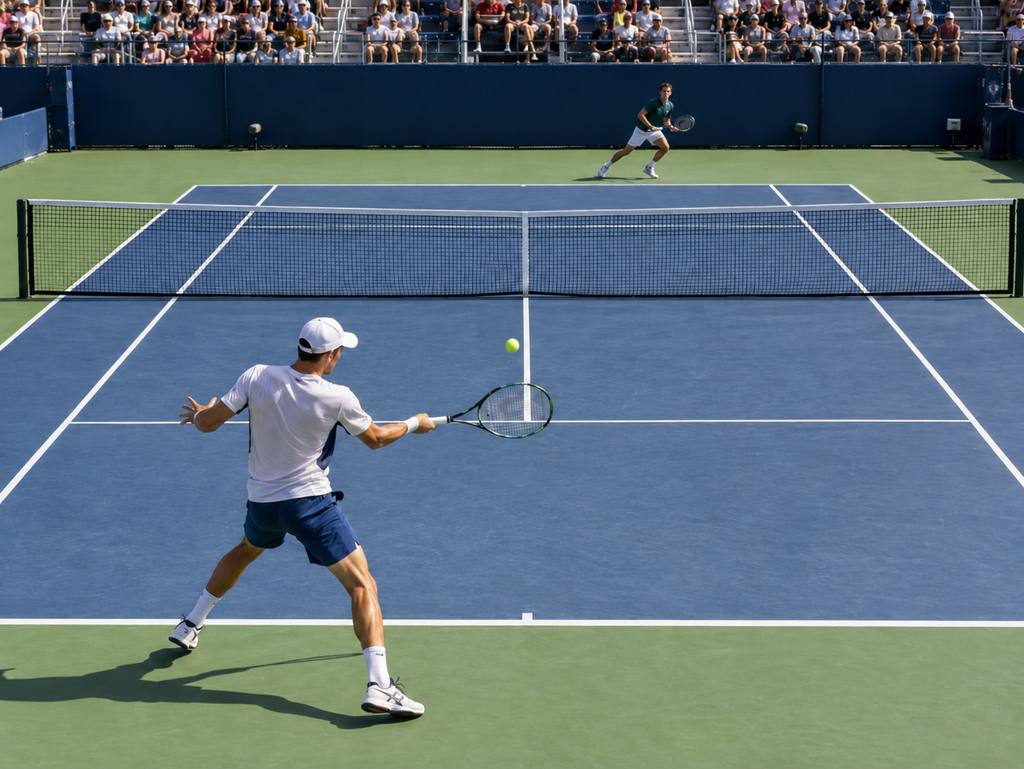
At higher levels of tennis, the difference between winning and losing often comes down to how effectively players use their existing skills. Two competitors may have similar serving ability, groundstroke pace, and court coverage, yet one consistently controls rallies by choosing better patterns, changing the tempo, and recognizing when an opponent is vulnerable.
Developing an effective advanced tennis strategy requires more than hitting accurate shots or maintaining long rallies. It involves creating situations that favor your strengths, anticipating how opponents may respond, and adjusting your decisions as the match develops. Rather than treating every shot as an isolated opportunity, experienced players learn to connect their choices into purposeful sequences.
What Makes Tennis Strategy Advanced?
At the intermediate level, strategy often focuses on maintaining consistency, choosing manageable targets, and recognizing attacking opportunities.
Advanced strategy adds another layer: influencing the type of ball an opponent is likely to produce.
A player may direct a shot toward a particular area not because that location is immediately open, but because the expected reply creates a favorable next shot.
For example, a deep crosscourt groundstroke may keep an opponent behind the baseline. Repeating that pattern can establish pressure, while a well-timed change in direction may take advantage of the opponent’s recovery movement.
The value of the pattern comes from the relationship between the shots, not necessarily from any single stroke.
Advanced tactical play generally involves:
- Controlling rally tempo and court position.
- Using repeatable patterns to create predictable responses.
- Changing direction or pace at advantageous moments.
- Exploiting an opponent’s recovery and movement.
- Recognizing when to maintain pressure rather than force a winner.
- Adjusting tactics according to match conditions and results.
The objective is to increase the number of situations in which you can execute your strongest shots under favorable conditions.
Control Time and Space During Rallies
Two important elements of competitive tennis are the time available to each player and the amount of court they must cover.
A shot can create pressure by reducing an opponent’s preparation time, increasing their movement distance, or combining both.
Take Time Away From Your Opponent
Taking the ball earlier can reduce the time an opponent has to recover.
For example, a player who contacts a manageable ball near the baseline may return it sooner than someone who retreats several meters before striking.
This can make the opponent’s next movement more difficult.
However, earlier contact also gives the hitter less reaction time.
Taking the ball early is useful only when your preparation, balance, and stroke control support it.
Do not move inside the baseline simply to appear aggressive.
Use Depth to Influence Court Position
A deep groundstroke can restrict an opponent’s ability to move forward comfortably.
Repeated depth may force the opponent to contact the ball farther behind the baseline, giving you greater opportunity to control the next exchange.
However, depth should be combined with placement and appropriate pace.
A deep ball directed toward an opponent’s strongest hitting zone may be less effective than a slightly shorter ball that forces difficult movement or contact.
Create Movement Without Overhitting
A wide shot can force an opponent to cover more court.
The goal is not always to hit near the sideline. Instead, use enough angle to create movement while preserving reasonable accuracy.
Once the opponent has been displaced, assess whether their recovery creates an opportunity elsewhere.
This approach often produces more reliable pressure than attempting consecutive maximum-power groundstrokes.
Use Tactical Patterns to Influence the Next Shot
Advanced players benefit from repeatable rally patterns that create favorable responses.
A tactical pattern is a sequence of shots designed around a particular objective.
It is not a rigid combination that must be completed regardless of the incoming ball.
Pattern 1: Establish Crosscourt Pressure, Then Redirect
Begin by directing controlled, deep groundstrokes toward the same crosscourt area.
This can encourage the opponent to remain positioned toward that side.
When you receive a suitable ball and recognize a recovery opening, redirect the shot down the line.
The tactical purpose: Use sustained pressure in one direction to create a more favorable opportunity in another.
The pattern works best when the change of direction is supported by your balance and contact position.
If the opponent produces a difficult ball, continue the safer exchange instead of forcing the planned redirection.
Pattern 2: Use Depth Before Creating an Angle
Begin with deep groundstrokes that keep the opponent near or behind the baseline.
When an easier incoming ball allows you to step forward, consider directing a controlled shot toward a wider area.
The tactical purpose: Use depth to influence court position before increasing the opponent’s lateral movement.
Attempting a sharp angle from several meters behind the baseline may require excessive precision.
Moving forward on a suitable ball can create a more favorable position for the angled shot.
Pattern 3: Pressure the Backhand, Then Change Direction
Against an opponent whose backhand produces less reliable or less aggressive replies, repeated backhand-side pressure may create a favorable ball.
The objective is not necessarily to win directly through the backhand exchange.
Instead, look for shorter returns, reduced pace, or predictable defensive responses.
When the opportunity develops, redirect toward an available area.
The tactical purpose: Create a repeatable weakness in the rally before changing the attacking direction.
This pattern should be adjusted if the opponent’s backhand proves effective under pressure.
Pattern 4: Draw the Opponent Forward, Then Exploit Their Position
A controlled shorter ball can sometimes encourage an opponent to move inside the baseline.
If the opponent cannot produce a strong attacking shot, their forward position may create opportunities for a passing shot or a ball directed into space behind them.
However, deliberately hitting short is risky against opponents who attack these balls effectively.
The tactical purpose: Change the opponent’s court position to create different shot options.
Use this pattern selectively rather than treating short balls as a universal attacking tool.
Manage Rally Tempo and Rhythm
Controlling a rally does not always mean increasing ball speed.
Players can create difficulty by changing the timing, height, depth, or pace of successive shots.
Change Pace With a Purpose
A slower, higher groundstroke may give you recovery time or require an opponent to generate their own pace.
A flatter, faster shot may take time away when you have a comfortable attacking opportunity.
The important principle is to change pace because it serves a tactical objective.
Slowing down a rally without considering the opponent’s strengths may simply give them more time to attack.
Vary Ball Height
Different ball trajectories can change an opponent’s preferred contact point.
A higher-bouncing topspin shot may force contact above a player’s comfortable hitting zone, while a lower trajectory may require them to adjust their stance and racket preparation.
These changes can become useful when the opponent has difficulty handling a particular height.
However, variation alone does not create pressure.
Pay attention to whether the adjustment actually reduces the quality of the opponent’s response.
Avoid Predictable Acceleration
Players sometimes hit several neutral shots and then suddenly attempt maximum power.
This can produce unnecessary errors if the incoming ball does not justify the increase.
Instead, accelerate when your court position, preparation, and target provide a realistic advantage.
Purposeful changes in tempo are generally more effective than random changes in intensity.
Recognize and Exploit Recovery Patterns
An opponent’s movement after a shot can provide information about where the next opportunity may develop.
Experienced players watch not only the ball but also how the opponent recovers.
Observe the Opponent’s First Recovery Movement
After forcing an opponent wide, notice whether they move quickly toward the center or remain close to the sideline.
An opponent who recovers aggressively may leave an opportunity behind their movement.
A player who remains wide may be vulnerable toward the opposite side.
These tendencies can influence your next target.
Avoid Attacking Based on Position Alone
An opponent who appears out of position may still be able to produce an effective defensive or counterattacking shot.
Consider the quality of your incoming ball, the opponent’s balance, and the time available.
A tactical opening is valuable only when you can execute the required shot reliably.
Use Repeated Patterns to Gather Information
Early in a match, several similar exchanges may reveal how an opponent responds to certain targets.
For example, they may consistently return a wide forehand crosscourt or choose a defensive lob when pressured near the baseline.
This information can help you anticipate likely responses later.
However, patterns are tendencies rather than guarantees. Maintain the ability to react when the opponent changes their response.
Adapt Your Strategy to Different Opponents
An effective advanced tennis strategy should reflect the opponent’s playing style and capabilities.
The same rally pattern may produce different results against different players.
Against an Aggressive Baseliner
Aggressive baseliners often try to control points through pace and early contact.
Potential responses include:
- Maintaining reliable depth to reduce easy attacking opportunities.
- Varying ball height or pace when the opponent struggles with rhythm changes.
- Using controlled angles to force additional movement.
- Avoiding short central balls that allow comfortable acceleration.
Do not assume that every aggressive player struggles with slower shots. Test different responses and evaluate the results.
Against a Consistent Defensive Player
Defensive players often rely on court coverage and the ability to return difficult shots.
Trying to hit a winner from every neutral position can increase your own error count.
Instead, build pressure over several shots.
Use depth and placement to create movement, then attack when the opponent produces a manageable ball.
Be prepared to finish points with a controlled follow-up rather than expecting one powerful groundstroke to end the rally.
Against a Player Who Approaches the Net Frequently
A frequent net attacker attempts to shorten points and intercept shots early.
Maintaining sufficient groundstroke depth can make it harder for them to approach comfortably.
When they move forward, evaluate passing-shot targets and lob opportunities according to their position.
Avoid predictable, comfortable balls that allow easy volleys.
Against a Player With an Uneven Stroke Profile
Some opponents are noticeably stronger on one groundstroke side.
Test whether directing balls toward the less reliable side produces weaker replies.
However, avoid becoming so predictable that the opponent can anticipate every shot.
Use their tendencies to guide your patterns while maintaining the option to change direction.
Detailed methods for identifying and exploiting weaknesses will be covered in a dedicated Advanced Tennis Guide.
Adjust Tactics During Different Match Situations
Tactical decisions should remain adaptable as match conditions change.
When Your Main Pattern Stops Working
A pattern that produces opportunities early in a match may become less effective once the opponent adjusts.
For example, an opponent may begin recovering earlier, changing their return direction, or moving closer to the baseline.
Recognize the adjustment instead of repeating the same sequence indefinitely.
Consider whether you need to change depth, direction, pace, or the timing of your attack.
When You Are Making Too Many Errors
An increased error count may indicate that your chosen targets are too demanding or that you are attacking unsuitable balls.
Temporarily increase your shot margins and focus on establishing useful depth.
This does not require abandoning aggression entirely.
It means rebuilding control before attempting more demanding patterns.
When You Are Controlling Most Rallies
If your existing tactics consistently produce favorable situations, unnecessary changes may reduce their effectiveness.
Continue using successful patterns while remaining alert to adjustments by the opponent.
Variation should support your advantage rather than become an objective in itself.
During Important Points
High-pressure points often tempt players to choose unfamiliar or unusually aggressive shots.
A more dependable approach is to rely on patterns that have already worked during the match.
Select targets and shot combinations you can execute confidently.
The objective is to make a sound tactical decision under pressure, not to produce an exceptional shot simply because the score is important.
Four Advanced Tennis Strategy Drills
These exercises connect tactical planning with realistic decision-making.
Drill 1: Pattern Recognition Rally
Objective: Identify recurring opponent responses and adjust the next shot accordingly.
Setup: Two players begin controlled baseline rallies.
Instructions:
- Direct several shots toward a designated area.
- Observe how your partner typically responds.
- Identify a recurring return direction or recovery movement.
- Select a suitable shot that takes advantage of that response.
- Continue the rally competitively.
- Repeat using another target area.
Practice focus: Recognize tendencies without assuming every response will be identical.
Drill 2: Depth Before Direction
Objective: Use deep groundstrokes to create a favorable directional opportunity.
Setup: Begin a cooperative baseline rally with a practice partner.
Instructions:
- Aim consecutive groundstrokes toward a deep target zone.
- Maintain control until a manageable attacking ball arrives.
- Move into an appropriate hitting position.
- Direct the next shot toward a wider target.
- Continue the point to completion.
- Repeat for ten to fifteen points.
Practice focus: Establish pressure before attempting a more demanding target.
Drill 3: Tempo Variation Challenge
Objective: Practice purposeful changes in rally pace and trajectory.
Setup: Two players rally from the baseline.
Instructions:
- Establish a neutral rally at a consistent pace.
- Introduce a higher or slower shot when appropriate.
- Observe how the opponent responds.
- Increase pace on a suitable incoming ball.
- Continue the point without following a rigid sequence.
- Review which changes created useful pressure.
Practice focus: Choose tempo changes based on their effect rather than changing speed randomly.
Drill 4: Tactical Adjustment Practice Set
Objective: Develop the ability to change strategy during competition.
Setup: Play a short set or series of practice games.
Instructions:
- Begin with one clearly defined tactical objective.
- Apply the chosen pattern during suitable points.
- Review the results after several games.
- Identify whether the opponent has adjusted.
- Make one tactical change if necessary.
- Continue playing and compare the results.
Practice focus: Evaluate repeated patterns and adjust without abandoning reliable fundamentals.
How to Evaluate Advanced Tactical Performance
Advanced tactical improvement cannot be measured solely by winners or total points won.
The quality of the decisions leading to those results is equally important.
Track Points Won Through Planned Patterns
Identify points in which a deliberate sequence helped create a favorable opportunity.
Record whether the pattern successfully produced the intended response, even when the final shot was missed.
This separates tactical effectiveness from execution quality.
Evaluate the Quality of Attacking Opportunities
Observe whether your patterns create manageable attacking balls.
A player who repeatedly receives short, attackable replies may be using effective tactics even if their finishing execution needs improvement.
Monitor Errors During Tactical Changes
Track whether changes of direction or tempo produce an excessive number of errors.
A pattern that creates occasional winners but frequent unnecessary mistakes may not be worthwhile.
Review Opponent Adjustments
After a match, identify whether the opponent changed position, direction, pace, or shot selection in response to your tactics.
Consider how effectively you recognized and answered those adjustments.
Compare Performance Across Different Opponents
A strategy that works against one playing style may not work against another.
Keep brief notes about which patterns were effective and which required modification.
Over time, this can help you develop a broader and more adaptable tactical game.
Develop a Strategy That Controls the Match
Effective advanced tennis strategy comes from using your technical skills to influence the conditions of each rally.
Instead of treating every shot independently, develop patterns that control depth, direction, tempo, and your opponent’s court position. Observe how your opponent responds, then choose the next shot according to the opportunity created.
Start with one or two reliable tactical patterns and practice them against different opponents. Evaluate whether they produce manageable attacking opportunities, reduce unnecessary risk, and remain effective as match conditions change.
As your tactical awareness improves, you can move beyond reacting to the ball and begin shaping rallies around your strengths, making more purposeful decisions throughout competitive matches.