
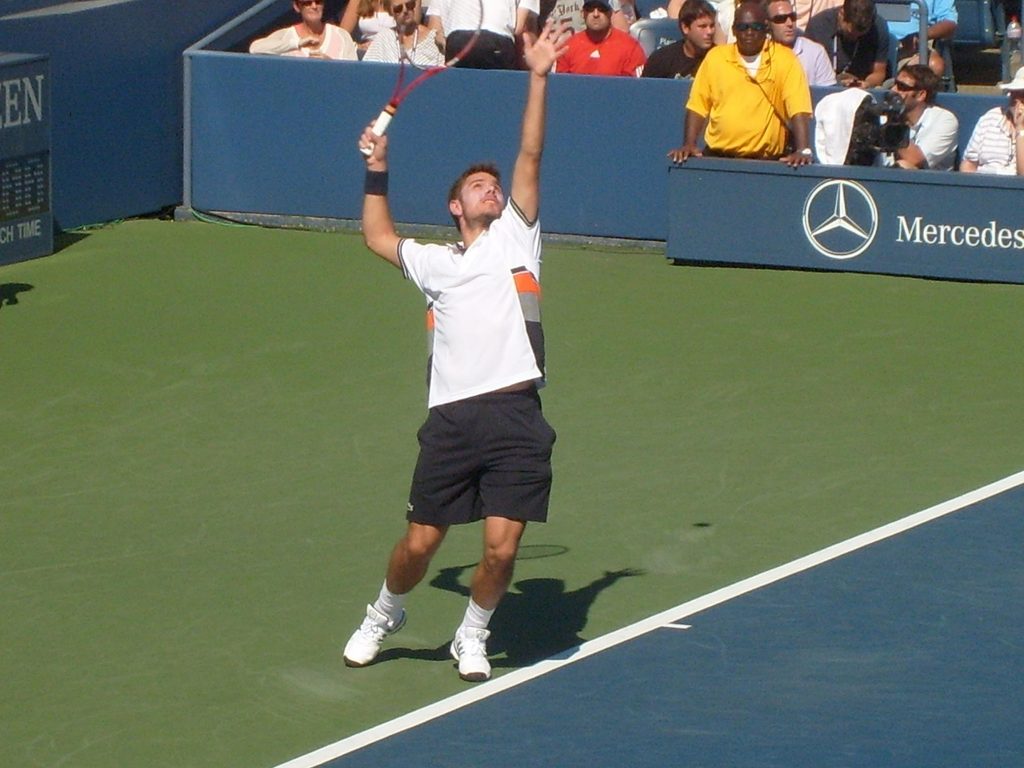
A strong tennis serve becomes more difficult to return when opponents cannot predict its speed, spin, trajectory, or bounce. While serving power and placement remain important, experienced players gain an additional advantage by developing multiple serve types that create different challenges for the receiver.
Understanding tennis serve variations allows advanced players to move beyond relying on a single serving motion. Flat serves can deliver pace and a direct trajectory, slice serves can move laterally through the air and after the bounce, and kick serves can produce greater net clearance and a higher, more challenging bounce. Each variation has different technical requirements and tactical applications.
Learning how these serves work, when to use them, and how to practice them can help you develop a more versatile and reliable service game.
Why Advanced Players Need Different Types of Tennis Serves
A player who repeatedly delivers the same serve gives opponents opportunities to adjust their return position and timing.
Even a powerful serve becomes easier to anticipate when its direction, speed, and bounce remain predictable.
Serve variation introduces uncertainty.
Instead of preparing for one familiar ball, the receiver must account for several possible trajectories and contact heights.
A developed serving repertoire provides several advantages:
- Different speeds and trajectories that challenge return timing.
- Spin variations that change the ball’s flight and bounce.
- Greater flexibility when selecting wide, body, or T targets.
- More options when the first serve is not landing consistently.
- Opportunities to exploit a receiver’s preferred contact height or return position.
- More tactical choices during important service points.
However, variation is useful only when each serve can be executed with reasonable reliability.
A player who attempts an unfamiliar serve during a critical point may introduce more risk than pressure.
Advanced serve development should begin with repeatable mechanics before progressing toward demanding placement and tactical combinations.
Understanding the Role of Spin in Tennis Serves
The main differences between flat, slice, and kick serves come from the racket’s motion through contact and the spin imparted to the ball.
Ball Rotation Changes Its Flight
A tennis ball’s rotation affects how it travels through the air.
Topspin contributes to a downward-curving trajectory, while sidespin can make the ball curve laterally.
The resulting flight also depends on ball speed, launch angle, and the combination of spin components.
No serve is entirely defined by one isolated physical effect.
For example, a typical slice serve combines sidespin with other rotational components, while a kick serve commonly combines substantial topspin and sidespin.
Spin Also Influences the Bounce
When a spinning ball contacts the court, its rotation interacts with the surface.
This can affect the direction, height, and speed of the bounce.
A serve with substantial topspin often rebounds more aggressively upward, while a slice serve can move sideways after bouncing.
The exact effect varies according to spin rate, court surface, ball condition, and the incoming trajectory.
Flat Does Not Mean Completely Spin-Free
A flat serve generally has less spin than a deliberately sliced or kicked serve.
However, a real flat serve does not necessarily travel without any rotation.
The term describes a serve emphasizing forward pace and a relatively direct trajectory rather than substantial spin production.
How to Hit a Flat Tennis Serve
The flat serve is commonly associated with pace and a direct ball flight.
It is frequently used as a first serve because it can reduce the receiver’s reaction time.
However, a faster serve generally leaves less margin for error if the trajectory and placement are not controlled.
Flat Serve Mechanics
A reliable flat serve depends on a coordinated motion involving the legs, trunk, shoulder, arm, and racket.
The objective is to accelerate the racket efficiently and make clean contact with an appropriate racket-face orientation.
Preparation and toss
Begin with your normal serving stance and a repeatable toss.
For a right-handed server, the toss for a typical flat serve is commonly positioned somewhat forward and toward the hitting side, although the ideal location varies with technique.
Maintain a comfortable rhythm that allows full extension without reaching excessively.
Racket acceleration
Accelerate upward toward the ball using coordinated body movement.
The racket travels through a three-dimensional path involving shoulder rotation and forearm pronation as part of the serving action.
Avoid attempting to create power through a deliberate last-second wrist snap.
Contact and follow-through
Contact the ball at a comfortable extended position with the racket face appropriately oriented toward the intended trajectory.
Allow the racket and body to continue through a natural follow-through.
The precise finish may vary between players.
When to Use a Flat Serve
A flat serve can be useful when:
- You want to reduce the receiver’s reaction time.
- Your first-serve accuracy is reliable.
- The receiver struggles against pace.
- You have identified a suitable target with enough margin.
- You want to vary the speed compared with previous serves.
A flat serve is not automatically the best choice on important points.
Its effectiveness depends on your ability to place it consistently.
Common Flat Serve Problems
Too many faults: Excessive pace or insufficient control may cause repeated misses.
Inconsistent contact: A variable toss or rushed serving rhythm may interfere with accuracy.
Overhitting: Trying to maximize racket speed without maintaining coordination can reduce reliability.
To improve, begin with controlled pace, develop repeatable contact, and increase speed gradually.
How to Hit a Slice Tennis Serve
The slice serve uses sidespin to influence the ball’s trajectory and bounce.
A well-executed slice serve can curve through the air and continue moving laterally after bouncing, potentially forcing the receiver away from a comfortable contact position.
It can also be effective when directed toward the receiver’s body.
Slice Serve Mechanics
The slice serve is created by changing the racket’s movement and orientation through contact while preserving an efficient serving action.
Preparation and toss
Use a repeatable toss suitable for your technique.
Some players make a modest toss adjustment compared with a flat serve, but dramatic changes may reduce consistency or reveal the intended serve.
Racket path
Accelerate the racket upward and across the ball to produce a substantial sidespin component.
The exact path depends on handedness, grip, toss, and the desired slice trajectory.
Rather than thinking only about brushing around the side of the ball, focus on a coordinated motion that generates both forward speed and rotation.
Contact and follow-through
Maintain sufficient racket speed through contact.
Allow the natural rotation of the arm and body to continue rather than forcing the wrist sideways.
A slice serve should still be delivered through a complete and balanced service motion.
When to Use a Slice Serve
Slice serves can be effective when you want to:
- Move a receiver laterally.
- Pull an opponent away from the central court.
- Create an awkward contact position.
- Vary the trajectory of your first serve.
- Change the receiver’s timing after a faster, flatter serve.
A slice serve directed wide may create an open court for the next shot.
However, a receiver who reaches the ball comfortably may also use the wide position to generate an angled return.
The placement must match your tactical plan.
Common Slice Serve Problems
Insufficient sideways movement: The racket path may not be generating enough sidespin.
Weak or floating serves: Excessive focus on brushing can reduce useful forward pace.
Unreliable placement: Dramatic toss changes or inconsistent racket orientation may create directional errors.
Practice combining spin with controlled acceleration rather than sacrificing all pace to generate rotation.
How to Hit a Kick Tennis Serve
The kick serve is valued for its combination of net clearance, downward-curving flight, and relatively high bounce.
It is frequently associated with second serves because its spin can provide a useful margin over the net while helping the ball descend into the service box.
However, kick serves can also be used aggressively as first serves.
Kick Serve Mechanics
A kick serve typically combines substantial topspin with a sidespin component.
The racket follows a more upward and across-the-ball path than a conventional flat serve.
Preparation and toss
Many players position the toss somewhat more toward the non-dominant side than they would for a flat serve.
For a right-handed player, this often means a toss more toward the left side of the player’s overhead contact area.
The precise position depends on the individual serving motion.
Avoid tossing so far behind the body that you must arch excessively or lose balance.
Upward racket acceleration
Accelerate the racket strongly upward through the contact zone while generating the spin required for the intended trajectory.
Although players often describe the action as brushing upward, the racket must also impart forward speed.
Trying to create spin through a slow, exaggerated brushing motion may produce a weak serve.
Contact and follow-through
Maintain coordinated shoulder and arm movement through contact.
The exact racket-face orientation and swing path differ from a flat serve, but the motion should remain fluid rather than involve a forced wrist flick.
Allow the racket to continue naturally after striking the ball.
Why the Kick Serve Bounces Higher
The topspin component helps produce a flight that drops into the service box and influences the ball’s rebound.
With suitable incoming speed, trajectory, and spin, the ball can kick upward after contact with the court.
This may force the receiver to strike at shoulder height or another uncomfortable position.
The lateral component can also make the bounce move sideways.
The amount of kick depends on technique, court surface, and other conditions.
When to Use a Kick Serve
A kick serve may be useful when:
- You need reliable net clearance on a second serve.
- An opponent struggles with higher contact points.
- You want to vary bounce height and return timing.
- You want a spin-based serve that still applies pressure.
- The receiver stands in a position that makes a high, moving bounce difficult to handle.
A kick serve does not need to be slow.
Advanced players can combine substantial spin with useful pace, making the serve challenging even when the receiver anticipates it.
Common Kick Serve Problems
Serving too short: Excessive brushing without enough forward acceleration may produce a weak ball.
Limited bounce height: Insufficient spin, an unsuitable trajectory, or inconsistent contact can reduce the kicking effect.
Excessive body arching: An uncomfortable toss may encourage poor balance or unnecessary stress.
Develop the motion gradually and avoid forcing extreme positions to imitate professional players.
Flat vs. Slice vs. Kick Serve: Key Differences
| Feature | Flat Serve | Slice Serve | Kick Serve |
|---|---|---|---|
| Primary emphasis | Pace | Lateral spin and movement | Topspin and high bounce |
| Ball trajectory | Relatively direct | Curving sideways | Greater clearance and downward dip |
| Typical bounce | More direct, often lower | Moves laterally | Can rise higher and move sideways |
| Common application | Fast first serve | Wide or body placement | Spin-based first or second serve |
| Main challenge | Controlling pace and margins | Balancing spin with speed | Coordinating upward acceleration and spin |
These are general characteristics, not rigid categories.
A player can hit a fast slice serve, an aggressive kick serve, or a flat serve with some rotation.
Serve selection should reflect what you can execute and what creates difficulty for the receiver.
How to Choose the Right Serve During a Match
Advanced tennis serve variations become more useful when connected to a clear tactical objective.
Consider the Receiver’s Position
A receiver standing far behind the baseline may have more time to react to a fast serve.
A player standing closer may take the return earlier but have less reaction time.
Observe their starting position and whether they adjust it after particular serves.
Identify Difficult Contact Heights
Some receivers are comfortable returning low, fast balls but struggle with higher bounces.
Others handle topspin effectively but have difficulty adjusting to a low or laterally moving serve.
Test different variations during the match and compare the quality of the returns.
Combine Serve Type With Placement
The effectiveness of a serve depends on both its spin and its target.
A slice serve directed wide produces a different tactical situation from one directed toward the body.
Similarly, a kick serve directed toward a receiver’s backhand may create a different response from a serve toward their forehand.
Choose combinations according to the opponent rather than assuming one serve type always belongs in one area.
Avoid Predictable Sequences
Repeatedly using the same serve in the same location can allow a skilled receiver to anticipate the bounce.
Variation can help prevent that adjustment.
However, changing serve type on every point is unnecessary.
Maintain successful combinations until the opponent demonstrates that they can handle them consistently.
Match Risk to Your Serving Ability
A high-speed flat serve may be appropriate when you can place it reliably.
A well-developed kick or slice serve may offer a better combination of margin and pressure in another situation.
Do not choose a serve solely because it is considered more advanced.
Choose the variation that offers a realistic advantage.
Five Advanced Tennis Serve Drills
The following exercises develop spin control, placement, and tactical variety.
Drill 1: Three-Serve Technique Rotation
Objective: Develop repeatable mechanics for flat, slice, and kick serves.
Setup: Prepare a basket of tennis balls and designate a broad target inside the correct service box.
Instructions:
- Warm up using progressive serving motions.
- Hit five controlled flat serves.
- Hit five slice serves.
- Hit five kick serves.
- Record service-box accuracy for each variation.
- Repeat from the opposite serving side.
Practice focus: Maintain a repeatable routine while producing a distinct trajectory and bounce for each serve.
Begin below maximum effort.
Drill 2: Slice Serve Target Challenge
Objective: Combine slice spin with controlled placement.
Setup: Mark a generous target zone toward the wider portion of the service box.
Instructions:
- Hit ten slice serves toward the selected target.
- Observe the ball’s flight and lateral bounce.
- Record how many serves land in the target zone.
- Repeat from the opposite serving side.
- Adjust the target only after establishing reliable accuracy.
Practice focus: Generate meaningful sidespin without losing forward pace or control.
Drill 3: Kick Serve Bounce Control
Objective: Develop a repeatable kick trajectory and useful bounce height.
Setup: Have a practice partner receive serves from a consistent return position.
Instructions:
- Deliver controlled kick serves toward a broad target.
- Ask the receiver to observe the bounce and contact height.
- Record whether the ball lands in the intended area.
- Compare trajectories over ten to fifteen serves.
- Adjust the serving motion based on repeated patterns.
Practice focus: Generate a reliable upward-and-forward racket action with appropriate spin.
Do not exaggerate the toss or body arch to force a higher bounce.
Drill 4: Serve Variation Recognition
Objective: Practice producing different serves without becoming predictable.
Setup: Use a partner who can call out a serve type before each attempt.
Instructions:
- Prepare using your normal serving routine.
- Have the partner call flat, slice, or kick.
- Execute the requested variation toward a broad target.
- Record serve accuracy and whether the intended spin effect occurred.
- Repeat for twenty attempts.
Practice focus: Maintain control while switching serve mechanics.
Progress to selecting the variation yourself according to a hypothetical receiver position.
Drill 5: Serve and Return Tactical Challenge
Objective: Evaluate serve variations against a live receiver.
Setup: Play short service games with a partner returning normally.
Instructions:
- Select a serve type and target before each point.
- Deliver the serve using a repeatable routine.
- Continue the point through the return and subsequent rally.
- Record whether the serve produced the intended response.
- Compare the results of different serve types.
- Adjust selections based on the receiver’s performance.
Practice focus: Evaluate serve effectiveness rather than measuring accuracy alone.
A serve that lands in but allows an easy attacking return may be less useful than one that produces a difficult response.
Common Mistakes When Developing Serve Variations
Changing the Toss Too Dramatically
Large toss differences may interfere with consistency or allow opponents to anticipate the serve.
Correction: Develop controlled, technically appropriate toss variations without unnecessarily changing the entire motion.
Trying to Generate Spin Only With the Wrist
Exaggerated wrist manipulation can disrupt racket control.
Correction: Use coordinated racket acceleration and a suitable contact path.
Practicing Only Maximum-Power Flat Serves
This can limit your ability to develop spin-based options and reduce your second-serve confidence.
Correction: Allocate dedicated practice time to each serve variation.
Sacrificing All Pace for Spin
Excessive brushing with little forward racket acceleration may produce short, attackable serves.
Correction: Develop the ability to combine useful spin with forward speed.
Using New Serves Before They Are Reliable
Attempting an unfamiliar kick serve during an important match point can create unnecessary risk.
Correction: Establish accuracy and repeatability in practice before relying on the variation competitively.
Ignoring the Receiver’s Response
Producing a technically good serve does not guarantee it is effective against a particular opponent.
Correction: Evaluate the quality of the return and adjust serve selection accordingly.
How to Measure Improvement in Serve Variation
Tracking a few indicators can help advanced players evaluate progress objectively.
Accuracy by Serve Type
Record successful serves separately for flat, slice, and kick variations.
Use the same number of attempts and similar target sizes when comparing sessions.
Intended Spin Execution
Observe whether each serve produces its expected trajectory or bounce.
For example, a slice serve should demonstrate meaningful lateral movement, while a kick serve should produce the intended higher or more challenging bounce.
Target Placement
Measure whether the serve reaches its chosen wide, body, or T area.
Serve-box accuracy alone does not establish precise placement control.
Return Quality
During practice points, evaluate how opponents respond to different serves.
Track returns that are missed, returned defensively, or struck aggressively.
Avoid interpreting one successful serve as proof of a superior tactic.
Reliability Under Pressure
Compare your normal practice results with those achieved during tiebreaks, simulated games, or actual matches.
An effective serving repertoire must remain reasonably dependable when the score matters.
Build a More Versatile Service Game
Developing effective tennis serve variations gives advanced players more ways to influence the start of a point.
The flat serve provides a direct, pace-oriented option. The slice serve introduces lateral movement, while the kick serve offers a different trajectory and potentially challenging bounce.
Each variation requires controlled mechanics, a repeatable serving motion, and an understanding of how the resulting ball affects the receiver.
Start by developing reliable execution of each serve independently. Then combine spin variations with different target locations and test them against live returns.
The goal is not to produce the fastest serve or the greatest amount of spin on every attempt. It is to develop a service game that offers multiple dependable options, allowing you to select the most effective serve for the opponent and match situation.