
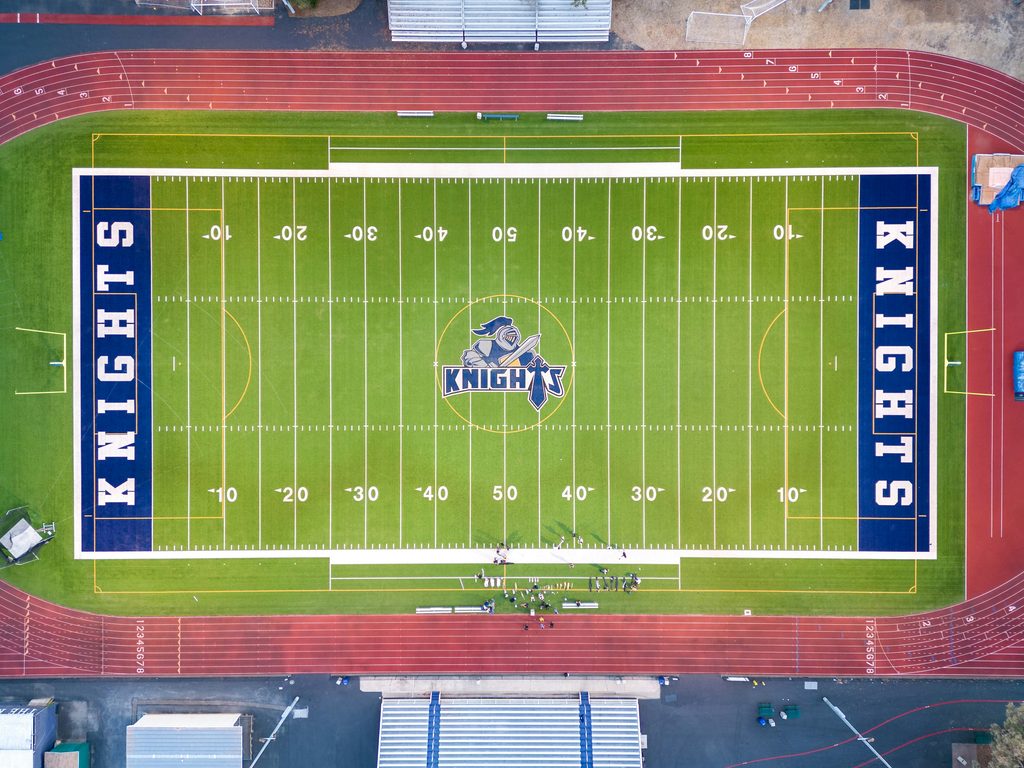
An American football field can look complicated when you first watch a game. There are numbers on both sides, lines running across the field, short marks near the middle, large painted end zones, and goalposts at each end.
Once you understand what those markings mean, following the action becomes much easier.
This american football field explained guide covers the main parts of the field, including its dimensions, end zones, goal lines, yard lines, numbers, hash marks, sidelines, end lines, goalposts, and the 50-yard line. It also explains how announcers describe field position during a game.
The purpose is simple: help a complete beginner look at a football field and understand where the ball is and where each team is trying to go.
How Big Is an American Football Field?
A standard American football field is rectangular.
From one end line to the other, the field is 120 yards long. However, only 100 of those yards make up the main field of play. The remaining 20 yards come from two 10-yard end zones, one at each end.
The field is 53 1/3 yards wide, which is 160 feet.
NFL rules describe the field as 360 feet long and 160 feet wide. The goal lines are positioned 10 yards inside each end line, creating the two end zones.
So the basic layout looks like this:
- 10-yard end zone
- 100-yard field of play
- 10-yard end zone
The dimensions are important because nearly everything that happens in football is measured according to a team’s position on this field.
What Are the End Zones?
The end zones are the scoring areas located at both ends of the field.
Each end zone is 10 yards deep and extends across the full width of the field. In the NFL, that means an end zone measures 10 yards by 53 1/3 yards.
Teams are normally trying to advance the football toward the opponent’s end zone.
A touchdown can be scored when a player legally possesses the ball in the opponent’s end zone. For example, a runner can carry the ball across the goal line, or an eligible receiver can catch a legal pass in the end zone.
End zones are often painted with team names, logos, or other designs, which makes them easy to identify when watching a game.
What Is the Goal Line?
The goal line separates the regular field of play from the end zone.
There is one goal line at each end of the 100-yard playing area.
The goal line is especially important because reaching or crossing it with possession of the football can result in a touchdown. Under NFL terminology, the goal line is considered part of the end zone, and the plane of the goal line extends vertically upward.
For a beginner, the easiest way to think about it is:
The goal line is the entrance to the end zone.
If a ball carrier has possession and the ball legally breaks the plane of the opponent’s goal line, the play can result in a touchdown even if the player’s entire body has not entered the end zone.
What Are Yard Lines?
The long white lines running across the width of the field are yard lines.
They help players, officials, coaches, and viewers measure how far the ball has moved.
Major yard lines are marked at five-yard intervals.
Starting from one goal line, the markings progress:
10, 20, 30, 40, 50.
After the 50-yard line, they count back down:
40, 30, 20, 10.
That pattern exists because yard lines are described according to their distance from the nearest goal line rather than by numbering the entire field from 1 to 100.
This explains why a football field does not have a visible “60-yard line” or “80-yard line.”
Instead, once you cross midfield, you begin counting down toward the other team’s goal line.
What Do the Yard Numbers Mean?
The large numbers painted on the field make it easier to identify field position.
You will normally see:
10, 20, 30, 40, 50, 40, 30, 20, 10
The numbers correspond to the yard lines.
Imagine that a team begins with the ball at its own 20-yard line. To reach midfield, it must move 30 yards.
If that team continues across the 50-yard line, it enters its opponent’s side of the field. From there, the numbers begin decreasing as the offense gets closer to the opponent’s end zone.
This may seem unusual at first, but it quickly becomes one of the easiest ways to understand where the football is.
Why Is the 50-Yard Line Important?
The 50-yard line marks the exact middle of the 100-yard field of play.
It separates one team’s half of the field from the other team’s half.
When an offense reaches the 50, it has reached midfield. Advancing beyond it means the offense has entered its opponent’s territory.
The 50-yard line also helps viewers quickly judge field position.
For example, a team beginning at its own 10-yard line has a long distance to travel before reaching the opponent’s end zone. A team beginning at the opponent’s 30-yard line already has favorable field position because it is much closer to scoring.
Midfield is also where teams frequently display a large logo.
What Are Hash Marks?
The short lines running down the field between the sidelines are called hash marks, or inbounds lines.
Hash marks help officials determine where the football should be positioned between plays.
They also provide one-yard references, making it possible to identify field position more precisely than the larger five-yard lines alone.
In the NFL, the hash marks are located 70 feet 9 inches from each sideline. College football uses a wider spacing, with its hash marks 60 feet from each sideline.
This is one of the visible differences between football fields used at different levels.
The exact spacing can affect strategy because plays beginning near a hash mark create different amounts of space on each side of the ball. For a beginner, however, the main thing to remember is that hash marks help establish where the next play begins.
Why Does the Ball Sometimes Move to a Hash Mark?
Suppose a running back carries the ball toward the sideline and is tackled close to the boundary.
The next play does not necessarily begin at that exact sideways position.
Instead, the ball may be brought inward and placed at the appropriate hash mark. This keeps plays from repeatedly starting extremely close to the edge of the field.
That is why you may see an official pick up the ball after a play and carry it several yards sideways before placing it down for the next snap.
The ball has not gained extra distance toward the goal line. The official is simply placing it at the correct inbounds position.
What Are the Sidelines?
The two long boundaries running from one end of the field to the other are the sidelines.
Anything beyond them is out of bounds.
The sidelines separate the playing area from team benches, coaches, substitutes, officials, photographers, and other people working around the field.
Sidelines are particularly important on running and passing plays.
If a player carrying the football steps out of bounds, the play ends.
For a completed pass near a sideline, the receiver must meet the possession and in-bounds requirements that apply under that league’s rules. Those details can vary by level, but the sideline itself always serves as a basic boundary.
What Are the End Lines?
The end lines are the boundaries at the very back of each end zone.
They should not be confused with the goal lines.
The goal line is at the front of the end zone. The end line is 10 yards farther back and marks the end of the field.
NFL terminology defines the end line as the boundary at the back of the end zone, 10 yards beyond the goal line.
So when looking from the field toward an end zone, the order is:
goal line → end zone → end line.
A player who goes beyond the end line is out of bounds.
Where Are the Goalposts?
A goalpost stands at each end of the field.
It consists of a horizontal crossbar and two vertical uprights.
In the NFL, the crossbar is 10 feet above the ground, and the uprights are 18 feet 6 inches apart.
Goalposts are used for field goals and extra-point kicks. For a successful kick, the football must travel above the crossbar and between the uprights.
Although goalposts are closely associated with scoring, they should not be confused with the goal line.
The goal line is painted on the field and helps define the end zone. The goalpost is the physical structure used for kicking plays.
Goalpost specifications can differ at some levels of football. High school football, for example, can use wider goalposts than the NFL. The basic purpose, however, is the same.
How Is Field Position Described?
Football announcers constantly describe where the ball is using yard-line terminology.
The most important distinction is between your own territory and your opponent’s territory.
Suppose the Dallas Cowboys have the ball at their own 25-yard line.
An announcer might say:
“The Cowboys start at their own 25.”
This means Dallas is 25 yards away from its own goal line and still has 75 yards of regular field to cover before reaching the opponent’s goal line.
Now imagine Dallas advances across midfield and reaches the opponent’s 35-yard line.
The announcer could say:
“Dallas has the ball at the opponent’s 35.”
The offense is now only 35 yards from the goal line it is attacking.
Understanding the words own and opponent’s is important because both halves of the field have a 10-, 20-, 30-, and 40-yard line.
Simple Field-Position Examples
Here are a few examples that show how the numbering works.
If a team has the ball at its own 10-yard line, it is deep in its own territory and has 90 yards to travel before reaching the opponent’s goal line.
At its own 40-yard line, the team needs 10 yards to reach midfield.
At the 50-yard line, the ball is exactly at midfield.
At the opponent’s 40-yard line, the offense has crossed midfield and is 40 yards from the goal line.
At the opponent’s 5-yard line, the offense is very close to the end zone.
This is why hearing the yard line immediately tells experienced viewers whether an offense has good or poor field position.
Why Do Teams Change Direction?
Football teams do not attack the same end zone for an entire game.
The direction of play changes during the game so that environmental conditions such as wind, sunlight, and field conditions do not favor one team in the same direction throughout the contest.
Teams change the goal they defend during the normal progression of the game, including changing ends between the first and second quarters and between the third and fourth quarters.
This can initially confuse new viewers because a team that was moving from left to right may later begin moving from right to left.
The team’s objective has not changed. It is simply attacking the opposite end of the field.
NFL, College, and High School Fields
The basic structure of an American football field is highly recognizable across the NFL, college football, and 11-player high school football.
You will generally see the same fundamental features:
- A 100-yard field of play
- Two end zones
- Goal lines
- Yard lines and yard numbers
- Sidelines and end lines
- Hash marks
- Goalposts
- A 50-yard midfield line
However, not every marking is identical.
One noticeable difference is hash-mark placement. NFL hash marks are closer together than college hash marks. The NFL’s current field-marking specifications list professional hash marks 70 feet 9 inches from the sidelines and college marks 60 feet from the sidelines.
High school fields can also use different goalpost and marking dimensions.
For beginners, those differences are less important than understanding what each part of the field does.
Why the Field Markings Matter During a Game
The markings are not merely decoration. They provide the measurement system that makes football possible.
Officials use them to determine where plays begin and end.
Coaches use them when making strategic decisions.
Players use them to understand distances, boundaries, and field position.
Television broadcasts use them to help viewers follow the action.
When you hear that a team has moved “from its own 20 to the opponent’s 35,” the field markings allow you to immediately understand how much ground the offense has gained.
Once those numbers and lines make sense, watching football becomes much easier to follow.
Frequently Asked Questions
Is a Football Field 100 or 120 Yards Long?
The entire field is 120 yards long from end line to end line.
The main field of play between the two goal lines is 100 yards long. Each end zone adds another 10 yards, producing a total length of 120 yards.
How Wide Is an American Football Field?
A standard field is 53 1/3 yards wide, or 160 feet.
Why Do the Numbers Go Backward After the 50-Yard Line?
The yard numbers measure distance from the nearest goal line.
They increase from 10 to 50 as you approach midfield and then decrease from 50 toward the opposite goal line.
What Is the Difference Between a Goal Line and an End Line?
The goal line marks the front of the end zone.
The end line marks the back of the end zone, 10 yards beyond the goal line.
What Are the Small Lines in the Middle of the Field?
They are called hash marks. Officials use them to help position the football and measure its location on the field.
What Does “At the Opponent’s 20” Mean?
It means the offense has the ball on the other team’s 20-yard line and is 20 yards from that team’s goal line.
Key Takeaways
An American football field is 120 yards long overall, consisting of a 100-yard field of play and two 10-yard end zones.
The field is 53 1/3 yards wide.
Goal lines mark the beginning of each end zone, while end lines form the boundaries at the back.
Yard lines, yard numbers, and hash marks help measure exactly where the football is positioned.
The 50-yard line marks midfield, and the yard numbers decrease as an offense moves from midfield toward the opponent’s goal line.
Sidelines and end lines mark the field’s out-of-bounds boundaries, while goalposts are used for field goals and extra-point kicks.
The most useful lesson from this american football field explained guide is that every marking helps describe distance or position. Once you can recognize the end zones, goal lines, yard numbers, hash marks, boundaries, and midfield, it becomes much easier to understand where the offense is going and how much field it still has to cover.