
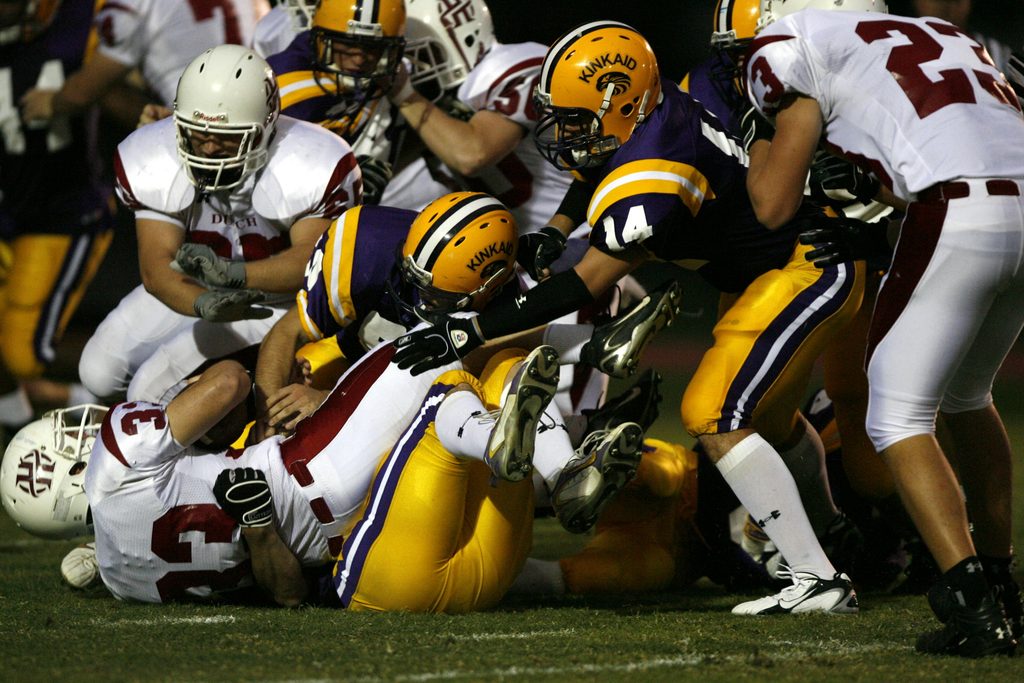
If you are new to American football, the down system can make the game seem complicated. You may hear announcers say “first and 10,” “third and short,” or “fourth down” without immediately knowing what those phrases mean.
Understanding what are downs in football is one of the biggest steps toward understanding how the entire game flows. A down is essentially one opportunity for the offense to run a play. The offense normally gets four downs to move the ball at least 10 yards. If it succeeds, it earns another set of four downs and can continue moving toward the opponent’s end zone.
Once you understand that basic idea, many of the numbers and graphics you see during a football game become much easier to follow.
What Is a Down in Football?
A down is one offensive play.
A down usually begins when the ball is snapped to start the play and ends when the play is over. For example, a down can end when:
- The ball carrier is tackled.
- A player with the ball goes out of bounds.
- A forward pass is incomplete.
- A team scores.
- An official stops the play for another reason.
After the play ends, the officials determine where the ball will be placed for the next down.
The offense then prepares for another play.
Think of downs as a limited number of chances. The offense cannot simply keep running plays forever. It must make enough progress to earn another set of downs.
Why Does the Offense Get Four Downs?
In most situations, the offense receives four downs to gain at least 10 yards.
The team does not need to gain all 10 yards on one play. It can divide those yards across several plays.
For example:
- First down: gain 3 yards.
- Second down: gain 4 yards.
- Third down: gain 3 yards.
The offense has gained 10 yards in total, so it earns a new first down.
That resets the process. The offense normally receives another four downs with another line to gain 10 yards ahead.
This cycle can continue throughout an offensive possession, often called a drive, as the team moves down the field.
What Is the 10-Yard Objective?
At the beginning of a normal new set of downs, officials establish a point 10 yards ahead of the ball. This point is commonly called the line to gain.
The offense must get the ball to or beyond that line to earn another first down.
Suppose the offense begins at its own 30-yard line. Its line to gain would normally be the 40-yard line.
If the offense reaches the 40-yard line within four downs, it gets another first down.
If it reaches the 40 on its second play, for example, it does not have to use the remaining downs from the original series. Instead, the down count resets immediately.
The next play becomes first down again.
The basic pattern is therefore simple:
Four downs → gain 10 yards → receive four more downs.
This is the foundation of how downs work in football.
What Does “1st and 10” Mean?
One of the most common phrases you will see during a football game is 1st and 10.
The first number tells you which down the offense is on.
The second number tells you approximately how many yards the offense needs to gain for another first down.
So:
1st and 10 means the offense is on its first down and needs 10 yards to reach the line to gain.
If the offense gains 4 yards, the next situation would normally be:
2nd and 6
It is now second down, and approximately 6 yards remain.
If the offense then gains another 3 yards, the situation becomes:
3rd and 3
The offense has reached third down and still needs approximately 3 yards for a new first down.
This down-and-distance information is normally shown on the television broadcast and on stadium displays because it is essential for understanding the situation.
First Down
First down is the first opportunity in a new set of downs.
A common starting situation is first and 10.
Because the offense has several downs remaining, teams have many possible options on first down. They may run the ball, throw a short pass, attempt a deeper pass, or use another offensive play designed for the situation.
If the offense gains enough yardage to reach the line to gain immediately, it earns another first down without needing to play second, third, or fourth down in that series.
For example, imagine the offense has first and 10 and completes a 15-yard pass.
The team has gained more than the required 10 yards, so the next play starts a new series of downs.
Second Down
If the offense does not reach the line to gain on first down, it moves to second down.
The distance depends on what happened during the first play.
For example, if the offense starts with first and 10 and gains 6 yards, the next situation is approximately:
2nd and 4
If the offense loses 2 yards instead, the situation could become:
2nd and 12
The offense still has the same original line to gain, but now it is farther away from it.
Second down is therefore not always “second and 10.” The required distance changes according to the results of the previous play and can also be affected by penalties.
Third Down
If the offense has still not reached the line to gain after second down, it faces third down.
Third downs are particularly important because the offense is getting close to the end of its normal four-down opportunity.
Suppose a team faces third and 5.
It needs approximately 5 yards to earn another first down.
If the offense gains 7 yards, it reaches the line to gain and receives a new first down.
If it gains only 2 yards, it would normally face fourth down with about 3 yards remaining.
You will often hear commentators discuss a team’s ability to “convert on third down.” A third-down conversion simply means the offense gained enough yardage on third down to earn a new first down.
Fourth Down
Fourth down is normally the offense’s final opportunity to reach the line to gain during that set of downs.
This creates an important decision.
The offense may:
- Run another normal offensive play and try to earn the first down.
- Punt the ball.
- Attempt a field goal when it is close enough to the opponent’s goalposts.
Which option a team chooses depends on factors such as the distance needed, field position, score, time remaining, and game situation.
For a beginner, the most important point is that fourth down is usually the offense’s final chance before it risks losing possession.
What Happens If a Team Goes for It on Fourth Down?
When an offense runs a normal play on fourth down, it is often described as going for it.
Suppose the offense faces fourth and 2.
It needs about 2 yards to reach the line to gain.
If the offense runs the ball for 3 yards, it succeeds. The team earns a first down and keeps possession.
If the runner gains only 1 yard, the offense has failed to reach the line to gain.
Possession then changes to the other team.
This is called a turnover on downs.
What Is a Turnover on Downs?
A turnover on downs happens when the offense uses its fourth down without reaching the line to gain.
The defending team then takes possession of the ball, generally at the spot where the previous play ended, subject to the applicable rules and any penalties.
For example, imagine Team A has fourth and 4 from Team B’s 45-yard line.
Team A runs a play but gains only 2 yards.
It needed 4.
Because Team A failed to reach the line to gain on fourth down, Team B takes possession at the resulting spot.
Unlike an interception or lost fumble, a turnover on downs does not require the defense to take the ball away during the play. The change of possession occurs because the offense failed to gain the required yardage before its set of downs expired.
Why Do Teams Punt on Fourth Down?
If fourth down is available, you might wonder why the offense does not simply try to gain the necessary yards every time.
The answer is field position.
Failing on fourth down can give the opponent the ball at a favorable location. Instead of taking that risk, an offense can punt the ball down the field.
A punt intentionally gives possession to the opposing team, but it can force that team to begin its next possession much farther away from the offense’s end zone.
For example, an offense facing fourth down deep in its own territory may not want to risk giving its opponent the ball close to the goal line.
Punting can move the opponent much farther down the field before possession changes.
That is why teams frequently punt when they reach fourth down and still have significant yardage to gain.
Why Might a Team Kick a Field Goal on Fourth Down?
If the offense is close enough to the opponent’s goalposts, another fourth-down option is a field goal attempt.
A successful field goal is worth three points.
The offense may therefore decide that attempting to score three points is better than running another offensive play and risking a turnover on downs.
A team’s decision depends partly on whether its coaches believe the kicker has a reasonable chance of making the kick from that distance.
A team that is too far away for a comfortable field goal attempt may punt instead.
How Does the Distance Change After Each Play?
The distance portion of the down-and-distance situation changes according to how many yards the offense gains or loses.
Imagine the offense begins with:
1st and 10
The offense gains 3 yards.
Now it is:
2nd and 7
On the next play, the offense gains 5 yards.
Now it is:
3rd and 2
The team needs approximately 2 more yards for a first down.
If it gains those 2 yards or more, the down count resets to first down.
But yardage can also move in the opposite direction.
Suppose a team starts with first and 10 and loses 4 yards on the play.
The next situation could be:
2nd and 14
The line to gain has not moved backward with the offense. The offense is now farther away from reaching it.
Penalties can also change the down, distance, or both depending on the specific foul and how the penalty is enforced.
How Does a Team Earn a New First Down?
An offense normally earns a new first down by getting the ball to or beyond the line to gain.
It might accomplish this with a running play.
For example:
3rd and 2: The running back carries the ball for 4 yards.
Because the offense gained enough yards, it earns a first down.
A passing play can do the same thing.
For example:
2nd and 8: The quarterback completes a pass for 12 yards.
The offense crossed the line to gain, so the next offensive series begins with first down.
Certain defensive penalties can also result in a first down depending on the rules and situation.
Once a new first down is awarded, the offense receives a new series and a new line to gain is established, normally 10 yards ahead.
What Happens After the Offense Reaches the Line to Gain?
As soon as the offense gains enough yardage for a first down, the previous down sequence is finished.
The offense does not continue to second, third, or fourth down from the old series.
Instead, it receives a fresh first down.
For example:
- 1st and 10: gain 4 yards.
- 2nd and 6: gain 7 yards.
The second play gained enough yardage to cross the original line to gain.
The result is another first down.
The offense now begins a new series rather than moving to third down.
This resetting process is what allows an offense to maintain possession and continue a long drive down the field.
A Simple Four-Down Example
Consider an offense beginning at its own 20-yard line.
It needs to reach the 30-yard line to earn a first down.
First down: The running back gains 3 yards.
The ball reaches the 23-yard line.
The situation is now roughly 2nd and 7.
Second down: The quarterback completes a pass for 4 yards.
The ball reaches the 27-yard line.
The situation becomes 3rd and 3.
Third down: The offense runs the ball for 2 yards.
The ball reaches the 29-yard line.
Now it is 4th and 1.
The offense still needs about 1 yard to reach the 30-yard line.
On fourth down, the team decides to go for it.
Fourth down: The runner gains 2 yards.
The ball reaches the 31-yard line.
The offense has crossed the line to gain, so it earns a new first down.
The next series begins at the 31-yard line, with the next line to gain normally 10 yards farther ahead.
If the runner had been stopped before reaching the required line on fourth down, the opposing team would have taken possession on a turnover on downs.
Why Downs Are So Important
Downs determine much of the strategy you see during an American football game.
A situation such as first and 10 gives the offense several opportunities to gain the required yardage.
Third and 1 is very different because only a short distance remains, but the offense has fewer downs available.
Third and 15 creates another challenge because the offense needs a large gain with only two downs remaining.
Fourth down creates the biggest decision because failing to reach the line to gain can end the possession.
Once you understand the down and distance, you can quickly tell how much progress an offense needs to make and how much pressure it is under.
Frequently Asked Questions
How Many Downs Does a Team Get in Football?
The offense normally receives four downs to gain at least 10 yards. If it reaches the line to gain, it earns another set of downs.
What Does First and 10 Mean?
First and 10 means it is first down and the offense normally needs 10 yards to earn another first down.
What Does Third and 5 Mean?
Third and 5 means the offense is on its third down and needs approximately 5 yards to reach the line to gain.
What Happens If the Offense Does Not Gain 10 Yards?
If the offense fails to reach the line to gain by the end of fourth down, the opposing team normally receives possession. This is called a turnover on downs.
The offense can also choose to punt or attempt a field goal instead of running a normal fourth-down play.
Does a Team Have to Use All Four Downs?
No. As soon as the offense reaches the line to gain, it earns a new first down.
For example, a team that gains 12 yards on first and 10 immediately receives another first down.
Can the Offense Lose Yards During a Down?
Yes. If a player is tackled behind the previous line of scrimmage, the offense can lose yardage.
That can increase the distance needed for a first down. A first-and-10 situation could therefore become second and 13 or another longer distance.
Is Fourth Down Always the Last Down?
Fourth down is normally the final down in a series. The offense must reach the line to gain to continue its possession with a new first down, or it may choose another option such as punting or attempting a field goal.
Key Takeaways
Understanding what are downs in football makes the basic structure of American football much easier to follow.
- A down is one offensive play.
- The offense normally gets four downs to gain at least 10 yards.
- The point the offense must reach is called the line to gain.
- “1st and 10” means first down with approximately 10 yards needed for another first down.
- The distance changes as the offense gains or loses yards.
- Reaching the line to gain gives the offense a new first down and another set of downs.
- Fourth down is normally the final opportunity in the series.
- Failure to reach the line to gain on fourth down results in a turnover on downs.
- Teams often punt or attempt a field goal on fourth down instead of risking a failed conversion.
Once the down system makes sense, phrases such as first and 10, third and short, and fourth and goal become much easier to understand while watching a game.