
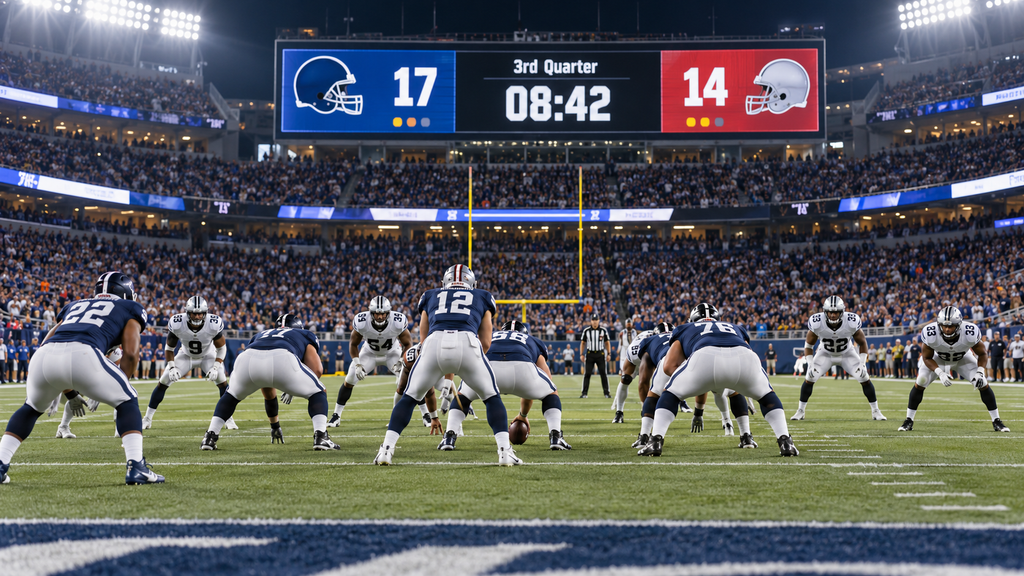
An American football game has 60 minutes of regulation playing time, but watching a complete game usually takes much longer. The 60 minutes are divided into four quarters, and the game clock frequently stops between plays.
For someone watching football for the first time, this can be confusing. A scoreboard may show only a few minutes remaining, yet the game can continue for much longer in real time.
So, how long is an American football game? The simple answer is that regulation lasts 60 minutes at the NFL and college levels, while the actual viewing time is commonly around three hours. Halftime, timeouts, incomplete passes, penalties, replay reviews, scoring plays, and other stoppages all extend the length of the game.
The exact timing rules also depend on the league. NFL and college football both use four 15-minute quarters, but some clock procedures and overtime rules differ.
How Many Quarters Are in a Football Game?
American football is divided into four quarters.
In the NFL, each quarter lasts 15 minutes, giving the game 60 minutes of regulation playing time. The official NFL rules define a game as four 15-minute periods.
The structure looks like this:
- First quarter: 15 minutes
- Second quarter: 15 minutes
- Halftime
- Third quarter: 15 minutes
- Fourth quarter: 15 minutes
The first and second quarters make up the first half, while the third and fourth quarters make up the second half.
There are short breaks between the first and second quarters and between the third and fourth quarters. A much longer halftime break takes place between the second and third quarters.
Why Does a 60-Minute Football Game Take Around Three Hours?
The important thing for beginners to understand is that game-clock time and real time are not the same thing.
The game clock does not continuously count down from 60:00 to 0:00. It starts and stops according to football’s timing rules.
Suppose there are five minutes left in the fourth quarter. Those five minutes do not necessarily mean the game will finish five minutes later. Several plays, timeouts, penalties, incomplete passes, reviews, and other stoppages could occur before those five minutes disappear from the clock.
This is why football game length in real time is much greater than the official 60 minutes.
Televised games also include commercial breaks during some natural stoppages, adding to the amount of time viewers spend watching the event.
What Is the Game Clock?
The game clock keeps track of how much time remains in a quarter.
At the beginning of an NFL quarter, for example, the game clock normally shows 15:00. As play continues, the clock counts toward 0:00.
The stadium clock serves as the official game clock in the NFL.
The clock may continue running after some plays and stop completely after others.
Understanding when it runs and stops helps explain why two football games with the same 60 minutes of regulation time can take different amounts of real time to complete.
When Does the Game Clock Keep Running?
The game clock commonly continues after a normal running play that ends in bounds.
For example, imagine a running back carries the ball for five yards and is tackled in the middle of the field. In many normal situations, the game clock continues counting down after the play.
The offense then prepares for its next play while time continues disappearing from the game clock.
Late in each half, clock rules become especially important because teams may deliberately try to save time or use as much time as possible.
College football has its own timing details. Under current NCAA rules, the clock generally continues after an in-bounds first down outside the final two minutes of each half. During the final two minutes, first-down timing changes apply.
What Stops the Clock in Football?
Many different situations can stop the game clock. These stoppages are the main reason a football game lasts far longer than 60 minutes in real time.
Incomplete Passes
An incomplete pass occurs when a legal forward pass is not caught.
When a quarterback throws the ball and it falls incomplete, the game clock stops. It does not begin running again simply because the players are ready. The next timing procedure applies when the ball is put back into play.
This makes passing situations particularly important when a team is trying to conserve time late in a half.
Players Going Out of Bounds
The clock can stop when a ball carrier goes out of bounds.
Exactly when it restarts can depend on the league, the situation, and how much time remains in the half.
For beginners, the important point is that going out of bounds can create a clock stoppage and is often deliberately used by offensive players late in a game.
A receiver near the sideline, for example, may catch a pass and step out of bounds rather than remain in the field and allow more time to run off the clock.
Timeouts
Teams can deliberately stop play by calling a timeout.
In the NFL, each team receives three timeouts in each half.
Timeouts have many uses. A team might call one to discuss strategy, make substitutions, avoid a delay-of-game penalty, or preserve time late in a half.
Late in a close game, timeouts become an important part of clock management.
Suppose the team with the ball is leading with one minute remaining. The defense may use its timeouts after running plays to prevent the offense from simply allowing the clock to keep running.
Penalties
A penalty can also create a stoppage while officials identify the foul and enforce the appropriate rule.
The clock procedure after a penalty depends on the specific situation.
Some penalties take only a short time to administer. Others involve discussions between officials, decisions about accepting or declining the penalty, or adjustments to the game clock.
Scoring Plays
The clock stops after scoring plays such as touchdowns and field goals.
After a touchdown, additional time is needed for the try, which may be an extra-point kick or a two-point conversion attempt. The teams then prepare for the following kickoff.
Those events take place outside the continuous countdown of the normal game clock, helping extend the actual length of the game.
Replay Reviews
Some plays can be reviewed using video replay.
A review may be needed to determine questions such as whether a player completed a catch, whether a runner crossed the goal line, where the ball should be spotted, or whether another reviewable ruling was correct.
While officials examine the video and reach a decision, the game clock is not simply running normally.
A complicated review can therefore add several minutes of real time even though little or no official game time disappears.
Injuries and Official Stoppages
Officials may stop play because of an injured player or for other administrative reasons.
These stoppages are necessary even though they increase the amount of real time required to finish the game.
What Is the Play Clock?
The play clock is different from the game clock.
The game clock tells you how much playing time remains in the quarter. The play clock tells the offense how long it has to begin its next play.
In the NFL, the play clock is commonly set to 40 seconds after the previous play ends. In certain situations involving administrative stoppages, it is set to 25 seconds instead.
If the offense fails to snap the ball before the play clock expires, it normally receives a delay-of-game penalty.
Imagine the fourth-quarter game clock shows 8:30 while the play clock shows 40.
Those clocks measure different things.
The offense may allow much of the 40-second play clock to expire before snapping the ball. During that time, the main game clock may also be running.
This is one reason a team that is leading late in a game often takes its time before starting each play.
How Long Is Halftime in Football?
Halftime occurs after the second quarter.
In the NFL, the official halftime intermission is 13 minutes. The breaks between the first and second quarters and between the third and fourth quarters are much shorter, with NFL rules providing intervals of at least two minutes.
From a television viewer’s perspective, the total interruption may feel longer because broadcasts may include analysis, commercials, highlights, and other coverage.
Halftime also gives players and coaches an opportunity to leave the field, recover, discuss strategy, and make adjustments for the second half.
College and high school football can use different halftime procedures, so the NFL’s 13-minute rule should not be treated as universal to every level of American football.
What Is the Two-Minute Warning?
The NFL has an automatic stoppage near the end of the second and fourth quarters traditionally known as the two-minute warning.
It occurs after the final play that begins before the game clock reaches the two-minute point.
For example, if a play begins with 2:06 remaining and ends with 1:58 on the clock, the two-minute warning occurs after that play.
This creates another stoppage in each half.
College football now also uses an automatic two-minute timeout in the second and fourth quarters. The NCAA approved the change beginning with the 2024 season.
Although NFL and college terminology and surrounding timing rules are not identical, viewers at both levels can expect an official stoppage near the two-minute point of each half.
How Timeouts Make the End of a Game Longer
The final few minutes of a close football game can take a surprisingly long time.
Imagine Team A leads by three points with 2:30 remaining.
Team A has possession and wants the game clock to run. Team B wants to stop the clock and get the ball back.
Team A runs the ball. Team B immediately calls timeout.
Team A runs another play. Team B calls another timeout.
A pass is then thrown incomplete, stopping the clock again.
A penalty occurs on the following play.
Suddenly, only a small amount of game-clock time has disappeared even though several minutes of real time have passed.
This is why the final two minutes of a close game may feel much longer than two minutes.
By contrast, if one team has a large lead and both teams keep the ball in bounds, the final minutes can disappear quickly.
Does Football Have Overtime?
Yes. If a game is tied after regulation, additional play may be required.
Overtime rules depend on the league.
In the NFL regular season, overtime uses a 10-minute period. Current NFL rules give both teams an opportunity to possess the ball, subject to the rules and the 10-minute limit. If the score remains tied when the regular-season overtime period ends, the game can finish as a tie.
NFL postseason games cannot end in a tie, so additional overtime play continues until a winner is determined.
College football uses a different overtime format. Instead of simply playing another normal timed quarter, teams receive alternating possessions under NCAA overtime procedures.
Because overtime is additional to the normal four quarters, a tied game can take significantly longer to finish.
How Long Are College Football Games?
College football also uses four 15-minute quarters, so regulation contains 60 minutes of official playing time.
However, college and NFL games do not use identical timing rules.
One important recent college change involves first downs. NCAA timing rules generally allow the game clock to continue after an in-bounds first down outside the final two minutes of each half. Inside the final two minutes, the clock stops when a first down is gained while officials prepare the ball for play.
College football also uses its own overtime system rather than the NFL format.
The practical result for a beginner is simple: both NFL and major college games have 60 minutes of regulation time, but the exact amount of real time required to watch them varies.
Why Football Uses Two Different Clocks
Having both a game clock and a play clock may initially seem complicated, but each serves a different purpose.
The game clock limits the overall playing time.
The play clock prevents a team from taking unlimited time before beginning the next play.
Together, they create much of football’s late-game strategy.
A team that is behind usually wants to preserve game-clock time. It may use timeouts, throw passes toward the sidelines, or move quickly between plays.
A team that is ahead often wants the opposite. It may keep the ball in bounds and wait until the play clock is nearly exhausted before snapping the ball.
Once you understand these two clocks, the pace of a football game becomes much easier to follow.
Frequently Asked Questions
How Long Is an American Football Game in Minutes?
NFL and college regulation games contain 60 minutes of official playing time, divided into four 15-minute quarters.
Actual real-world game length is much longer because the clock repeatedly stops.
How Long Does a Football Game Last in Real Time?
A typical game often takes roughly three hours to watch from beginning to end. The exact duration varies depending on timeouts, incomplete passes, penalties, reviews, scoring, injuries, commercials, and possible overtime.
How Long Is Each Football Quarter?
NFL and college football quarters are 15 minutes long.
Four quarters produce 60 minutes of regulation playing time.
Does the Clock Stop After Every Football Play?
No.
After many plays that end in bounds, the game clock continues running. Other events, including incomplete passes, timeouts, certain out-of-bounds plays, penalties, scores, and official stoppages, can stop it.
Is the Play Clock the Same as the Game Clock?
No.
The game clock measures the time remaining in the quarter. The play clock limits how long the offense has to begin the next play.
In the NFL, the play clock is commonly 40 seconds between ordinary plays and 25 seconds after certain administrative stoppages.
Can a Football Game End in a Tie?
An NFL regular-season game can end in a tie if the score remains even after the overtime period.
NFL postseason games continue until a winner is determined.
College football uses a different overtime system designed to produce a winner.
Key Takeaways
An American football game has 60 minutes of regulation playing time, divided into four 15-minute quarters.
That does not mean the game takes only one hour to watch. The game clock repeatedly stops for events such as incomplete passes, timeouts, penalties, scoring plays, replay reviews, and other official stoppages.
Football also has a separate play clock that controls how much time an offense has to begin its next play.
Halftime and breaks between quarters add more real time, while overtime can make a tied game even longer.
For a beginner wondering how long is an American football game, the easiest rule to remember is this: 60 minutes are on the regulation game clock, but plan on roughly three hours of actual viewing time for a typical game.