
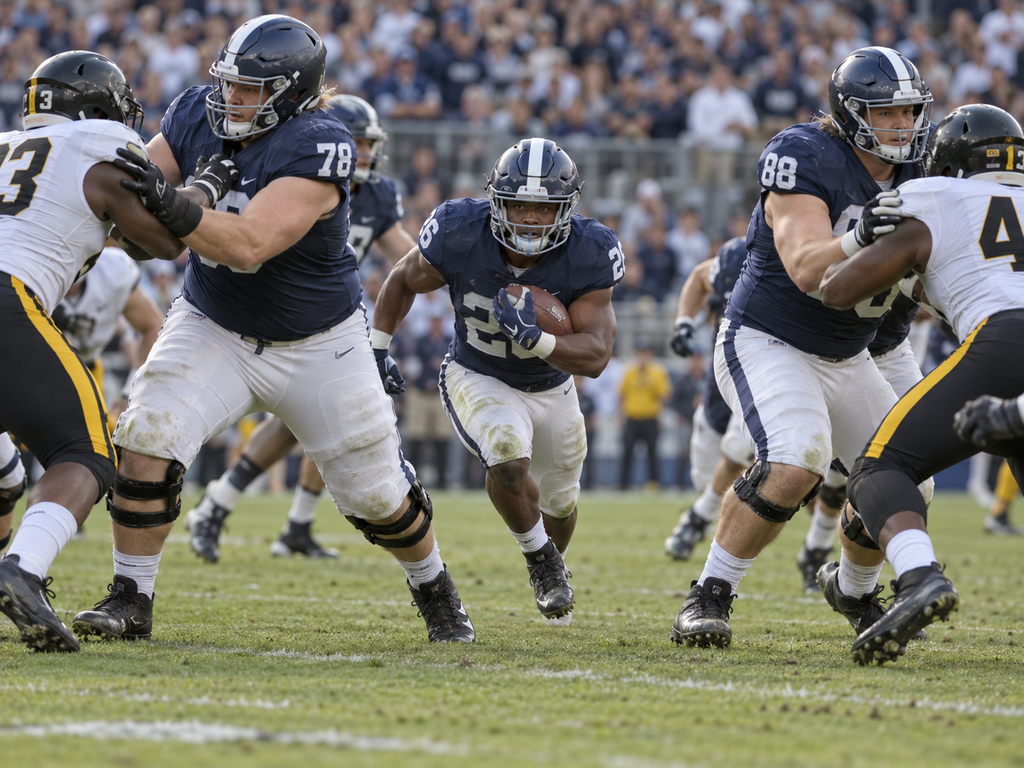
The quarterback hands the football to a running back moving toward the right side of the offensive line.
At first, the play appears to depend entirely on the runner finding an opening. But several other players determine whether that opening develops.
The right tackle maintains position against a defensive lineman. The tight end works to control a defender near the edge, while a wide receiver engages an opponent farther downfield.
Each blocker performs a different assignment, yet their actions contribute to the same objective: creating space for the ball carrier.
On a passing play, those responsibilities change. Offensive linemen must protect the quarterback, a running back may help account for a pass rusher, and a tight end might block briefly before moving into a receiving route if the play requires it.
Understanding football blocking techniques helps developing players recognize how positioning, leverage, footwork and coordination contribute to offensive execution.
Blocking is not simply pushing an opponent as hard as possible. Effective blocking requires maintaining balance, using legal hand placement, moving the feet and understanding where the defender is trying to go.
Different positions also require different approaches. An offensive tackle protecting the quarterback faces different movement demands from a wide receiver blocking a defensive back.
This guide explains practical blocking fundamentals and how they apply to offensive linemen, tight ends, running backs and receivers.
What Is Blocking in American Football?
Blocking is the legal use of body positioning and contact to prevent or delay an opponent from reaching a particular area.
Offensive players use blocking to support running plays, protect the quarterback and help teammates advance the football.
A block does not necessarily require driving the defender backward.
In many situations, maintaining a favorable position is enough to create the intended opportunity.
For example, an offensive lineman may successfully block a defender by preventing that player from entering a particular running gap.
A wide receiver might support a running play by maintaining position between a defensive back and the ball carrier.
The effectiveness of the block depends on the assignment.
Run Blocking
Run blocking supports a rushing play.
Blockers work together to create or protect running lanes while preventing defenders from reaching the ball carrier.
The required movement depends on the running concept and defensive alignment.
Some assignments emphasize moving a defender away from the intended path.
Others require establishing leverage or maintaining position while the ball carrier reads the developing play.
Pass Blocking
Pass blocking protects the quarterback while a passing play develops.
The offensive line generally works to prevent rushers from reaching the passer.
Unlike many run-blocking assignments, pass protection often involves controlled movement backward or laterally.
Blockers must maintain balance while responding to defensive movement.
Blocking Beyond the Offensive Line
Offensive linemen perform most of the traditional blocking responsibilities, but they are not the only blockers.
Tight ends frequently participate in both run blocking and pass protection.
Running backs may be assigned to account for particular rushers.
Wide receivers can support running plays, screens and other concepts through legal downfield blocking.
Each position contributes differently.
Understand the Fundamentals of Effective Blocking
Although assignments vary, several technical principles apply across offensive positions.
Maintain a Balanced Base
A blocker needs a stance that provides stability without preventing movement.
Feet that are excessively close together may reduce balance.
An excessively wide stance can make it difficult to take efficient steps.
The appropriate width depends on the player’s position and the task.
For example, a pass-blocking tackle may need a different setup from a receiver preparing to block in space.
Keep the Feet Moving
Some inexperienced blockers establish initial contact and then stop moving their feet.
This can allow a defender to change direction and escape the block.
Effective blockers adjust their foot position while maintaining appropriate leverage.
The objective is to stay connected to the assignment through controlled movement rather than leaning on the opponent.
Use Legal Hand Placement
Hand placement helps a blocker maintain control of the engagement.
Coaches commonly teach offensive players to keep their hands within the defender’s legal contact area and avoid grabbing or restricting an opponent illegally.
A blocker must not hook, pull, wrap or otherwise illegally restrain a defender.
Simply placing the hands inside a defender’s frame does not make every subsequent action legal.
The blocker must continue using permitted contact.
Maintain Body Control
Leaning excessively forward may make a blocker vulnerable to a defender changing direction.
The player should maintain an appropriate relationship between the hips, feet and torso.
If the defender moves, the blocker needs to adjust rather than lose balance.
Keep the Head Out of Contact
Blocking should not involve deliberately striking an opponent with the helmet or initiating contact with the crown of the helmet.
Players should maintain a safe head position and use techniques taught by qualified coaches.
Helmet-first contact can cause serious head, neck and spinal injuries.
No blocking technique should depend on using the head as a weapon.
Understand Leverage in Football Blocking
Leverage describes how a player’s positioning and movement influence the ability to control space against an opponent.
In blocking, leverage often involves the relationship between the blocker, defender and intended destination.
Inside Leverage
A blocker may attempt to maintain position between a defender and an interior running lane.
The objective is to prevent the defender from entering the area the offensive play intends to use.
For example, a guard may need to protect an interior gap while a running back approaches the line.
The guard’s success depends on the assigned blocking relationship, not necessarily on moving the defender several yards backward.
Outside Leverage
On some plays, a blocker must prevent a defender from reaching the outside edge.
For example, a tight end may be responsible for maintaining an appropriate position against an edge defender.
If the defender gains favorable outside positioning, the intended running lane may become more difficult to use.
Leverage Changes During the Play
A defender is not stationary.
They may move toward an interior gap, work outside or attempt to disengage.
The blocker needs to maintain control of the assigned area while responding legally.
This is why footwork and positioning are important even after initial contact.
Offensive Line Blocking Techniques
The offensive line consists of the center, two guards and two tackles.
These five players have related responsibilities, but their assignments differ according to position, play call and defensive front.
Center Blocking Responsibilities
The center begins each offensive play by snapping the football.
After the snap, the center may block a defensive lineman, assist a teammate or move according to the assigned blocking scheme.
The center also frequently plays an important communication role.
Depending on the offensive system, the center may help identify defensive alignments and communicate protection assignments.
The challenge is coordinating the snap with the next movement.
A center who loses balance or delays the first blocking step may create an opening for a defender.
Guard Blocking Responsibilities
Guards align on either side of the center.
They commonly face defensive tackles and interior linebackers.
Their responsibilities may include controlling interior defenders, helping with combination blocks or moving across the formation on specific running plays.
A guard frequently operates in relatively confined space.
Controlled footwork and awareness of nearby teammates are especially important.
Tackle Blocking Responsibilities
Tackles align outside the guards.
During passing plays, they often face defensive ends or edge rushers attempting to reach the quarterback.
The tackle must respond to defenders attacking from different angles.
An effective pass set helps establish an appropriate position without allowing the rusher an easy path toward the quarterback.
Tackles also participate in running plays, where their assignments may involve interior movement, edge positioning or coordinated blocking with a tight end.
Run Blocking Techniques for Offensive Linemen
Run blocking requires offensive linemen to coordinate their initial steps, body positioning and assignments.
Drive Blocking
A drive block generally involves engaging an assigned defender and attempting to create movement in the intended direction.
The blocker uses coached footwork and legal contact to establish leverage.
The objective is to help create space for the ball carrier.
Effective drive blocking relies on technique and coordination, not uncontrolled collision.
Reach Blocking
A reach block involves attempting to gain a favorable position toward one side of a defender.
It is often associated with outside-running concepts.
For example, an offensive tackle may try to establish outside leverage against a defender when the running play develops toward the edge.
Whether that positioning is achievable depends on the defender’s alignment and movement.
Coaches teach specific footwork and alternatives when the defender prevents the intended reach.
Down Blocking
A down block generally involves a blocker moving toward an inside defender or interior area according to the play design.
This can be part of a gap-running concept.
For example, a tackle may block toward an interior defender while another teammate performs a complementary assignment.
The blocking angle must match the play’s rules.
Combination Blocking
Two offensive linemen may initially work together against a defender before one moves toward another defensive responsibility.
A common example involves a guard and center coordinating their movement against a defensive lineman and linebacker.
The transition requires timing and communication.
If one blocker disengages too early, the initial defender may escape.
If both remain too long, the linebacker may reach the running lane without being accounted for.
Pass Blocking Techniques for Offensive Linemen
Pass blocking presents different challenges from run blocking.
The offensive line must create and maintain a usable area for the quarterback.
Establish a Controlled Pass Set
A pass set is the initial movement a blocker uses to establish position against a pass rusher.
The technique varies by position and offensive system.
A tackle facing a wide edge rusher may need to gain depth and maintain an appropriate angle.
An interior lineman may need to respond to a defender approaching through a narrower space.
The blocker should use coached steps rather than retreating without control.
Maintain Appropriate Spacing
Offensive linemen must understand their relationship with neighboring blockers.
If two players move too far apart, a defender may gain access through the space between them.
If blockers crowd each other, their movements may interfere.
Good pass protection depends on coordinated positioning.
Respond to Defensive Movement
A pass rusher may attack outside before redirecting inside.
Another defender may attempt to move through an opening created by a teammate.
The blocker must recognize these movements while maintaining balance.
A player who lunges or leans too far may become vulnerable to a change of direction.
Avoid Illegal Holding
When a defender begins moving beyond a blocker, the offensive player may be tempted to grab the jersey or hook an arm to prevent escape.
Such actions can lead to holding penalties.
Instead, blockers should practice maintaining legal position through effective feet and body control.
Tight End Blocking Techniques
Tight ends frequently perform both receiving and blocking responsibilities.
They may align next to an offensive tackle, move before the snap or position themselves away from the line.
Their blocking assignments can vary considerably.
Blocking Near the Offensive Tackle
A tight end aligned beside a tackle may help establish the edge of a rushing play.
The tight end might engage a defensive end, outside linebacker or another assigned defender.
The goal depends on the offensive concept.
Some plays require maintaining outside leverage.
Others require moving the defender away from a particular running lane.
Blocking From Motion
A tight end may move before the snap and begin the play from a different position.
This changes the angle and timing of the blocking assignment.
The player must arrive at the intended location legally and establish control without initiating prohibited contact.
The offense also needs to follow formation and motion rules.
Pass Protection Responsibilities
A tight end may remain in protection rather than immediately running a route.
This can provide additional help against a defensive rusher.
In other concepts, the tight end may perform a brief blocking action before releasing into a route if permitted by the play design and applicable rules.
The tight end must understand whether the assignment prioritizes protection or receiving.
Why Tight End Footwork Matters
Tight ends may face larger defensive linemen near the line and quicker defenders in open space.
The same movement technique will not fit every assignment.
Training should include controlled blocking positions, lateral movement and recognizing assigned defenders.
Running Back Blocking Techniques
Running backs do more than carry the football and catch passes.
In many offensive systems, they also participate in pass protection.
This responsibility can be especially challenging because a running back may need to recognize which defender becomes a rushing threat.
Understand Pass Protection Assignments
Before the snap, the running back should know the protection responsibility.
Depending on the play, the assignment may involve checking a particular area or accounting for a designated defender.
If the expected defender does not rush, the running back may have another responsibility according to the offensive system.
These decisions are not improvised.
They should follow the team’s protection rules.
Establish Position Against a Rusher
When a defender approaches, the running back needs to establish a legal blocking position.
Controlled footwork and body balance are important.
A smaller blocker should not assume that success requires overpowering a larger defender.
Maintaining favorable position long enough to support the quarterback may fulfill the assignment.
Avoid Dangerous Contact
A running back should never lead with the crown of the helmet or attempt an uncontrolled collision to stop a pass rusher.
Coaches should teach safe body positioning and legal engagement techniques appropriate to the player’s age and level.
Understand When to Release
Some passing concepts assign the running back to assist in protection before becoming a receiving option.
The conditions for releasing depend on the play call.
Leaving protection too early can expose the quarterback.
Remaining in protection when the running back is supposed to release can disrupt the passing concept.
Understanding the complete assignment is essential.
Wide Receiver Blocking Techniques
Wide receivers often block defensive backs during running plays and screens.
Unlike offensive linemen, receivers frequently perform blocking assignments in open space.
This requires controlled movement, awareness and legal positioning.
Blocking During a Running Play
Imagine a running back approaching the sideline.
An outside receiver may be assigned to block the defensive back responsible for that area.
The receiver’s objective is to maintain an appropriate relationship between the defender and the intended running lane.
It is not always necessary to push the defender backward.
Positioning can be enough to help the ball carrier advance.
Blocking During a Screen
On a receiver screen, another receiver may be assigned to support the ball carrier through legal blocking.
The timing is important.
The blocker must understand the rules governing contact before and after the ball is caught, including restrictions that can apply on forward passes crossing the line of scrimmage.
Illegal early contact may result in offensive pass interference or another penalty.
Avoid Blocking From Behind
A receiver may approach a defender who is facing away from the intended blocker.
This creates a dangerous situation.
Players should avoid illegal blocks from behind and prohibited blindside contact.
A defender who cannot see the approaching blocker is especially vulnerable to injury.
The correct action may be to establish legal position rather than initiate a forceful collision.
Use Space Instead of Excessive Force
Open-field blocking rewards awareness.
A receiver who understands the defender’s path can position themselves effectively without delivering an unnecessarily forceful hit.
Controlled feet and legal contact are essential.
How Blocking Responsibilities Change by Position
| Position | Main blocking responsibilities | Important skills |
|---|---|---|
| Center | Interior blocking, snap coordination, protection communication | Balance, initial steps, awareness |
| Guard | Interior run blocking, combination blocks, pass protection | Leverage, coordination, footwork |
| Tackle | Edge protection and run blocking | Pass-set positioning, lateral movement |
| Tight end | Edge run blocking, additional pass protection | Versatile movement, assignment recognition |
| Running back | Pass protection and occasional lead-blocking assignments | Rusher recognition, controlled positioning |
| Wide receiver | Downfield and screen support blocking | Open-space movement, legal positioning |
These responsibilities vary with the team’s offensive system.
Players should follow their coaches’ position-specific instruction rather than assume every offense uses identical assignments.
Understand Blocking Communication
Blocking becomes more complicated when defenders move or change alignment.
Players must recognize the defensive structure and communicate according to the offensive system.
Recognize Defensive Fronts
Before the snap, offensive players should identify nearby defenders and understand which players might affect their assignments.
A guard may need to recognize a defensive tackle shaded toward one shoulder.
A tackle may need to account for a standing edge defender.
The correct response depends on the play call.
Understand Defensive Movement
Defensive linemen may exchange rushing paths after the snap.
For example, one defender may move inside while another loops around a teammate.
Offensive blockers need to maintain awareness and apply the team’s protection rules.
Communicate Without Improvising
An offensive lineman should not abandon an assigned responsibility simply because another defender appears threatening.
Similarly, a running back should not independently change a protection assignment without following the established system.
Clear communication reduces confusion.
Common Football Blocking Mistakes
Leaning Too Far Forward
A blocker attempts to create force by lunging toward the defender.
This may lead to a loss of balance.
Correction: Maintain controlled posture and move the feet to support the block.
Stopping the Feet After Contact
A blocker establishes initial contact but allows the defender to move away.
Correction: Continue adjusting foot position legally as the assignment develops.
Grabbing the Defender
A player attempts to maintain the block by holding the jersey or wrapping an arm around the defender.
Correction: Practice permitted hand placement and positional control.
Blocking the Wrong Defender
A player reacts to the nearest opponent instead of following the assignment.
Correction: Review the play design and identify the responsible defender before the snap.
Using the Helmet as a Contact Point
A blocker lowers the head and initiates helmet-first contact.
Correction: Stop the drill and correct the technique under qualified coaching. Never use the head as the primary point of contact.
Ignoring the Ball Carrier’s Path
A receiver maintains contact with a defender but blocks toward an area unrelated to the running play.
Correction: Understand how the assignment connects to the intended running lane.
Losing Awareness During Pass Protection
A blocker focuses on one defender and fails to recognize coordinated defensive movement.
Correction: Practice reading nearby rush threats and applying the team’s protection rules.
Six Practical Football Blocking Drills
Blocking skills should be introduced with non-contact movement exercises before progressing to supervised contact.
Drill 1: Blocking Stance and Balance
Purpose: Develop a stable starting position.
Begin in a position-appropriate blocking stance.
A coach provides a visual signal for a short movement.
Take the coached first step and return to a balanced position.
Repeat without contact.
Focus: Controlled feet, balanced posture and efficient initial movement.
Drill 2: Mirror Footwork
Purpose: Improve lateral positioning.
Two players face each other without making contact.
One moves slowly within a marked area while the other mirrors the movement.
The blocking player attempts to maintain an appropriate position.
Focus: Moving the feet instead of reaching or leaning.
Drill 3: Run-Blocking Angle Walkthrough
Purpose: Understand the path required for a run-blocking assignment.
Set up markers representing an offensive lineman and defender.
A coach explains the intended blocking angle.
The player practices approaching the assigned position without contact.
Focus: Foot placement, positioning and understanding the running lane.
Drill 4: Pass Protection Recognition
Purpose: Identify potential rush threats.
A coach presents a defensive alignment using cones or stationary teammates.
An offensive lineman or running back identifies the assigned responsibility.
Defenders then simulate different rushing movements at walking speed.
Focus: Recognition and communication before physical engagement.
Drill 5: Combination Blocking Walkthrough
Purpose: Improve coordination between neighboring offensive linemen.
Two blockers align against a stationary defender with a second defender represented farther away.
The coach explains the initial shared responsibility and the conditions for transitioning to the next assignment.
Players practice the movement slowly without contact.
Focus: Timing, spacing and communication.
Drill 6: Receiver Open-Space Positioning
Purpose: Improve legal blocking position in space.
Set up a receiver, a defensive back and a marked running lane.
The defender moves along a controlled path.
The receiver practices maintaining position between the defender and the lane without initiating contact.
Focus: Anticipation, footwork and body control.
Contact-based progression should only occur under qualified supervision with appropriate equipment and league-compliant techniques.
Build a Blocking Practice Routine
A focused practice session can combine technical preparation with assignment understanding.
| Practice phase | Activity | Suggested time |
|---|---|---|
| Warm-up | Dynamic movement and balance exercises | 5–10 minutes |
| Footwork | Position-specific first steps and lateral movement | 10 minutes |
| Assignment recognition | Identify defenders and blocking responsibilities | 10 minutes |
| Coordination | Partner walkthroughs and combination assignments | 10 minutes |
| Position application | Non-contact run or pass blocking scenarios | 10 minutes |
| Review | Coach feedback and technique corrections | 5 minutes |
The schedule is illustrative.
Players should adjust activity according to their age, conditioning, team practices and recovery needs.
Blocking repetitions involving contact require additional safety planning.
Understand Blocking Safety and Legal Contact
Blocking involves physical contact, so safe technique must be a priority throughout training.
Rules vary by league and level, but several principles are broadly important.
Avoid Helmet-First Contact
Players should not initiate contact with the crown of the helmet.
The neck should not be placed in a vulnerable position to deliver a block.
A player who repeatedly lowers the head into contact needs immediate technical correction.
Learn the Rules for Low Blocks
Blocks directed toward an opponent’s legs are heavily regulated, and some are prohibited depending on the competition and circumstances.
Players should not attempt cut blocks or other low-contact techniques without qualified instruction and confirmation that the technique is legal in the specific league.
Avoid Illegal Blocks From Behind
Blocks from behind can create serious injury risks and may be penalized.
Players should understand prohibited clipping, block-in-the-back and blindside-block situations.
The exact rules and exceptions depend on the competition.
Use Appropriate Protective Equipment
Contact practices should follow the team’s equipment, supervision and progression requirements.
Equipment does not eliminate injury risk.
Players who experience head impacts, neck pain, dizziness or other concerning symptoms should stop participating and be evaluated according to appropriate medical and concussion protocols.
Prioritize Technique Over Collision
A powerful impact is not proof of a successful block.
Coaches should evaluate legal positioning, assignment execution, footwork and control.
Safe technique supports better long-term development.
How to Measure Blocking Improvement
Blocking performance should not be evaluated only by whether a defender falls or moves backward.
Different assignments require different outcomes.
Evaluate the Assignment
Did the blocker engage the correct defender or area?
Did the player understand the intended responsibility?
Did the block support the overall offensive concept?
Evaluate Movement Quality
Was the blocker balanced?
Did the feet continue moving appropriately?
Did the player maintain legal positioning?
Evaluate Communication
Did the player recognize relevant defensive movement?
Were necessary calls communicated?
Did neighboring blockers coordinate their assignments?
Evaluate the Result Carefully
A running play can fail even when one blocker performs correctly.
A pass can be completed despite a blocking mistake.
Use film review and coaching feedback to separate individual technique from the final result.
| Evaluation area | What to look for |
|---|---|
| Assignment | Correct defender or blocking area |
| Stance and steps | Balanced starting position and controlled movement |
| Leverage | Appropriate positional relationship |
| Hand use | Legal contact without grabbing or restricting |
| Coordination | Effective communication with teammates |
| Safety | No dangerous head or prohibited contact |
| Execution | Block supports the intended play |
Improve Blocking Through Film Review
Film study helps players understand how their movement affects the offense.
Review the Initial Alignment
Identify the defender and the assignment before the snap.
Consider how the starting position influences the required first steps.
Watch the First Moments of the Play
Pay attention to the blocker’s initial movement.
Did the player move toward the correct responsibility?
Was the body balanced?
Did the movement fit the play call?
Examine the Defender’s Response
A defender may attempt to move around, through or away from the blocker.
Review whether the offensive player adjusted legally while maintaining the assignment.
Identify One Practical Improvement
Avoid vague feedback such as “block harder.”
A useful correction might involve improving foot placement, understanding the intended angle or recognizing a defensive movement sooner.
Specific feedback makes the next practice more productive.
Final Thoughts: Effective Blocking Is a Team Skill
Learning football blocking techniques requires more than physical strength.
Offensive linemen, tight ends, running backs and wide receivers all contribute through different responsibilities.
A center may coordinate interior blocking and communication. A tackle may protect the quarterback against an edge rusher. A running back may help account for pressure, while a receiver maintains legal positioning against a defensive back.
Although the movements differ, effective blockers share important habits.
They understand their assignments, maintain balance, move their feet and use legal contact.
They also recognize that blocking success depends on how their actions support the complete offensive play.
Develop these skills through non-contact walkthroughs, position-specific footwork drills and supervised coaching. Review performance using technique and assignment quality rather than the force of a collision.
As blocking becomes more consistent, players can contribute more effectively to both rushing and passing plays.
Explore more Intermediate American Football Guides for additional position-specific skills, or visit the American Football Learning Path to continue developing your understanding of offensive execution and team coordination.